
CYFIRMA’s Intelligence and Research team has observed multiple incidents and threat patterns indicating the growing weaponization of student data within India’s education ecosystem. The increasing use of digital platforms for admissions, examinations, fee payments, online learning, and student communication has significantly expanded the volume of sensitive information accessible across educational institutions, third-party vendors, and online services.
Threat actors are increasingly exploiting this environment to conduct phishing, impersonation, social engineering, and financially motivated fraud operations targeting students and their families. The assessment observed that attackers commonly leverage exposed or misused student information to create highly convincing scams related to admissions, scholarships, internships, fee payments, and academic services. In several instances, threat actors exploited trusted educational branding, fraudulent portals, and insider access to obtain credentials, financial information, or direct payments. Additionally, some cases indicated the misuse of student-linked bank accounts within broader fraud and mule account operations.
The overall activity suggests a shift from opportunistic scams toward more structured and data-driven campaigns where student information is used to improve targeting accuracy and increase financial returns. The combination of large student populations, expanding digital payment adoption, and varying cybersecurity maturity across institutions continues to make the education sector an attractive target for cybercriminal activity. This report examines the attack lifecycle associated with student-focused cybercrime, highlights observed case studies, assesses the potential impact on students and institutions, and provides recommendations aimed at reducing exposure to phishing, social engineering, and financial fraud risks.
The education sector in India has undergone a rapid digital transformation over the last several years. Universities, colleges, coaching institutes, scholarship programs, and private learning platforms now rely heavily on online systems for admissions, fee collection, examinations, identity verification, learning management, and student communication. While this shift has improved accessibility and efficiency, it has also created an environment where large volumes of personal information are stored across multiple platforms, many of which operate with uneven security standards. As a result, student data has become an increasingly attractive target for cybercriminals.
Unlike attacks directed at large enterprises, the targeting of students is often less visible and therefore receives limited public attention. However, the threat is significant. Student records commonly contain names, mobile numbers, email addresses, residential details, academic information, government-issued identifiers, and in some cases banking or payment data. This information is highly valuable because it allows threat actors to build convincing fraud scenarios tailored to the victim’s current circumstances. A student awaiting admission results, applying for scholarships, searching for internships, or paying semester fees is more likely to engage with messages that appear relevant to those activities.
Traditional phishing campaigns often rely on generic messages sent in bulk. The current threat environment shows a gradual shift toward more targeted and believable lures. Attackers increasingly use themes such as admission confirmations, scholarship approvals, fee reminders, internship offers, examination updates, or KYC verification requests. These messages are effective because they align with genuine student concerns and deadlines. A student waiting for results or attempting to secure a placement opportunity may be more likely to respond quickly without fully validating the source. In some cases, attackers already possess accurate personal details, which makes fraudulent communication appear even more legitimate.
Another factor increasing the risk is the fragmented nature of the student data ecosystem. Information is often spread across universities, coaching centres, EdTech providers, placement agencies, payment processors, and outsourced support vendors. Each additional platform creates another potential point of exposure. Some organizations may have mature cybersecurity practices, while others operate with limited budgets, outdated systems, or weak internal controls. Even when a primary institution is secure, data may still be compromised through a less protected third-party partner or through insider misuse. This makes the ecosystem difficult to defend as a whole.
Threat actors targeting students often follow a structured process rather than relying on random or generic scams. These operations usually begin with access to student information, followed by carefully planned communication, exploitation of trust, and eventual financial gains. While the techniques may differ, the overall pattern remains consistent and is designed to maximize the chances of success.
Stage 1: Data Acquisition
The first step is obtaining student data through exposed portals, insider misuse, third-party vendors, or fake websites designed to imitate legitimate institutions. In some cases, information may also be collected from publicly available sources or social media profiles. Even limited details such as names, phone numbers, email addresses, course information, or college names can be enough to support future scams and make communication appear genuine.
Stage 2: Targeting and Contact
Once data is collected, individuals are selected based on relevance and potential response rate. Students involved in admissions, scholarships, internships, education loans, or placements may be approached through email, SMS, WhatsApp, or phone calls. Messages are often crafted to appear urgent or official, such as fee reminders, exam updates, placement offers, or requests to verify account details. The use of accurate personal information increases the credibility of these messages.
Stage 3: Exploitation
After gaining trust, attackers attempt to obtain something of value. This may include login credentials, one-time passwords, identity documents, or direct payments. In some cases, victims may be persuaded to click malicious links, share banking details, or install remote access applications that allow further compromise. This stage often depends on social engineering rather than technical sophistication.
Stage 4: Monetization
The final objective is financial gain. This may involve fraudulent transactions, fake fee collections, account takeover, identity misuse, or resale of stolen data. In some cases, student bank accounts may also be misused to move illicit funds through mule account networks, helping attackers conceal the movement of money.
1. Student Bank Account Used in ₹7 Crore Cyber Fraud
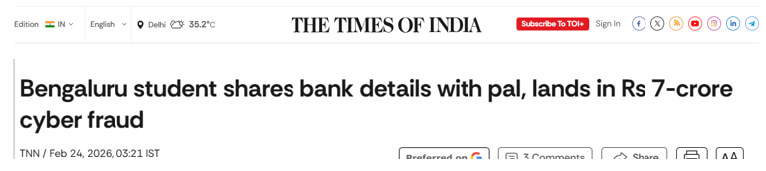
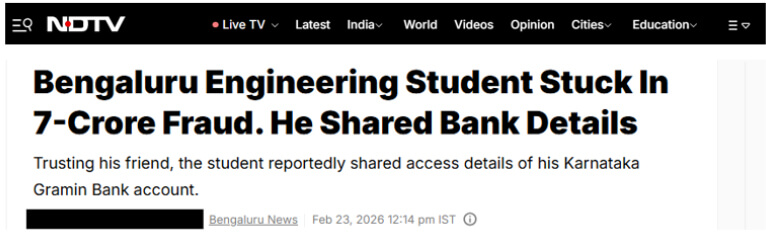
On 24th February 2026, a notable case was reported from Bengaluru involving an engineering student whose bank account was allegedly used to process nearly ₹7 crore in suspicious transactions within a short period. According to reports, the student had shared access details with an acquaintance who claimed temporary assistance was required. As publicly reported in the Times of India, “What began as a favour for a friend has now landed a 23-year-old engineering student in trouble after his bank account was allegedly used to route nearly Rs 7 crore in two days as part of a cybercrime network.” Investigators later linked the account activity to a wider mule account network commonly used to move illicit funds.
This case is significant because it demonstrates how students can be exploited not only as fraud victims but also as operational assets in financial crime schemes. It also highlights the growing use of trust-based social engineering to obtain access to legitimate banking channels.
2. Student Data Misused by Former Academic Counsellor
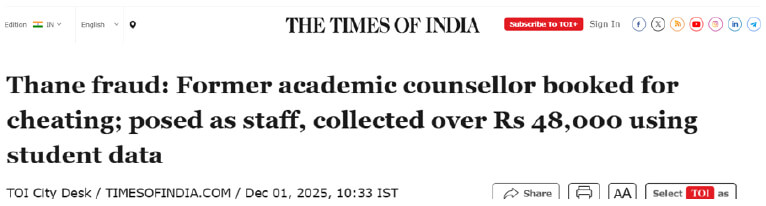
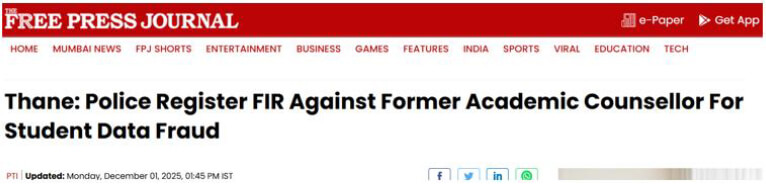
In another relevant case reported on 1 December 2025, police in Thane registered a case against a former academic counsellor accused of misusing student records to collect money fraudulently. The individual allegedly continued contacting students after leaving the institution, falsely presenting himself as an active staff member and requesting payments under misleading pretexts.
The case reflects the insider threat risk within educational environments, where access to student data can be abused for impersonation and direct financial fraud. It also shows that cyber-enabled fraud does not always require technical compromise; misuse of legitimate data and trust can be equally effective.
3. Fake University Website Used for Data Harvesting
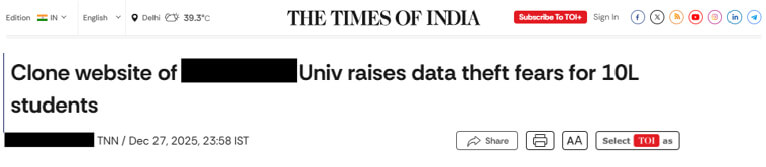
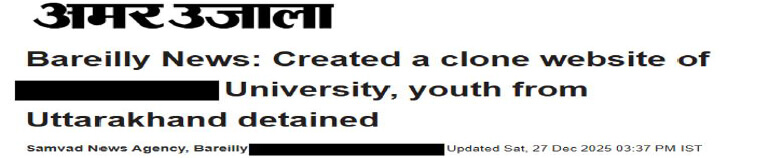
On 27th December 2025, a cloned website imitating a prominent Indian university was identified and reported to authorities after concerns emerged that it was collecting student fees and sensitive information. The fraudulent site closely resembled the official university portal and displayed academic content to appear authentic.
This case is relevant because it illustrates how threat actors exploit trusted educational brands to harvest credentials, personal data, and payments. Such infrastructure can also be reused for future phishing campaigns or identity fraud. The scale of potential exposure was notable given the university’s large, affiliated student base.
The weaponization of student data creates risks that extend beyond isolated fraud incidents. Once personal information is exposed or misused, students may become targets for repeated phishing attempts, impersonation scams, account takeover, or identity theft. Because many students are at an early stage of managing finances and digital services independently, even a single successful attack can result in significant financial loss or long-term misuse of personal credentials. In cases where bank accounts are exploited for fraudulent transactions, affected individuals may also face account restrictions or legal complications.
Educational institutions face a different but equally serious set of consequences. Exposure or misuse of student records can damage trust among students, parents, and stakeholders, particularly where institutions are expected to safeguard sensitive information. Reputational harm may lead to reduced confidence in digital systems, while internal investigations, remediation efforts, and potential regulatory scrutiny can create additional operational burdens. Institutions that rely heavily on third-party vendors may also face indirect risk if partners fail to maintain adequate security controls. The wider financial ecosystem is also impacted when student identities or accounts are drawn into fraud networks. Compromised accounts may be used as mule accounts to transfer illicit funds, making detection more difficult for banks and investigators. At scale, these activities contribute to rising fraud losses and increase the complexity of financial crime investigations.
Overall, the risk is not limited to individual victims. The continued exploitation of student data supports a broader criminal ecosystem where stolen information can be reused across multiple campaigns. Without stronger controls and awareness measures, the impact is likely to grow in both frequency and sophistication.
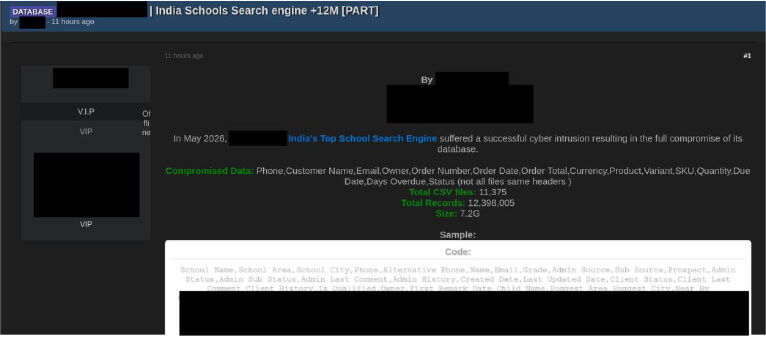
In May 2026, a threat actor on a cybercrime forum allegedly claimed responsibility for compromising the database of an Indian school search and admissions-related platform. The post advertised more than 12 million records distributed across thousands of CSV files, suggesting large-scale exposure of educational and customer-related data. Based on the forum post and exposed samples, the dataset reportedly included information such as school names, contact numbers, email addresses, customer and owner details, student-related information, admission planning data, internal comments, lead-generation records, and marketing metadata. The breadth of the exposed fields indicates potential access to both operational and user-related datasets.
Although the authenticity and origin of the dataset could not be independently verified at the time of assessment, the alleged leak may pose risks, including targeted phishing, admission-related scams, impersonation attempts, spam campaigns, and social engineering attacks against schools, students, parents, and associated organizations. The incident further highlights the growing exposure risks within India’s education technology and student data ecosystem.
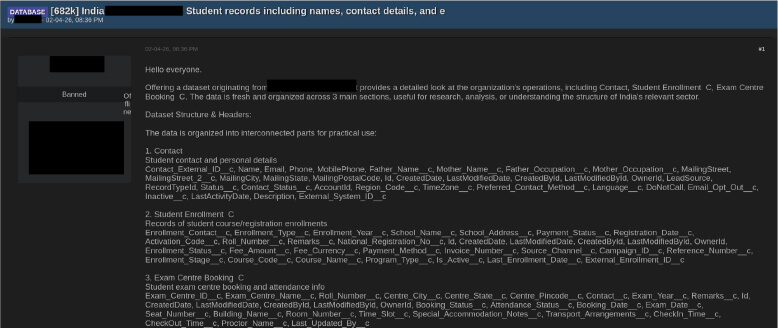
In April 2026, a threat actor advertised an alleged database containing approximately 682,000 student-related records associated with an Indian educational platform. According to the post, the dataset allegedly included personally identifiable information (PII), student enrolment data, contact details, and examination centre booking records. The exposed sample suggested the presence of student names, email addresses, phone numbers, parent or guardian information, payment-related details, registration data, and location-specific information such as city, state, and postal codes.
The actor also claimed that the data was organized across multiple interconnected sections, potentially allowing correlation between student identities, academic activities, and examination logistics. If authentic, the exposure could increase the risk of phishing, social engineering, impersonation attempts, academic fraud, and financially motivated scams targeting students and parents. While the source and method of compromise remain unverified, such exposures are commonly linked to unsecured databases, compromised administrative access, exposed APIs, or weaknesses within third-party systems.
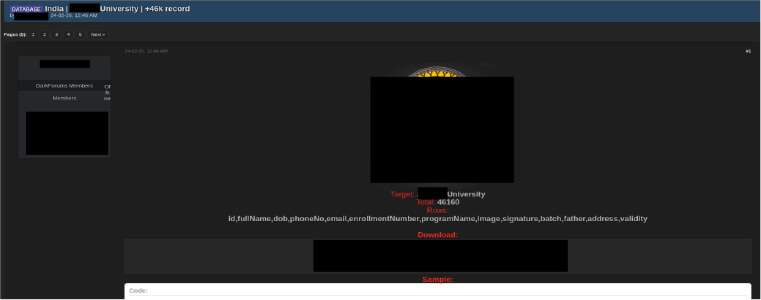
On 24 February 2026, a threat actor on a cybercrime forum allegedly advertised a database linked to a major Indian university, claiming exposure of more than 46,000 records. The post suggested that the dataset contained personally identifiable information (PII), including full names, dates of birth, phone numbers, email addresses, enrolment details, addresses, profile images, and signatures.
Although the authenticity of the data could not be independently verified at the time of assessment, the nature of the exposed information may present risks of phishing, identity misuse, impersonation, and social engineering attacks targeting students and affiliated individuals. The incident also highlights the growing targeting of educational institutions and student data ecosystems by cybercriminal actors.
The findings of this assessment indicate that student data has become an increasingly valuable resource for threat actors engaged in phishing, social engineering, and financial fraud. As educational services continue to move online, the volume of sensitive information stored across institutions, platforms, and third-party providers has expanded, creating more opportunities for misuse. What may begin as a limited data exposure can quickly develop into targeted scams, identity abuse, or fraudulent financial activity. Observed cases show that the threat is no longer limited to generic scams. Attackers are using trusted academic themes, exploiting institutional reputations, and in some instances misusing student accounts or records as part of broader fraud operations. This reflects a more organized and deliberate threat model built around access to data and exploitation of trust.
Going forward, reducing this risk will require stronger data governance, better monitoring of student-facing systems, and greater awareness among students and institutions alike. Without proactive measures, the education sector is likely to remain an attractive environment for cybercriminal activity due to its scale, digital dependence, and concentration of valuable personal information.
