

Ransomware activity during May 2026 underscored the continued evolution of the threat landscape from isolated malware campaigns into a mature, service-driven criminal ecosystem capable of sustaining large-scale operations across multiple regions and sectors.
With 778 publicly disclosed victims, activity remained significantly above historical levels, reflecting the enduring effectiveness of ransomware-as-a-service (RaaS) models and the growing specialization of cybercriminal networks. Organizations within Professional Goods & Services, Manufacturing, Information Technology, Healthcare, and Real Estate & Construction experienced the highest levels of targeting, demonstrating attackers’ preference for environments where operational disruption, sensitive information exposure, and business continuity pressures can be leveraged to maximize extortion outcomes.
The reporting period also highlighted a notable shift in intrusion methodologies, with threat actors increasingly exploiting identity-related weaknesses, incomplete remediation efforts, misconfigurations, trusted relationships, and internet-facing infrastructure rather than relying exclusively on traditional vulnerability exploitation. Several incidents demonstrated a growing emphasis on long-term access, privilege escalation, defense evasion, and reconnaissance activities designed to establish strategic positioning before monetization occurs. Simultaneously, data theft continued to expand as a primary objective, with intellectual property, source code repositories, customer records, educational datasets, and other high-value information assets increasingly serving as the basis for extortion, often reducing the need for disruptive encryption activities altogether. The continued targeting of software development environments, cloud platforms, hosting infrastructure, supply chains, and shared-service ecosystems further illustrates how attackers are seeking opportunities to amplify impact through a single compromise.
Additionally, the growing role of Initial Access Brokers (IABs), anonymization providers, malware-signing services, hosting operators, and other specialized criminal service providers highlights the increasing professionalization and operational efficiency of the ransomware economy.
Collectively, these developments demonstrate that modern ransomware operations are becoming more persistent, intelligence-driven, and data-focused, requiring organizations to strengthen cyber resilience through improved identity security, accelerated remediation processes, enhanced visibility, supply-chain risk management, and proactive threat intelligence capabilities to mitigate both immediate and long-term business risk.
Welcome to the May 2026 Ransomware Threat Report. This report delivers a detailed analysis of the ransomware landscape, highlighting the emergence of new ransomware groups, evolving attack techniques, and notable shifts in targeted industries. By examining key trends, tactics, and significant incidents, this report aims to support organizations and security teams in understanding the current threat environment. As ransomware campaigns continue to grow in complexity, this report serves as a vital resource for anticipating future threats and strengthening proactive cybersecurity strategies.
Throughout May 2026, there was notable activity from several ransomware groups. Here are the trends regarding the top 10:
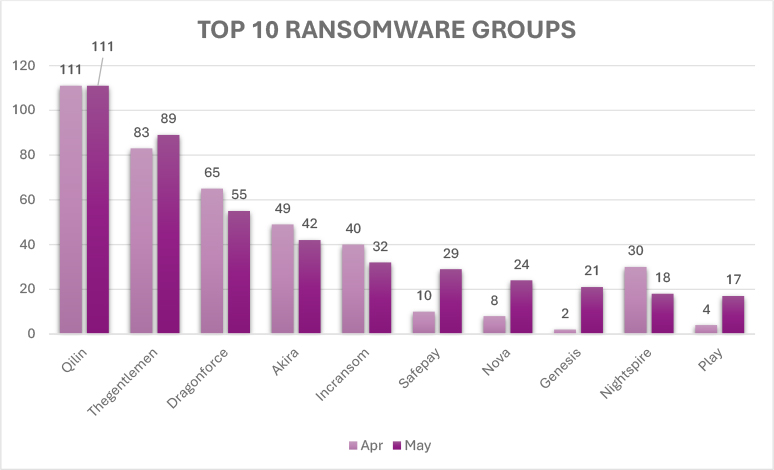
The April–May 2026 data highlight a continued redistribution of ransomware activity across the threat landscape. Qilin remained the most active group with 111 incidents in both months, maintaining a stable operational tempo, while Thegentlemen increased its activity from 83 to 89 incidents, further strengthening its position among the leading ransomware operators. Several established groups recorded declines, including Dragonforce (65→55), Akira (49→42), Incransom (40→32), and Nightspire (30→18), indicating reduced campaign volume or shifting operational priorities.
In contrast, notable growth was observed among emerging actors, with Safepay (10→29), Nova (8→24), Genesis (2→21), and Play (4→17) significantly expanding their activity and increasing their visibility within the ransomware ecosystem. Overall, the data suggests that while some established operators experienced declining activity, new and growing groups continued to fill the gap, demonstrating the resilience and adaptability of the ransomware-as-a-service (RaaS) landscape rather than any meaningful reduction in the overall threat environment.
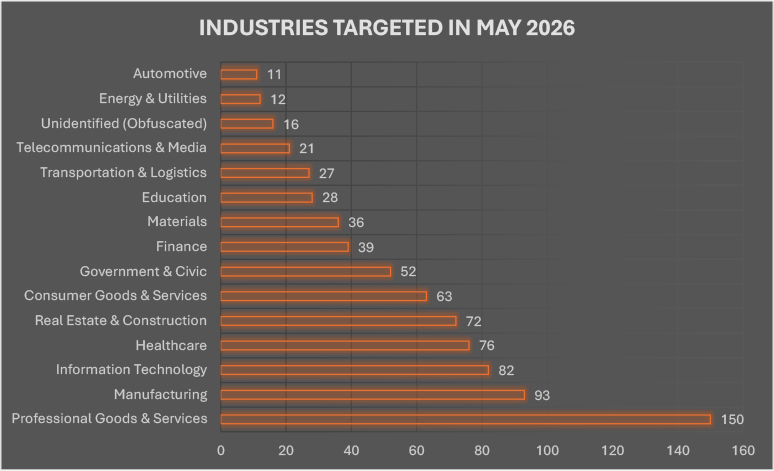
In May 2026, ransomware activity remained concentrated in sectors where operational disruption and data exposure can be most effectively monetized. Professional Goods & Services (150 incidents) was the most targeted industry, followed by Manufacturing (93), Information Technology (82), Healthcare (76), and Real Estate & Construction (72), highlighting sustained adversary interest in organizations reliant on continuous operations and sensitive information. Significant activity was also observed in Consumer Goods & Services (63) and Government & Civic (52), while Finance (39), Materials (36), Education (28), Transportation & Logistics (27), and Telecommunications & Media (21) experienced moderate levels of targeting. Comparatively fewer incidents were recorded in Energy & Utilities (12) and Automotive (11), and 16 incidents remained unattributed due to victim obfuscation. Overall, the sectoral distribution indicates that ransomware operators continue to prioritize industries where operational downtime, business disruption, and data compromise are likely to create strong incentives for victim organizations to engage with extortion demands.
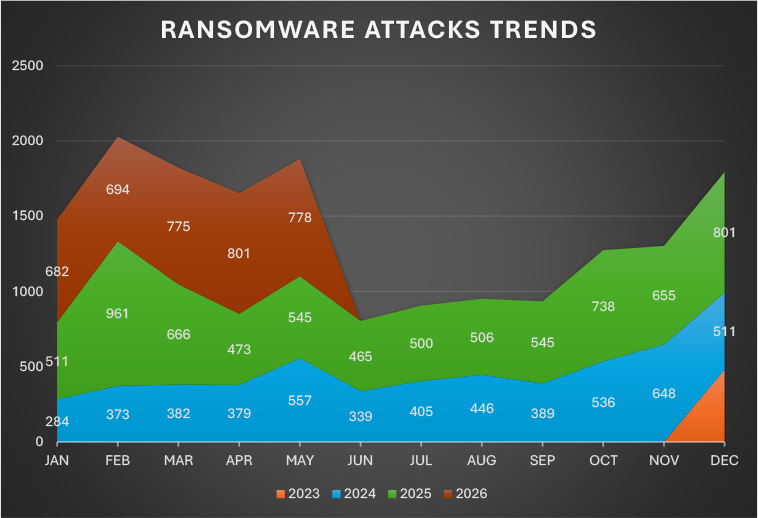
Ransomware activity continued to operate at historically elevated levels in 2026, although May recorded 778 incidents, slightly below the peaks observed in April 2026 (801) and December 2025 (801). Compared with previous years, ransomware volumes remain substantially higher, with January (682), February (694), March (775), April (801), and May (778), all exceeding equivalent periods in 2024 and approaching or surpassing most 2025 monthly totals.
While February 2025 (961 incidents) remains the highest monthly spike across the dataset, the broader trend indicates that elevated ransomware activity has become sustained rather than episodic. The consistently high volumes recorded throughout 2025 and into 2026 suggest continued expansion of ransomware-as-a-service (RaaS) operations, growing affiliate participation, and increasingly mature attack ecosystems capable of maintaining large-scale targeting across multiple sectors and regions.
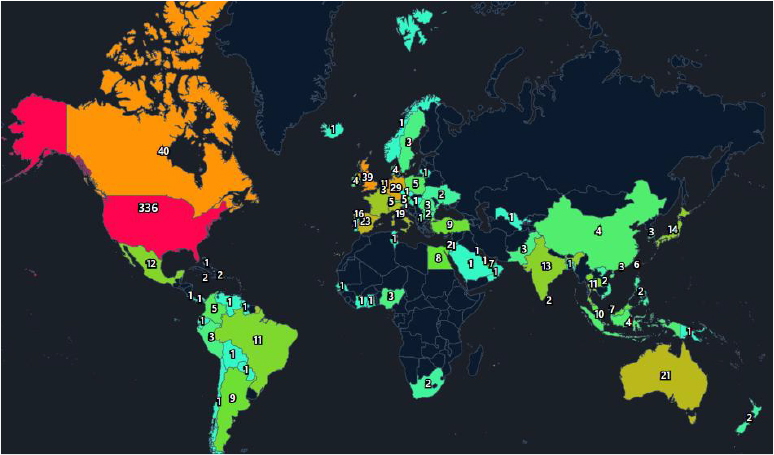
Ransomware activity in May 2026 remained heavily concentrated in the United States (336 incidents), which accounted for a substantial share of all recorded victims and continued to stand out as the primary global target. A second tier of highly targeted countries included Canada (40), the United Kingdom (39), Germany (29), Spain (23), Australia (21), and Italy (19), reflecting sustained adversary focus on mature economies with extensive digital infrastructure and significant extortion potential. Additional notable activity was observed across France (16), Japan (14), India (13), Mexico (12), Brazil (11), the Netherlands (11), Thailand (11), and Singapore (10), demonstrating continued ransomware reach across both developed and emerging markets. Lower but consistent levels of activity were distributed across Europe, Asia, the Middle East, Africa, and Latin America, while 17 incidents remained unidentified or obfuscated, highlighting ongoing attribution challenges.
Overall, the geographic distribution indicates that ransomware operators continue to prioritize North American and Western European organizations while maintaining a broad global footprint, consistent with the persistent expansion and international reach of ransomware-as-a-service (RaaS) operations.
Exploitation of Remediation Gaps to Establish Ransomware-Ready Access
This incident highlights the evolution of ransomware intrusion activity from exploiting unpatched vulnerabilities to systematically targeting misconfigured or incompletely remediated security controls. The unidentified threat actor, assessed with medium confidence to be an initial access broker (IAB), leveraged CVE-2024-12802 to bypass MFA protections on SonicWall Gen6 SSL-VPN appliances, despite organizations having installed the relevant firmware updates. Rather than immediately deploying ransomware, the actor conducted reconnaissance, validated credential reuse opportunities, established privileged access via RDP, and attempted to deploy Cobalt Strike and BYOVD-based tooling. This reflects a more mature access-broker model where attackers prioritize stealthy access acquisition and monetization before ransomware operators are introduced into the intrusion chain.
ETLM Assessment
Threat actors are expected to place greater emphasis on exploiting weaknesses in security implementation and operational controls rather than relying exclusively on software vulnerabilities. Security shortcomings such as unresolved remediation actions, improperly configured defenses, weaknesses in identity governance, and inadequate authentication controls may present increasingly valuable opportunities for threat actors seeking initial access or privilege escalation. Access brokerage networks are also expected to expand the use of automation for credential assessment, access validation, and environment profiling, enabling them to identify and monetize valuable enterprise access more efficiently. As enterprises expand their reliance on VPN infrastructure, cloud-based identity services, single sign-on platforms, and remote connectivity solutions, threat actors are expected to increasingly target weaknesses in platform configurations and interconnected trust mechanisms. Exploiting these gaps can enable unauthorized access, facilitate lateral movement, and allow attackers to circumvent traditional security safeguards without directly compromising endpoint defenses.
Expansion of Ransomware Leverage Through Supply Chain-Centric Targeting
This incident demonstrates the continued evolution of ransomware from targeting individual organizations to targeting high-value supply chain aggregators that hold sensitive intellectual property and operational data belonging to multiple global enterprises. The threat group Nitrogen reportedly targeted an organisation’s North American manufacturing operations and claimed to have exfiltrated over 8TB of data, including technical documentation, schematics, and project-related information associated with major technology companies. Rather than focusing solely on operational disruption through encryption, the campaign reflects a more mature double-extortion strategy where the value of stolen third-party intellectual property and supply chain leverage may exceed the value of encrypting the organization’s systems alone. This represents a shift toward attacking manufacturers as gateways to broader ecosystems of customers, partners, and downstream supply chains.
ETLM Assessment
Manufacturing firms and technology service providers are expected to remain high-value targets because they often serve as centralized repositories for sensitive operational data, intellectual assets, and information associated with multiple business partners. Rather than focusing solely on a single victim, attackers are increasingly pursuing opportunities that provide broader influence across suppliers, customers, and associated business networks. Future intrusion activity may place greater emphasis on obtaining access to environments that support product design, operational processes, software creation, and collaborative business functions, as these areas often contain information that can be exploited for financial gain or strategic advantage. The growing value of proprietary data is expected to encourage attackers to pursue multiple monetization paths, including extortion, unauthorized resale, competitive exploitation, and follow-on attacks against organizations linked to the original compromise.
Escalation of Data-Centric Intrusions into Regulatory and Operational Risk
This incident highlights the evolution of ransomware campaigns from rapid encryption-focused attacks to long-term, intelligence-driven intrusions designed to maximize data theft and operational leverage. The threat group Cl0p maintained access within South Staffordshire Water’s environment for nearly 20 months following an initial phishing compromise, gradually escalating privileges to domain administrator level before exfiltrating over 4TB of sensitive data. The case demonstrates how modern ransomware operations increasingly prioritize persistence, lateral movement, and large-scale data theft over immediate disruption, allowing attackers to extract maximum value before extortion efforts begin. The resulting regulatory penalty further illustrates how ransomware impacts now extend beyond operational and financial losses to include significant compliance and legal consequences for victims.
ETLM Assessment
Ransomware groups are expected to continue adopting extended dwell-time strategies, focusing on stealth, privileged access acquisition, and large-scale data exfiltration before initiating extortion. Critical infrastructure operators may increasingly face dual pressure from both threat actors and regulators, with future incidents likely resulting in heightened scrutiny, larger penalties, and mandatory cybersecurity compliance requirements. Adversaries are likely to favor environments where aging infrastructure, limited security oversight, and visibility gaps reduce the probability of early detection, enabling them to maintain access and conduct operations over extended periods.
Systematic Neutralization of Recovery Mechanisms to Maximize Extortion Leverage
The incident demonstrates how ransomware operations have evolved beyond simply encrypting systems to deliberately undermining an organization’s ability to recover from an attack. Before deploying ransomware, threat actors are increasingly dedicating time to identifying and assessing backup infrastructure, disaster recovery resources, storage snapshots, and administrative recovery tools. Once these assets are located, attackers may disable, modify, erase, or otherwise compromise them to weaken recovery capabilities and increase operational disruption. This approach reflects a more deliberate and strategic intrusion model in which adversaries seek to reduce recovery options, prolong business impact, and strengthen their negotiating position before initiating extortion or encryption activities. As a result, ransomware campaigns are becoming less opportunistic and more focused on systematically weakening an organization’s resilience throughout the attack lifecycle.
ETLM Assessment
Ransomware groups are expected to further expand attacks against backup management platforms, cloud recovery environments, disaster recovery systems, and immutable storage controls. Future campaigns will likely combine backup destruction with data exfiltration, making restoration alone insufficient even when backups survive. Organizations may increasingly face multi-extortion scenarios where attackers leverage stolen data, operational disruption, and compromised recovery infrastructure simultaneously. Consequently, organizations are expected to place greater emphasis on comprehensive cyber resilience approaches that combine protected backups, isolated recovery environments, continuous threat monitoring, and regular recovery testing to minimize the impact of ransomware incidents.
Acceleration of Vulnerability-Driven Ransomware Operations Against Shared Hosting Environments
This incident demonstrates the evolution of ransomware operations toward near-immediate weaponization of newly disclosed vulnerabilities. The threat group “Sorry” rapidly operationalized CVE-2026-41940, a critical authentication bypass flaw in cPanel and WHM, to gain unauthorized administrative access to hosting environments and deploy a Go-based Linux ransomware encryptor. Unlike traditional ransomware campaigns that rely on phishing, credential theft, or lengthy post-compromise activity, this campaign leveraged internet-scale exploitation of a widely deployed management platform. The targeting of cPanel is particularly significant because a single compromised hosting server can impact dozens or hundreds of websites simultaneously, allowing ransomware operators to maximize victim volume and operational efficiency through a single intrusion vector. This reflects a broader shift from targeted enterprise intrusions to scalable exploitation campaigns that prioritize speed, automation, and maximum reach immediately following vulnerability disclosure.
ETLM Assessment
Ransomware groups are likely to further accelerate vulnerability-to-exploitation timelines, integrating newly disclosed flaws into automated scanning and attack frameworks within hours or days of public release. Future campaigns may increasingly target internet-facing management platforms, hosting infrastructure, cloud administration portals, and shared-service environments where a single compromise can affect multiple organizations. Threat actors may also combine mass exploitation with data theft, credential harvesting, and supply chain extortion to increase monetization opportunities beyond traditional encryption-based attacks. As Linux-based infrastructure continues to support critical business services, ransomware operators are expected to expand their focus on server-centric and cloud-hosted environments.
Convergence of Insider Expertise and Ransomware Tradecraft for Enhanced Extortion Operations
This case highlights a significant evolution in the ransomware landscape where individuals entrusted with defending victims became active participants in ransomware operations. The threat group ALPHV/BlackCat leveraged the expertise of cybersecurity professionals, including incident responders and ransomware negotiators, who possessed deep knowledge of victim response procedures, recovery strategies, and ransom negotiation processes. Rather than relying solely on technical intrusion capabilities, the operation benefited from insider understanding of how organizations react during cyber crises, enabling more effective extortion and attack execution. This demonstrates the growing convergence of technical compromise, business intelligence, and human expertise within modern ransomware ecosystems.
ETLM Assessment
Ransomware operators are likely to continue seeking access to specialized expertise through insider recruitment, coercion, or collaboration with individuals possessing incident response, cyber insurance, negotiation, and digital forensics experience. Future campaigns may increasingly incorporate intelligence gathered from victim-response processes to refine extortion strategies, improve ransom pricing models, and identify organizations most likely to pay. The growing professionalization of ransomware operations may further blur the distinction between traditional cybercrime actors and legitimate cybersecurity expertise, creating new insider-risk challenges for the security industry.
Shift From Authentication Bypass to User-Driven Access Manipulation
This development highlights the evolution of account compromise techniques from bypassing authentication technologies to manipulating user behavior within legitimate security processes. Rather than attempting to defeat MFA through technical exploitation, threat actors increasingly rely on MFA Prompt Bombing (MFA Fatigue), repeatedly triggering authentication requests until a user approves one out of confusion, frustration, or urgency. This shift demonstrates how adversaries are targeting the human element of identity security after obtaining valid credentials through phishing, infostealers, or credential leaks. The technique has become particularly attractive because it allows attackers to circumvent otherwise effective MFA deployments without exploiting software vulnerabilities, reflecting a broader transition toward psychologically driven access attacks.
ETLM Assessment
Threat actors are likely to combine MFA fatigue attacks with AI-powered social engineering, voice impersonation, SMS phishing, and helpdesk manipulation to increase success rates. Future campaigns may leverage automated credential validation systems that identify accounts protected by push-based MFA and immediately launch prompt-bombing sequences. Organizations will increasingly shift toward phishing-resistant authentication mechanisms such as FIDO2 security keys, passkeys, number matching, biometric verification, and risk-based authentication to reduce reliance on user approval prompts. The focus of identity attacks is expected to move further away from passwords and toward exploiting authentication recovery processes, user trust, and human decision-making.
Privilege Escalation Through Shared Hosting Infrastructure as a Force Multiplier for Cyber Intrusions
This incident demonstrates the evolution of ransomware and intrusion operations toward privilege escalation through shared hosting infrastructure components rather than direct exploitation of enterprise endpoints. The vulnerability, CVE-2026-48172 (CVSS 10.0), allowed a low-privileged cPanel user to execute arbitrary scripts with root privileges on affected LiteSpeed User-End cPanel Plugin installations. Unlike traditional attacks that require phishing, credential theft, or external compromise, a single compromised hosting account could potentially escalate into complete server control, creating a pathway to compromise multiple hosted websites and services simultaneously. The active exploitation of this flaw highlights a growing trend where attackers target administrative and hosting management platforms to maximize impact through a single point of compromise.
ETLM Assessment
Threat actors are likely to continue prioritizing hosting control panels, web management platforms, and multi-tenant environments where privilege escalation vulnerabilities can provide disproportionate access and scale. Future campaigns may combine initial web application compromises, stolen hosting credentials, or compromised customer accounts with privilege escalation flaws to achieve root-level access and deploy ransomware, webshells, cryptominers, or supply-chain malware. As hosting providers increasingly become aggregation points for multiple organizations, attackers will continue seeking vulnerabilities that enable lateral impact across numerous customers from a single intrusion.
Dismantling of a Critical Infrastructure Layer Within the Ransomware Ecosystem
This incident highlights the evolution of ransomware ecosystems beyond malware developers and affiliates to include specialized criminal infrastructure providers. The dismantled service, First VPN, was reportedly used by at least 25 ransomware groups to conceal network reconnaissance, credential attacks, ransomware deployment, data theft, and other malicious activities. Rather than building and maintaining their own anonymization infrastructure, ransomware operators increasingly rely on dedicated underground service providers that offer privacy-focused VPN services, anonymous payment methods, and infrastructure specifically designed to evade law enforcement. This reflects the continued professionalization of the ransomware economy, where operational capabilities are outsourced across a mature cybercriminal supply chain, enabling threat actors to scale operations while reducing attribution risks.
ETLM Assessment
Following the disruption of First VPN, ransomware operators will likely migrate toward alternative anonymization providers, decentralized hosting services, residential proxy networks, bulletproof hosting providers, and multi-layered VPN chains to maintain operational security. Cybercriminal infrastructure is expected to become increasingly fragmented and resilient, with threat actors diversifying their anonymity mechanisms to reduce dependence on any single provider. Law enforcement success against infrastructure enablers may also drive ransomware groups toward self-managed infrastructure, encrypted peer-to-peer communications, and more sophisticated operational security practices to limit future exposure.
Reinforcement of Covert Persistence Capabilities Within Modern Attack Operations
This development highlights the evolution of cyber intrusions from short-term access and smash-and-grab attacks toward long-term stealth and persistence-focused operations. Linux rootkits, once considered a niche threat, continue to evolve alongside cloud infrastructure, containers, and modern Linux environments, enabling attackers to conceal processes, evade security monitoring, maintain privileged access, and survive remediation efforts. Modern threat actors increasingly prioritize persistence and operational longevity, using rootkit capabilities to remain undetected while conducting espionage, credential theft, lateral movement, or ransomware preparation. The continued relevance of Linux rootkits demonstrates a broader shift toward defense-evasion techniques designed to undermine traditional visibility and detection mechanisms. For ransomware operations specifically, rootkits provide a valuable capability by allowing attackers to maintain covert access for extended periods before deploying encryption payloads. This evolution reflects a transition from immediate monetization toward intelligence-led intrusions where adversaries first establish persistence, map the environment, identify critical assets, and weaken defenses before launching the final stage of the attack.
ETLM Assessment
Threat actors are likely to increasingly develop rootkits tailored for cloud workloads, containerized environments, virtualization platforms, and hybrid infrastructures where traditional endpoint security visibility is limited. Future rootkits may incorporate AI-assisted evasion techniques, kernel-level defense bypass mechanisms, and capabilities specifically designed to disable EDR, XDR, and forensic tooling. Ransomware groups are also expected to adopt rootkit functionality more frequently through partnerships with Initial Access Brokers (IABs) and malware developers, enabling longer dwell times and improved operational security. As organizations continue migrating critical workloads to Linux-based systems, cloud servers, and Kubernetes environments, attackers will likely focus on persistence mechanisms that can survive reboots, updates, and security remediation efforts while remaining undetected.
Weaponization of Trusted Software Ecosystems to Accelerate Ransomware Delivery
This incident highlights the evolution of ransomware operations from developing proprietary malware capabilities to leveraging specialized cybercrime service providers that abuse trusted digital ecosystems. Microsoft disrupted a Malware-as-a-Service (MSaaS) operation operated by the threat actor Fox Tempest, which exploited Microsoft’s Artifact Signing platform to generate and sell code-signing certificates used to make malware appear legitimate. These certificates were subsequently leveraged by multiple malware and ransomware campaigns, including those associated with Rhysida, Qilin, BlackByte, Akira, Lumma Stealer, and Vidar. By weaponizing trusted code-signing infrastructure, attackers were able to increase malware execution success rates, evade security controls, and accelerate ransomware deployment. This reflects a significant maturation of the ransomware ecosystem, where specialized providers now supply critical services that support multiple threat groups simultaneously, creating a cybercriminal supply chain model.
ETLM Assessment
Threat actors are likely to further industrialize trust-based attacks by targeting software signing services, cloud platforms, identity providers, and software distribution channels that enable malware to inherit legitimate trust relationships. Future ransomware campaigns may increasingly rely on short-lived certificates, compromised developer environments, stolen identities, and fraudulent software distribution mechanisms to bypass traditional security defenses. As law enforcement and technology providers disrupt individual services such as Fox Tempest, cybercriminals will likely diversify into decentralized malware-signing services and underground marketplaces offering trusted digital artifacts as a service. This will continue shifting ransomware operations toward highly specialized criminal supply chains where infrastructure providers, access brokers, malware developers, and ransomware affiliates operate as interconnected business units.
Strategic Targeting of Software Development Assets for Extortion and Supply Chain Leverage
This incident highlights the evolution of cyber extortion from targeting production environments and customer data to targeting software development ecosystems and source code repositories. An unidentified threat actor, later linked by some reports to the CoinbaseCartel threat group, obtained a compromised GitHub token that provided access to Grafana’s GitHub environment, enabling the download of the company’s codebase and a subsequent extortion attempt. Rather than deploying ransomware or disrupting operations, the actor focused on stealing intellectual property and leveraging the threat of public disclosure for financial gain. This reflects a growing trend where attackers view source code, development pipelines, CI/CD environments, and software intellectual property as high-value extortion assets capable of generating revenue without the operational risks associated with traditional ransomware deployment.
ETLM Assessment
Threat actors are likely to increasingly target GitHub environments, code repositories, developer credentials, access tokens, CI/CD pipelines, and software signing infrastructure as part of broader software supply chain attacks. Future campaigns may combine source code theft with credential harvesting, insertion of malicious code, software backdoors, and downstream supply chain compromise affecting customers and partners. As organizations strengthen defenses around production systems, adversaries are expected to focus more heavily on development ecosystems where access can provide intellectual property theft opportunities, extortion leverage, and potential pathways into customer environments. The convergence of source code theft, supply chain compromise, and extortion is likely to become a recurring feature of modern cybercrime operations.
Expansion of Multi-Vector Intrusion Strategies Through Vulnerability, AI, and Supply Chain Convergence
This bulletin highlights a broader evolution in cyber threats where attackers are increasingly combining high-impact infrastructure vulnerabilities, supply chain abuse, AI-assisted attack techniques, and trust exploitation to achieve operational objectives. Among the most significant developments was the active exploitation of the PAN-OS RCE vulnerability (CVE-2026-0300), which enabled unauthenticated root-level access to internet-facing firewalls and facilitated espionage-focused post-exploitation activities. Simultaneously, emerging concerns around AI tokenizer attacks, supply chain compromise campaigns, and vulnerability discovery advancements such as Mythos demonstrate that attackers are no longer dependent on a single intrusion vector. Instead, modern operations increasingly blend automation, trusted platform abuse, and scalable exploitation methods to reduce attack complexity while increasing operational reach. This reflects a shift from isolated attacks toward interconnected intrusion ecosystems where vulnerabilities, AI capabilities, and supply chain access are leveraged in combination.
ETLM Assessment
Threat actors are likely to continue integrating AI-assisted reconnaissance, exploit development, and vulnerability discovery into their operations, significantly reducing the time between vulnerability disclosure and weaponization. Future campaigns may increasingly target security appliances, identity systems, AI platforms, and software supply chains, allowing attackers to gain privileged access through trusted infrastructure rather than traditional endpoint compromise. As AI capabilities mature, defenders may face adversaries capable of automating portions of vulnerability research, attack-path identification, and exploitation workflows, resulting in faster and more adaptive intrusion campaigns. Simultaneously, supply chain compromise and trust-based attacks are expected to become increasingly attractive due to their ability to impact multiple organizations through a single compromise event.
Expansion of Data-Centric Extortion Through High-Volume Digital Ecosystems
This incident demonstrates the continued evolution of ransomware and extortion operations from encryption-based attacks toward large-scale data theft and extortion without relying on operational disruption. The threat group ShinyHunters breached a learning platform, exfiltrating approximately 3.65TB of data affecting nearly 9,000 educational institutions and an estimated 275 million records. Rather than focusing on encrypting systems, the attackers leveraged stolen student, faculty, and institutional data as their primary source of extortion leverage, even escalating pressure by defacing the organization’s login portals with ransom messages. The organization ultimately reached an agreement with the threat actors, reportedly securing the return and destruction of the stolen data while preventing downstream extortion of affected customers. This reflects a broader shift in the threat landscape where attackers increasingly view sensitive data itself as the ransom asset, reducing the need for disruptive encryption operations while maximizing pressure on victims.
ETLM Assessment
Threat actors are likely to continue targeting SaaS platforms, educational technology providers, cloud services, and centralized digital ecosystems that aggregate data from thousands of organizations. Future extortion campaigns may increasingly focus on intellectual property, communications data, identity records, and institutional information rather than system encryption. The success of large-scale data-centric extortion operations may further encourage attackers to target trusted platforms that serve multiple customers simultaneously, creating opportunities for mass victimization through a single compromise. Additionally, education-sector platforms may face increased targeting due to the concentration of student, staff, and institutional data that can be leveraged for phishing, fraud, identity theft, and secondary extortion campaigns.
Operational Scaling Through Automated Exploitation of Shared Hosting Infrastructure
This incident demonstrates the rapid evolution of ransomware and cybercrime operations toward internet-scale exploitation of critical infrastructure vulnerabilities immediately following public disclosure. The exploitation of CVE-2026-41940, a critical authentication bypass flaw in cPanel and WHM, enabled threat actors to gain unauthorized administrative access to hosting environments without valid credentials. The threat actor Mr_Rot13 was observed leveraging the vulnerability to deploy the Filemanager backdoor, establish persistent SSH access, harvest credentials, steal sensitive data, and facilitate ransomware deployment. Security researchers identified more than 2,000 attacker-controlled IPs participating in automated exploitation campaigns, highlighting a shift from targeted intrusions to highly scalable attacks capable of compromising large numbers of hosting servers simultaneously. The campaign illustrates how modern ransomware ecosystems increasingly rely on vulnerability-driven access operations, where backdoors, credential theft, and persistence mechanisms are established before monetization through ransomware or data extortion.
ETLM Assessment
Threat actors are likely to continue prioritizing hosting control panels, MSP infrastructure, cloud management platforms, and internet-facing administrative services because a single compromise can provide access to numerous downstream organizations. Future campaigns may increasingly combine automated vulnerability exploitation with credential harvesting, web shell deployment, ransomware execution, and supply-chain compromise activities. As vulnerability weaponization timelines continue to shrink, organizations may face attacks within hours of disclosure, forcing a transition toward continuous exposure monitoring and accelerated patch management. The convergence of hosting infrastructure compromise and ransomware operations is expected to remain a prominent threat due to the high operational leverage these platforms provide.
Concealment of Intelligence Collection Operations Through Ransomware-Themed Deception
This incident demonstrates a significant evolution in cyber operations where a nation-state threat group, Muddy Water, leveraged ransomware tactics as a false-flag mechanism to conceal espionage objectives. Instead of relying on traditional phishing campaigns, Muddy Water used Microsoft Teams-based social engineering, impersonating IT personnel to convince victims to disclose credentials and facilitate remote access. Following initial compromise, the group established persistence, harvested credentials, modified authentication settings, exfiltrated sensitive information, and only later deployed Chaos ransomware to create the appearance of a financially motivated attack. This represents an evolution from conventional cyber espionage toward hybrid operations that blend state-sponsored intelligence collection with ransomware tradecraft, making attribution more difficult and delaying incident response efforts.
ETLM Assessment
State-sponsored threat groups are likely to increasingly adopt ransomware-related tooling, extortion techniques, and criminal infrastructure to mask their true objectives and complicate attribution. Future campaigns may combine social engineering through collaboration platforms such as Microsoft Teams, remote management tools, credential theft, and false-flag ransomware deployment to disguise espionage activity as ordinary cybercrime. As organizations strengthen email security controls, attackers are also expected to shift further toward trusted communication platforms, helpdesk impersonation, and human-centric attack methods that exploit user trust rather than technical vulnerabilities. The line between nation-state espionage and financially motivated ransomware activity will likely continue to blur, creating greater challenges for defenders attempting to determine attacker intent.
Based on available public reports, approximately 31% of enterprises are compelled to halt their operations, either temporarily or permanently, in the aftermath of a ransomware onslaught. The ripple effects extend beyond operational disruptions, as detailed by additional metrics:
Impact Assessment
Ransomware remains a major threat to both organizations and individuals, locking critical data and demanding payment for its release. The consequences extend well beyond the ransom, often leading to costly recovery efforts, extended downtime, reputational harm, and potential regulatory fines. Such disruptions can destabilize operations and erode stakeholder trust. Addressing this growing risk demands a proactive cybersecurity posture and stronger collaboration between public and private sectors to build resilience against future attacks.
Victimology
Cybercriminals are increasingly targeting industries that manage vast amounts of sensitive data ranging from personal and financial information to proprietary assets. Sectors such as manufacturing, real estate, healthcare, FMCG, e-commerce, finance, and technology remain high on the threat radar due to their complex and extensive digital infrastructures. Adversaries strategically exploit vulnerabilities in economically advanced regions, launching well-planned attacks designed to encrypt critical systems and extract significant ransom payments. These operations are calculated to yield maximum financial returns.
Ransomware entering 2026 is no longer a discrete cyber incident but an enduring, multi-stage business threat that blends elements of cybercrime, espionage tradecraft, and economic coercion. The continued separation of access, execution, and extortion, combined with browser-based trust abuse, engineered delivery artifacts, and long-lived access infrastructure, has significantly eroded the effectiveness of exploit-centric and signature-driven defences. At the same time, the scale and complexity of affiliate-driven operations introduce inherent fragility, creating opportunities for disruption beyond traditional endpoint containment, particularly at the levels of access brokerage, backend infrastructure, and coordination workflows. For organizations, resilience in this environment will depend less on preventing individual intrusions and more on governance readiness, third-party risk management, user interaction telemetry, and executive decision preparedness. As ransomware groups continue to evolve toward stealth, optionality, and psychological leverage, proactive external threat landscape management and cross-functional response planning will be critical to reducing both operational impact and long-term business risk.
