
The SAARC (South Asian Association for Regional Cooperation) telecommunications sector remained exposed to a broad and evolving cyber-threat landscape during April–September 2026, driven primarily by exploitation of internet-facing infrastructure, credential compromise, ransomware, data exposure, supply-chain risk, and persistent targeting of network and management systems. Dark-web monitoring identified continued interest in telecom-related credentials, subscriber information, databases, and alleged system access; however, underground claims were treated as intelligence indicators rather than confirmed compromises unless independently validated. The growing adoption of 5G, cloud-native platforms, APIs, virtualization, and software-defined networking is further expanding the regional attack surface, increasing the importance of continuous vulnerability, identity, network, and threat-intelligence monitoring.
Key Trends
Priority Actions
Overall Assessment: The findings reinforce the need for a continuous, intelligence-led security approach across SAARC telecommunications, centered on reducing exposed attack surfaces, protecting privileged access, detecting persistent network compromise, safeguarding sensitive telecom data, and maintaining operational resilience.
1. DOES THIS AFFECT ME?
Yes, the threat environment is directly relevant to telecommunications organizations across India and the SAARC region.
The primary areas of concern are:
Technologies in scope this period include Cisco IOS XE, Ivanti Endpoint Manager Mobile (EPMM), SmarterTools SmarterMail, React Server Components, and the SOHO router, home-gateway, and NVR/DVR product families from Netgear, D-Link/TRENDnet, Huawei, Zyxel, Dasan, Realtek, Tenda, Linksys, TVT, and Vacron listed under Priority Vulnerabilities below.
2. HOW EXPOSED AM I?
The highest-priority exposure areas identified in this assessment are:
High Priority
Elevated Priority
Exposure should be assessed against actual asset inventory, vulnerability status, authentication controls, external attack surface, third-party connectivity, and available security telemetry.
3. WHAT SHOULD I DO NOW?
Immediate priorities:
Evidence and Confidence Summary
| Intelligence question | Current assessment | Confidence |
| Is SAARC telecom subscriber data being traded underground? | Yes — three advertisements observed April–September 2026; none independently verified. | High (observation); claims unverified |
| Are China-nexus telecom-focused APTs active against SAARC operators? | Capability and intent documented in public reporting; no SAARC-specific activity observed in this period. | Moderate |
| Is ransomware targeting SAARC telecom? | 2 of 150 SAARC leak-site victims in the period were in Telecommunications & Media. | High |
| Are the listed vulnerabilities being exploited against SAARC telecom networks? | Not established; 5 of 15 have exploitation attributed to named actors in public reporting. | Low |
Confidence is assessed on the High / Moderate / Low scale defined under Methodology & Source Attribution. Confidence in an observation is stated separately from the verification status of any underlying claim.
Scope & Assessment Context
This assessment examines the cyber-threat landscape affecting the telecommunications sector across India and the SAARC region, with emphasis on threats to network infrastructure, subscriber information, authentication systems, operational environments, digital services, and supporting technology ecosystems.
The assessment focuses on externally observable threat activity, reported incidents, threat-actor activity, underground exposure, ransomware activity, vulnerability exploitation, telecom-specific attack surfaces, and relevant security developments affecting the sector.
This is a threat-landscape and risk assessment and should not be interpreted as an assessment of the internal security posture of any specific telecom operator. No authenticated penetration testing, exploitation of customer environments, or direct access to operator systems was performed as part of this assessment.
Collection Sources
The assessment draws on multiple categories of threat intelligence and publicly available information, including:
Analytical Approach
Observed information was reviewed and categorized into consistent threat-event and risk categories, including:
Threat-actor assessments consider observed behaviors, reported campaigns, known targeting patterns, and relevance to telecommunications environments.
The assessment also considers the relationship between threat activity and telecom-specific technologies, including network appliances, routers, gateways, management platforms, APIs, cloud infrastructure, virtualized network functions, signaling environments, authentication systems, and third-party services.
Confidence and Verification
Findings are assessed using the following confidence framework:
Confidence in the observation is assessed separately from the verification status of the underlying claim. For example, a threat-intelligence listing may be observed with high confidence while the authenticity or impact of the claimed compromise remains unverified.
Verification Caveats
Assessment Limitations
This assessment provides an external threat perspective based on available intelligence and observable activity. It does not provide a complete measurement of all cyber incidents affecting India or SAARC telecommunications organizations.
The findings should therefore be used as risk-prioritization and threat-intelligence inputs, supporting exposure management, monitoring, incident preparedness and strategic cybersecurity decision-making.
Sources
Charts, victim counts and underground observations in this report are drawn from CYFIRMA’s own dark-web, leak-site and underground monitoring (DeCYFIR) for April–September 2026. Statements attributed to public reporting are sourced as follows: Statements attributed to public reporting are sourced as follows: GSMA, Mobile Telecommunications Security Landscape 2026, February 2026; Acronis Threat Research Unit, PATCHCORD: New malware cluster targets Afghan telecom and South Asian critical infrastructure, 13 August 2026; ITU-T, Recommendation Q.3066 (01/2026): Principles for detection and mitigation of signalling attacks in telecommunication networks, approved 13 January 2026, together with relevant GSMA and 3GPP security standards referenced therein; Cyber Security Agency of Singapore (CSA) and Infocomm Media Development Authority (IMDA), Largest Multi-Agency Cyber Operation Mounted to Counter Threat Posed by Advanced Persistent Threat (APT) Actor UNC3886 to Singapore’s Telecommunications Sector, 9 February 2026; CISA and international partners, Countering Chinese State-Sponsored Actors Compromise of Networks Worldwide to Feed Global Espionage System, August 2025; and Group-IB, APAC Threat Landscape Report, August 2026.
The cyber-threat environment affecting India and the wider SAARC telecommunications sector is influenced by the strategic importance of communications infrastructure, increasing digital dependency, technology concentration, and the continued interest of sophisticated threat actors in telecom environments.
Strategic Importance of Telecommunications
Telecommunications infrastructure provides access to communications networks, subscriber information, authentication systems, signaling environments, network-management platforms, and interconnected digital services. This makes telecom operators strategically important targets for both financially motivated and intelligence-oriented threat activity.
The assessment indicates that sophisticated actors are increasingly relevant to telecom environments because persistent access to network infrastructure can provide opportunities for intelligence collection, credential compromise, traffic visibility, configuration manipulation, and access to interconnected systems.
Regional Cyber Competition and Nation-State Activity
Nation-state and advanced persistent threat activity remains a significant consideration for the regional telecom environment. The threat-actor assessment identifies network infrastructure, routers, management systems, credentials, and communications-related environments as areas requiring continued monitoring.
The reported targeting patterns associated with actors such as UNC3886, Salt Typhoon, APT41, APT5, and APT31 reinforce the importance of monitoring persistent access to network and management infrastructure rather than focusing exclusively on conventional endpoint malware.
These actors should be treated as monitoring priorities rather than evidence of confirmed activity against a specific SAARC telecom operator.
Digital Transformation and Expanding Attack Surface
The continued adoption of 5G, cloud-native infrastructure, APIs, virtualization, automation, and software-defined network functions is expanding the number of technologies that require continuous security monitoring.
This creates additional dependencies across:
The expansion of these interconnected environments increases the potential impact of a compromised credential, vulnerable network device, exposed management interface, or compromised third-party service.
Economic and Operational Pressure
Telecommunications organizations operate highly interconnected environments in which service availability, customer trust and protection of subscriber information are critical. Cyber incidents involving ransomware, data theft, fraud or disruption can therefore create both direct security impacts and broader operational and reputational consequences.
The increasing value of subscriber information, credentials and access to telecom-supporting systems also creates incentives for financially motivated actors to pursue data theft, extortion, fraud and account compromise.
Key Implications
The combined effect of strategic telecom importance, expanding digital infrastructure, third-party dependencies and persistent threat-actor interest means that telecom security programs should treat network infrastructure, privileged identities, subscriber data, cloud environments, APIs and third-party access as interconnected risk areas rather than isolated security domains.
The SAARC telecommunications environment is facing a combination of cyber threats affecting network infrastructure, subscriber data, operational systems, digital identity, and connected services. The principal risks during 2026 include exploitation of internet-facing infrastructure, credential compromise, malware targeting telecom environments, supply-chain exposure, signaling abuse, ransomware and data theft, DDoS activity, and fraud conducted through telecom resources.
Telecommunications operators represent a particularly attractive target because compromise can provide access to large volumes of subscriber information, network-management systems, authentication infrastructure, communications metadata, and interconnected third-party platforms. The increasing adoption of 5G, cloud-based network functions, virtualization, APIs, and software-defined infrastructure is also expanding the number of systems that require continuous security monitoring. According to public reporting, GSMA’s 2026 mobile telecommunications security assessment identifies software vulnerabilities, supply-chain compromise, pre-positioning attacks, weak cyber hygiene, and scams among the key security themes affecting the sector.
Key Regional Threat Areas
Internet-Facing Infrastructure:
Publicly accessible network appliances, VPN gateways, application servers, management interfaces, and telecom-support systems remain important entry points. Vulnerability exploitation can provide attackers with direct access to operator environments or supporting infrastructure.
Credential and Identity Compromise:
Compromised administrative credentials, phishing, credential stuffing, and authentication abuse can provide access to network-management platforms, cloud environments, and internal applications. Identity compromise is particularly significant where privileged accounts provide access across multiple operational systems.
Telecom Malware and Targeted Intrusions:
Targeted malware campaigns remain a material concern. According to public vendor reporting in August 2026, researchers identified a previously undocumented malware cluster targeting Afghan telecom providers and other South Asian critical-infrastructure organizations through sector-specific lures, including fake VPN installers and telecom-management tools. Acronis Threat Research Unit (TRU) — PATCHCORD campaign / malware cluster, with related SHEETCORD and HACKERAI C2 Agent implants; Acronis assesses the activity with moderate confidence as overlapping with APT36 (Transparent Tribe) or a closely related Pakistan-linked threat actor.
Signaling and Core-Network Security:
Telecom signaling infrastructure remains a distinct attack surface. Current international standards work (GSMA, 3GPP and ITU-T) addresses threats affecting legacy and modern signaling protocols including SS7, Diameter, SIP and GTP, with potential impacts including subscriber-location information, identifiers and call/session data.
Supply-Chain Risk:
Telecom networks depend on equipment manufacturers, software suppliers, managed-service providers, contractors and other third parties. A weakness in a commonly deployed component or trusted service relationship can create systemic exposure across multiple operators.
Data Theft and Ransomware:
Telecom operators hold high-value subscriber and operational information, making them attractive targets for data theft and extortion. Ransomware risk extends beyond traditional IT environments where supporting systems, enterprise applications, or administrative infrastructure are connected to operational networks.
DDoS and Availability Attacks:
Availability attacks remain relevant because disruption of telecom services can affect customers, enterprises, and dependent digital services. The impact can extend beyond the targeted operator where shared infrastructure or interconnected services are affected.
Telecom-Enabled Fraud:
Fraudulent calls, spoofing, malicious SMS, phishing links, SIM-related abuse, and misuse of telecom identifiers represent an additional threat category. Regulatory responses to this category are covered under Regulatory & Policy Developments below.
Overall, the SAARC telecommunications sector should be assessed as an environment where network infrastructure, subscriber identity, signaling systems, cloud platforms, third-party services and customer-facing channels are interconnected attack surfaces. Security monitoring therefore needs to extend beyond conventional enterprise IT and incorporate telecom-specific infrastructure, signaling, fraud and supply-chain risks.
Regulatory and policy developments remain an important component of the telecommunications cyber-risk environment because changes in fraud controls, network security expectations and protection of subscriber information can directly influence operator security requirements.
Telecom Fraud and Spoofed-Call Controls
India has implemented measures aimed at identifying and blocking international spoofed calls displaying Indian telephone numbers and has established mechanisms for identifying telecom resources associated with suspected fraudulent activity. The Department of Telecommunications (DoT) launched the International Incoming Spoofed Calls Prevention System in October 2024, with the formal launch reported on 22 October 2024. The system is designed to identify and block incoming international calls that manipulate calling-line identification (CLI) to display Indian telephone numbers. DoT subsequently reported that the system had substantially reduced such spoofed-call traffic reaching Indian subscribers.
DoT has also established the Digital Intelligence Platform (DIP) as a mechanism for sharing intelligence on the misuse of telecom resources for cyber fraud. A key component is the Financial Fraud Risk Indicator (FRI), launched in May 2025, which provides participating financial institutions and other stakeholders with a risk-based assessment of mobile numbers associated with suspected financial fraud. DoT reported in December 2025 that more than 1,000 banks, payment-system operators and other financial entities had onboarded the DIP and that FRI had been used to help prevent reported potential fraud losses.
These measures are relevant to the broader telecom threat landscape because spoofing, malicious calling, impersonation and telecom-enabled fraud can be used to support phishing, social engineering, financial fraud and identity abuse.
No telecom-specific cybersecurity regulatory changes were identified in Bangladesh, Sri Lanka, Pakistan, Nepal, Bhutan, the Maldives or Afghanistan during the assessment period.
Security Implications for Telecom Operators
Operators should consider regulatory and policy developments alongside technical threat intelligence when assessing telecom security exposure.
Priority areas include:
Policy Outlook
The continued convergence of cybersecurity, telecom fraud, digital identity and subscriber-data protection means that regulatory developments should be incorporated into ongoing security-risk assessments.
Telecom organizations should therefore maintain a process for monitoring relevant regulatory and policy changes and translating them into technical controls, monitoring requirements, incident-response procedures and governance actions.
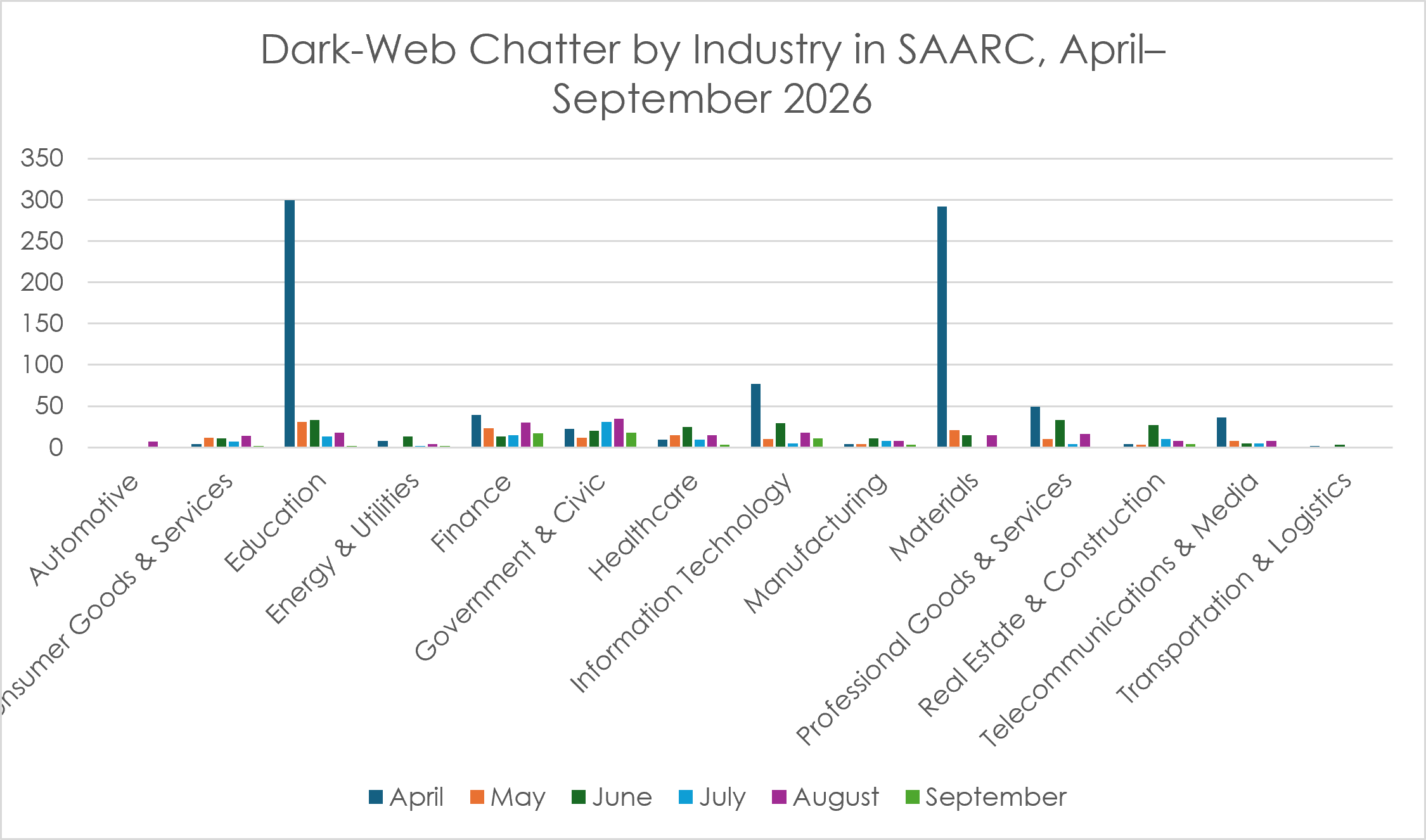
Dark Web Chatter Trends by Industry in SAARC
Dark-web chatter referencing the SAARC Telecommunications & Media sector fell from 36 observations in April to 8 in May, 5 in June and July, 8 in August and 0 in September — 62 observations across the period, or 3.9% of the 1,605 SAARC observations recorded across all sectors. The decline tracks the broad post-April normalization seen across all SAARC sectors rather than a telecom-specific change: total SAARC chatter fell from 845 observations in April to 64 in September, with the April peak concentrated in Education (299) and Materials (292).
For comparison, Finance (13–39 observations per month) and Government & Civic (12–35) were the most consistently active sectors in the later months, while Information Technology — the sector most closely adjacent to telecom operations — fell from 77 observations in April to 11 in September. Telecom therefore represented a small and declining share of observed SAARC chatter in this period. The absence of observed chatter in September should not be read as an absence of underground interest (see Verification Caveats).
Notable Dark-Web Observations, April–September 2026
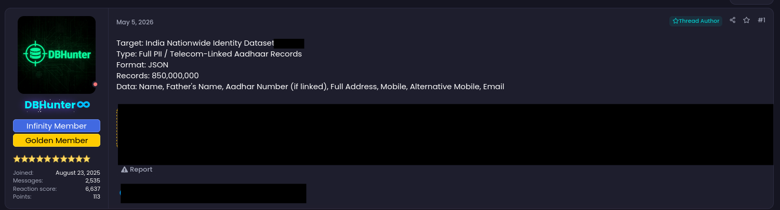
On May 5, 2026, a user of the dark web forum identified as “DBHunter” advertised an alleged nationwide Indian identity dataset reportedly containing approximately 850 million records and totaling 109 GB. The post claimed that the dataset had been obtained from a telecommunications-sector breach and described it as containing telecom-linked identity records in JSON format, including names, fathers’ names, Aadhaar numbers where linked, full residential addresses, mobile and alternative mobile numbers, and email addresses. If authentic, the alleged breach could represent a large-scale exposure of highly sensitive subscriber and identity information across India, with potential implications for identity theft, fraud, and targeted social engineering. The claimed telecom origin, authenticity, provenance, uniqueness, completeness, and actual volume of the dataset could not be independently verified from the forum post alone. Confidence: High that the advertisement was posted as described; the claim itself is unverified.
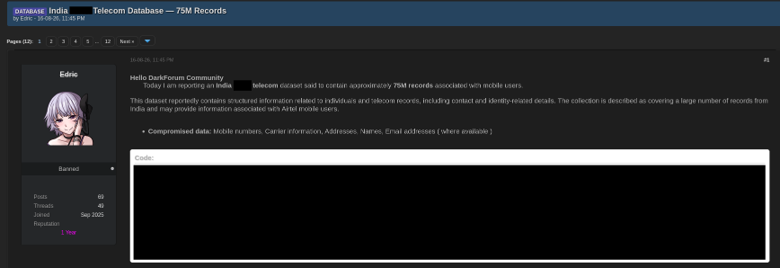
On August 16, 2026, a user of the dark web forum identified as “Edric” advertised an alleged database containing approximately 75 million records associated with a major Indian telecommunications provider. According to the post, the dataset reportedly included mobile numbers, carrier information, names, addresses, and email addresses where available, with samples appearing to reference subscribers across multiple Indian states, including Andhra Pradesh and Delhi. The seller also provided a Telegram contact for prospective buyers and promoted additional database offerings. If authentic, the alleged dataset would represent a substantial exposure of telecom subscriber information and personally identifiable data. The authenticity, provenance, completeness, and claimed volume of the dataset could not be independently verified from the forum post alone. Confidence: High that the advertisement was posted as described; the claim itself is unverified.
On September 14, 2026, a user of the dark web forum identified as “Decoded_Trojans” replied to an earlier discussion concerning the availability of an alleged Indian telecommunications-related database and another Indian dataset, stating that they possessed both and inviting interested parties to contact them. The discussion originated from an April 5, 2026 request by another forum user seeking the two datasets, followed by a June 16 response from a separate user claiming to possess the telecommunications-related database while seeking the other dataset. The September response indicates continued interest and alleged availability of the datasets within the underground forum ecosystem. However, the post does not provide sufficient evidence to establish the authenticity, provenance, contents, or actual possession of the claimed databases. Confidence: High that the reply was posted as described; possession of the datasets is unverified.
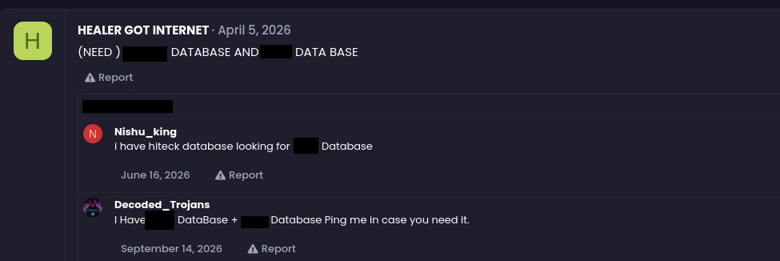
The relationship between these three sellers and the datasets they advertised has not been independently established, and no conclusion regarding common origin is drawn from the similarity of the advertised content.
Key Dark-Web Findings
No network or host indicators of compromise arise from the material reviewed in this assessment. Customer-specific indicators, exposed credentials, and attack-surface findings are available to CYFIRMA customers through DeCYFIR.Implications for the Indian & SAARC Telecom Sector
The dark-web observations reviewed during April–September 2026 indicate that telecom-related subscriber data, credentials, databases, and potential system access can have continued underground value. While the observed claims cannot uniformly be treated as confirmed compromises, they highlight several areas of risk for telecom operators across the SAARC region.
Overall, the observations support continued prioritization of credential protection, privileged-access monitoring, exposure management, third-party risk monitoring, subscriber-data protection, and correlation of underground intelligence with internal security telemetry across SAARC telecom environments.
Nation-state activity remains a relevant threat to the SAARC telecommunications sector because telecom networks provide access to communications infrastructure, authentication systems, subscriber information, signaling environments, and network-management platforms. The current threat environment indicates a shift toward persistent access, credential compromise, exploitation of network infrastructure, and long-term positioning rather than disruption alone.
APT Actors to Monitor
| Threat Actor | Telecom Relevance (Confidence) | Primary Behaviors to Monitor |
| UNC3886 | High — Confidence: High | Network-device compromise, exploitation of exposed infrastructure, credential theft, persistence within network environments, and long-term access |
| Salt Typhoon | High — Confidence: High | Compromise of telecom/network infrastructure, router and network-device targeting, credential theft, traffic and configuration collection, persistent access |
| APT41 | High — Confidence: Moderate | Spear-phishing, exploitation of internet-facing systems, credential theft, web shells, malware deployment and post-compromise movement |
| APT5 | High — Confidence: Moderate | Telecom and technology targeting, network-device compromise, credential/keylogging activity, and manipulation of network-appliance software |
| APT31 | Moderate–High — Confidence: Moderate | Spear-phishing, exploitation of vulnerabilities, credential theft and intelligence collection against telecommunications and technology environments |
| Lazarus Group | Moderate — Confidence: Low | Credential theft, social engineering, malware delivery, exploitation and financially motivated activity that can affect telecom-adjacent enterprise environments |
UNC3886 should receive particular attention in telecom-focused monitoring because public reporting in 2026 has documented a targeted campaign against telecommunications environments and highlighted its capability to operate within telecom infrastructure.
Salt Typhoon and related China-linked activity remain important monitoring priorities because joint government cybersecurity reporting has documented targeting of telecommunications and internet-service-provider infrastructure, including backbone, provider-edge, and customer-edge routers. Reported techniques include modifying network devices to maintain persistent access and using compromised infrastructure to pivot into other networks.
APT41 and APT5 remain relevant because of their established telecommunications targeting profiles. Current threat-intelligence references identify APT41 as having targeted telecommunications and high-technology organizations, while APT5 has a particularly strong historical focus on telecommunications, technology companies, satellite communications, and networking equipment.
Key Behaviors for Telecom Threat Hunting
Rather than monitoring actor names alone, telecom security teams should hunt for the following behaviors (MITRE ATT&CK technique references in brackets):
Assessment
The principal APT concern for SAARC telecom operators is persistent access to network and management infrastructure rather than conventional endpoint compromise alone. Recent telecom threat reporting highlights the possibility of long-term positioning inside core network environments, including routing, signaling, authentication, and subscriber-management layers. Confidence: Moderate — based on public reporting of actor capability and intent; no SAARC-specific APT activity was observed in this period.
Accordingly, monitoring should combine actor intelligence, tactics, techniques, and procedures (TTP)-based detection, network-device telemetry, privileged-account monitoring, configuration integrity, vulnerability management, and third-party access monitoring.
The actors listed above should be treated as watchlist priorities, not as evidence that each actor is currently operating against a SAARC telecom operator.
Total Reported Ransomware Victims in SAARC, April–September 2026
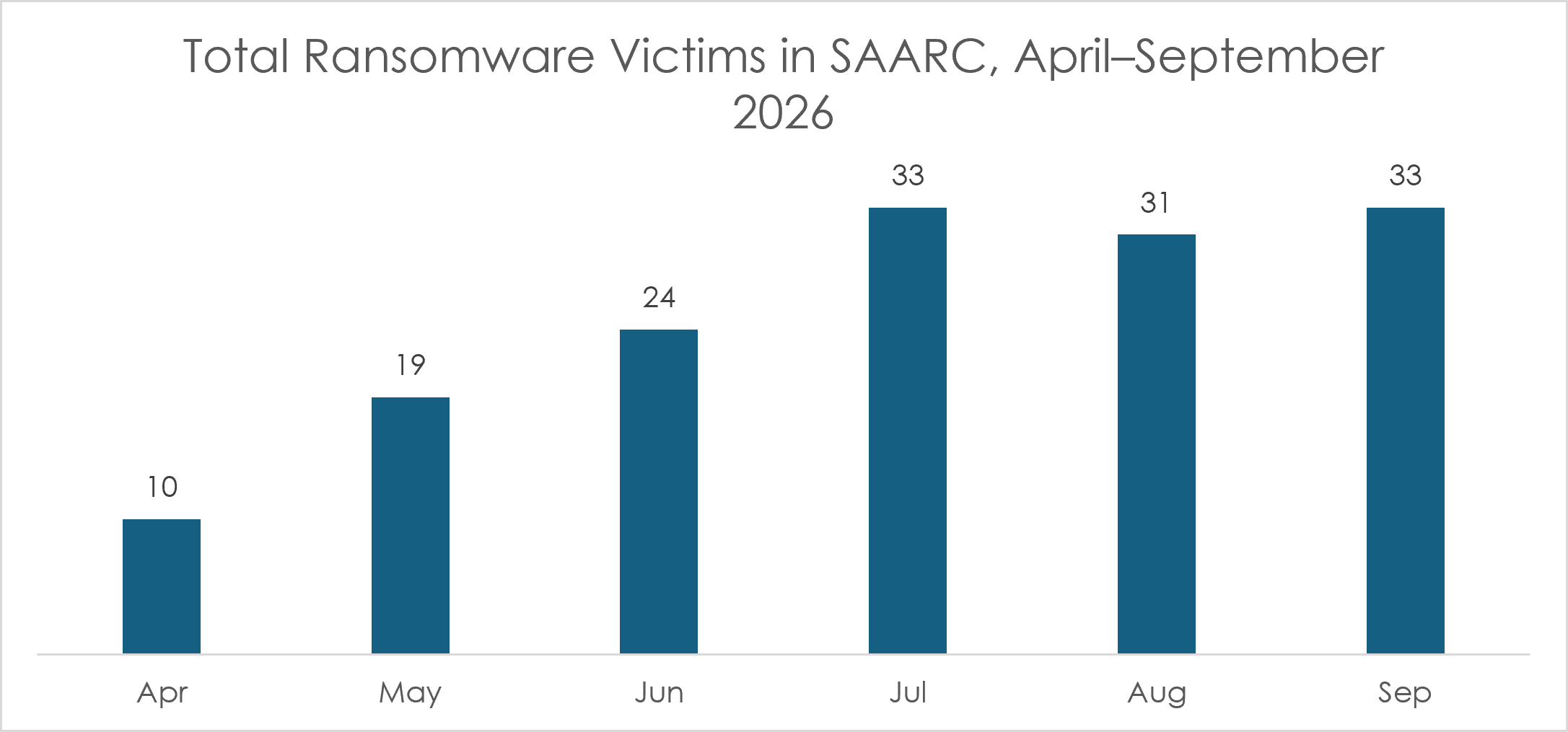
The number of ransomware victims in SAARC showed a clear upward trend from April to September 2026, despite a slight decline in August. The number of victims increased from 10 in April to 19 in May and then to 24 in June, followed by a further rise to 33 in July. In August, the figure decreased slightly to 31 victims before reaching 33 again in September. Overall, 150 ransomware victims were recorded during the six-month period, with an average of 25 victims per month. Compared with April, the number of victims in September was 230% higher, indicating a substantial increase in ransomware incidents over the period. The repeated high figures in July and September suggest that ransomware activity remained elevated toward the end of the observed period.
Leading Ransomware Groups Targeting SAARC
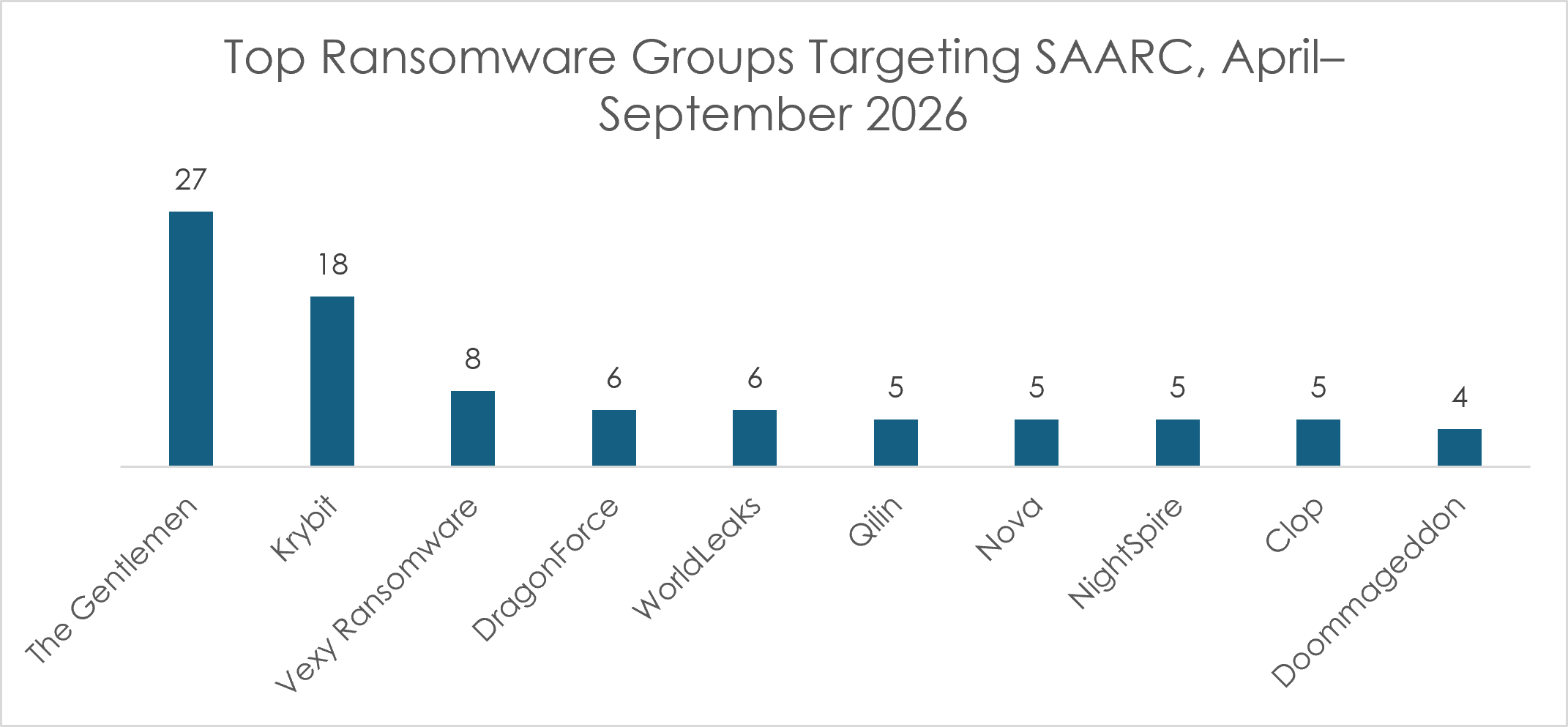
From April to September 2026, 46 ransomware groups were observed targeting organizations across SAARC, with The Gentlemen accounting for the highest number of reported victims at 27, followed by Krybit with 18. Vexy Ransomware recorded 8 victims, while DragonForce and WorldLeaks each accounted for 6. Qilin, Nova, NightSpire, and Clop were each associated with 5 victims, and Doommageddon recorded 4. The distribution shows that a relatively small number of groups accounted for a substantial share of the reported ransomware activity, with The Gentlemen and Krybit together responsible for 45 of the 89 victims represented in the table. This indicates that ransomware activity in SAARC during the period was concentrated among a few prominent groups, while several other groups contributed smaller but still notable numbers of incidents.
Industry Targeting: SAARC vs Global
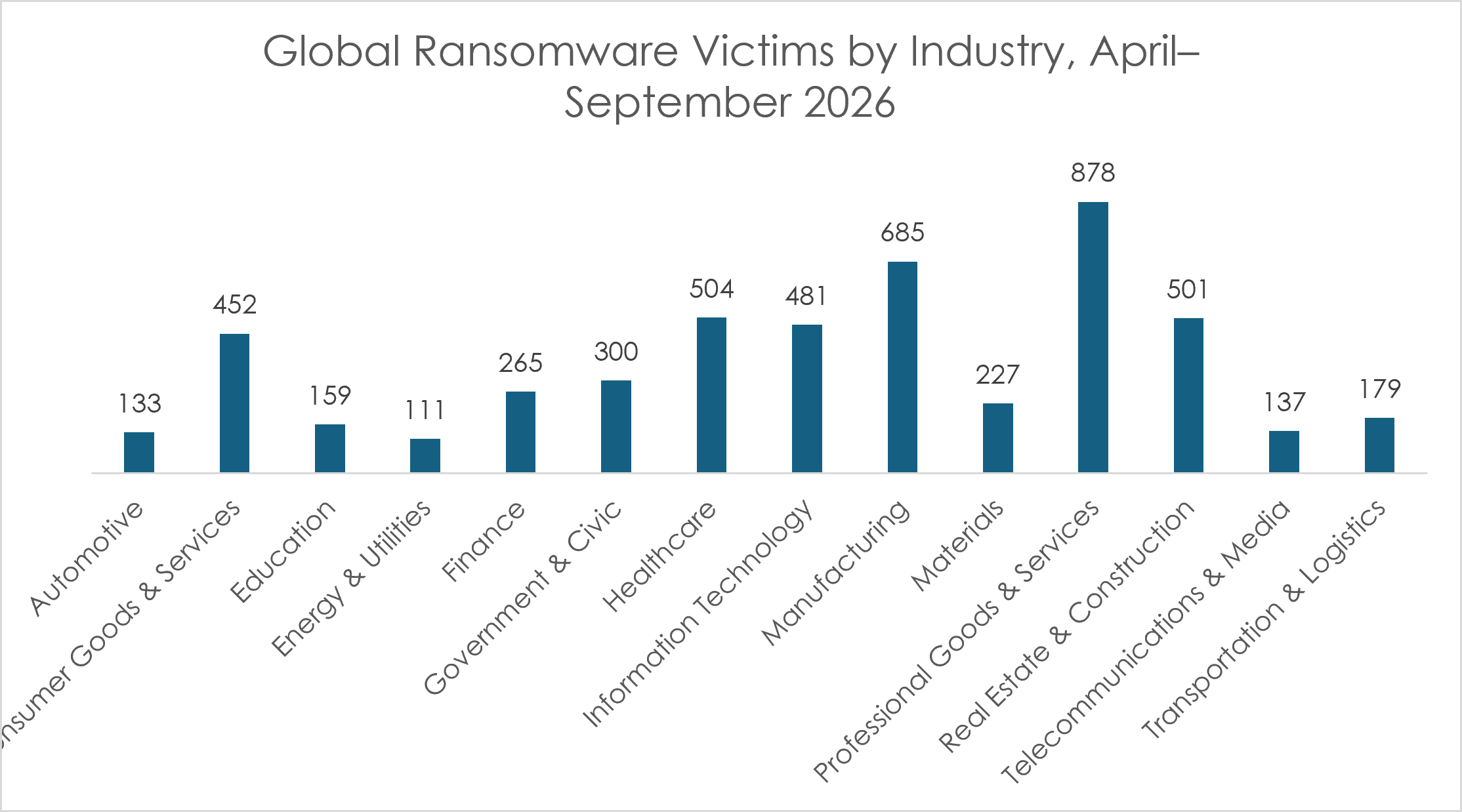
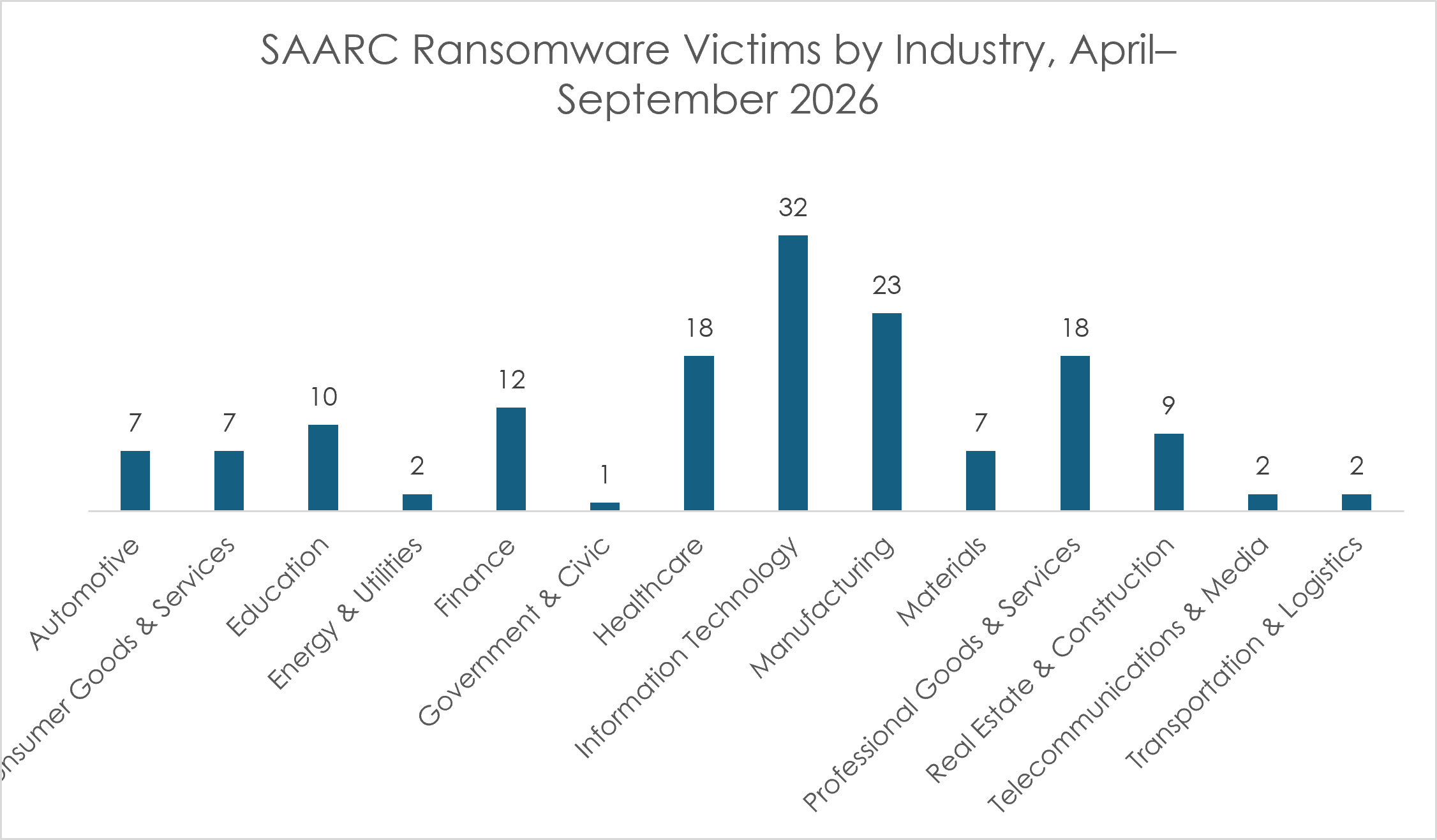
Globally, ransomware targeting during April–September 2026 was broadly distributed across multiple industries, with Professional Goods & Services recording the highest number of victims at 878, followed by Manufacturing (685), Healthcare (504), Real Estate & Construction (501), and Information Technology (481). Consumer Goods & Services (452) and Government & Civic (300) also represented substantial portions of the global victim pool.
This distribution suggests that ransomware activity was not concentrated in a single sector globally, but instead affected organizations with valuable operational data, business-critical systems, and potentially significant disruption costs. At the lower end, Automotive (133), Telecommunications & Media (137), Energy & Utilities (111), and Transportation & Logistics (179) recorded comparatively fewer victims. Overall, the global pattern shows a wide sectoral spread, with professional services and manufacturing standing out as the largest categories.
In SAARC, the distribution was considerably more concentrated, with Information Technology accounting for 32 victims, the highest of any sector and substantially ahead of Manufacturing (23). Healthcare and Professional Goods & Services each recorded 18 victims, followed by Finance (12), Education (10), and Real Estate & Construction (9). Automotive, Consumer Goods & Services, and Materials each recorded 7 victims, while Energy & Utilities, Telecommunications & Media, and Transportation & Logistics each had only 2, and Government & Civic had 1.
Compared with the global pattern, SAARC therefore shows a stronger concentration in IT and manufacturing, while sectors that dominate the global totals—particularly Professional Goods & Services—have a smaller absolute footprint in the regional dataset. Taken together, the figures indicate that ransomware targeting in SAARC during the period was more concentrated in technology-intensive and production-related sectors, whereas global activity was distributed more extensively across professional services, manufacturing, healthcare, construction, and IT.
The two SAARC Telecommunications & Media listings in the period were Tikona Infinet (India), listed by thegentlemen, and ratnasagar.com (India), listed by L Group. Tikona Infinet is categorized as an Internet Service Provider (ISP), while ratnasagar.com is categorized as a Digital Media & Content Platform. The available records do not expose the listing dates in the source extract and therefore no month is assigned here. Leak-site listings represent attacker claims and should not automatically be interpreted as independently confirmed compromises.
From a lessons-learned perspective, the available victim records do not disclose the initial-access vector. Accordingly, the two listings should not be used to attribute exploitation, credential compromise, phishing, or another specific intrusion technique without corroborating evidence from the relevant ransomware group, the affected organization, or independent incident reporting.
Ransomware activity remains a material threat to telecommunications because operators combine highly connected enterprise environments with sensitive subscriber information and business-critical network-support systems. The 2026 telecom security landscape continues to identify software vulnerabilities, weak cyber hygiene, supply-chain exposure, and pre-positioning as important attack themes.
For the SAARC telecom environment, ransomware risk should therefore be assessed beyond the encryption of conventional IT endpoints. Compromise of supporting systems, privileged accounts, cloud environments, customer-management platforms or third-party infrastructure may enable data theft, operational disruption and subsequent extortion.
Ransomware Tactics and Initial Access
The principal ransomware pathways relevant to telecom environments include:
Recent regional public reporting also indicates continued growth of ransomware and digital-extortion activity across Asia-Pacific, with ransomware-as-a-service models lowering the barrier for criminal groups to conduct attacks. Recent regional public reporting also indicates elevated ransomware and digital-extortion activity across Asia-Pacific. Group-IB’s APAC Threat Landscape Report, August 2026, recorded 190 ransomware events in the region during August 2026, a 26.7% increase from July, while CYFIRMA’s August 2026 ransomware reporting characterizes the broader ransomware ecosystem as resilient and service-driven, with RaaS operations continuing to support large-scale criminal activity.
Telecom-Specific Impact
A successful ransomware intrusion against a telecom environment could affect:
| Exposure area | Potential impact |
| Customer-management systems | Subscriber-data exposure and service disruption |
| Enterprise IT systems | Business-process interruption |
| Network-management systems | Potential operational disruption |
| Authentication infrastructure | Account and access compromise |
| Cloud and virtualized platforms | Large-scale service or data impact |
| Third-party systems | Indirect compromise of telecom operations |
| Corporate data repositories | Data theft and extortion |
| Backup infrastructure | Reduced recovery capability |
The potential consequences therefore extend beyond data encryption and may include service degradation, customer-data exposure, operational disruption, regulatory consequences, and prolonged recovery requirements.
Ransomware Risk Assessment
The current assessment indicates that ransomware should be treated as both a data-extortion and operational-resilience threat for SAARC telecommunications. Confidence: High for the victim counts (CYFIRMA leak-site monitoring); Moderate for the telecom-specific risk judgement.
Particular attention should be given to internet-facing systems, privileged accounts, remote-access infrastructure, backup environments, third-party connections and systems supporting customer and network operations.
The presence of a ransomware listing or claimed victimization should not automatically be interpreted as a confirmed compromise. Underground claims and leak-site listings require correlation with technical evidence before being classified as confirmed incidents.
Key Takeaways
| Vulnerability | CVSS | Vendor | Product | Reported Exploitation by Threat Actors (public reporting) |
| CVE-2024-12847 | 9.8 | Netgear | Netgear DGN1000 | None attributed in the reporting reviewed |
| CVE-2018-10562 | 9.8 | Dasan | Dasan GPON Home Router | None attributed in the reporting reviewed |
| CVE-2016-10372 | 9.8 | Zyxel | Eir D1000 | None attributed in the reporting reviewed |
| CVE-2014-8361 | 9.8 | Realtek | Realtek SDK | None attributed in the reporting reviewed |
| CVE-2015-2051 | 8.8 | D-Link | D-Link and TRENDnet SOHO routers/access points, including DIR/DAP and TEW series models. | None attributed in the reporting reviewed |
| CVE-2025-34036 | 9.8 | Shenzhen TVT | CCTV-DVR (rebranded by multiple vendors) | None attributed in the reporting reviewed |
| CVE-2017-17215 | 8.8 | Huawei | Huawei Home Gateway HG532 | Exploited by IceFog |
| CVE-2025-34043 | 10 | Vacron | Network Video Recorder (NVR) | Exploited by Lucky Cat, TeamTNT and GCMAN |
| CVE-2016-6277 | 8.8 | Netgear | NETGEAR R/D Series Routers | None attributed in the reporting reviewed |
| CVE-2026-23760 | 9.8 | SmarterTools | SmarterMail | Exploited by Storm-2603 |
| CVE-2025-34037 | 10 | Linksys | Linksys E-Series | None attributed in the reporting reviewed |
| CVE-2021-27691 | 9.8 | Tenda | Tenda G0/G1/G3 | None attributed in the reporting reviewed |
| CVE-2023-20198 | 10 | Cisco | Cisco IOS XE | Exploited by APT6, Salt Typhoon and Harvester |
| CVE-2026-1281 | 9.8 | Ivanti | Endpoint Manager Mobile (EPMM), formerly MobileIron Core | Exploited by APT34, GCMAN, Prince of Persia and RedCurl |
| CVE-2025-55182 | 10 | Meta | React Server Components | Exploited by Ashen Lepsus, ShadowEarth053 and Earth Lamia |
Source = Decyfir + OSINT
The vulnerabilities presented in this table represent selected high-severity weaknesses associated with systems and products observed in the SAARC threat environment. The list includes vulnerabilities affecting SOHO and enterprise routers and home gateways, surveillance devices (DVR/NVR), a mail server (SmarterMail), an enterprise network operating system (Cisco IOS XE), a mobile-device management platform (Ivanti EPMM), and a web application framework (React Server Components). Exploitation attributions are drawn from public reporting.
Vulnerability Exploitation Assessment
The vulnerabilities identified in the preceding table represent potential attack paths across network appliances, routers, security gateways, management platforms, and other technologies that may form part of or support telecom environments. Their presence in threat intelligence or exploitation reporting does not by itself establish exploitation within a SAARC telecom network.
The primary concern is the combination of high-severity vulnerabilities, internet exposure, delayed patching, and privileged access. Vulnerabilities affecting externally reachable network and management infrastructure can provide attackers with an initial foothold that may subsequently enable credential theft, persistence, lateral movement, or access to supporting telecom systems.
Key Exploitation Patterns
Telecom Risk Considerations
For SAARC telecom operators, vulnerability management should prioritize assets according to exploitability and business impact, rather than CVSS severity alone. Internet-facing assets, privileged management interfaces, network infrastructure, authentication systems, and systems supporting customer or operational functions should receive the highest scrutiny.
Particular attention should be given to:
Assessment
The vulnerability landscape indicates that rapid identification and remediation of externally exposed high-risk assets is more important than maintaining a vulnerability inventory alone. Security teams should correlate vulnerability intelligence with asset exposure, exploit availability, authentication logs, configuration changes, and network telemetry to determine whether a vulnerable system has actually been targeted. Confidence: Low that any listed vulnerability has been exploited against a SAARC telecom network specifically; exploitation activity is drawn from public reporting.
Where immediate patching is not possible, compensating controls should include restricting external access, disabling unnecessary services, enforcing strong administrative authentication, monitoring for exploitation attempts, and increasing logging around affected systems.
Telecom operators face a combination of external, credential-based, application, and supply-chain attack vectors. The principal risks identified for the assessment period are:
| Attack Vector | Data / Assets at Risk | Potential Impact |
| Exploitation of internet-facing systems | Network infrastructure, credentials, configurations | Initial access and persistence |
| Credential theft / phishing | Employee, administrator and customer credentials | Account takeover and lateral movement |
| Malware / remote-access tools | Endpoints, enterprise systems, sensitive files | Data theft and operational disruption |
| Web application/API exploitation | Customer and service databases | Data exposure and unauthorized access |
| Supply-chain compromise | Vendor systems and privileged connections | Indirect access to telecom environments |
| Ransomware / data extortion | Corporate and customer data, critical systems | Service disruption and data leakage |
| Network-device exploitation | Routers, gateways and management platforms | Network compromise and traffic manipulation |
| Social engineering / telecom fraud | Subscriber identity and authentication data | Fraud, impersonation and account takeover |
Key Assessment
The most sensitive assets include subscriber personally identifiable information (PII), authentication credentials, call-related metadata, network configurations, customer-management data, corporate credentials, and operational information. Attack paths that combine credential compromise with access to network or management infrastructure present the potential for broader impact than isolated endpoint compromise. Priority defensive measures should therefore focus on internet-facing exposure management, privileged-account protection, MFA, network-device monitoring, API security, third-party access controls, and rapid remediation of actively exploited vulnerabilities.
The SAARC telecom threat landscape is expected to evolve as networks adopt 5G, cloud-native infrastructure, APIs, virtualization, automation, and software-defined network functions. The outlook below identifies the threat vectors that should receive priority monitoring during the next reporting period, based on the activity, attack surfaces, and technology trends identified in this assessment. These are forward-looking risk assessments and should not be interpreted as predictions of confirmed incidents.
| Emerging Threat | Telecom Risk |
| 5G / cloud-native exploitation | Compromise of virtualized network functions, APIs and orchestration platforms |
| AI-assisted attacks | Faster phishing, reconnaissance, social engineering and malware development |
| Network-device persistence | Long-term compromise of routers, gateways and management infrastructure |
| API and identity abuse | Account takeover, unauthorized service access and data exposure |
| Supply-chain compromise | Indirect access through vendors, managed services and software dependencies |
| IoT / connected-device exploitation | Large-scale device compromise and use as an entry point or botnet |
| Signaling-layer attacks | Abuse of SS7, Diameter, SIP and GTP environments for interception, fraud or disruption |
| Cloud credential compromise | Unauthorized access to telecom applications, data and administrative consoles |
NEXT-QUARTER PRIORITIES
Based on the threat activity and technology trends identified in this assessment, the following areas should receive priority monitoring during the next reporting period:
The April–September 2026 assessment indicates that the SAARC telecommunications sector remains exposed to a broad and evolving cyber-threat environment spanning vulnerability exploitation, credential compromise, ransomware, data exposure, supply-chain compromise, network-device targeting, and persistent APT activity.
The assessment of dark-web activity identified continued underground interest in telecom-related information, including subscriber data, databases, credentials, and potential system access. These observations provide useful early-warning indicators; however, underground advertisements, database-sale claims, and leak-site postings should not automatically be interpreted as confirmed compromises. Independent technical evidence remains necessary to establish the authenticity, scope, and impact of an alleged incident.
Vulnerability exploitation represents another significant area of concern. Internet-facing network appliances, management platforms, remote-access infrastructure, applications, and supporting technologies can provide attackers with an initial foothold. The risk increases where vulnerable assets are externally exposed, difficult to patch, poorly monitored, or connected to privileged operational environments.
Ransomware presents a broader resilience challenge because the impact can extend beyond conventional endpoint encryption. Data theft, extortion, compromise of enterprise systems, disruption of supporting services, and abuse of third-party access can affect telecom operations even when core network availability is maintained.
The APT environment also requires continued attention. Recent telecom-focused threat reporting demonstrates that sophisticated actors can pursue persistent access to network infrastructure, management systems, authentication environments, and other critical control layers. For telecom operators, the key concern is therefore not only malware detection but the identification of long-term unauthorized access, credential abuse, configuration manipulation, and anomalous activity within network infrastructure.
The continued adoption of 5G, cloud-native platforms, virtualization, APIs, software-defined networking, automation, and third-party managed services further expands the attack surface. Security controls that focus exclusively on traditional endpoints and perimeter infrastructure may therefore leave important parts of the telecom environment insufficiently monitored.
Overall, the assessment supports a security approach based on continuous exposure management, strong identity controls, network-device visibility, rapid vulnerability remediation, third-party risk management, resilient recovery capabilities, and intelligence-led monitoring. Dark-web intelligence, vulnerability intelligence, APT indicators, and internal security telemetry should be correlated to distinguish emerging threats from confirmed security incidents.
The findings should be interpreted within the limitations of the available collection period and intelligence visibility. The absence of an observed underground claim or publicly reported incident does not establish the absence of compromise, while the presence of a claim does not independently establish that a compromise occurred.
Review all externally accessible routers, VPNs, firewalls, network-management interfaces, web applications, APIs, cloud interfaces, and third-party access points. Remove unnecessary exposure and restrict administrative interfaces to trusted networks.
Prioritize vulnerabilities based on active exploitation, internet exposure, asset criticality, available privileges, public exploit code, and legacy systems. Where patching is delayed, use isolation, access restrictions, hardening, and enhanced monitoring.
Review privileged accounts and enforce MFA, remove dormant accounts, reduce excessive privileges, rotate exposed credentials, monitor administrative activity, and separate admin accounts from normal user accounts.
Monitor routers, switches, firewalls, gateways, and management platforms for unexpected configuration changes, new accounts, unauthorized firmware changes, unusual connections, routing changes, and abnormal administrative activity.
Ensure critical systems have protected and recoverable backups. Test backup restoration, recovery objectives, backup isolation, and protection against unauthorized deletion or encryption. Conduct scenario-based ransomware exercises.
Correlate dark-web and credential intelligence with corporate and privileged accounts. Reset exposed credentials, revoke sessions and tokens, review authentication activity, and investigate suspicious mailbox, application, or third-party access.
Review vendor, contractor, and managed-service access to telecom environments. Verify business justification, privileges, MFA, access duration, source locations, logging, and account ownership. Remove inactive or unnecessary access.
