
LANDSCAPE · SECTOR LENS
1 July to 30 September 2026, compared with Q2 2026
2026 to date through 31 October · issued 11 November 2026
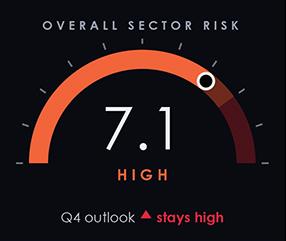
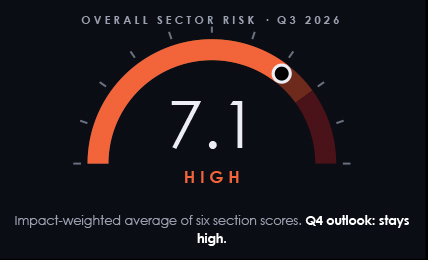
Q3 IN NUMBERS
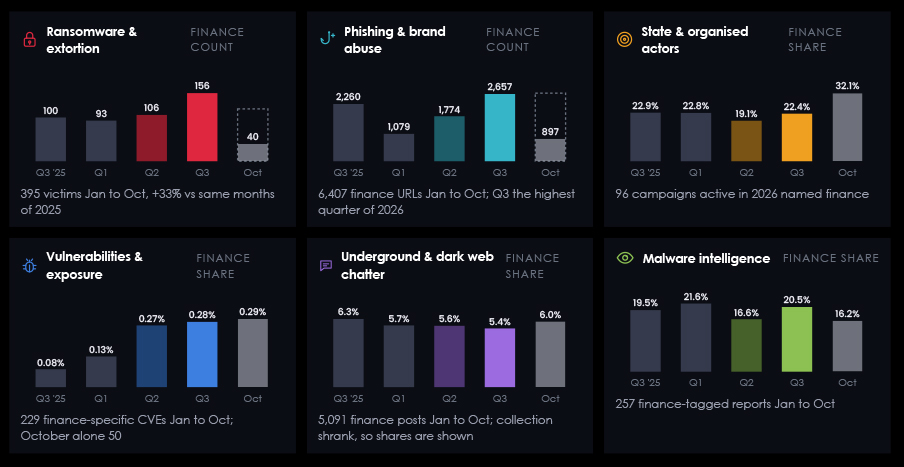
Each panel shows the same measure for Q3 2025, the first three quarters of 2026 and October. Counts are used where collection was steady; shares of the whole dataset are used where collection changed (state actor reporting, CVE volumes, underground and research feeds). The dashed outline on October shows the quarter it would make at the same pace.
THE YEAR IN ONE PARAGRAPH
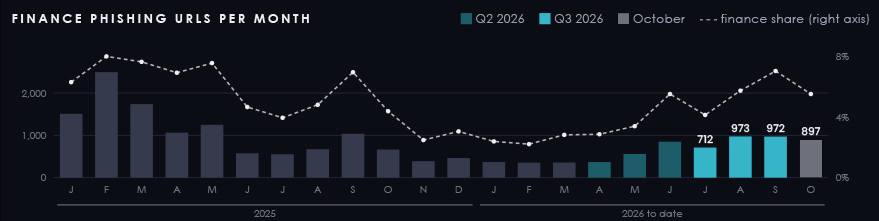
2026 built steadily toward a third-quarter peak. Ransomware against finance rose every quarter (93, 106, 156) and is already +33% ahead of the same months of 2025. Finance phishing grew from 1,079 in Q1 to 2,657 in Q3, carried by cryptocurrency wallet lures. Finance-specific vulnerabilities climbed from 20 to 104, and October (50) suggests Q4 will be higher still.
WHAT OCTOBER TELLS US ABOUT Q4
October finance ransomware victims ran −23% below the Q3 monthly pace while all-sector victims hit a record. Finance’s share of active state-actor campaigns rose to 32%, phishing held its Q3 pace (897), and the finance share of underground posts edged up to 6.0%. Only malware research turned down (16% from 20%).
WHAT HAPPENED
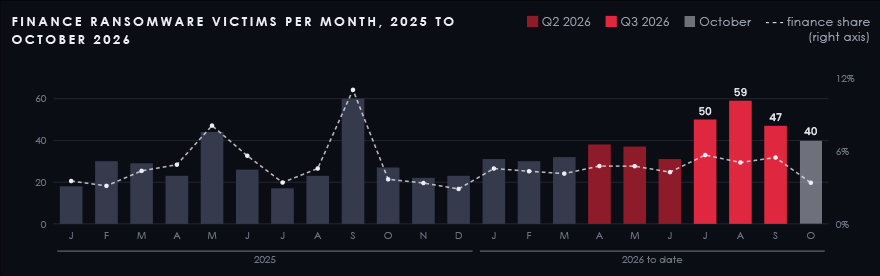
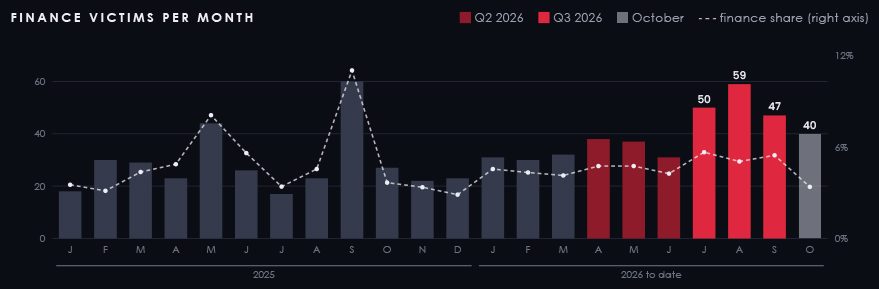
Ransomware groups named 156 finance organisations on leak sites in Q3, up from 106 in Q2 and the highest quarter in our records. Every month of Q3 (50, 59, 47) beat every month of 2025 except September 2025.
Finance did not just ride the wider increase. All victims rose +26%; finance rose +47%, so its share climbed from 4.6% to 5.3%.
The quarter was driven by new and small groups: 50 different groups hit finance (37 in Q2), and 40% of victims came from groups that first posted after 1 April.
OCTOBER SIGNAL
October posted 40 finance victims, below the Q3 pace of 52 a month, while all-sector victims hit a record 1,184. Finance share fell to 3.4%. The exception is Qilin: 12 finance victims in October, double its previous 2026 monthly high (6).
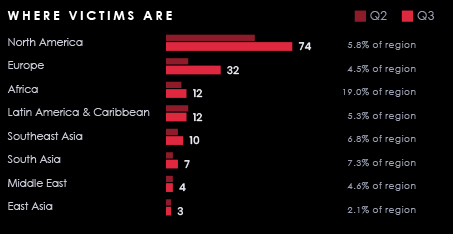
Right: finance share of each region’s Q3 victims (worldwide 5.3%). Europe more than doubled (13 to 32); the United States alone accounts for 68 of 156. Africa stands out: finance is 19% of its victims (12 of 63, small numbers).
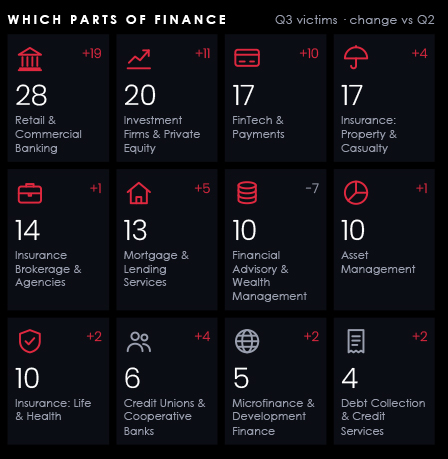
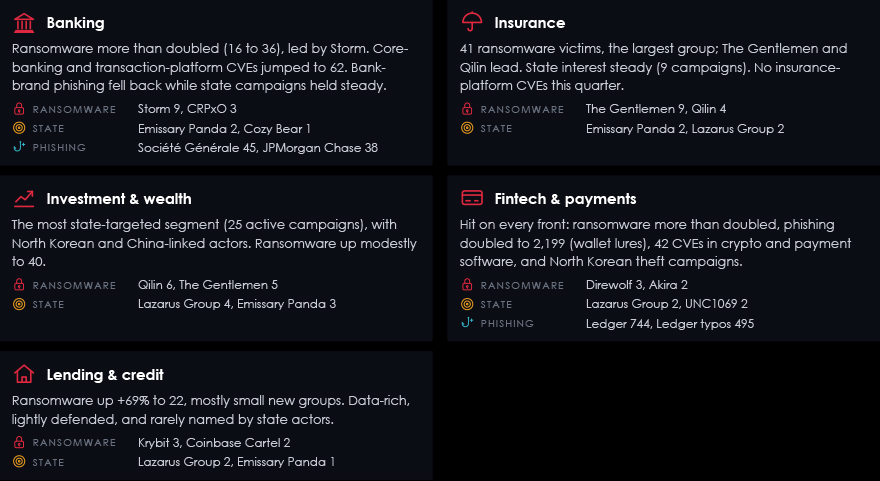
Banks moved to the front. Retail and commercial banks: 28 victims in Q3, three times Q2 (9). Fintech and payments more than doubled.
FINANCE SPECIALISTS
groups where finance is at least twice the worldwide share (5.3%) of their Q3 victims

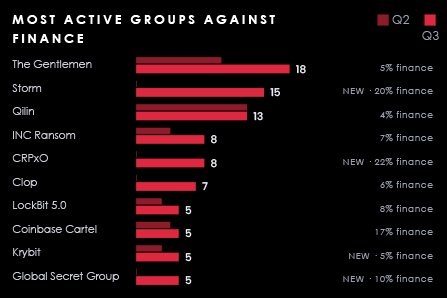
Right: share of the group’s own Q3 victims that are finance. NEW = first leak-site post after 1 April 2026.
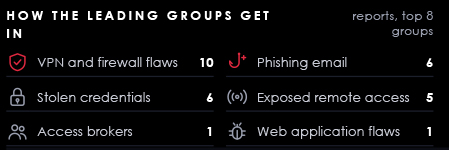
KNOWN EXPLOITED FLAWS REPORTED FOR THESE GROUPS
| CVE | PRODUCT (CISA KEV) | GROUP | LAST REPORTED |
|---|---|---|---|
| CVE-2026-50751 | Check Point Security Gateway | Qilin | 2026-10 |
| CVE-2024-55591 | Fortinet FortiOS and FortiProxy | Qilin, The Gentlemen | 2026-05 |
| CVE-2023-27532 | Veeam Backup & Replication | Qilin, The Gentlemen | 2026-03 |
| CVE-2025-32463 | Sudo | The Gentlemen | 2026-03 |
| CVE-2024-37085 | VMware ESXi | The Gentlemen | 2026-03 |
| CVE-2024-21762 | Fortinet FortiOS | Qilin | 2025-09 |
Qilin was reported in October using a Check Point Security Gateway flaw (CVE-2026-50751, added to KEV with known ransomware use). Qilin is a ransomware-as-a-service group; the North Korean group Moonstone Sleet has been reported using it, which does not make Qilin itself state-run.
▲
Q4 2026 OUTLOOK
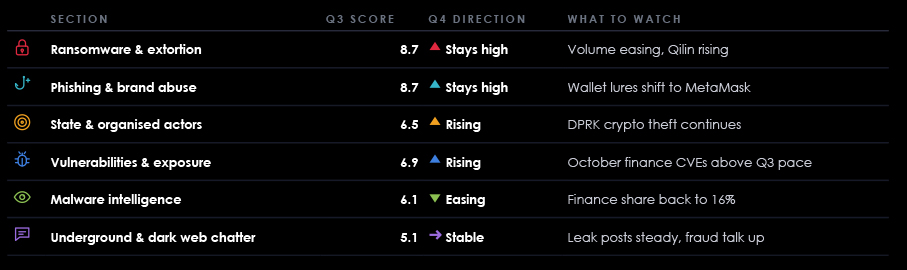
STAYS HIGH
Volume easing, Qilin rising
If October’s pace holds, Q4 ends near 120 finance victims: below Q3 but above every 2025 quarter. Two things could push it back up: Qilin’s October surge, and the steady flow of new groups, four of which (Storm, CRPxO, Global Secret Group, Wallstreet) put finance well above average in their target mix.
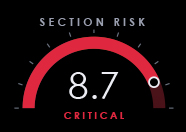
Risk score 8.7 = 35% momentum (finance leak-site victims, Q3 vs Q2 +47%, scored 8.8) + 35% level (Q3 vs the Q1 to Q2 average, 1.57x, scored 8.4) + 30% impact weight (9 of 10). Measured as a count. Victims are organisations named on leak sites, dated by post date (not attack date), from CYFIRMA’s curated ransomware log; Q3 classification confidence: 93 high, 59 medium, 4 low.
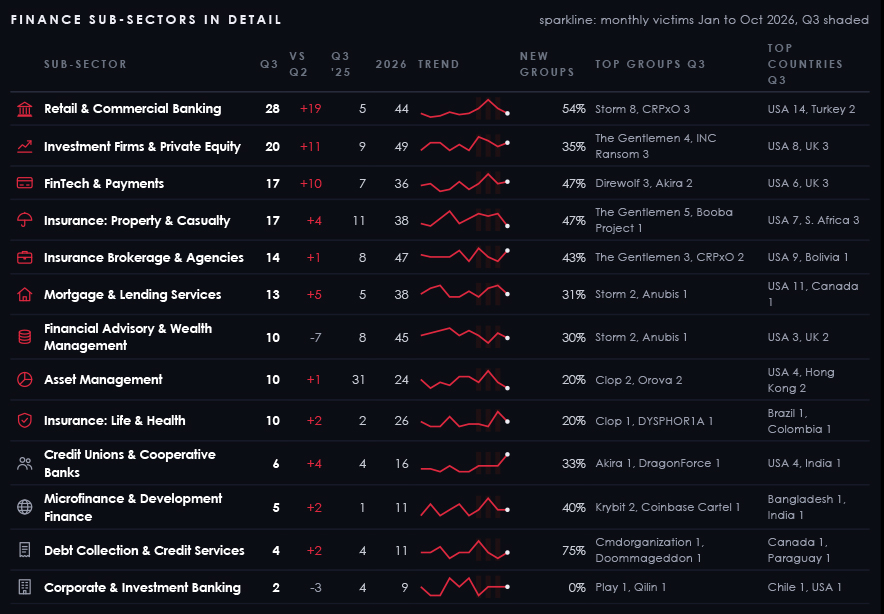
New groups = share of the sub-sector’s Q3 victims posted by groups first seen after 1 April 2026. 2026 = January to October. Sub-sector counts under 10 are indicative only.
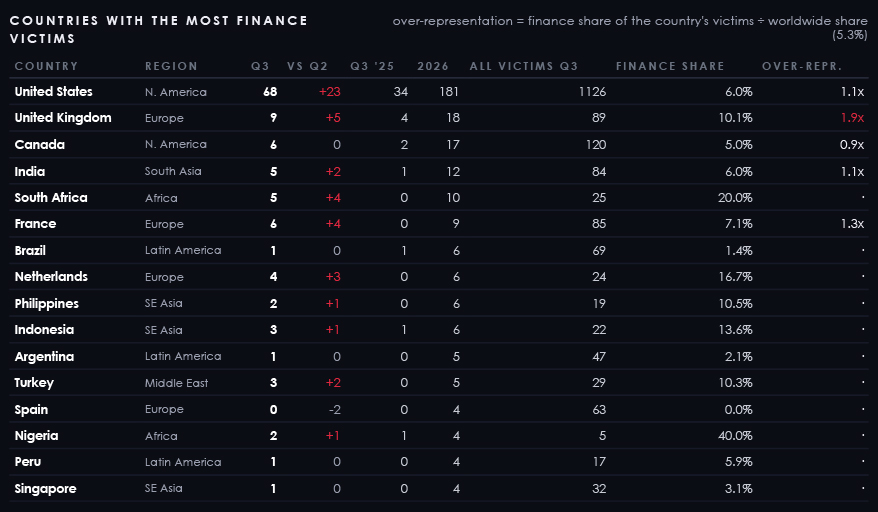
Over-representation shown only where a country posted at least 30 victims of all sectors and 3 finance victims in Q3. Above 1.5x (red) finance is hit noticeably more often than elsewhere.
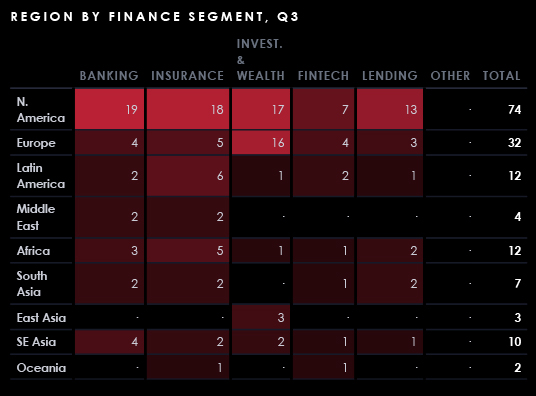
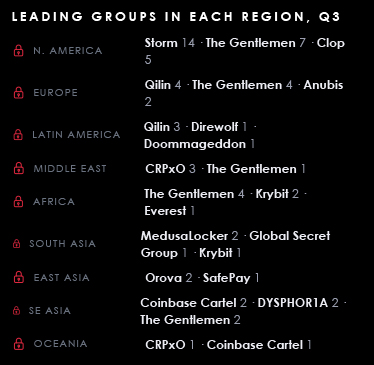
The United States had 68 of 156 finance victims (44%), close to its share of all victims, so finance is not singled out there. The concentration is in the groups: Storm and CRPxO hit North American banks, while Europe saw a broader spread of groups.
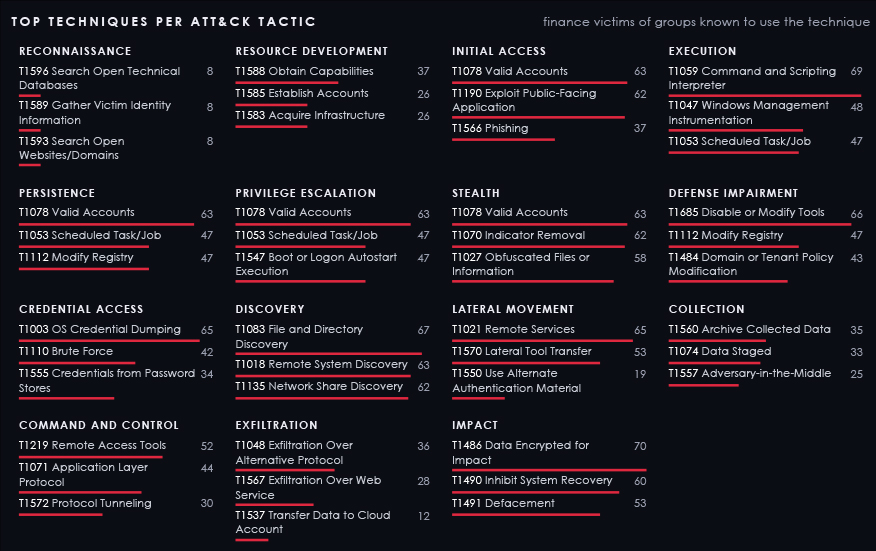
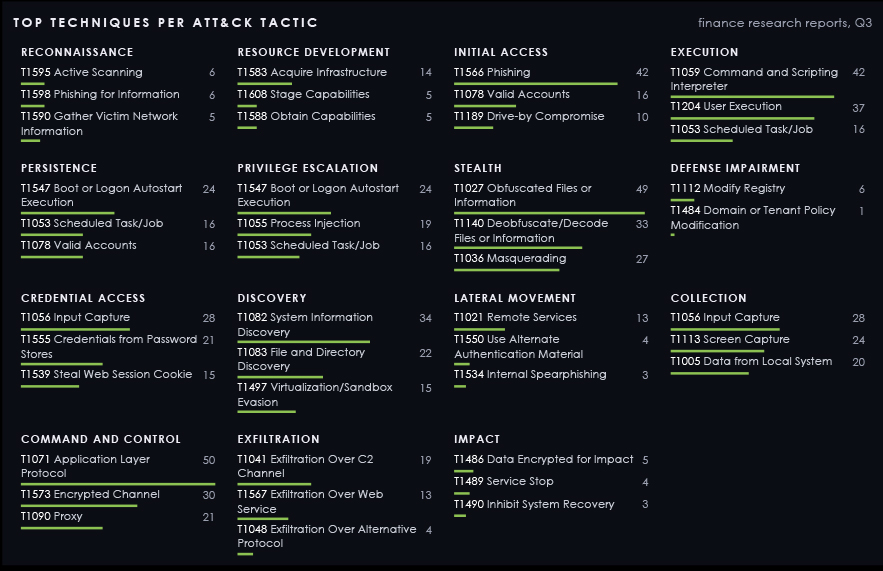
Techniques, tools and access methods reported for the groups that hit finance in Q3, weighted by each group’s finance victims. Profiles cover 14 of 50 groups (71 of 156 victims, 46%); most small new groups have none yet.
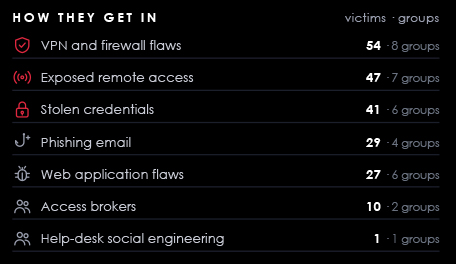
finance victims of groups using the tool
What the pattern says. Data encryption (T1486) and backup deletion (T1490) appear for almost every profiled group, and ESXi tools (esxcli, vmkfstools) for the groups behind 32 finance victims. Remote-access software (AnyDesk) and PsExec are the most common ways to move once inside.
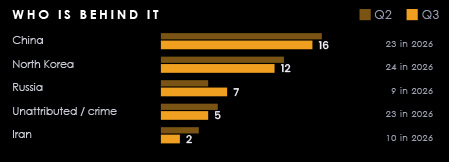
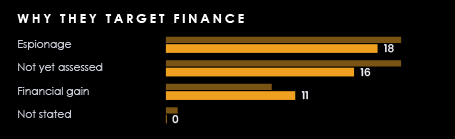
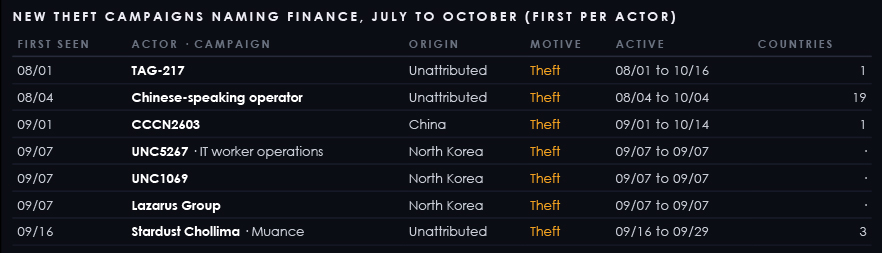
North Korea’s September theft cluster. Four reports in one week described UNC1069 (CryptoCore), Jade Sleet and IT-worker schemes against crypto and fintech firms, while Lazarus’ Binance heist activity ran from June to October.
▲
Q4 2026 OUTLOOK
STAYS HIGH
DPRK crypto theft continues
Finance was named in 32% of campaigns active in October, the highest share this year. Expect North Korean theft against exchanges, wallets and fintech payroll (IT-worker fraud) to continue, and China-linked espionage to keep targeting banks in Asia, North America and Europe. Totals for recent months will rise as late reports arrive.
Risk score 6.5 = 35% momentum (finance share of active campaigns, Q3 vs Q2 +17%, scored 6.4) + 35% level (Q3 vs the Q1 to Q2 average, 1.07x, scored 5.4) + 30% impact weight (8 of 10). Measured as a share. Campaigns count when active in the quarter. APT reporting is delayed by nature, so recent counts are incomplete; shares are compared. 67% of Q3 finance campaigns come from CYFIRMA early-warning collection.
COUNTRIES NAMED IN FINANCE CAMPAIGNS
Q3 · vs Q2 · 2026
| COUNTRY | REGION | Q3 | VS Q2 | 2026 |
|---|---|---|---|---|
| United States | N. America | 31 | -4 | 51 |
| Japan | East Asia | 27 | -2 | 36 |
| United Kingdom | Europe | 21 | -1 | 25 |
| South Korea | East Asia | 20 | -1 | 32 |
| India | South Asia | 20 | -3 | 28 |
| Australia | Oceania | 17 | -2 | 21 |
| Thailand | SE Asia | 14 | -1 | 20 |
| Taiwan | East Asia | 14 | -1 | 20 |
| Saudi Arabia | Middle East | 9 | 0 | 19 |
| Singapore | SE Asia | 9 | -3 | 15 |
| Germany | Europe | 9 | -2 | 11 |
| Vietnam | SE Asia | 8 | 0 | 12 |
| Indonesia | SE Asia | 7 | 0 | 11 |
| Malaysia | SE Asia | 7 | +1 | 9 |
| United Arab Emirates | Middle East | 6 | +1 | 14 |
MOST ACTIVE ACTORS AGAINST FINANCE IN 2026
| Actor | Origin | Q3 | 2026 | Motive |
|---|---|---|---|---|
| Lazarus Group | North Korea | 7 | 12 | Theft, Unassessed |
| Winnti Group | China | 3 | 3 | Unassessed |
| Emissary Panda | China | 3 | 3 | Espionage |
| UNC5267 | North Korea | 2 | 4 | Theft |
| Stone Panda | China | 2 | 4 | Espionage |
| UNC1069 | North Korea | 2 | 3 | Theft |
| Cozy Bear | Russia | 2 | 2 | Espionage |
| APT43 | North Korea | 1 | 2 | Unassessed, Espionage |
| Stardust Chollima | n/a | 1 | 2 | Theft |
| UNC1549 | Iran | 1 | 2 | Espionage |
| Mustang Panda | China | 1 | 2 | Espionage |
| Earth Estries | China | 1 | 2 | Unassessed, Espionage |
Campaigns active in the period. Lazarus Group alone ran 12 finance campaigns in 2026, the most of any actor.
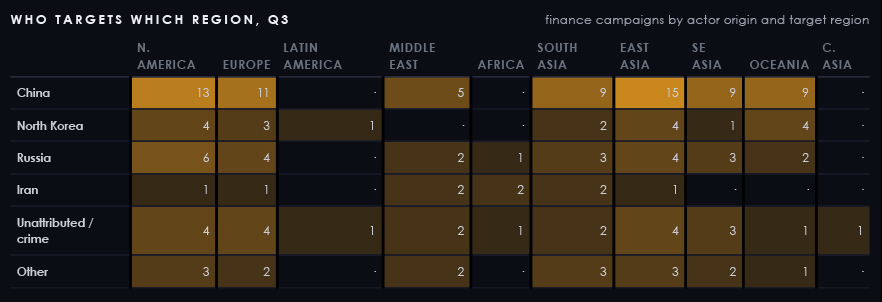
China-linked actors focus on East and Southeast Asia and North America; North Korean actors reach every region because crypto and fintech targets are global. A campaign that names several regions counts once in each.
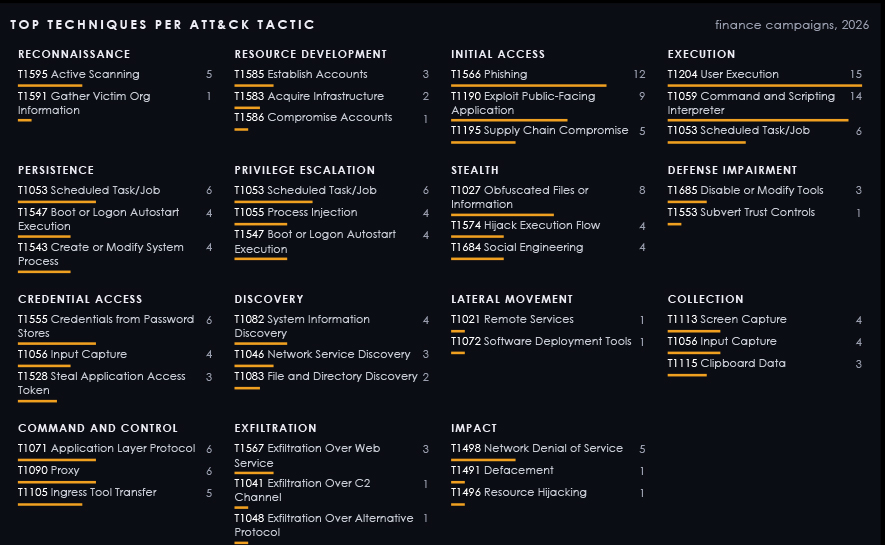
Techniques reported for finance campaigns active in 2026 (40 of 96 campaigns have technique detail). Counts are campaigns using the technique.
MALWARE AND TOOLS IN FINANCE CAMPAIGNS
campaigns, 2026
AI as an attack tool. The open-source ARTEX attack agent appears in 6 finance campaigns, and commercial AI services are named as tooling in 9 more mentions. TAG217 used ARTEX against South Korean banks.
LIVING-OFF-THE-LAND BINARIES
campaigns, 2026
macOS utilities (osascript, softwareupdate, sysctl) point to North Korean campaigns against crypto and fintech developers, who mostly work on Macs. Windows entries (Certutil, Msedge, DLL hijacks) belong to Chinalinked espionage.
WHAT TO HUNT FOR
WHO THE LURES COPY
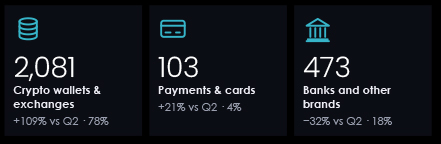
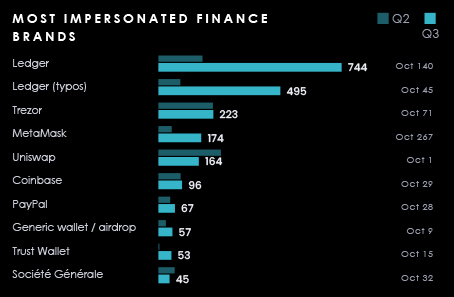
Crypto brands made up 78% of finance phishing in Q3. Hardware-wallet lures (Ledger, Trezor) target recovery phrases, which give attackers irreversible access to funds. US bank lures rose (Chase, Bank of America, Wells Fargo); Brazilian ones fell back. In October, MetaMask lures (267) already exceeded its whole Q3 total (174).
Target country follows the brand’s home market, so France (Ledger) leads with 1,306 URLs
▲
Q4 2026 OUTLOOK
STAYS HIGH
Wallet lures shift to MetaMask
Expect wallet and exchange lures to stay dominant, with attackers rotating brands (Ledger in Q3, MetaMask in October). Volumes from November include two new phishing feeds, so Q4 counts will rise partly from collection; compare shares.
WHAT TO DO NOW
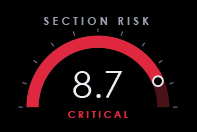
Risk score 8.7 = 35% momentum (finance phishing URLs, Q3 vs Q2 +50%, scored 9.0) + 35% level (Q3 vs the Q1 to Q2 average, 1.86x, scored 10.0) + 30% impact weight (7 of 10). Measured as a count. URLs from public phishing feeds classified by brand and sector; about 70% of all phishing URLs carry no brand, so finance counts are a lower bound.
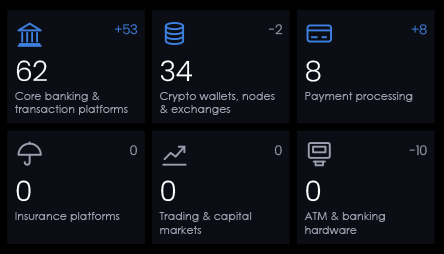
WHAT KIND OF FINANCE TECHNOLOGY
Q3 · vs Q2
PRODUCTS WITH THE MOST NEW FINANCE CVES
Jul to Oct
| Product | CVEs | Crit/High | Max CVSS |
|---|---|---|---|
| Financial Transaction Manager (FTM) for RedHat OpenShift | 46 | 31 | 9.9 |
| Zebra (Zcash node) | 32 | 10 | 9.3 |
| Klever blockchain (klever-go) | 17 | 15 | 9.6 |
| Vyper smart-contract language | 13 | 2 | 8.6 |
| Apache Fineract | 5 | 5 | 9.8 |
| CoinEx crypto exchange app | 4 | 0 | 5.3 |
| OpenVM | 3 | 2 | 8.7 |
WHAT IT MEANS
The jump is concentrated: IBM Financial Transaction Manager (the platform many banks use to run payment and SWIFT message flows) received 46 CVEs, 31 of them critical or high. Apache Fineract, an open-source core-banking system used by microfinance and digital lenders, had five critical or high flaws. Oracle banking modules (origination, trade finance, lending) also appear.
Crypto infrastructure is the second cluster: Zcash’s Zebra node, Klever and the Vyper smart-contract language. October added 50 finance CVEs, 45 of them in crypto wallets and exchanges.
EXPLOITED FLAWS ADDED TO KEV
Jul to Oct, by vendor
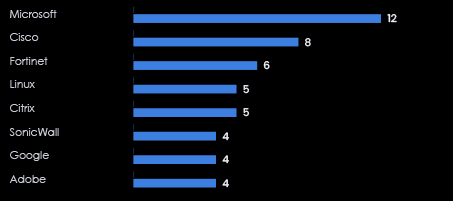
Microsoft, Cisco, Fortinet and Citrix lead. Finance runs all four at its perimeter; only one KEV entry so far is finance-specific software.
| Product | KEV Added | Exposed Instances | Countries | Ransomware Use |
|---|---|---|---|---|
| MikroTik RouterOS ×3 | 09/10 | 134,438 | 193 | |
| WordPress Core ×3 | 07/21 | 91,718 | 100 | |
| Microsoft SharePoint ×7 | 04/14 | 17,910 | 92 | Known |
| cPanel & WHM | 04/30 | 9,671 | 32 | Known |
| ConnectWise ScreenConnect ×2 | 04/28 | 7,961 | 38 | Known |
| JetBrains TeamCity ×2 | 04/20 | 4,235 | 37 | Known |
| Gitea | 08/25 | 3,680 | 71 |
Internet hosts whose software version carries the flaw, counted once per product (largest of its flaws); version-based, so some may already be mitigated. MikroTik routers and WordPress sites dominate: both are common in small lenders, brokers and fintech marketing estates.
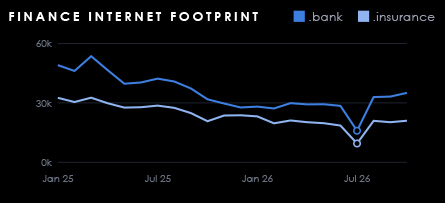
Hosts seen per month. Hollow dots mark July 2026, a collection gap. The .bank footprint grew from 28.6k (June) to 35.2k (October).
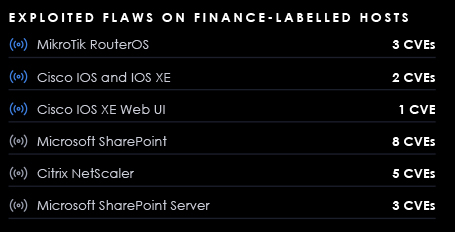
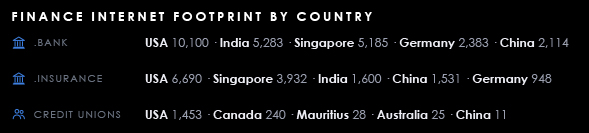
Single snapshot (2026-11-08). Hosts whose organisation or domain identifies a bank, insurer or credit union. Exposure counts are per vulnerability and can repeat for one machine.
▲
Q4 2026 OUTLOOK
RISING
October finance CVEs above Q3 pace
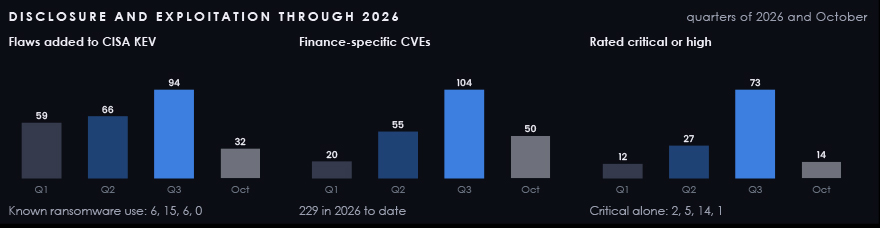
October’s 50 finance CVEs, 32 new KEV entries and the Black October disclosure wave (PHP2Shell, Ivanti, AhsayCBS) point to a busier Q4. 55 exploited products are visible on internet hosts today, led by routers, web servers and content platforms that smaller finance firms run, so the risk is shifting to newly disclosed flaws in gateways, collaboration servers and AI or web frameworks that finance adopted quickly.
WHAT TO DO NOW
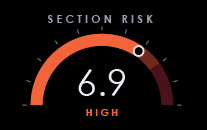
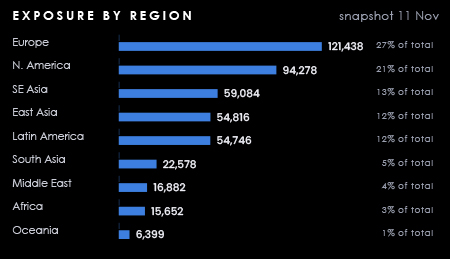
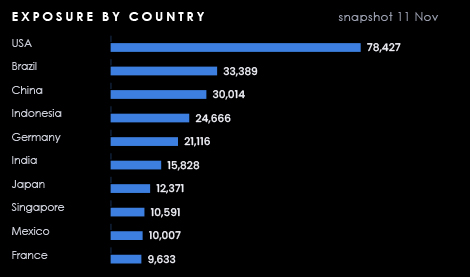
Risk score 6.9 = 35% momentum (finance share of new CVEs, Q3 vs Q2 +6%, scored 5.5) + 35% level (Q3 vs the Q1 to Q2 average, 1.42x, scored 7.5) + 30% impact weight (8 of 10). Measured as a share. Finance CVEs: high- or medium-confidence finance tag. Exposure figures are one snapshot of internet hosts whose software version carries a KEV-listed flaw (CYFIRMA internet exposure monitoring), counted once per product; aggregate counts only, never IP addresses.
PRODUCTS DRIVING IT
| Product | Flaws | Exposed | Countries |
|---|---|---|---|
| PHP (PHP-CGI flaw) | 1 | 154,251 | 182 |
| MikroTik RouterOS | 3 | 134,413 | 193 |
| WordPress Core | 2 | 91,574 | 113 |
| MongoDB Server | 1 | 37,172 | 100 |
| Microsoft SharePoint | 11 | 18,032 | 92 |
| Cisco IOS and IOS XE | 2 | 3,409 | 105 |
Finance-relevant = flaws used by ransomware groups that hit finance this year, or seen on finance-labelled hosts. One count per product and country (largest of its flaws), by software version. PHP, MikroTik routers and WordPress make up most of it.
WEAKNESS TYPES IN NEW KEV ENTRIES
Jul to Oct

WHY IT MATTERS FOR FINANCE
PHP runs most of the web, including bank marketing sites, customer portals, WordPress and Magento storefronts and payment plugins. Two AI-assisted teams found the flaws in August; the fix took over two months, the embargo broke early, and public exploit code appeared on 18 October, three days before disclosure.
29 underground posts (20 to 29 Oct), none naming finance; beyond software version tags there is no measurement of PHP2Shell exposure yet. On finance hosts, 53 of 352 .bank hosts running PHP carry a PHP2Shell version tag (an upper bound), and Ivanti or Pulse VPN portals sit on 74 insurernamed hosts (52 in the US).
BLACK OCTOBER INCIDENTS THAT TOUCH FINANCE
Incidents as reported in CYFIRMA Threat Horizon, 3 November 2026.
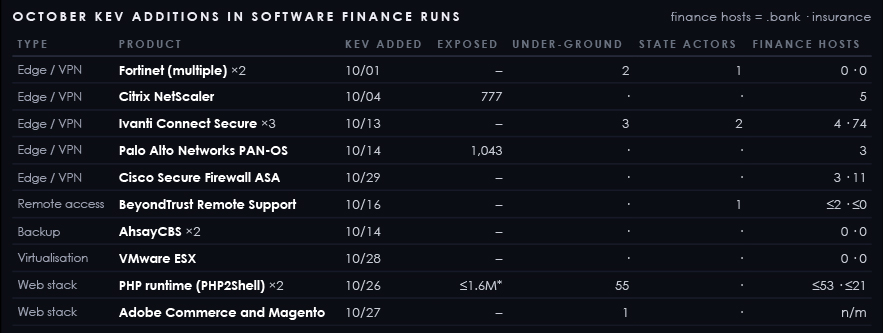
Exposure: internet hosts whose software version carries the flaw, snapshot 8 Nov. * version-banner match, upper bound. –: not tagged. Finance hosts (10 to 11 Nov): hosts running the product on .bank or insurance domains or insurer-named hosts; PHP figures are upper bounds; 0 = none found; single numbers come from the 8 Nov snapshot.
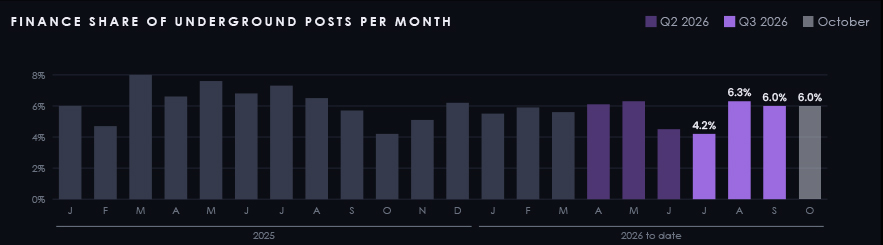
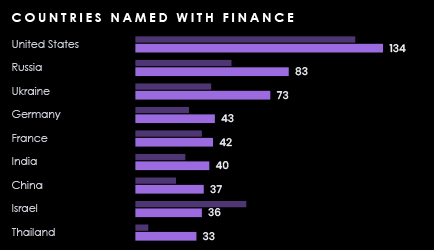
Russia (+60%) and Ukraine rose with war-related hacktivist and fraud chatter; Thailand jumped from 7 to 33; Israel fell back after a Q2 spike.
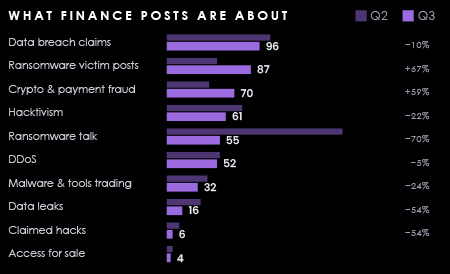
Reading the decline correctly. The number of monitored channels discussing finance fell from 82 to 59 (all channels 168 to 117), so raw totals understate activity. Finance’s share held near 5.5%, and the categories that signal real harm (victim posts, fraud) grew.
→
Q4 2026 OUTLOOK
STABLE
Leak posts steady, fraud talk up
Expect finance share to hold between 5% and 6%, with fraud services (card and crypto cash-out, account takeover kits) and leak posts driving it. Hacktivist DDoS claims track geopolitical events and can spike at short notice.
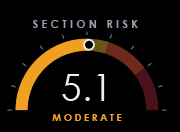
Risk score 5.1 = 35% momentum (finance share of underground posts, Q3 vs Q2 −4%, scored 4.7) + 35% level (Q3 vs the Q1 to Q2 average, 0.95x, scored 4.7) + 30% impact weight (6 of 10). Measured as a share. Chatter volumes reflect collection coverage; shares are compared, not totals. Posts can mention several sectors and countries.
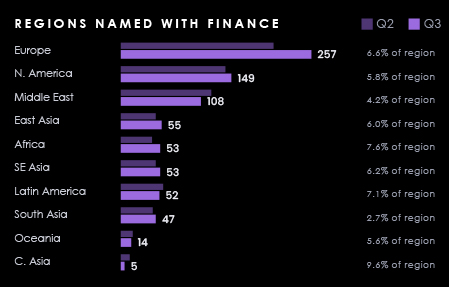
Right: finance share of all posts naming the region. Europe and North America dominate; the Middle East is mostly hacktivist chatter.
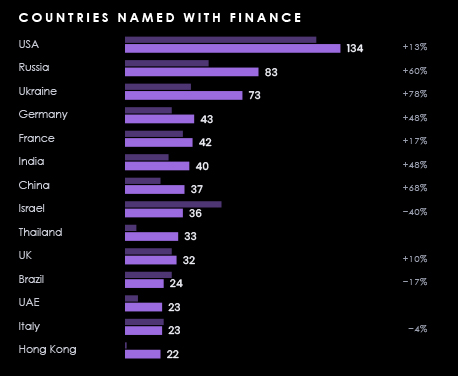
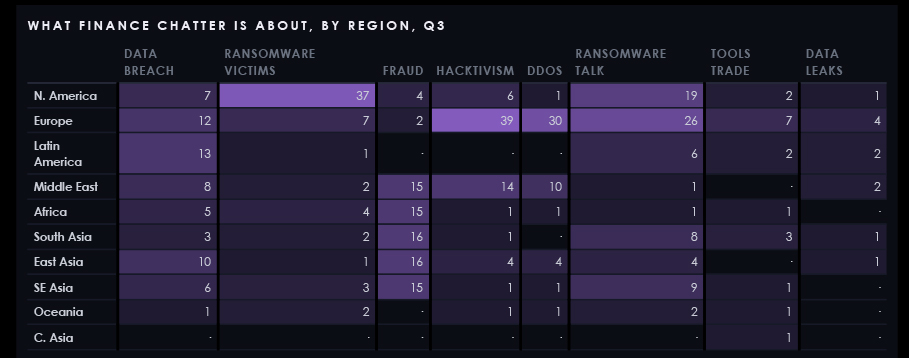
Posts about finance by category and the region they name. Fraud and data-breach claims cluster in North America and Europe; hacktivism and DDoS in the Middle East and South Asia.
VULNERABILITY TALK UNDERGROUND
all sectors
Posts naming CVEs tripled from 157 in Q2 to 502 in Q3 (330 distinct CVEs), and October alone had 223. None named finance directly, but the most discussed flaws sit in software finance runs.
| CVE | Product | Posts |
|---|---|---|
| CVE-2026-109618 | PHP Group PHP | 28 |
| CVE-2026-109619 | PHP Group PHP | 27 |
| CVE-2026-63030 | WordPress Core | 18 |
| CVE-2026-87902 | WordPress Core | 10 |
| CVE-2026-82222 | not in KEV | 9 |
| CVE-2026-32475 | not in KEV | 8 |
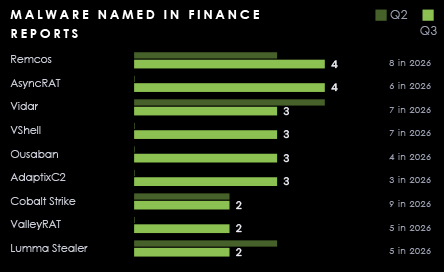
Public research reports tagged finance, by malware named. A report can name several families.
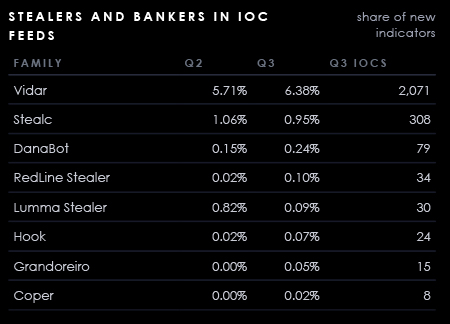
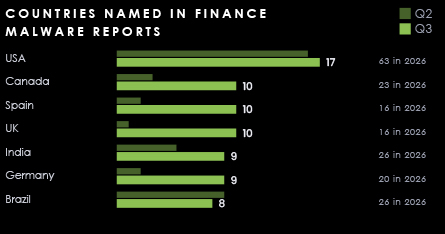
Indicator collection doubled between Q2 and Q3, so shares are compared. Credential stealers feed account takeover and initial access for ransomware.
HOW THE MALWARE WORKS
techniques in Q3 finance reports
Why this matters for finance. Commodity remote-access tools (AsyncRAT, Remcos, XWorm) and stealers (Vidar, Stealc) harvest session cookies and banking credentials; Latin American bankers (Ousaban, Metamorfo, Grandoreiro) and Android bankers (Hook, Coper, ToxicPanda) attack customers directly.
▼
Q4 2026 OUTLOOK
EASING
Finance share back to 16%
Finance’s share of malware reporting eased in October. Expect stealer families to keep rotating after Lumma’s disruption (Vidar and Stealc filled the gap) and Android banking trojans to keep growing in Latin America, Europe and Southeast Asia.
WHAT TO DO NOW
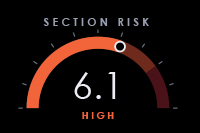
Risk score 6.1 = 35% momentum (finance share of malware reports, Q3 vs Q2 +23%, scored 6.9) + 35% level (Q3 vs the Q1 to Q2 average, 1.07x, scored 5.4) + 30% impact weight (6 of 10). Measured as a share. Research reports are public threat-sharing pulses tagged with the finance sector; IOC figures are new indicators from malware feeds, capped per family and week.
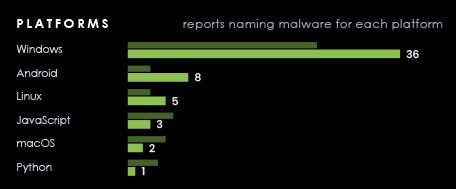
Android banking malware nearly tripled in finance reporting (3 to 8).
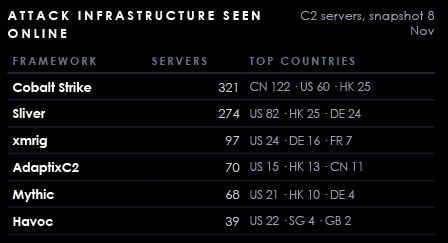
Command-and-control servers identified by banner. AdaptixC2, named in three Q3 finance reports, has 70 live servers.
SHARED WITH STATE ACTORS
actors reported using the family
Families seen in finance reports this quarter that state actors also use, so a hit can mean either crime or espionage.
Finance sub-sectors grouped into five segments, Q3 2026 with the change from Q2. Sub-sector detail exists for ransomware, state campaigns, phishing and CVEs; underground posts and malware reports name the sector but rarely the sub-sector. A campaign or CVE can cover several segments.
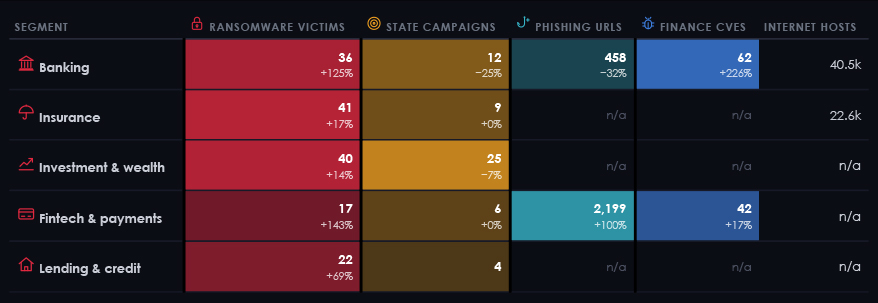
State campaigns: 34 further campaigns name finance without a sub-sector. Phishing sub-sector comes from the impersonated brand (wallets and payment apps count as fintech). Internet hosts: single snapshot, .bank domains and credit union hosts for banking, .insurance domains for insurance.
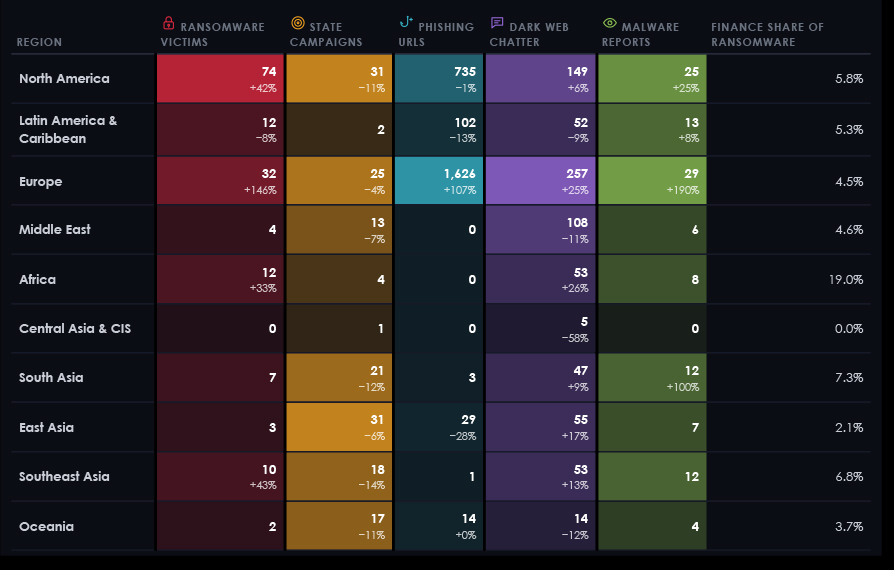
Finance-related activity per region in Q3 2026 across five datasets, with the change from Q2 where the base is large enough. Colour depth is relative within each column. A campaign, post or report can name several regions.
North America
Most ransomware victims (74, +42%) and the most state campaigns naming finance. US megabank lures rose in phishing.
Europe
The fastest ransomware growth (13 to 32). Phishing totals are inflated by French and Czech wallet brands (Ledger, Trezor), which target customers worldwide.
Latin America
Stable ransomware (13 to 12) but persistent bank phishing (Bradesco, Itaú, Banco do Brasil) and home-grown banking trojans.
East and South Asia
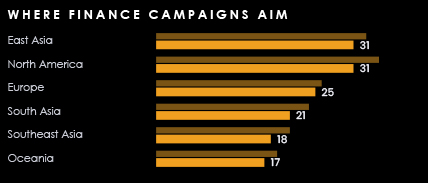
Heavy state-actor focus (31 and 21 active campaigns) from China- and North Korea-linked groups, with fewer leak-site victims than internet size suggests.
Southeast Asia and Oceania
Ransomware up modestly (7 to 10 in Southeast Asia); CYFIRMA early-warning collection shows sustained espionage against regional banks.
Africa and Middle East
Small numbers, but finance is 19% of Africa’s ransomware victims, more than three times the worldwide share.
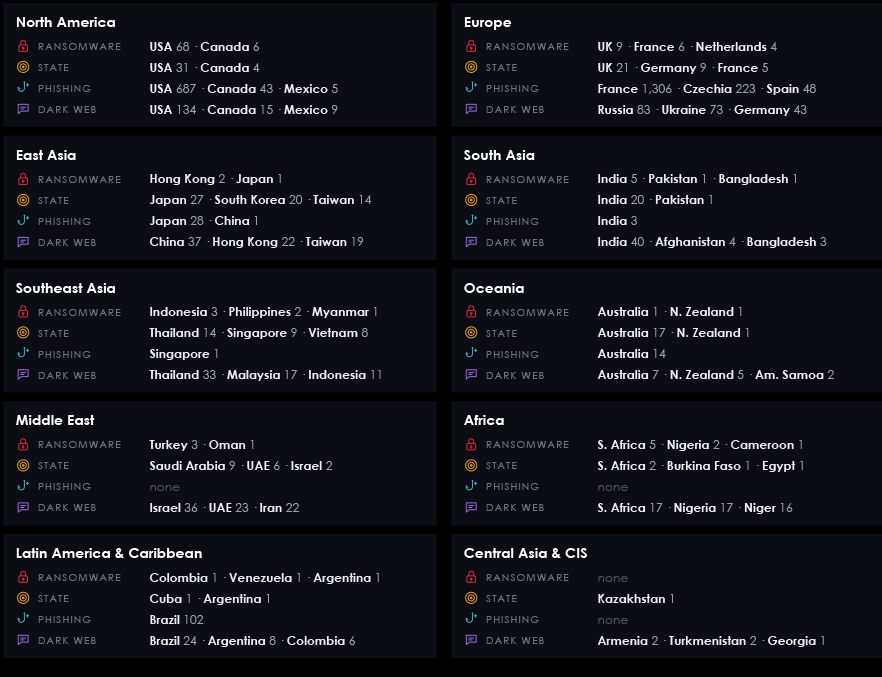
The three countries with the most finance-related activity in each region in Q3 2026: ransomware victims, state campaigns naming the country, phishing URLs by target country and underground posts naming the country with finance.
WHAT STANDS OUT
READ WITH CARE
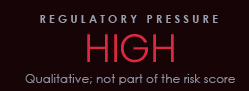
Regulators in Q3 focused less on new cyber rules and more on enforcing resilience: oversight of cloud and technology suppliers, recovery testing and board accountability. Four of them issued warnings about frontier-AI cyber threats in about two months. The EU AI Act is the exception, with high-risk obligations for lenders and insurers pushed back.
27 Jul 2026
EU AI Act Digital Omnibus in force
Regulation (EU) 2026/1744 moves high-risk obligations for Annex III systems, including credit scoring and life and health insurance pricing, to 2 Dec 2027 (product-embedded AI to 2 Aug 2028).
18 Nov 2025 →
DORA: first critical ICT providers under direct oversight
The EBA, EIOPA and ESMA published the first list of critical ICT third-party providers; 2026 is the first full year of direct oversight, with annual review of the list.
13 Jul 2026
UK designates its first critical third parties
HM Treasury named AWS, Google Cloud, Microsoft and Oracle; the Bank of England, PRA and FCA now oversee their services to UK finance.
10 Sep 2026
NYDFS guidance on cyber risk assessments
Explains how Part 500 firms should run and use risk assessments, flagging incomplete asset inventories (cloud, third parties) and weak methods. Follows a 21 May letter on frontier-AI cyber risk.
3 Jun 2026
SEC Regulation S-P: smaller firms now in scope
Incident response programmes and customer breach notification now apply to smaller brokerdealers, advisers, funds and transfer agents (larger firms since 3 Dec 2025).
Pending
CIRCIA final rule still not published
CISA held new town halls in June 2026; until the final rule takes effect, the proposed 72-hour incident and 24-hour ransom-payment reports are not required.
1 Jun 2026
HKMA: all banks met the OR-2 resilience deadline
Every authorised institution reached operational resilience by end-May; on 2 Jun the HKMA warned of AI-empowered attacks and announced a Cyber Resilience Testing Framework.
1 Jan 2026
Hong Kong critical infrastructure law in force
The Protection of Critical Infrastructures (Computer Systems) Ordinance makes cyber duties statutory; a banking and financial services code of practice has been issued.
30 Jul 2026
Japan FSA IT resilience report
Second annual report covering cyber, cloud and operational resilience; on 15 Jun the FSA also asked firms to take short-term measures against frontier-AI threats.
Jun–Jul 2026
MAS consults on tougher technology risk notices
Proposes a 4-hour recovery time objective and at most 4 hours of unplanned downtime a year for critical systems, plus immutable or offline backups. MAS and the banks set up an AI-driven cyber risk taskforce in July.
1 Jul 2026
APRA CPS 230 amendments take effect
Narrow exemption for some non-traditional service providers; pre-existing service provider contracts had to comply by 1 Jul 2026 at the latest.
31 Jul 2026
RBI issues cyber security directions per entity type
Separate directions for commercial, payments and small finance banks, NBFCs, co-operative banks and AIFIs: separate cyber policy, a security operations centre, fast incident reporting.
INCIDENT NOTIFICATION CLOCKS FINANCE MUST MEET
| Regime | Deadline | What |
|---|---|---|
| EU · DORA | 4 hours | initial notice after a major ICT incident is classified (no later than 24 hours from awareness) |
| Singapore · MAS | 1 hour | relevant IT incidents, under the technology risk notice |
| India · CERT-In / RBI | 6 hours | cyber incidents; RBI’s 2026 directions keep the 6-hour clock |
| Hong Kong · CI law | 12 / 48 hours | serious / other incidents at designated critical infrastructure |
| US · bank regulators | 36 hours | notification incidents at banks |
| US · NYDFS Part 500 | 72 hours | cybersecurity incidents; extortion payments within 24 hours |
| Australia · APRA CPS 234 | 72 hours | material information security incidents |
| US · SEC | 4 business days | material incidents of listed companies (Form 8-K) |
| US · CIRCIA | pending | proposed 72 hours, ransom payments 24 hours |
Simplified; scope, triggers and thresholds differ by rule. A multinational bank hit by ransomware may face the 1-hour and 4-hour clocks before it has finished triage.
REGULATORS WARN ABOUT FRONTIER-AI THREATS
21 May 2026
NYDFS
letter on heightened cyber risk from frontier AI models
2 Jun 2026
HKMA
circular on AI-empowered cyber threats; testing framework
15 Jun 2026
Japan FSA
request for short-term measures against frontier-AI threats
Jul 2026
MAS and ABS
AI-driven cyber and technology risk taskforce
Four warnings in about two months, matching what our data shows: AI attack agents (ARTEX) in six finance campaigns, and an AI gateway among the most-attacked exploited flaws.
WHAT THIS MEANS FOR FINANCE CISOS
LINK TO THIS QUARTER’S THREATS
Checked against regulator publications on 11 November 2026: EUR-Lex (Regulation 2026/1744); EBA/ESMA/EIOPA joint press release (18 Nov 2025); HM Treasury and Bank of England (Jul 2026); NYDFS industry letters (21 May, 10 Sep 2026); SEC Regulation S-P small entity compliance guide; CISA CIRCIA page; HKMA circulars (1 and 2 Jun 2026); Hong Kong Government press release (27 Jun 2025); FSA Japan (15 Jun, 30 Jul 2026); MAS consultation paper and media release (2026); APRA CPS 230 (Jul 2026); RBI master directions (31 Jul 2026). Notification clocks reflect the rules as generally applied and should be confirmed for each entity’s scope. Regulation varies by country; a dedicated regulatory tracking dataset is recommended for future editions.
SECTOR OUTLOOK
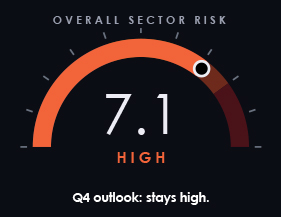
Q4 should stay at a high level of risk, with the mix shifting. Ransomware volume against finance is easing from its Q3 peak but remains above any 2025 quarter, and Qilin is accelerating. Finance’s share of state activity is the highest of the year, driven by North Korean theft. October’s finance CVE count is already half of Q3’s, and new exploited flaws are appearing faster than old ones are patched. Phishing will look higher from November because of new feeds; its real trend is a steady, crypto-heavy plateau.
P1 now · P2 this quarter · P3 next · number = report section
02 · 05
Patch internet-facing gateways and PHP within days
VPN and firewall flaws are the top access route for Qilin and The Gentlemen; October added Ivanti, PAN-OS, Cisco ASA and PHP2Shell, exploited before disclosure.
02
Make backups and hypervisors ransomware proof
Veeam and VMware ESXi flaws recur across the leading groups, and bank victims tripled. Keep offline copies and test restores.
05
Fast-track core payment and banking platform patches
IBM FTM (46 CVEs, max CVSS 9.9), Apache Fineract and Oracle banking modules; restrict their internet reachability.
04
Fight wallet and brand impersonation
78% of finance phishing copies crypto brands, mostly on domains under 30 days old. Monitor lookalikes and run takedowns.
03
Harden crypto, treasury and payroll against North Korea
September theft cluster and IT-worker fraud: verify remote hires, separate signing keys, watch wallet movements.
02
Track new ransomware groups
40% of Q3 finance victims came from groups new since April; five groups put finance at twice the normal share or more.
07
Revoke stolen sessions quickly
Vidar and Stealc lead stealer indicators; stolen cookies bypass MFA and feed ransomware access.
09
Rehearse recovery against regulatory clocks
Notification clocks run from 1 hour (MAS) and 4 hours (DORA) to 72 hours; MAS proposes a 4-hour recovery target for critical systems.
PERIODS
Last quarter = Q3 2026 (1 July to 30 September), compared with Q2 2026 (1 April to 30 June). Context: Q1 2026, Q3 2025 and October 2026. Data cut-off 31 October 2026; extracted 11 November 2026 from the CYFIRMA threat warehouse.
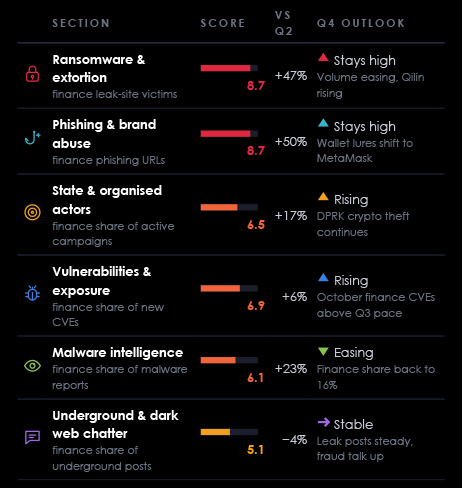
RISK SCORES Each section score (0 to 10) = 35% momentum (Q3 vs Q2), 35% level (Q3 vs the average of Q1 and Q2) and 30% impact weight for the threat type. Momentum score = 5 + 8 x change; level score = 5 + 6 x (ratio − 1), both capped at 0 and 10. Where collection volume changed, the finance share of the dataset replaces counts. The overall score is the impactweighted average. Bands: 8 and above critical, 6 to 8 high, 4 to 6 moderate, below 4 low
| Section | Measure | Impact | Mom. | Level | Score |
|---|---|---|---|---|---|
| Ransomware | finance leak-site victims | 9 | 8.8 | 8.4 | 8.7 |
| State | share of active campaigns | 8 | 6.4 | 5.4 | 6.5 |
| Vulnerabilities | share of new CVEs | 8 | 5.5 | 7.5 | 6.9 |
| Phishing | finance phishing URLs | 7 | 9.0 | 10.0 | 8.7 |
| Underground | share of underground posts | 6 | 4.7 | 4.7 | 5.1 |
| Malware intelligence | share of malware reports | 6 | 6.9 | 5.4 | 6.1 |
OUTLOOKS
Q4 outlooks are analyst judgments based on the October reading against the Q3 pace and on the qualitative evidence in each section.
DATA SOURCES
READ WITH CARE
