

CYFIRMA has identified a multi-domain malware distribution campaign abusing the Indian Income Tax Department theme to deliver a malicious payload. The campaign deploys a network of ten fraudulent tax-themed domains designed to impersonate legitimate government communication and trick victims into downloading a malicious archive containing staged malware components.
The threat actors employ social engineering by presenting a fabricated Notice of Assessment u/s 143(3) containing tax-related terminology, legal references, PAN details, demand amounts, compliance requirements, and financial implications to create urgency and increase victim interaction. The fraudulent portal presents a Download Assessment Order & Workings control that initiates the download of a malicious disk image file (Common_Offline_Utility_ITR-1_to_4_AY2026-07-27.vhdx) delivering a PE loader (Common_Offline_Utility_ITR-1_to_4_AY2026-27.exe) and an associated DLL payload (tedutil.dll) loaded from the binary’s resource section.
Attackers abuse virtual hard disk containers (VHDX) to distribute malicious content that eludes traditional email security and static detection because of its atypical file type. When mounted, the VHDX reveals the embedded loader and DLL payload, extending the attack into a multi-stage infection chain.
The campaign’s modular loader/payload architecture, use of a non-standard container (VHDX), reliance on spoofed government identity, and deployment across multiple disposable domains reflect a deliberate, scalable operation designed to sustain compromise, evade detection, and potentially establish persistent remote access to compromised systems.
This report analyzes a malware distribution campaign that leverages a fraudulent Indian Income Tax Department assessment notice to deliver a RAT-like payload targeting Windows environments. Unlike single-domain campaigns, this operation simultaneously employs ten separate malicious domains to host a fake tax assessment portal designed to resemble official government communication.
The attack chain begins with a social engineering lure that prompts victims to download a malicious VHDX disk image file (Common_Offline_Utility_ITR-1_to_4_AY2026-07-27.vhdx) disguised as a legitimate offline utility for ITR-1 to ITR-4 forms for FY2025 – 26. When mounted, the VHDX delivers a loader executable (Common_Offline_Utility_ITR-1_to_4_AY2026-27.exe) and a malicious DLL payload (tedutil.dll) that is loaded as a resource.
The malware follows a staged execution approach in which the executable acts as a loader, extracting and executing the DLL payload embedded within its resources. Subsequent analysis indicates RAT-like capabilities that enable persistence, host reconnaissance, command execution, and remote communication.
The use of multiple domains for the same campaign significantly expands the infrastructure footprint, complicates blocking and takedown efforts, and reinforces the resourcefulness of the operators. The campaign demonstrates the continued effectiveness of government-themed impersonation combined with non-standard container formats and modular payload delivery to bypass user awareness and security controls.
The campaign leverages a counterfeit Income Tax Department Notice of Assessment to target individuals and organizations in India. Threat actors operate a network of ten fraudulent tax-themed domains that closely imitate the appearance, language, and structure of legitimate government tax communications.
Fake Assessment Notice Highlights
The fraudulent notice impersonates the Government of India and the Income Tax Department, incorporating official branding and the national emblem to establish credibility. It includes a reference number, PAN details, and assessment year, along with a purported Notice of Assessment under Section 143(3) citing various tax additions, disallowances, and applicable interest provisions. The notice further incorporates urgency indicators, including penalty proceedings, additional interest for delayed payment, and a defined period for submitting supporting documentation, intended to pressure recipients into immediate action.
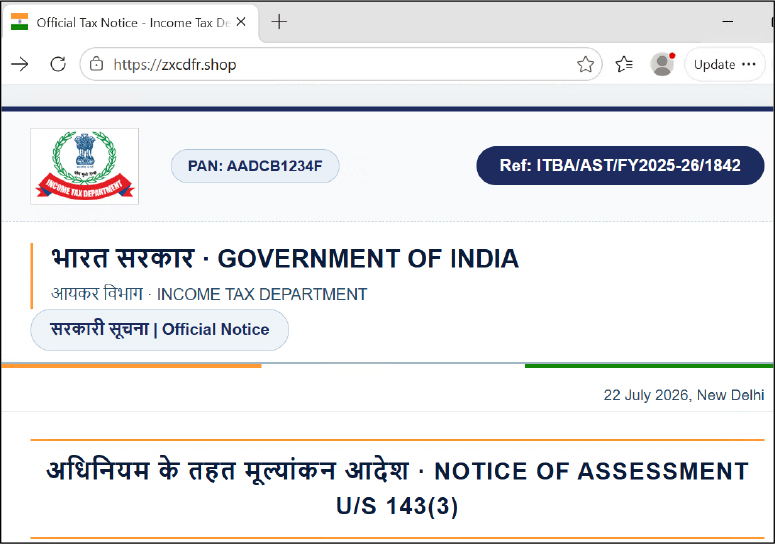
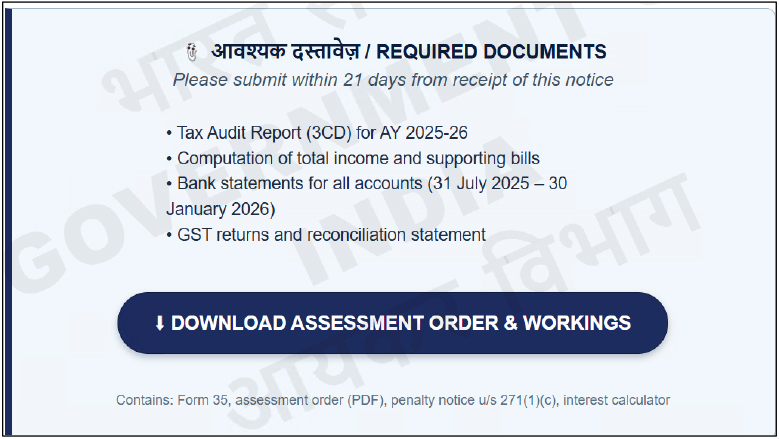
The website displays a fraudulent assessment order containing purported taxpayer information, legal references, financial penalties, and compliance instructions, thereby creating an appearance of legitimacy and instilling a sense of urgency among potential victims. To further facilitate user interaction, the page provides a button labeled “Download Assessment Order & Workings.” Clicking this button initiates the download of a malicious VHDX file, which is presented as an official tax-related document but is instead used as the delivery mechanism for the malicious payload.
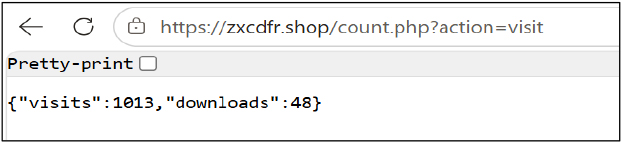
At the time of analysis, the tracking endpoint recorded 1,013 visit events and 48 download events. These values represent observed requests to the tracking endpoint and should not be interpreted as confirmed unique users or victims.
Supporting Domain Infrastructure:
The campaign leverages multiple domains exhibiting a consistent naming pattern and serving the same malicious payload, including the following:
The short keyboard-pattern names and same-day registration on 14 July 2026 suggest bulk registration and support a wide-scale distribution strategy. The use of multiple disposable domains also enables rapid infrastructure rotation, helping the threat actors evade domain-reputation controls, URL filtering, and blocklisting mechanisms.
Basic Details:
| Target Technologies | Windows Operating System, VHDX Disk Image |
| Threat Type | Malware Distribution Campaign |
| File Types | VHDX Virtual Disk (.vhdx), Portable Executable (.exe), Dynamic Link Library (.dll) |
| Key Malware Identifiers | Tax-themed lure, fraudulent Income Tax Department Notice of Assessment, multi-domain fake assessment portal, VHDX disk image (Common_Offline_Utility_ITR-1_to_4_AY2026-07-27.vhdx), PE loader masquerading as offline utility (Common_Offline_Utility_ITR-1_to_4_AY2026-27.exe), DLL payload loaded as a resource (tedutil.dll) |
| Impact | Potential Unauthorized Remote Access / Data Theft (C2 Not Established) |
| MD5 Hashes | Common_Offline_Utility_ITR-1_to_4_AY2026-07-27.vhdx = 2462c9ca59a40ce04e3f072a95e104f0 Common_Offline_Utility_ITR-1_to_4_AY2026-27.exe = e347d86749a1f9e61c6e3b330c681b50 tedutil.dll = 69c5a70b15c886a7f9ab5449be286779 |
Initial Access and Delivery
In the initial stage, the victim is directed to one of multiple fraudulent tax-themed domains and prompted to download a malicious VHDX file named Common_Offline_Utility_ITR-1_to_4_AY2026-07-27.vhdx, which is presented as an official offline utility for Income Tax Return preparation.
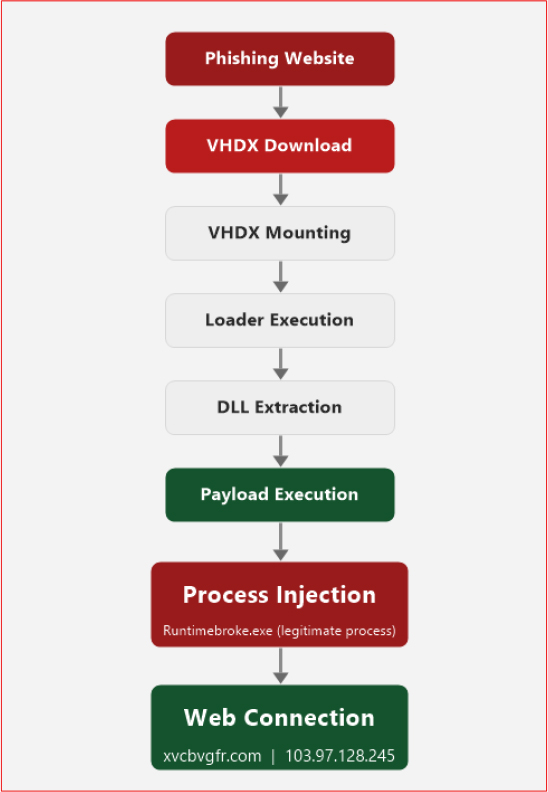
Upon mounting the VHDX image, the malicious content is revealed. The VHDX container can conceal payloads from traditional defenses because disk-image attachments may not be routinely inspected or blocked by email and web security controls.

The image contains metadata identifying it as a Virtual Hard Disk v2 (VHDX) container. The metadata indicates creation on Windows 11, version 25H2 (build 10.0.26200.0). Microsoft identifies build 26200 with Windows 11, version 25H2.
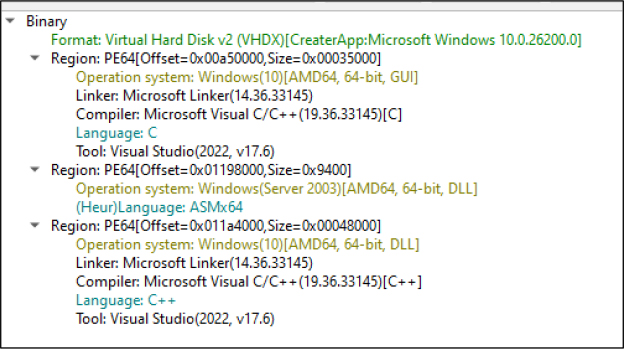
Analysis of the VHDX Disk Image
Analysis of the VHDX file revealed the presence of two malicious components associated with the next stage of the infection chain. The first component, Common_Offline_Utility_ITR-1_to_4_AY2026-27.exe, is a Portable Executable (PE) file that functions as a loader. The second component, tedutil.dll, is a Dynamic Link Library (DLL) that serves as the primary malware payload and is loaded by the loader from the binary’s resource section during the infection process.

Suspicious File Metadata Identified
Common_Offline_Utility_ITR-1_to_4_AY2026-07-27.vhdx contains an executable whose embedded metadata identifies the original filename as topoedit.exe, with File Description: Topology Editor, Product Name: Media Foundation Topology Editor, and Product/File Version: 1.0.0.1. The metadata also claims Microsoft copyright, which is inconsistent with the tax-related filename and delivery context. This discrepancy between the presented filename and the embedded Microsoft-related metadata suggests masquerading and potential metadata abuse, likely intended to make the executable appear legitimate and reduce suspicion during execution.
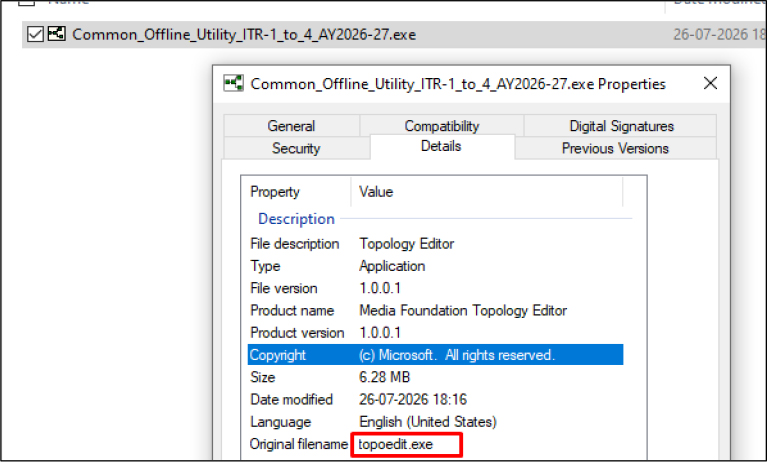
DETAILED ARTIFACT ANALYSIS
| Artifact / Attribute | Detail |
| Malicious container | Common_Offline_Utility_ITR-1_to_4_AY2026-07-27.vhdx (Virtual Hard Disk v2) |
| VHDX creation host | Microsoft Windows 11, version 25H2 (built 10.0.26200.0) |
| Loader executable | Common_Offline_Utility_ITR-1_to_4_AY2026-27.exe (Portable Executable) |
| Payload DLL | tedutil.dll (loaded from the loader’s resource section) |
| Embedded file metadata | Original filename: topoedit.exe; File Description: Topology Editor; Product Name: Media Foundation Topology Editor; Version: 1.0.0.1; Microsoft copyright |
| Masquerading indicator | Tax-related filenames vs Microsoft Topology Editor metadata (metadata abuse to increase perceived legitimacy) |
| Observed behavior | Process injection into Runtimebroke.exe during execution |
| Observed network | Web connection to xvcbvgfr.com resolving 103[.]97[.]128[.]245 |
| Campaign engagement | Tracking endpoint: 1,013 visits and 48 downloads |
Runtime Process Injection with RuntimeBroke.exe
During execution, the malware performs process injection into Runtimebroke.exe, enabling the malicious code to operate within the context of a legitimate process and potentially evade process-based security monitoring and detection mechanisms.

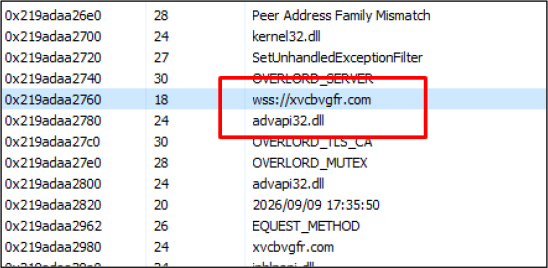
Upon execution, the malware attempted to initiate a TCP connection to the external domain xvcbvgfr[.]com, which resolves to 103[.]97[.]128[.]245. Network analysis observed a TCP SYN packet sent to the resolved IP address, indicating an attempted connection; however, the TCP handshake was not completed. No successful C2 communication was established or observed during the analysis period.

Based on the observed tactics, techniques, and procedures (TTPs), malware capabilities, delivery mechanism, and associated infrastructure, the activity is assessed as an unattributed malware distribution campaign targeting Indian users and organizations. The use of an Indian Income Tax Department-themed lure, VHDX-based delivery, DLL-based execution, and RAT-like capabilities indicates a deliberate campaign leveraging social engineering and evasive malware-delivery techniques. The observed activity demonstrates TTP overlaps with techniques reported in campaigns associated with China-linked threat activity targeting Indian entities; however, these similarities alone are insufficient to establish attribution to the same actor or activity cluster.
The campaign infrastructure exhibits characteristics consistent with a scalable and potentially disposable distribution model. Multiple similarly structured domains have been identified in association with 103[.]59[.]103[.]170, while the malware also attempted to establish a network connection to xvcbvgfr[.]com, which resolves to 103[.]97[.]128[.]245 and is assessed as a suspected C2 endpoint based on its association with the analyzed malware. However, during analysis, only a TCP SYN packet was observed, and the connection handshake was not completed; therefore, successful C2 communication with this endpoint was not established. The use of multiple randomly structured domains under the .shop TLD, combined with multiple infrastructure endpoints, is consistent with a low-cost and potentially automated infrastructure model that could facilitate rapid domain rotation and replacement following detection or disruption.
At this stage, no definitive attribution can be established based on the available evidence. The observed TTP similarities with China-associated campaigns should therefore be treated as a supporting analytical lead rather than an attribution indicator. Further correlation of malware configurations, C2 infrastructure, domain-registration patterns, infrastructure reuse, and additional campaign artifacts would be required to determine whether the activity is connected to any previously identified threat actor or activity cluster.
The analyzed campaign highlights the continued evolution of government-themed malware distribution operations, in which threat actors impersonate trusted government institutions and regulatory processes to increase victim engagement. By impersonating the Income Tax Department, the operators use realistic tax-related notifications, assessment references, PAN-related information, compliance terminology, and financial implications to create a strong sense of legitimacy and urgency. Such themes can be particularly effective during tax and assessment periods, increasing the likelihood of users interacting with malicious links, downloading files, or executing seemingly legitimate utilities.
The campaign demonstrates a structured multi-stage infection framework that begins with fraudulent tax-themed domains distributing a malicious VHDX file disguised as an official offline ITR utility. The infection chain incorporates a VHDX container, executable loader, and DLL-based payload, separating the initial delivery mechanism from the subsequent malicious functionality. This modular approach provides operational flexibility and can reduce the visibility of malicious components during the initial stages of compromise. The combination of deceptive filenames, process injections, and remote communications demonstrates an emphasis on maintaining execution and access after initial compromise.
The campaign also aligns with the broader pattern of Income Tax-themed malware activity previously documented by CYFIRMA, including An Income Tax Assessment Notice Phishing Campaign Delivering Malware (23 June 2026) and Operation TaxShadow (June 2026). The timing is also notable, with the identified domains registered on 14 July 2026, shortly before the 31 July ITR-1/ITR-2 filing deadline. This timing suggests that the campaign leveraged a period when tax-related communications and filing activity were particularly relevant to potential victims. The combination of a familiar government theme, time-sensitive tax context, and an apparently legitimate offline utility increases the credibility of the delivery lure.
| Tactic | ID | Technique Name |
| Execution | T1204.002 | User Execution: Malicious File |
| Stealth | T1055 | Process Injection |
| T1036 | Masquerading | |
| T1036.005 | Masquerading: Match Legitimate Resource Name or Location | |
| Discovery | T1082 | System Information Discovery |
| Command & Control | T1071.001 | Application Layer Protocol: Web Protocols |
The analysis identifies a multi-domain malware campaign leveraging a fraudulent Income Tax Department-themed lure to distribute a malicious payload through a staged infection chain involving a VHDX file, the executable loader (Common_Offline_Utility_ITR-1_to_4_AY2026-27.exe), and the DLL payload (tedutil.dll). The campaign uses deceptive tax-related naming, resource-based payload extraction, VHDX-based delivery, and multiple disposable domains to facilitate malware delivery. Observed activity includes process injection and an attempted command-and-control (C2) connection. Based on analysis of the identified payload family, the malware is assessed to have capabilities related to persistence, system discovery, and remote command execution.
The identified phishing domains share an association with 103[.]59[.]103[.]170, while the malware attempted to communicate with xvcbvgfr[.]com, which resolves to 103[.]97[.]128[.]245; however, successful C2 communication was not established during analysis. These infrastructure relationships are consistent with coordinated campaign infrastructure; however, IP geolocation alone is insufficient to establish attribution to a specific threat actor or geographic origin. The campaign’s use of tax-themed lures and disposable infrastructure indicates a deliberate malware distribution operation with potential for sustained unauthorized access.
Kindly refer to the IOCs section, applying relevant security controls.
| S. No | Indicator | Remarks |
| 1 | zasxcd[.]shop | Block |
| 2 | ssefcv[.]shop | Block |
| 3 | cbvfrd[.]shop | Block |
| 4 | bvnbhy[.]shop | Block |
| 5 | bmnjhy[.]shop | Block |
| 6 | mkjiun[.]shop | Block |
| 7 | nmhjnu[.]shop | Block |
| 8 | zxcdfr[.]shop | Block |
| 9 | sfbnhy[.]shop | Block |
| 10 | xvbndr[.]shop | Block |
| 11 | Common_Offline_Utility_ITR-1_to_4_AY2026-07-27.vhdx | Monitor |
| 12 | Common_Offline_Utility_ITR-1_to_4_AY2026-27.exe | Monitor |
| 13 | 518ee4c9ae0321bd4fe8616e4f195f0079c6503109d2710e80e09d1a0f1dc98f | Monitor |
| 14 | f4ae0f7c0c663e41dab28b2992f1afa9b97fe13a52f2d1fa26156554a23b99a7 | Block |
| 15 | 71d15f3c13f5b11866cf65d9cf014236a47d221155ae992d9992abccedb66cf2 | Monitor |
| 16 | 103[.]59[.]103[.]170 | Block |
| 17 | xvcbvgfr[.]com | Monitor |
| 18 | 103[.]97[.]128[.]245 | Monitor |
rule IncomeTax_Themed_VHDX_Malware_Campaign
{
meta:
description = “Detection rule for the multi-domain Income Tax themed VHDX malware distribution campaign”
author = “CYFIRMA”
date = “2026-09-09”
strings:
// File name indicators
$file1 = “Common_Offline_Utility_ITR-1_to_4_AY2026-07-27.vhdx”
$file2 = “Common_Offline_Utility_ITR-1_to_4_AY2026-27.exe”
// Domain indicators
$dom1 = “zasxcd.shop”
$dom2 = “ssefcv.shop”
$dom3 = “cbvfrd.shop”
$dom4 = “bvnbhy.shop”
$dom5 = “bmnjhy.shop”
$dom6 = “mkjiun.shop”
$dom7 = “nmhjnu.shop”
$dom8 = “zxcdfr.shop”
$dom9 = “sfbnhy.shop”
$dom10 = “xvbndr.shop”
$dom11 = “xvcbvgfr.com”
// IP address indicator
$ip1 = “103.59.103.170”
$ip2 = “103.97.128.245”
// SHA-256 hash indicators
$hash1 = “518ee4c9ae0321bd4fe8616e4f195f0079c6503109d2710e80e09d1a0f1dc98f”
$hash2 = “f4ae0f7c0c663e41dab28b2992f1afa9b97fe13a52f2d1fa26156554a23b99a7”
$hash3 = “71d15f3c13f5b11866cf65d9cf014236a47d221155ae992d9992abccedb66cf2”
condition:
any of ($file*) or
any of ($dom*) or
any of ($ip*) or
any of ($hash*)
}
