Published On : 2026-08-27
Executive Summary
Synthetic media-AI-generated audio, video, and images capable of convincingly impersonating real individuals-has moved from a reputational and disinformation concern into a material operational risk for manufacturing organizations. Manufacturing is increasingly named alongside finance and other critical infrastructure sectors in government and industry threat guidance on AI-enabled impersonation fraud-including Microsoft Threat Intelligence’s June 2025 assessment of DPRK IT-worker targeting, discussed later in this report-and it carries structural exposures that other sectors do not: distributed multi-tier vendor networks, high-value one-off wire transfers for capital equipment and raw materials, hybrid/legacy IT-OT environments, and a historical reliance on voice and video as informal trust anchors between geographically dispersed procurement, finance, and engineering teams.
This report surveys four converging attack patterns-executive/vendor impersonation fraud, synthetic identity infiltration of the workforce, supply-chain-level disinformation and reconnaissance, and emerging risks to physical quality/provenance processes-and maps them to the manufacturing threat surface specifically. It closes with a defense framework organized around identity verification, payment-process hardening, workforce screening, and content provenance, referencing current U.S. government guidance and industry standards.
Key Findings
- According to public reporting, in January 2024 the global engineering firm Arup lost $25 million after attackers used AI-generated video and audio to impersonate senior leadership on a live video call and convinced an employee to authorize the transfer. Commentary since has framed this as the moment synthetic fraud graduated from an isolated incident to an enterprise-scale theft technique.
- Fraud-detection firm Pindrop reported that AI-driven fraud attacks rose 1,210% during 2025. In figures Pindrop supplied to trade press covering that research, an analysis of more than 50 major U.S. customers put combined losses at an estimated $1 billion, and Pindrop’s chief executive characterized the shift as fraud moving from manual operations to an “automated supply chain.”
- North Korean state-linked operatives have historically concentrated fraudulent remote-worker infiltration schemes on the technology, critical manufacturing, and transportation sectors, and have since broadened their targeting to additional industries globally. DOJ’s May 2024 case against an Arizona-based “laptop farm” facilitator found the scheme had infiltrated more than 300 U.S. companies, including an aerospace manufacturer-which had unknowingly hired these operatives.
- As of mid-2026, security researchers assess that North Korean IT-worker operations are using real-time deepfake video inference during live hiring interviews rather than static image substitution, a technique capable of defeating conventional liveness detection. A joint alert co-signed by eleven nations in July 2026 warns of video feeds in hiring interviews that “appear to be manipulated or artificially generated.”
- No single technical control-provenance standards, watermarking, or detection classifiers-currently closes the gap on its own. Microsoft Research’s February 2026 assessment concluded that “no foolproof method for media integrity and authentication exists” and that using these methods individually “presents a host of issues”; the EU’s second draft Code of Practice on marking and labelling AI-generated content, published in March 2026, took the same view, setting out a layered marking approach rather than a single mechanism.
Why Manufacturing is a Disproportionately Attractive Target
Manufacturing supply chains combine several conditions that make deepfake-enabled social engineering unusually effective, compared to, say, a retail or media organization:
- High-value, time-pressured payment events. Capital equipment purchases, raw material contracts, and tooling changeovers routinely involve large one-time wire transfers to unfamiliar or infrequent counterparties, and procurement teams are culturally optimized for speed over friction. Fraudulent AI-generated voices and videos impersonating trusted executives or suppliers are used specifically to trick staff into authorizing payments or diverting shipments.
- Deep, opaque multi-tier vendor networks. Enterprises that rely heavily on external vendors are exposed when attackers impersonate suppliers to send fraudulent invoices or alter payment details. A deepfake message from a “vendor representative” can bypass standard checks in fast-moving supply chains where speed is prioritized over verification. A single OEM may depend on hundreds of Tier 2/3 suppliers. It has limited visibility into-so impersonation of any node in that chain, not just the OEM itself, can trigger a fraudulent transaction or a disruptive shipment diversion.
- Distributed, remote-first coordination. Manufacturing organizations depend on interconnected operational systems whose disruption can produce significant material and financial damage, and decentralized physical locations further increase vulnerability to communication-based fraud. Plant managers, regional procurement leads, and finance staff frequently interact with corporate leadership and vendors exclusively through video calls, voice calls, and messaging apps, the exact channels synthetic media are designed to exploit.
- A historically softer target for workforce infiltration. According to public reporting and vendor threat intelligence, DPRK IT worker operations infiltrate defense contractors, government contractors, and critical infrastructure organizations to obtain sensitive internal access, and once inside, exfiltrate confidential data and intellectual property, install backdoors for follow-on operations, or threaten data leaks after termination to extort money. As remote and hybrid technical roles (controls engineers, ERP/MES administrators, PLM staff) have expanded in manufacturing, this workforce vector has followed.
- Industrialized, low-cost tooling for attackers. Fraud-as-a-Service platforms now replicate SaaS business models, bundling phishing kits, mule-recruitment services, and AI-powered deepfake tools into subscription tiers accessible to low-skilled actors; one industry forecast puts entry-level access at as little as $50 a month, though that figure is an analyst estimate rather than measured marketplace data. Producing a convincing impersonation now requires only a few seconds of an executive’s voice pulled from a webinar or LinkedIn clip and a single reference photo to construct a believable video call. The economics that once limited this technique to nation-state actors have collapsed.
Threat Pattern 1: Executive and Vendor Impersonation Fraud (Observed)
1.1 The Arup precedent and its variants
The Arup case is treated by researchers as a milestone precisely because the target organization had strong cybersecurity but lacked “identity resilience”, the ability to verify that the human on the other side of a call was human. The attack did not exploit a technical vulnerability; it exploited the assumption that a face and voice on a video call constitute proof of identity.
This is now a documented pattern rather than an isolated event. In Singapore, according to public reporting, attackers used deepfake-as-a-service platforms to impersonate executives and instruct employees to transfer millions of dollars to fraudulent accounts. The clearest documented proof point of the video-based variant remains the Arup case, in which, according to public reporting, every participant other than the victim employee-including the CFO-was synthetic.
1.2 Blended-channel attacks defeat single-channel verification
The more mature variant of this fraud pattern layers channels to simulate the verification step organizations are trained to perform. A deepfake-enhanced BEC attack pairs a spoofed email thread requesting a vendor bank-detail change with a follow-up voice or video clip “from the CEO” that appears to confirm it-so the employee believes they have already independently verified the request, when in fact both channels were compromised by the same actor. This substantially increases both believability and loss size.
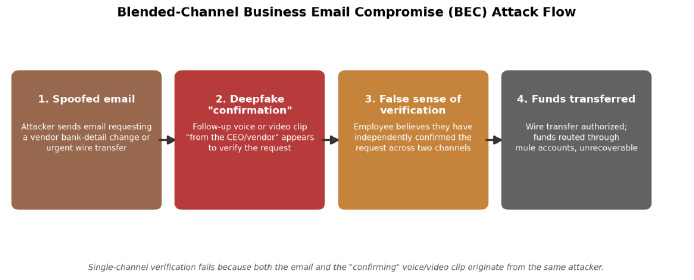
Figure 1: The blended-channel BEC pattern. Because the spoofed email and the “confirming” voice/video clip both originate from the attacker, sequential single-channel checks fail-the defense requires an independent, out-of-band verification step.
1.3 Quantifying the trend
- The FBI’s IC3 2025 Internet Crime Report recorded $3.046 billion in business email compromise losses across 24,768 complaints in 2025. Of the more than $893 million in adjusted losses tied to complaints reporting an AI component, over $30 million was attributed specifically to BEC scams involving AI. The FBI notes this is the first time in the report’s history that it has carried a dedicated section on artificial intelligence.
- Deloitte’s Center for Financial Services estimated generative-AI-enabled fraud losses in the U.S. banking sector at $12.3 billion in 2023, projecting a climb to $40 billion by 2027 under its base-case scenario. The estimate is scoped to financial services rather than to the economy as a whole, but it is indicative of the direction of travel for any sector exposed to payment fraud.
- Deepfake fraud across the Asia-Pacific region-where a large share of manufacturing capacity and supplier networks are concentrated-surged 1,530% between 2022 and 2023 (Sumsub Identity Fraud Report 2023, published November 2023). Sumsub’s Identity Fraud Report 2024 found a further 194% year-on-year rise across the region, indicating the trend has continued rather than plateaued.
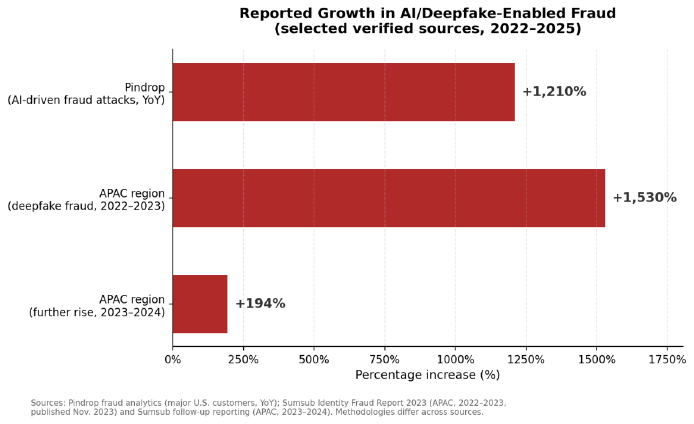
Figure 2: Reported percentage growth in AI/deepfake-enabled fraud across three independently reported metrics. Methodologies and time windows differ across sources; figures should be read as directional evidence of trend, not as a single comparable statistic.
1.4 Manufacturing-specific manifestations
Beyond CEO/CFO wire fraud, this pattern extends into supply-chain-specific fraud types relevant to manufacturers:
- Shipment diversion fraud- Impersonation of a logistics or procurement contact to redirect a shipment of raw materials or finished goods to an attacker-controlled destination.
- Fraudulent logistics brand phishing-AI-generated, highly convincing fake logistics brands with professional-looking websites are used to lure supply-chain personnel into engaging with fraudulent freight, customs, or booking requests.
- Synthetic quality/compliance communications-fabricated audio or video “confirmations” from a quality manager or regulatory contact used to pressure staff into waiving an inspection hold or approving a nonconforming shipment (an extension of the same trust-exploitation mechanism, not yet as widely documented as financial fraud but structurally identical).
Threat Pattern 2: Synthetic Identity Infiltration of the Workforce (Observed)
This is arguably the most consequential and least understood by traditional fraud teams-deepfake risk facing manufacturers, because it targets hiring pipelines rather than payment processes, and it converts a single successful infiltration into standing insider access.
2.1 The DPRK IT worker campaign
A DPRK-affiliated cluster tracked by CrowdStrike as “Famous Chollima” has, according to public reporting, used AI and deepfake technology to generate synthetic identities, résumés, and written communications, and to conduct fraudulent video job interviews. These operatives target defense contractors, government contractors, and critical infrastructure organizations-explicitly including manufacturing to obtain sensitive internal access, after which they exfiltrate confidential data and intellectual property, install backdoors for follow-on operations, or extort the employer with data-leak threats after termination. Microsoft Threat Intelligence states that the scheme “has focused on targeting United States (US) companies in the technology, critical manufacturing, and transportation sectors,” and has since broadened to technology-related roles across additional industries globally.
Financially, this is not a marginal criminal enterprise. The schemes use stolen identities, fabricated credentials, and domestic facilitators to secure remote IT positions at companies in the U.S. and elsewhere, funneling wages back to sanctioned entities. According to U.S. government reporting, they provide a significant revenue stream for North Korea’s weapons development programs.
2.2 Technical escalation: From static images to real-time deepfakes
The technique has matured rapidly and is now specifically designed to defeat the controls organizations put in place after the initial wave of awareness:
- Rather than pre-recorded videos or static image substitutions, which liveness detection can flag, operatives are now using real-time video inference: a deepfake model running live during the call, mapping a stolen or synthetic face onto the operative’s actual video feed and routing the output through a virtual camera driver that the video-conferencing platform accepts as a normal webcam input. In July 2026, this prompted a joint alert co-signed by eleven nations: the United States, the United Kingdom, France, Germany, Italy, the Netherlands, Japan, the Republic of Korea, Australia, Canada, and New Zealand.
- Unit 42 researchers demonstrated that a single researcher with no image-manipulation experience and limited deepfake knowledge built a working synthetic identity for job interviews in 70 minutes, using readily available tools and a five-year-old computer with a consumer-grade GPU-meaning the barrier to entry for this specific attack has effectively collapsed.
- Detection is not hopeless: Documented failed attempts show the deepfake overlay breaking down under scrutiny, for example, a candidate’s mouth remaining shut while speech continued, or heavily filtered facial reconstruction artifacts becoming visible mid-interview.
2.3 Documented breach cases
In the most fully documented public case, the security-awareness vendor KnowBe4 reported that a newly hired principal software engineer began manipulating and transferring potentially harmful files and attempting to execute unauthorized software shortly after receiving a company workstation. Endpoint detection software flagged the activity; the company’s security operations team and outside forensic investigators, working with the FBI, assessed the hire to be a North Korean operative who had passed four video-conference interviews as well as background and pre-hiring checks. The individual’s profile photo was an AI-generated fake built from a stock photograph, and the work laptop had been shipped to what investigators identified as an “IT mule laptop farm,” from which the actor connected via VPN from North Korea or a border region of China.
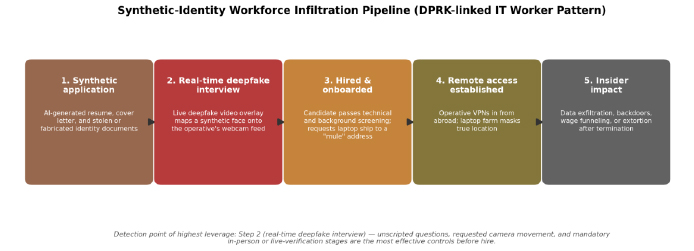
Figure 3: The synthetic-identity infiltration pipeline associated with DPRK-linked IT worker schemes. The highest-leverage detection point remains the live interview stage, before standing access is granted.
2.4 Adjacent risk: Fake recruiters targeting real candidates
A related but inverted operation, “Contagious Interview,” has actors pose as recruiters rather than candidates, tricking real job applicants into downloading malware during a fake technical interview process-a risk to manufacturers’ own engineering and technical staff who may be approached externally, and a reputational/liability risk if attackers spoof the manufacturer’s own hiring brand.
Threat Pattern 3: Reconnaissance, Disinformation, and Market Manipulation (Mixed-Observed and Assessed)
Deepfakes also function as an enabling layer for broader supply-chain attacks rather than as a standalone fraud vector:
- AI-driven reconnaissance scrapes vendor policies, code repositories, and leaked credentials to rapidly identify weak links in a supply chain, with compromised GitHub repositories and misconfigured cloud services now serving as common entry points; separately, poisoning of AI datasets used in procurement, demand forecasting, and logistics decision-making can produce fraudulent vendor approvals or enable malicious code injection across an entire supplier ecosystem.
- Synthetic media can be weaponized against financial markets: a fabricated announcement about earnings, a merger, or a leadership change can spread rapidly and trigger stock volatility, with automated trading systems that react to headlines especially vulnerable to amplifying the effect of the false information. For publicly traded manufacturers, a fabricated video of a plant explosion, product recall announcement, or executive resignation could move share price or trigger contractual force majeure disputes with suppliers before the fabrication is confirmed.
- Independent of any single incident, supply-chain exposure continues to dominate breach reviews generally, as third-party risk grows faster than the internal controls organizations put in place to manage it.
Threat Pattern 4: Emerging Risk to Physical Provenance and Quality Assurance (Assessed/Emerging-Not Yet Publicly Documented)
This category is less mature in the public threat-intelligence literature but follows directly from the same underlying capability shift, and threat researchers in manufacturing should track it closely:
- Synthetic quality documentation. As generative tools make convincing fabricated images, video walkthroughs, and even audio “verbal confirmations” trivial to produce, the same technique used for financial fraud is technically applicable to falsifying material certifications, inspection footage, or supplier facility audits-an extension of long-standing counterfeit-parts risk into the synthetic-media era. No large-scale documented case has yet been publicly attributed at the time of writing, but the enabling technology and economic incentive (counterfeit/substandard parts entering aerospace, automotive, defense, and medical-device supply chains) are both already present.
- Remote supplier audits. Manufacturers that rely on video-based remote facility audits or supplier qualification calls (increasingly common for cost and geopolitical-access reasons) inherit the same identity-verification gap described under “Executive and Vendor Impersonation Fraud” above-there is no structural difference between a deepfaked “CFO” authorizing a wire and a deepfaked “plant manager” walking an auditor through a video tour of a facility that does not meet the standard being certified.
Why Current Technical Countermeasures Are Necessary but Not Sufficient
Organizations often ask whether provenance standards or AI detection tools can simply solve this problem. The honest answer, per the researchers and standards bodies closest to the work, is no-not alone.
Content Credentials (C2PA). C2PA defines a signed manifest bound to an image, video, or audio file, recording the device or model that produced it, every edit applied, and the cryptographic chain of signatures linking those steps. The specification has advanced rapidly-2.1 in September 2024, 2.3 in January 2026, and 2.4 in April 2026-while formal ISO standardization remains in progress: the corresponding standard, ISO 22144, is at Draft International Standard stage and has not yet been published. Camera manufacturers including Leica, Nikon, and Canon are integrating C2PA signing at the hardware level, and major software and AI providers including Adobe, Microsoft, OpenAI, and Google are adding support.
Convergent conclusion from industry and regulators. Microsoft Research’s February 2026 report Media Integrity and Authentication: Status, Directions, and Futures states that “no foolproof method for media integrity and authentication exists,” that using these methods individually “presents a host of issues,” and that sophisticated actors-including nation-state and organized-crime actors-can be expected to “remove and/or undermine all media integrity and authentication methods.” The European Commission’s second draft Code of Practice on marking and labelling AI-generated content, published on 5 March 2026, took a comparable view, setting out a two-layered marking approach of secured metadata and watermarking, with fingerprinting and logging as optional additions. The Code itself is voluntary; the binding obligations sit in Article 50 of the EU AI Act. Passive, after-the-fact detection remains the only recourse for the enormous volume of content that is unmarked or produced by generators that decline to participate in provenance schemes.
The practical implication for manufacturers: technical detection is a supporting control, not a primary defense. Process controls-out-of-band verification, callback procedures, and payment-workflow friction-remain the load-bearing defense against this threat class.
Regulatory and Government Guidance Landscape
- The NSA, FBI, and CISA jointly released a Cybersecurity Information Sheet, “Contextualizing Deepfake Threats to Organizations,” in September 2023, providing an overview of synthetic media threats and recommending best practices. It was developed collaboratively by U.S. government agencies for National Security Systems, the Department of Defense, the Defense Industrial Base, and national critical infrastructure owners and operators. The agencies warned that organizations may be vulnerable to fake online accounts used in social engineering, fraudulent text and voice messages used to evade technical defenses, and faked videos used for executive impersonation, financial fraud, and illegitimate access to internal communications, noting that malicious actors could create video and audio content impersonating executives to manipulate brand perception or influence stock prices. The Information Sheet addresses critical infrastructure owners and operators generically and does not enumerate individual sectors; the manufacturing-specific targeting evidence in this report comes from vendor threat intelligence rather than from this guidance.
- No enacted U.S. federal equivalent to EU AI Act Article 50 currently governs deepfake disclosure for this fraud category. The DEEPFAKES Accountability Act (H.R.5586), which would require disclosure and watermarking of AI-generated content, was introduced in the House on 20 September 2023 (118th Congress), never received a committee or floor vote, and died at the end of that Congress; it has not been reintroduced in the 119th Congress as of the time of writing. The DEFIANCE Act, sometimes cited alongside it, creates a narrower federal civil remedy limited to victims of nonconsensual, sexually explicit deepfake imagery and is not directly applicable to executive or vendor impersonation fraud; the 118th Congress version (S.3696) passed the Senate in July 2024 but did not become law, and the reintroduced DEFIANCE Act of 2025 (S.1837) passed the Senate in January 2026 and remains before the House. EU AI Act Article 50, which requires providers and deployers to mark or disclose certain AI-generated and manipulated content, took effect on 2 August 2026.
- The DOJ and FBI have documented DPRK IT-worker infiltration schemes across multiple prosecutions-a separate November 2025 action, involving five guilty pleas, documented more than 136 affected U.S. companies, distinct from the May 2024 case referenced above-and eleven nations have now co-signed a joint alert covering the use of manipulated or artificially generated video in hiring interviews.
Conclusion
Deepfake technology has crossed the threshold from a reputational nuisance into a material operational and financial risk for manufacturing supply chains. This is not a distant, hypothetical threat-it maps onto structural weaknesses manufacturers already have: distributed vendor networks, high-value one-off payments, remote hiring pipelines, and a habit of treating a face or voice on a call as proof of identity. The Arup case ($25 million lost to a fully synthetic executive video call) and the ongoing DPRK synthetic-identity hiring campaigns show this is already a proven, repeatable attack pattern rather than an edge case.
Organizations often ask whether provenance standards or AI detection tools can simply solve this problem. The honest answer, per the researchers and standards bodies closest to the work, is no-not alone. Based on the public research and vendor assessments reviewed here, detection technology is not yet reliable at the scale required to serve as a primary defense. C2PA, watermarking, and passive detection all have documented gaps, and both Microsoft Research and EU regulators have concluded that no single technical control closes them on its own. That means process controls must remain the primary defense, supported by technical controls-built on verification workflows that don’t trust a single channel, however convincing, with provenance and detection tooling layered in as an additional signal.
Manufacturers that treat this purely as an “IT security” problem will miss the exposure, because the attack surface runs through procurement, finance, and HR just as much as it runs through the network. The organizations best positioned are the ones that build friction into high-stakes moments (payments, vendor changes, hiring) before an incident forces them to.
Immediate Actions
- Institute callback verification for all payment-detail changes and wire transfers above a set threshold. Use a phone number from internal records predating the request-never one supplied in the same email, call, or video that is asking for the change.
- Establish a codeword or challenge-response protocol between finance/procurement staff and executives for authorizing urgent transfers.
- Flag “urgency + confidentiality + bypass normal approval” as an automatic fraud trigger, regardless of how convincing the requester appears or sounds.
- Brief finance, procurement, and HR teams this week on the existence of real-time deepfake video/voice fraud-most staff still assume “seeing is believing” on a video call.
- Add basic liveness checks to remote interviews immediately: ask candidates to move their head, hold an object to the camera, or answer an unscripted question (local weather, a same-day news item).
- Report any suspected incident to IC3 (ic3.gov) and your sector ISAC-this both triggers law enforcement support and contributes to shared threat intelligence.
Recommendations
The following recommendations are based on the intelligence available at the time of writing and on publicly reported cases; their applicability and priority will depend on each organization’s own controls, monitoring, and risk appetite.
Payment & Vendor Controls
- Mandate multi-party, multi-channel authorization for high-value transfers-no single call or clip should ever be sufficient.
- Build vendor-change workflows that require independent verification through a pre-established channel, not the channel the change request arrived on.
Hiring Pipeline Hardening
- Extend deepfake-aware screening beyond software/IT roles to all remote-eligible technical positions (controls engineers, ERP/MES admins, PLM staff)-DPRK-linked campaigns have specifically targeted manufacturing and critical infrastructure.
- Require an in-person or live-verification stage for finalist candidates in sensitive remote roles.
- Cross-check candidate identity signals (résumé history vs. account creation dates, inconsistent digital footprints) as standard practice, not exception handling.
- Establish a clear HR-to-security escalation path-hiring staff should not be expected to make the final call on suspected nation-state infiltration alone.
- Flag unusual payroll routing (crypto payment requests, foreign intermediary accounts) at onboarding.
Governance & Culture
- Shift organizational posture from “awareness training” to “assume untrusted by default” for high-stakes requests-this is a process change, not merely an education one.
- Run tabletop exercises simulating deepfake-enabled executive or vendor impersonation specifically with procurement, finance, and plant-management staff.
- Build incident-response playbooks that cover post-hire discovery of synthetic-identity insiders, not just financial fraud.
Technical Layer (supporting, not primary)
- Adopt C2PA-aware tooling for outbound corporate media where practical but treat the absence of a Content Credential as inconclusive-not proof of anything.
- Use passive AI-detection tools as a secondary signal, understanding that they are probabilistic and will need human judgment layered on top.