
2026 | Seasonal Domain Signals and Phishing Outlook
CYFIRMA examines early-warning signals across seasonal domain activity and outlines how retail fraud, workplace phishing and AI-assisted deception could evolve before Black Friday on 27 November and Cyber Monday on 30 November.
TLP:CLEAR · ISSUED 24 NOVEMBER 2026
Observed refers to directly measured domain-name patterns. Assessed refers to analytically plausible implications. Forecast refers to potential behavior during 24–30 November; those scenarios are not confirmed campaigns. Confidence is High, Moderate or Low and describes how well the available evidence supports a judgment; it is not a probability.
110 SEASONAL DOMAIN SIGNALS · 5 FORWARD-LOOKING PREDICTIONS
CYFIRMA reviewed 1,807,343 distinct domain names and identified 110 containing explicit Black Friday, Cyber Monday, Black Week, or Black November terminology. Of these, 103 referenced Black Friday and 2 referenced Cyber Monday. These are early-warning indicators, not 110 confirmed malicious websites: the analysis covers domain names only and does not establish whether any name hosts a live page.
Of the names reviewed, 1,803,429 came from full daily collections for 14–19 November and the remainder from 1,000-name daily samples for 20–23 November. Coverage of 20–23 November, the days closest to Black Friday in the observation period, is therefore limited.
The more meaningful signal is concentration: 26 names belong to repeated promotional naming patterns, and 5 follow a numbered US-themed shopping structure. Such features are consistent with batch domain acquisition or campaign preparation, but they also have legitimate explanations.
As Black Friday (27 November) and Cyber Monday (30 November) approach, the commercial urgency surrounding online shopping provides opportunities for phishing, payment fraud, brand impersonation and workplace-targeted deception. CYFIRMA recommends extending monitoring from domain names to website activation, to deceptive checkout or identity workflows and to reuse of the same sites across the two events.
| MEASURE | OBSERVED RESULT | INTERPRETATION |
|---|---|---|
| Distinct domains reviewed | 1,807,343 | Domain-intelligence observation population |
| Seasonal domain names | 110 | Keyword matches; not confirmed phishing |
| Black Friday names | 103 | 93.6% of the seasonal-name cohort |
| Cyber Monday names | 2 | Keyword-specific count; not event threat prevalence |
| Repeated promotional formats | 26 | 23.6% of seasonal names; possible clustering leads |
| Numbered US-themed names | 5 | Sequence merits technical follow-up |
| Highest daily count | 17 November: 27 | Includes 4 of the 5 numbered names; rate similar to 14, 16 and 19 November |
| Retail-oriented top-level domains (TLDs) | 38 | Combined .shop, .online and .store names (34.5%) |
The most actionable risk is not a provable increase in phishing volume. It is the potential activation or repurposing of seasonal domain names, followed by stronger promotional lures, corporate identity requests, order-related deception, and Cyber Monday rebranding. Monitor site behavior and repeated technical artifacts to separate malicious activity from legitimate retail promotion.
PRE-EVENT DOMAIN ACTIVITY · POSSIBLE CAMPAIGN PREPARATION
The 2026 shopping window is marked by a dense mix of legitimate retail messaging and potentially deceptive lookalike promotions. In CYFIRMA’s observations, 110 seasonal domain names surfaced ahead of Black Friday and Cyber Monday. The domain cohort is small relative to the overall observed population (about 6 in every 100,000 names), but several names display repeated formats that make them useful investigation leads. The key analytical question is whether these names later become active in synchronized or fraudulent workflows.
The domain-name patterns support early-warning prioritization but not claims of a particular campaign, common criminal operator, confirmed phishing prevalence, or AI-generated content. The broader 14–19 November collection and narrower 20–23 November samples also have different coverage; they cannot be treated as a single comparable daily trend. This report does not compare the figures with a non-seasonal period or with 2025, so they do not show whether seasonal naming is above normal.
| CATEGORY | COUNT | DEFINITION |
|---|---|---|
| Black Friday | 103 | Names with explicit Black Friday wording |
| Cyber Monday | 2 | Names referencing Cyber Monday |
| Black Week | 4 | Names referencing Black Week |
| Black November | 1 | Names referencing Black November |
Black Friday dominates the observed seasonal names: 103 of 110 (93.6%). Cyber Monday accounts for 2 names, Black Week for 4 and Black November for 1. These proportions describe explicit keywords only; scams can target either event without naming it in the domain.
PRE-BLACK FRIDAY DOMAIN OBSERVATIONS · 14–23 NOVEMBER 2026
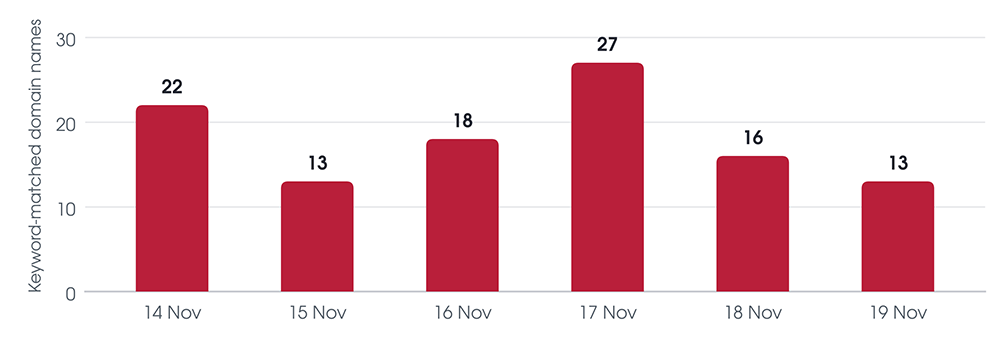
Figure 1: Seasonal domain-name observations in the six full daily collections, 14–19 November 2026. 109 matches across 1,803,429 observed names; not confirmed phishing. Source: CYFIRMA
| DATE | DOMAIN NAMES OBSERVED | SEASONAL NAME MATCHES | PER 100,000 NAMES |
|---|---|---|---|
| 14 NOV | 318,148 | 22 | 6.9 |
| 15 NOV | 273,030 | 13 | 4.8 |
| 16 NOV | 265,884 | 18 | 6.8 |
| 17 NOV | 366,354 | 27 | 7.4 |
| 18 NOV | 390,650 | 16 | 4.1 |
| 19 NOV | 189,363 | 13 | 6.9 |
| 14–19 NOV TOTAL | 1,803,429 | 109 | 6.0 |
The broader daily collections identified 22, 13, 18, 27, 16 and 13 seasonal names from 14–19 November, respectively. The highest count was 27 on 17 November, 4 of which are the numbered names described in Section 03. Measured per 100,000 names observed, 14, 16, 17, and 19 November are similar (6.8 to 7.4), so the fluctuating counts do not prove a rise in malicious registrations.
Narrower monitoring for 20–23 November added one more unique seasonal candidate. The combined corpus contains 1,807,343 distinct names after de-duplication; only 110 matched the explicit seasonal naming rules.
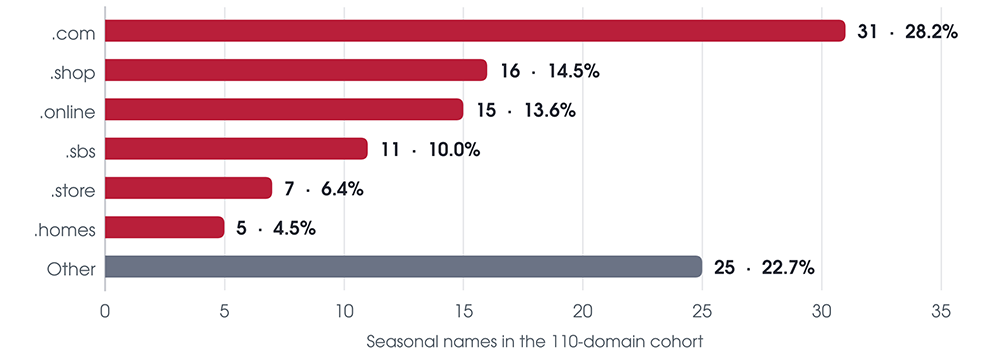
TLD composition describes naming choices; no extension establishes malicious intent. Source: CYFIRMA
| TLD | DOMAINS | SHARE OF 110 |
|---|---|---|
| .com | 31 | 28.2% |
| .shop | 16 | 14.5% |
| .online | 15 | 13.6% |
| .sbs | 11 | 10.0% |
| .store | 7 | 6.4% |
| .homes | 5 | 4.5% |
| Others | 25 | 22.7% |
Among the 110 seasonal names, .com was the most frequent (31; 28.2%), followed by .shop (16; 14.5%), and .online (15; 13.6%). Together, .shop, .online, and .store accounted for 38 names (34.5%). These extensions are legitimately used by businesses, and extension choice alone does not indicate phishing. Risk escalates when an active page misrepresents a retailer or requests sensitive data through an unrelated checkout or login flow.
REPEATED PROMOTIONAL LABELS · POSSIBLE PREPARATORY ACTIVITY
Twenty-six seasonal names fall within repeated promotional naming patterns, including variants of “Black Friday event,” “Black Friday prices,” “Black Friday promotion,” and “Black Friday sale 2026.” Their recurrence across TLDs may indicate coordinated registration, commercial portfolio management, or coincidental naming. Matching registrar details, DNS history, certificate records, and archived content would be required before treating them as one operation.
| OBSERVED NAMING TYPE | ANALYTICAL SIGNIFICANCE |
|---|---|
| Multi-TLD “event” naming | Same seasonal phrase appears under .homes, .sbs, .shop, and .store; investigate registration and content correlations. |
| Multi-TLD “prices” naming | Same promotional wording appears under .online, .sbs, and .store; does not alone establish common ownership. |
| Numbered US-themed naming | Five sequentially styled .shop domains; test DNS, scripts, and first-seen page behavior before assessing coordinated activity. |
Five names in the observed cohort follow a numbered US-themed Black Friday storefront format. Four appeared in the 17 November collection and another in the 18 November collection. The numbering is consistent with batch registration, but is not by itself an indicator of fraud. A useful next test is whether the sites share non-generic scripts, form endpoints or synchronized deployment dates.
Other names contain strings that match retailer names, including a five-name group whose wording matches the name of the Swiss retailer Manor. Whether these names refer to that retailer has not been established: such strings deserve brand-protection review, but ownership and impersonation cannot be determined from naming alone. In particular, a promotional domain may be authorized, defensive, parked, or unrelated to the named retailer.
BLACK FRIDAY · 27 NOVEMBER 2026 | CYBER MONDAY · 30 NOVEMBER 2026
The days around Black Friday and Cyber Monday form a single commercial period but can support different social-engineering narratives. Black Friday favors physical-goods discounts, flash sales and checkout urgency; Cyber Monday offers additional pretexts involving digital services, software, subscriptions and account activation. The two Cyber Monday keyword matches in the observed cohort are not a measure of the event’s underlying phishing risk.
| BLACK FRIDAY: 27 NOV | CYBER MONDAY: 30 NOV |
|---|---|
| Flash sales, retailer lookalikes and checkout urgency | Digital-service, software-license and subscription offers |
| Limited-stock and early-access promotional emails | Account activation, member access and renewal lures |
| Payment verification around consumer purchases | Billing-card confirmation and service access requests |
| Delivery notification preparation | Potential reuse of promotional infrastructure after the weekend |
A site that first presents a Black Friday offer could be rebranded for Cyber Monday while retaining the same scripts, redirect infrastructure, or data-collection workflow. This is a testable forecast, not a confirmed observation. Defenders should compare historical screenshots and network resources before and after the event; common visual themes alone are insufficient to establish a connection.
WORKPLACE TRUST · PROMOTIONAL URGENCY · ENTERPRISE IDENTITY
The shopping season is also a business-email opportunity. Employees receive genuine messages about software procurement, subscription renewals, professional learning, vendor quotations, and employee benefits. A phishing message framed as a seasonal commercial offer may therefore feel operationally relevant, especially when it requests urgent approval or directs a recipient to an unfamiliar work-account sign-in page. These are plausible attack scenarios, not campaigns established by the domain observations.
| TARGET CONTEXT | PLAUSIBLE EMAIL PRETEXT | POTENTIAL EXPOSURE |
|---|---|---|
| IT / SaaS users | Limited-time subscription, account or license offer | Work-account sign-in or unauthorized app consent |
| Finance / Procurement | Time-sensitive software quotation or revised payment | Invoice diversion or fraudulent purchase approval |
| HR / Employee programs | Employee-exclusive digital reward or benefit offer | Credential compromise or personal-data disclosure |
| Professional services | Specialist training, course access, or enrollment promotion | Fake enrollment payment or account takeover |
Seasonal business offer → apparently familiar vendor or benefit portal → work-account authentication, application consent, or urgent payment → potential identity compromise or financial loss. The presence of such a workflow must be demonstrated in an actual message or website before assigning a malicious verdict.
Defenders should correlate unusual sender domains, email-authentication (DMARC, SPF and DKIM) results, mail-to-web redirects, newly observed sign-in destinations, third-party application consent requests and time-sensitive invoice or vendor-bank changes. The domain observations do not cover email activity, and no corporate-email phishing campaign is reported here.
PERSONALIZED LURES · RAPID PAGE VARIATION · EVIDENCE BOUNDARIES
Generative AI could make seasonal social engineering less predictable by enabling rapid editing of promotional copy, localization, and customer-support responses. Combined with reusable templates and inexpensive hosting, this may permit visually varied pages to be deployed at scale. The observed domain statistics do not establish AI use, and fluent writing, translated text, or polished images are not proof of an AI-assisted attack.
| POTENTIAL AI-ERA CAPABILITY | WHAT WOULD VALIDATE THE HYPOTHESIS |
|---|---|
| Language and offer localization | Repeated snapshots showing synchronized changes plus supporting automation evidence |
| Customized storefront appearance | Distinctive shared scripts or form destinations beneath differing interfaces |
| Adaptive chat persuasion | Captured fraudulent conversations tied to a verifiable deceptive collection flow |
| Direct generative AI involvement | Verified operator tooling, service integration, or corroborated production artifacts |
Direct tooling artifacts or independently corroborated operator-side evidence are needed to attribute AI use. Repeated scripts may reveal scalable operations, while synchronized multilingual changes may indicate automation; neither alone proves generative AI involvement.
FRAUDULENT SHOPPING EXPERIENCES · VERIFICATION AND REFUND PRETEXTS
| POTENTIAL ATTACK STAGE | EVIDENCE REQUIRED FOR CONFIRMATION |
|---|---|
| Promotional entry | Archived deceptive advertisement, email, or landing page |
| Brand impersonation | Unauthorized brand cues, misleading ownership, or misleading domain |
| User interaction | Observed credential, OTP, payment, or unauthorized consent request |
| Infrastructure relationship | Distinctive shared resource hashes, redirects, or collection destination |
| Threat determination | Corroborated collection behavior, fraud evidence, or trusted threat verdict |
A defensible phishing classification requires evidence, such as unauthorized brand imitation, misleading destination domains, deceptive form submission, malicious redirects, fraudulent payment details, or corroborated independent reporting. The presence of a seasonal promotion on a newly observed domain is not sufficient.
24–30 NOVEMBER 2026 · FIVE TIME-BASED PREDICTIONS
CYFIRMA expects the highest value from monitoring how seasonal pages and messages change during the event window. The following five judgments identify plausible attack opportunities and concrete early-warning indicators; they are not predictions of global incident volume or verified ongoing campaigns.
| WINDOW | PREDICTED RISK DEVELOPMENT | EARLY-WARNING SIGNAL |
|---|---|---|
| 24–25 NOV | Seasonal websites may transition from parked or promotional to active shopping pages | New landing pages, retailer claims, unfamiliar sign-in flows |
| 26 NOV | Urgency-themed offers may intensify immediately ahead of Black Friday | Countdowns, same-day payment requests, abrupt destination changes |
| 27 NOV | Fake checkout and limited-stock narratives may gain relevance | Card entry, unfamiliar processors, retailer-brand inconsistencies |
| 28–29 NOV | Order follow-up, delivery or refund deception becomes more plausible | Courier impersonation, order-status links, refund verification prompts |
| 30 NOV | Some operators may shift toward digital-service offers or Cyber Monday branding | Subscription/renewal lures, reused scripts, renamed promotions |
Higher confidence would require verified activation of related domains, archived evidence of fraudulent collection, repeated technical artifacts across multiple sites, or captured malicious email flows. A numeric phishing-volume forecast would require a consistent historical series of confirmed incidents, which is not available from this domain-name cohort.
BRAND PROTECTION · EMPLOYEE IDENTITY · PAYMENT AND WEB MONITORING
| PRIORITY | RECOMMENDED DEFENSE | OWNER | RISK REDUCED |
|---|---|---|---|
| 1 | Investigate new brand-plus-seasonal domains with website and DNS verification | Brand protection | Reduces retailer impersonation blind spots |
| 2 | Revisit suspicious pages through both shopping events | Threat intelligence | Detects rebranding and infrastructure reuse |
| 3 | Verify unexpected procurement, subscription, and benefit emails out of band | Finance and procurement | Limits corporate identity and payment compromise |
| 4 | Alert on unfamiliar payment, OTP, credential, and OAuth destinations | Security operations | Targets deceptive behavior rather than names alone |
| 5 | Cluster distinctive scripts, images, redirects, and collection endpoints | Threat intelligence | Reveals related deployments while reducing false positives |
| 6 | Coordinate customer-support, fraud, security and brand-reporting response | Fraud and customer support | Shortens response time for verified impersonation |
The 110 names are not a phishing incident count. Their value is as an early-warning population that can be monitored for activation, brand misuse, and shared technical behavior. The risk forecast points to five plausible developments across 24–30 November; stronger conclusions will depend on verified web or email evidence as the shopping period unfolds.
FROM SEASONAL DOMAIN SIGNALS TO VERIFIABLE THREATS
| WATCHPOINT | RELEVANT TELEMETRY | ESCALATION CRITERION |
|---|---|---|
| Seasonal domain activation | DNS A/AAAA, recent TLS, historical capture | Unexpected live retail page with misleading affiliation |
| Retail brand likeness | Screenshot, logo, page ownership | Unapproved retailer representation |
| New checkout flow | Form action, redirect, payment processor | Unrelated or deceptive card-entry destination |
| Account sign-in prompts | Single sign-on (SSO) and OAuth links, login page | Unexpected corporate identity request |
| Urgent subscription renewal | Mail headers, links, invoice metadata | Inconsistent vendor or payment details |
| Employee-exclusive offer | Email sender, campaign landing page | Unapproved authentication or data collection |
| Delivery exception message | Courier brand, short link, page | Unrelated payment or identity request |
| Refund verification | Order context, form destination | Unexpected card or account verification |
| Gift-card promotion | Prize claim, contact flow | Advance payment or personal data request |
| Related naming strings | Keyword-family registrations | Shared distinctive technical artifacts |
| Sequential domain names | DNS, scripts, hosted assets | Synchronized deceptive deployment |
| Cross-event content change | Archive comparison, HTML/title | Brand or offer changes with common backend |
| Localization anomaly | Regional versions, currency | Evidence of coordinated deceptive variants |
| Chat-based sales pressure | Captured interactions | Support-led fraud or credential requests |
| AI-service integration claim | Verified operator or code artifacts | Corroborated AI use; not stylistic inference |
Apply these indicators to suspicious sites and email messages during the shopping window. Prioritize evidence that an operator has misrepresented a trusted brand, requested sensitive data, or deployed a shared technical component across multiple websites.
These indicators guide triage; they are not a blocklist and do not imply that every seasonal domain is fraudulent. Escalation requires corroborating evidence of deceptive behavior or a verified malicious workflow.
OBSERVATION WINDOW · COVERAGE · INTELLIGENCE CONSTRAINTS
CYFIRMA examined domain-intelligence observations spanning 14–23 November 2026. The 14–19 November interval used six broader daily collections containing 1,803,429 distinct names; 20–23 November used narrower 1,000-name daily samples. After accounting for 86 overlapping names, the combined observation set comprised 1,807,343 distinct domains and 110 seasonal keyword matches. The two coverage levels are not suitable for direct day-to-day trend comparison.
| ASSESSMENT LEVEL | MINIMUM EVIDENCE | WHAT IT SUPPORTS |
|---|---|---|
| Observed naming signal | Timestamped domain intelligence observation | Seasonal or repeated naming pattern was observed |
| Registry-confirmed creation | Registration Data Access Protocol (RDAP) or registry creation timestamp |
Domain creation date independently verified |
| Suspicious website behavior | Archived misleading content or abnormal workflow | Website merits further investigation |
| Confirmed phishing / fraud | Deceptive collection or payment flow plus corroboration | Verified harmful behavior, linked to evidence |
| Operational / AI linkage | Distinctive technical overlap or direct AI operator evidence | Qualified campaign correlation or substantiated AI use |
The data does not independently verify registration creation dates, active phishing websites, victim impact, campaign attribution, or AI involvement. Domain names matching promotional terminology are treated as leads for assessment, not as malicious indicators by default.
Issued 24 November 2026. Observation period: 14–23 November 2026. Black Friday: 27 November 2026. Cyber Monday: 30 November 2026. Public research release: TLP:CLEAR.
