
Pharmaceutical Cyber Threat Landscape 2026
A global assessment of nation-state activity, underground exposure, ransomware and technical threats affecting pharmaceutical organisations.
The pharmaceutical sector remains an attractive target for nation-state espionage and financially motivated cyber operations due to the value of its intellectual property, research capabilities and manufacturing infrastructure. This assessment examines the threat landscape from April to November 2026, alongside relevant historical intelligence. Documented operations involving China, Russia and North Korea-linked actors highlight continued interest in pharmaceutical research, vaccine development and sensitive scientific information. Notably, the October 2026 VAPOR PANDA campaign involved intrusions against two US-based pharmaceutical organisations, demonstrating the use of AI-assisted attack capabilities against the sector.
Dark Web monitoring identified multiple claims involving pharmaceutical source code, clinical research data, biological information, cloud credentials, distributor records and confidential corporate information. These findings indicate potential exposure across research, technology and commercial operations, including sensitive intellectual property and third-party business information. The authenticity and extent of individual exposures remain subject to validation.
Ransomware intelligence recorded 96 victim entries across 31 countries, involving 38 ransomware groups. North America, Europe and East Asia accounted for approximately 77.1% of the recorded entries, with N0n, TheGentlemen and Qilin representing the highest recorded group-level concentrations. Technical findings further highlight risks associated with vulnerability exploitation, credential compromise, cloud infrastructure access and malicious file execution.
Overall, the findings demonstrate that pharmaceutical organisations face interconnected risks involving research espionage, intellectual property exposure, ransomware-driven extortion and third-party compromise. Protecting proprietary research, strengthening identity and cloud security, monitoring underground exposure and maintaining manufacturing resilience should remain key security priorities.
Overall Assessment: Pharmaceutical organisations face continued exposure to state-sponsored espionage, intellectual property theft, underground data exposure and ransomware. Protecting sensitive research and maintaining secure, resilient operations should remain key priorities.
This assessment examines cyber threats targeting the global pharmaceutical sector during the period 1 April 2026 to 17 November 2026. It focuses on nation-state-sponsored operations, cyber espionage, intellectual property theft and other emerging threats with the potential to compromise sensitive research, proprietary information and critical business operations.
The assessment also incorporates Dark Web intelligence and ransomware-related activity to provide a broader understanding of the threat environment. These intelligence streams are examined to identify sector-specific exposure, adversarial interest, compromised access and potential risks to pharmaceutical organisations.
The research covers pharmaceutical organisations operating across global markets.
The primary scope includes pharmaceutical manufacturers, biotechnology companies, Contract Research Organisations (CROs), Contract Development and Manufacturing Organisations (CDMOs) and Active Pharmaceutical Ingredient (API) manufacturers.
Relevant third-party service providers, research partners and supply-chain entities are considered where their exposure could affect pharmaceutical operations, research activities or sensitive organisational information.
The assessment draws upon multiple intelligence streams to examine both targeted operations and broader sector exposure:
Information is drawn from government and CERT advisories, established cybersecurity research, threat intelligence publications, corporate disclosures, regulatory filings and accessible underground intelligence sources. The assessment also incorporates relevant intelligence datasets made available during the research process.
Collected intelligence is evaluated for sector relevance, source credibility and supporting evidence before inclusion. The analysis distinguishes between confirmed incidents, observed threat activity, unverified claims and suspected targeting.
Where multiple sources report the same activity, findings are consolidated to avoid duplication. Potential relationships between threat actors, campaigns and incidents are examined using available evidence, including infrastructure, malware, operational patterns and documented TTPs.
Activity dates, observation dates and publication dates are maintained separately to ensure chronological accuracy. Historical intelligence predating April 2026 is considered only where it provides relevant context for understanding established threat actors or developments within the assessment period.
Threat actor attribution is based on available technical evidence, credible intelligence reporting and independent corroboration. Alleged affiliations, similarities in attack techniques or geopolitical context alone are not considered sufficient to establish state sponsorship.
Findings are assigned the following confidence levels:
| Confidence | Assessment criteria |
| High | Supported by authoritative attribution, substantial technical evidence or multiple independent and credible sources. |
| Moderate | Supported by credible reporting and relevant indicators, with some verification or attribution gaps. |
| Low | Based on limited, uncorroborated or primarily claim-based intelligence. |
Confidence reflects the strength of available evidence and may be revised as additional intelligence emerges.
The assessment is based on intelligence available through the identified sources and does not represent an exhaustive account of all cyber activity affecting the pharmaceutical sector. Restricted access to underground communities, delayed incident disclosures, incomplete reporting and unverified threat actor claims may affect the visibility of certain activities.
Furthermore, ransomware disclosures, Dark Web listings and threat actor statements are treated as intelligence leads rather than independently confirmed compromises unless supporting evidence is available. Statistics from different intelligence providers are assessed according to their respective collection methodologies and are not directly aggregated where definitions or coverage differ.
All findings are presented according to the available evidence, with clear distinctions between confirmed activity, assessed threats and unverified claims.
The pharmaceutical industry holds significant scientific, economic and strategic value. Its research capabilities, proprietary technologies, manufacturing expertise and role in public health make it a potential target for state-sponsored espionage.
Unlike conventional commercial information, pharmaceutical assets can provide access to scientific developments, emerging treatments, intellectual property and critical medicine supply-chain information. Their acquisition may offer technological, economic or strategic advantages to competing states.
Pharmaceutical innovation depends on substantial research investment, specialised expertise and lengthy development processes. The industry’s strategic value lies in its ability to develop new treatments, advance biotechnology and maintain specialised manufacturing capabilities.
Beyond commercial interests, pharmaceutical production contributes to national health security. Access to essential medicines, vaccine development and reliable manufacturing capacity can influence a country’s preparedness for public health emergencies.
These characteristics make pharmaceutical organisations valuable sources of scientific and industrial intelligence.
State-linked actors may target pharmaceutical organisations to acquire information that supports broader technological, economic and strategic interests.
These represent potential strategic motivations and should not be interpreted as confirmed objectives without supporting evidence.
| Asset category | Sensitive information | Strategic value |
| Research and Development | Drug discoveries, molecular data and experimental findings | Scientific innovation and research advantage |
| Clinical Research | Trial results, safety data and regulatory submissions | Access to confidential development information |
| Intellectual Property | Formulations, patents and trade secrets | Technological and commercial advantage |
| Manufacturing | Production processes, API formulations and quality records | Manufacturing expertise and production capabilities |
| Corporate Intelligence | Licensing agreements, business plans and commercial strategies | Competitive and economic intelligence |
Pharmaceutical operations depend on interconnected research partners, contract manufacturers, API suppliers, technology providers and distribution networks. These relationships extend across multiple organisations and geographical markets.
This creates additional exposure beyond internal corporate infrastructure:
Compromise of a critical third party may expose multiple organisations or disrupt interconnected pharmaceutical operations.
The Organisation for Economic Co-operation and Development (OECD) has highlighted supply-chain dependencies and limited visibility into certain upstream pharmaceutical suppliers.
Similarly, the US Food and Drug Administration (FDA) has highlighted cybersecurity risks associated with connected technologies used in pharmaceutical manufacturing.
The strategic exposure therefore extends beyond individual pharmaceutical companies to the wider research, manufacturing and distribution ecosystem that supports medicine development and supply.
Nation-state-linked threat actors have demonstrated interest in pharmaceutical, biotechnology and medical research organisations, primarily seeking access to intellectual property, scientific developments and commercially sensitive information. Their activities include targeted espionage, credential compromise, research-data theft and unauthorised access to corporate and production environments.
APT41 (Double Dragon / BARIUM)
APT41 is a China-linked threat group known for conducting state-sponsored espionage alongside financially motivated cyber operations. Active since at least 2012, the group has targeted organisations across healthcare, technology, telecommunications and other industries. Its operations involve a broad range of malware, phishing techniques and exploitation methods to gain access to targeted environments.
APT41 has historically targeted pharmaceutical, biotechnology and medical-device organisations. Its operations have involved the theft of pharmaceutical development information, clinical-trial data, academic research and confidential corporate documents. One documented intrusion against a biotechnology company also exposed information relating to research funding and corporate acquisition activities. These operations demonstrate the group’s interest in proprietary scientific information and commercially valuable research.
APT27 (Emissary Panda)
APT27 is a China-linked cyber espionage group primarily associated with intellectual property theft and the collection of confidential business information. The group has targeted organisations across multiple industries and is known for using spear-phishing, vulnerability exploitation and compromised enterprise infrastructure to establish access.
APT27 has targeted pharmaceutical and technology companies in Germany, with operations involving the theft of trade secrets and intellectual property. The group has also used access obtained within compromised organisations to conduct spear-phishing activity against other targets, highlighting the potential exposure of interconnected business environments.
APT10 (Stone Panda)
APT10 is a Chinese cyber espionage group associated with the Ministry of State Security (MSS). The group is known for targeting managed service providers, technology companies and research-intensive industries to obtain intellectual property and confidential business information. Its operations have also involved exploiting trusted IT service relationships to reach additional organisations.
APT10 has been associated with pharmaceutical manufacturing, biotechnology and healthcare targeting. In 2021, the group was also accused of targeting India’s biotechnology organisations to obtain vaccine-related intellectual property and competitive information. The specific compromise allegations remain unconfirmed.
APT9
APT9 is an espionage group associated with the theft of commercially valuable information from pharmaceutical, biotechnology, aerospace and other research-intensive industries. Its state affiliation remains uncertain, although some intelligence assessments suggest possible Chinese sponsorship. The group has used spear-phishing, legitimate account compromise and remote-service access to infiltrate targeted organisations.
APT9 has historically targeted pharmaceutical and biotechnology companies, seeking access to proprietary research, development projects and confidential business information. Its activity has also involved suspected exploitation of trusted relationships between biotechnology organisations to gain access to connected environments.
VAPOR PANDA
VAPOR PANDA is a China-nexus espionage actor associated with intrusions against strategically important organisations. Its operations have historically focused on establishing access within government, energy, extractive and other high-value environments. The group has also demonstrated the use of automated attack workflows to coordinate intrusion activity across multiple targets.
On 29 October 2026, CrowdStrike reported that VAPOR PANDA had targeted two US-based pharmaceutical organisations during October 2026 as part of a wider espionage campaign. The intrusions involved exploitation of cloud authentication weaknesses, deployment of web shells and unauthorised access to production container environments. The actor also used ARTEX, an AI-driven intrusion framework, alongside commercial language models to coordinate multiple operations.
APT29 (Cozy Bear)
APT29 is a Russian state-sponsored cyber espionage group associated with the Foreign Intelligence Service (SVR). Its primary objectives involve intelligence collection through covert access to government, research and strategically important organisations. The group is known for credential theft, spear-phishing and the deployment of sophisticated malware to maintain access to compromised environments.
APT29 targeted organisations involved in COVID-19 vaccine development in the United States, United Kingdom and Canada. The operations were intended to obtain vaccine-related research and intellectual property. The targeting demonstrates the group’s interest in sensitive scientific developments and research information with strategic value.
APT28 (Fancy Bear)
APT28 is a Russian military-intelligence-linked threat group associated with the General Staff Main Intelligence Directorate (GRU). Its operations primarily focus on espionage against government, defence, diplomatic and strategically important organisations. The group has used spear-phishing, password spraying and credential theft to gain access to targeted accounts and networks.
APT28 has been associated with password-spraying attempts against pharmaceutical companies and individuals involved in COVID-19 vaccine development. The activity targeted researchers and pharmaceutical organisations across several countries, including the United States, Canada, France, India and South Korea. The reported attempts highlight the targeting of research personnel and their accounts to gain access to sensitive scientific information.
Turla (Waterbug / Venomous Bear)
Turla is a long-running Russian cyber espionage group attributed to the Federal Security Service (FSB). Active since at least 2004, the group has targeted government, military, diplomatic, research and other strategically important organisations. Its operations have involved spear-phishing, watering-hole attacks, custom malware and covert infrastructure to maintain access to compromised systems.
Pharmaceutical companies are included among Turla’s documented target sectors. However, publicly available intelligence provides limited incident-level detail concerning specific pharmaceutical compromises. Its established interest in research-intensive organisations makes it relevant to continued pharmaceutical-sector monitoring.
Andariel (Onyx Sleet / Stonefly)
Andariel is a North Korean state-linked threat group associated with the Reconnaissance General Bureau (RGB). The group conducts cyber espionage, information theft and financially motivated operations against government, defence and commercial organisations. Its activities are also associated with the acquisition of information supporting North Korea’s strategic and technological priorities.
Andariel-associated operators have been linked to the exfiltration of pharmaceutical research and development information, alongside weapons-related research. The activity highlights the potential use of cyber operations to acquire sensitive scientific knowledge and proprietary research from organisations holding strategically valuable information.
Lazarus Group – Operation DreamJob
Lazarus Group is a broad designation associated with North Korean state-linked cyber operations involving espionage, financial theft and strategic information collection. Its operations have included spear-phishing, malicious applications, remote-access malware and the compromise of corporate environments.
In March 2026, shortly before the assessment period, ESET reported that Operation DreamJob, an activity cluster tracked under the broader Lazarus umbrella, targeted the South Korean pharmaceutical sector through employment-themed lures, weaponised MFC applications and a RAR archive exploiting CVE-2025-8088 and CVE-2025-6218. ESET describes BlindingCan as the cluster’s current main remote-access trojan. The activity demonstrates how recruitment-themed deception can be used to gain access to pharmaceutical organisations and their sensitive information.
Consolidated Threat Assessment
The identified actors demonstrate varying levels of interest in pharmaceutical organisations. China-linked groups have been associated with pharmaceutical intellectual property theft and biotechnology research targeting, while Russian operations have focused on vaccine research and scientific intelligence collection. North Korean actors have demonstrated interest in pharmaceutical R&D.
Across these operations, the principal areas of concern include the acquisition of proprietary research, unauthorised access to sensitive corporate environments and the exploitation of trusted relationships to obtain additional access. These activities reinforce the need to assess pharmaceutical-sector threats through both the value of targeted information and the potential for sustained access to critical research and operational environments.
Documented pharmaceutical-sector intrusions demonstrate the use of targeted social engineering, software exploitation, identity abuse and unauthorised access to enterprise environments. The following techniques highlight the main intrusion paths identified across relevant operations.
Social Engineering and Malicious Applications: Employment-themed lures, spear-phishing and weaponised documents have been used to target pharmaceutical employees. Such activity can introduce malicious applications and remote-access malware into corporate environments.
Exploitation of Applications and Services: Vulnerable software, exposed web applications and misconfigured services can provide direct access to organisational systems. Documented activity includes exploitation of vulnerabilities and unauthenticated orchestration services.
Identity and Privilege Abuse: Compromised credentials, authentication weaknesses and excessive cloud permissions can allow adversaries to obtain elevated access beyond the initially compromised system.
Persistence and Remote Access: Web shells, remote-access malware and compromised infrastructure can provide continued access to targeted environments and support follow-on operations.
Credential Discovery and Data Collection: Access to privileged credentials and internal resources can enable further access to research repositories, clinical information and confidential corporate documents.
The following tools and mechanisms have been associated with pharmaceutical-related targeting or the wider campaigns discussed in this assessment.
| Tool / Malware | Associated activity | Purpose |
| BlindingCan RAT | Operation DreamJob | Remote access, command execution and control of compromised systems. |
| Weaponised MFC Applications | Operation DreamJob | Malicious execution and delivery of subsequent payloads. |
| Web Shells | VAPOR PANDA | Remote access and command execution within compromised environments. |
| ARTEX | VAPOR PANDA | AI-driven framework used to coordinate reconnaissance and intrusion activities. |
| BLOODALCHEMY | Wider VAPOR PANDA campaign | Backdoor used for follow-on access and control. |
ARTEX is an intrusion framework rather than malware. BLOODALCHEMY was reported within the wider VAPOR PANDA campaign; its use should not be assumed for each pharmaceutical victim.
Vulnerabilities affecting enterprise applications, remote-access infrastructure, data integration platforms and backup environments present potential entry points into pharmaceutical organisations. Their exploitation may expose sensitive research information, compromise internal systems or affect business and manufacturing continuity.
The following vulnerabilities have been identified through pharmaceutical-related targeting intelligence and broader healthcare-sector threat monitoring.
| CVE ID | Affected Product | Vulnerability | CVSS / Severity | Pharmaceutical-Sector Relevance | Actors Reported Exploiting |
| CVE-2025-8088 | WinRAR for Windows | Path traversal allowing arbitrary file placement and potential code execution through malicious archives. | 8.4 (v4.0), High | Directly associated with Operation DreamJob targeting South Korean pharmaceutical organisations. | Lazarus (Operation DreamJob); also APT44 / Turla |
| CVE-2025-6218 | WinRAR for Windows | Directory traversal enabling remote code execution through crafted archive files. | 7.8 (v3.0), High | Identified in the same pharmaceutical-targeting campaign. | Lazarus (Operation DreamJob); also APT-C-08 (Bitter / Manlinghua) |
| CVE-2023-43208 | NextGen Healthcare Mirth Connect | Unauthenticated remote code execution caused by improper deserialisation. | 9.8 (v3.1), Critical | Relevant to organisations using Mirth Connect for clinical-data and healthcare-system integration. | Storm-1175 |
| CVE-2025-55182 | React Server Components | Pre-authentication remote code execution through unsafe deserialisation of server-function requests. | 10.0 (v3.1), Critical | Relevant to pharmaceutical web applications and internet-facing portals using affected React Server Components or Next.js versions. | UNC6600 / UNC6586 / Earth Lamia / Jackpot Panda |
| CVE-2024-55591 | Fortinet FortiOS / FortiProxy | Authentication bypass allowing remote attackers to obtain super-administrator privileges. | 9.8 (v3.1), Critical | Associated with ransomware activity against the wider healthcare sector; relevant to organisations using affected security gateways. | Mora_001 (LockBit) |
| CVE-2024-21887 | Ivanti Connect Secure / Policy Secure | Command injection allowing authenticated administrators to execute arbitrary commands on affected appliances. | 9.1 (v3.1), Critical | Relevant to pharmaceutical remote-access infrastructure and enterprise network gateways. | UNC5221 |
| CVE-2023-46805 | Ivanti Connect Secure / Policy Secure | Authentication bypass allowing access to restricted resources. | 8.2 (v3.1), High | Can expose remote-access environments and was exploited in combination with other Ivanti vulnerabilities. | UNC5221 |
| CVE-2023-27532 | Veeam Backup & Replication | Exposure of encrypted credentials stored in the backup configuration database. | 7.5 (v3.1), High | Relevant to pharmaceutical backup infrastructure and recovery environments; associated with ransomware activity in healthcare monitoring. | Cuba Ransomware Group |
| CVE-2024-37085 | VMware ESXi | Authentication bypass allowing an attacker with sufficient Active Directory permissions to gain full access to an affected ESXi host. | 7.2 (v3.1), High | Relevant to virtualised enterprise and production-support environments; ransomware operators have exploited the vulnerability. | Storm-0506 /Storm-1175 / Octo Tempest / Manatee Tempest |
CVE-2025-8088 and CVE-2025-6218 have the strongest direct pharmaceutical-sector connection. The remaining vulnerabilities represent relevant healthcare or enterprise technology exposure and should be prioritised where affected products are deployed within pharmaceutical environments. Their inclusion does not establish exploitation of a pharmaceutical organisation.
| Tactic | Technique ID | Technique Name |
| Resource Development | T1588.007 | Obtain Capabilities: Artificial Intelligence |
| Initial Access | T1190 | Exploit Public-Facing Application |
| Initial Access | T1078 | Valid Accounts |
| Initial Access | T1133 | External Remote Services |
| Execution | T1651 | Cloud Administration Command |
| Execution | T1204.002 | User Execution: Malicious File |
| Persistence | T1505.003 | Server Software Component: Web Shell |
| Privilege Escalation | T1134.001 | Access Token Manipulation: Token Impersonation/Theft |
| Stealth | T1574.001 | Hijack Execution Flow: DLL |
| Stealth | T1036.005 | Masquerading: Match Legitimate Resource Name or Location |
| Credential Access | T1552.005 | Unsecured Credentials: Cloud Instance Metadata API |
| Credential Access | T1555 | Credentials from Password Stores |
| Credential Access | T1606.002 | Forge Web Credentials: SAML Tokens |
| Credential Access | T1110.003 | Brute Force: Password Spraying |
| Discovery | T1518.001 | Software Discovery: Security Software Discovery |
| Collection | T1114.002 | Email Collection: Remote Email Collection |
| Command and Control | T1090.003 | Proxy: Multi-hop Proxy |
| Command and Control | T1572 | Protocol Tunneling |
The pharmaceutical environment contains interconnected research, corporate and manufacturing systems. Their compromise may expose sensitive information or affect operational continuity.
| Environment | Potential exposure | Security implications |
| R&D Infrastructure | Research databases, laboratory systems, scientific repositories and proprietary development files. | Theft of research findings and intellectual property. |
| Clinical Research Systems | Clinical-trial platforms, patient-related research data and regulatory documentation. | Exposure of confidential trial information and research integrity risks. |
| Cloud and Identity Infrastructure | SSO, SAML, cloud accounts, privileged roles and container environments. | Unauthorised access, privilege escalation and wider enterprise compromise. |
| Manufacturing and OT | Manufacturing Execution Systems (MES), Industrial Control Systems (ICS), PLCs and connected production equipment. | Production disruption, process-integrity risks and reduced operational visibility. |
| Third-Party and Supply-Chain Systems | API suppliers, external service providers and shared-access environments. | Exposure through compromised partners and interconnected infrastructure. |
Ransomware activity poses a significant threat to pharmaceutical and biotechnology organisations due to the sensitivity of their research, intellectual property and business-critical information. Beyond operational disruption, compromised organisations may face the exposure of proprietary research, clinical-development information and confidential corporate records.
The collected intelligence identifies 96 ransomware-related victim records across 31 countries, involving 38 distinct ransomware groups. The findings indicate a geographically concentrated threat environment, with repeated victim disclosures associated with several ransomware operations.
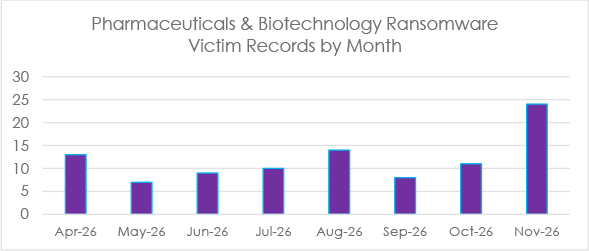
The monthly distribution indicates recurring ransomware-related disclosures throughout the assessment period, with considerable variations in reported activity.
Activity declined from 13 recorded entries in April to 7 in May, before increasing progressively to 14 in August. Following a reduction to 8 in September, activity increased to 11 in October and reached 24 entries by 18 November 2026.
Source: CYFIRMA
The November figure represents the highest monthly count in the dataset, exceeding the previous peak of 14 recorded in August. Although this increase warrants attention, November remains an incomplete reporting month and should be treated as an interim observation.
The persistence of victim disclosures across the assessment period indicates continued exposure of pharmaceutical and biotechnology organisations to ransomware-related extortion.
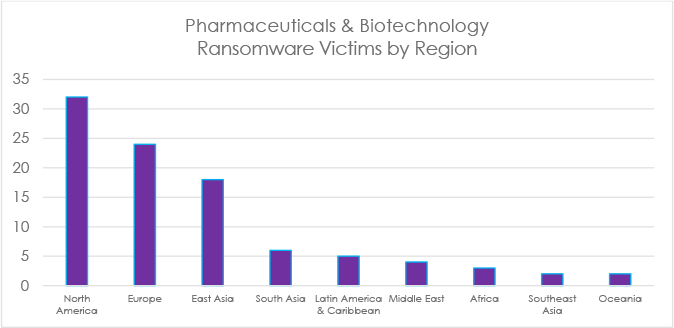
Ransomware-related victim records demonstrate a clear geographical concentration, with North America, Europe and East Asia collectively accounting for 74 of the 96 entries, representing approximately 77.1% of the dataset.
Source: CYFIRMA
North America represents the largest concentration, with 32 recorded entries (33.3%), followed by Europe with 24 (25.0%) and East Asia with 18 (18.8%). The remaining activity is distributed across South Asia, Latin America and the Caribbean, the Middle East, Africa, Southeast Asia and Oceania.
Source: CYFIRMA
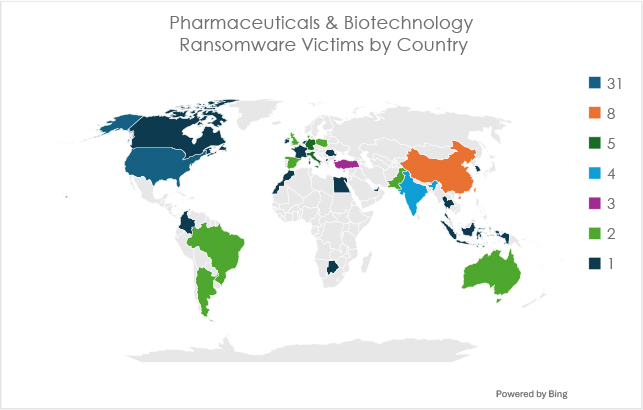
At the country level, the United States accounts for 31 victim records, representing approximately 32.3% of the total dataset. Taiwan and China each recorded 8 entries, followed by Italy and Germany with 5 each. India accounted for 4 entries.
The concentration of records in the United States, European markets and East Asia highlights the exposure of major pharmaceutical and biotechnology markets. Meanwhile, the presence of victims across other regions indicates that ransomware-related activity extends beyond these primary concentrations.
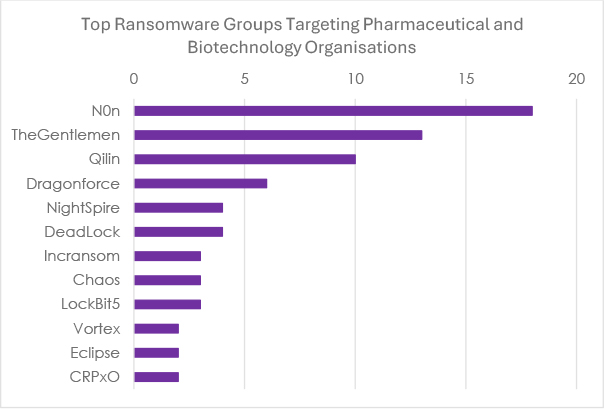
The collected intelligence identifies 38 ransomware groups associated with pharmaceutical and biotechnology victim records. To distinguish recurring targeting activity from isolated disclosures, the analysis focuses on groups associated with at least two recorded victims.
Of the 38 identified groups, 12 met this threshold and collectively accounted for 70 victim records. The remaining 26 groups were each associated with a single recorded victim and are excluded from the accompanying chart.
Source: CYFIRMA
N0n recorded the highest number of victim entries, with 18, followed by TheGentlemen with 13 and Qilin with 10. Together, these three groups account for 41 records, representing approximately 42.7% of the overall dataset.
Dragonforce followed with 6 entries, while NightSpire and DeadLock were each associated with 4. Incransom, Chaos and LockBit5 recorded 3 each, while Vortex, Eclipse and CRPxO recorded 2 each.
The distribution indicates that ransomware exposure is not concentrated around a single operation. Instead, multiple groups have appeared in pharmaceutical and biotechnology victim disclosures, with N0n, TheGentlemen and Qilin accounting for the largest recorded concentrations.
The collected intelligence highlights three significant characteristics of ransomware activity affecting the pharmaceutical and biotechnology sectors:
Extortion can expose proprietary research and manufacturing information, creating risks to intellectual property, regulatory obligations and business continuity.
Underground monitoring identified multiple listings involving pharmaceutical organisations, healthcare service providers and associated distribution networks. The observed activity includes advertised database leaks, alleged theft of proprietary research, compromised corporate access, cloud infrastructure exposure and the sale of sensitive business information.
The findings highlight exposure across several layers of the pharmaceutical ecosystem, ranging from research and intellectual property to commercial operations, employee information and healthcare-related data.
15 MAY 2026 | PHARMACEUTICAL MANUFACTURING AND DISTRIBUTION
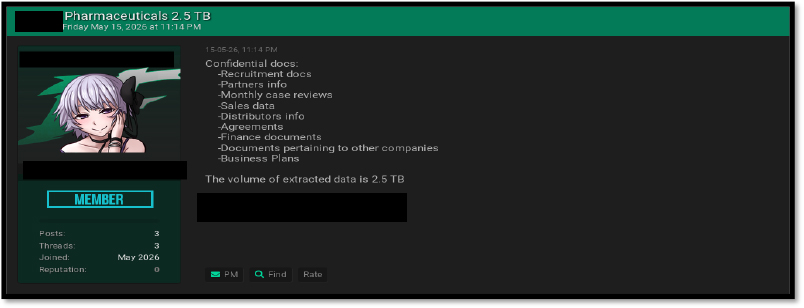
An underground forum listing advertised approximately 2.5 TB of allegedly extracted corporate information associated with a pharmaceutical organisation. The advertised material included recruitment records, business partner information, sales data, distributor records, financial documents, commercial agreements, internal case reviews and business plans.
The claimed exposure indicates potential access to commercially sensitive information, including internal business operations, distribution relationships and financial activities.
10 JUNE 2026 | HEALTHCARE ADMINISTRATION AND PROFESSIONAL REGISTRY
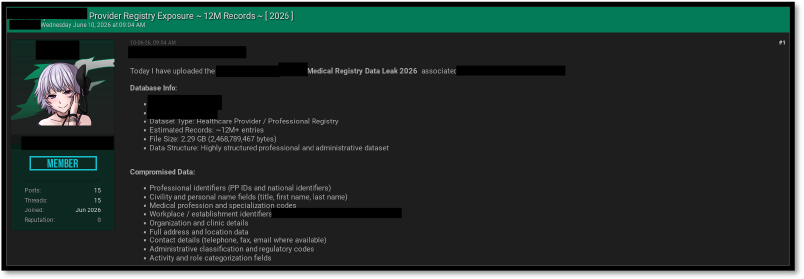
An underground forum user claimed to have uploaded a healthcare professional registry dataset containing more than 12 million records, with a reported file size of approximately 2.29 GB.
The advertised information included professional and national identifiers, personal names, medical specialities, workplace and establishment identifiers, clinic details, addresses, contact information and administrative classification records.
The claimed exposure represents a potential compromise of healthcare professional identities and administrative information on a substantial scale.
3 JULY 2026 | PHARMACEUTICAL AND BIOTECHNOLOGY INFRASTRUCTURE
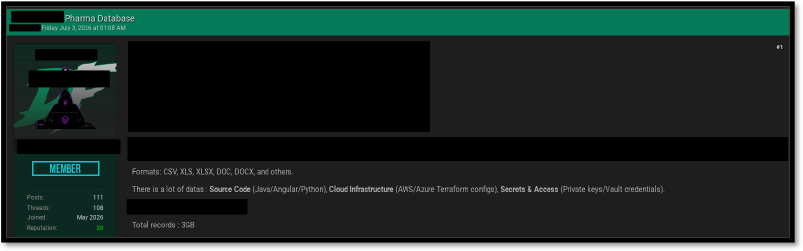
An underground listing advertised approximately 3 GB of pharmaceutical-related data in compressed archive format. The advertised material reportedly contained source code developed using Java, Angular and Python, alongside AWS and Azure infrastructure configurations, Terraform files, private keys and vault credentials.
The claimed exposure extends beyond conventional corporate records to include application source code, cloud infrastructure documentation and sensitive authentication material. If authentic, these assets could expose development environments and supporting cloud infrastructure to further compromise.
19 AUGUST 2026 | PHARMACEUTICAL MANUFACTURING AND BUSINESS OPERATIONS
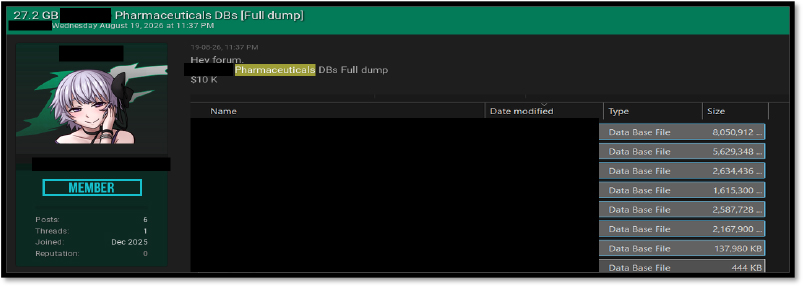
An underground forum user advertised a purported 27.2 GB pharmaceutical database dump, presented as a full extraction of multiple internal database files.
The displayed file inventory included databases associated with recruitment, master records, operational modules, healthcare services and other business functions. The listing was offered for sale as a consolidated database archive.
The advertised inventory suggests potential exposure across multiple internal business applications. However, the screenshot primarily establishes the presence of database files and does not independently verify their complete contents or authenticity.
27 AUGUST 2026 | PHARMACEUTICAL WHOLESALE AND CONTRACT MANUFACTURING
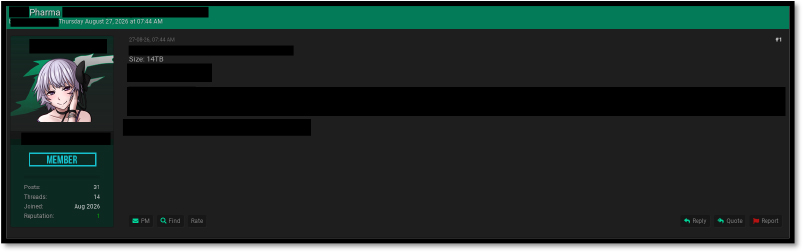
An underground listing advertised approximately 14 TB of data allegedly associated with a pharmaceutical wholesale and distribution organisation operating in the European market.
The post described business activities involving the import and distribution of patented and generic medicines, alongside contract manufacturing services for external clients. A download reference was provided, although the listing did not contain a detailed breakdown of the advertised dataset or sufficient sample material to assess the full extent of the alleged exposure.
The claimed volume warrants attention given the organisation’s involvement in pharmaceutical distribution and third-party manufacturing activities.
6 SEPTEMBER 2026 | PHARMACEUTICAL WHOLESALE AND PHARMACY RETAIL
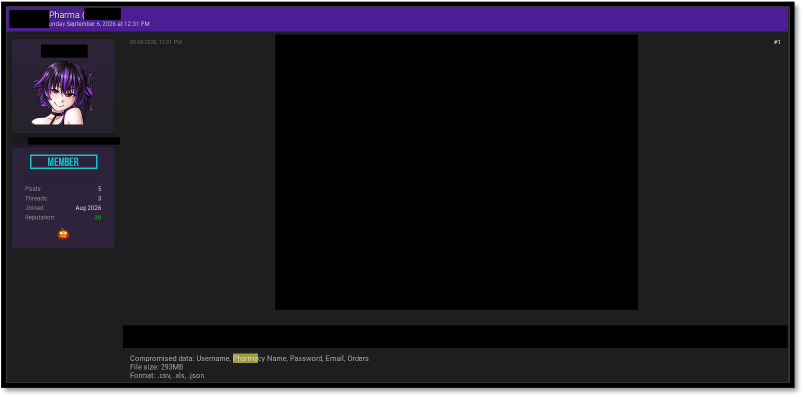
An underground listing claimed that internal business information associated with pharmaceutical wholesale, pharmacy retail and medical service operations in Serbia and Bulgaria had been compromised.
The advertised dataset, approximately 293 MB in size, reportedly contained pharmacy names, usernames, passwords, email addresses and order-related information in CSV, XLS and JSON formats.
The claimed exposure indicates potential compromise of business-to-business information, pharmacy-related credentials and operational records across the two markets.
7 OCTOBER 2026 | PHARMACEUTICAL AND MEDICAL DISTRIBUTION
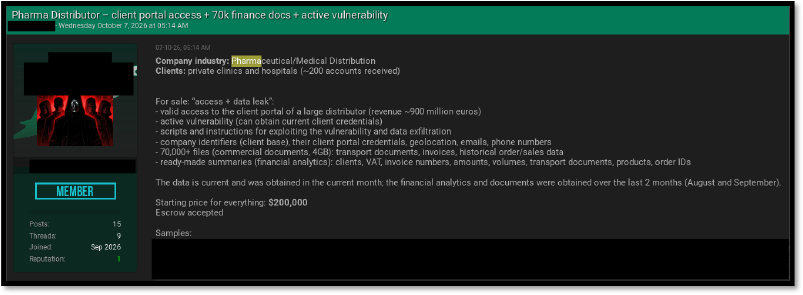
An underground access advertisement offered alleged access to the client portal of a large pharmaceutical and medical distributor. The seller claimed that the access involved approximately 200 client accounts and more than 70,000 documents, approximately 4 GB.
The advertised information included client identifiers, portal credentials, contact details, geolocation records, invoices, transport documents, historical orders and sales records. The seller additionally claimed to possess an active vulnerability and associated exploitation instructions that could enable the acquisition of current client credentials.
The offering represents a potential combination of unauthorised corporate access and data exposure, with implications for customer information, commercial relationships and distribution operations. The claimed access and vulnerability have not been independently validated.
11 OCTOBER 2026 | BIOTECHNOLOGY AND PHARMACEUTICAL R&D
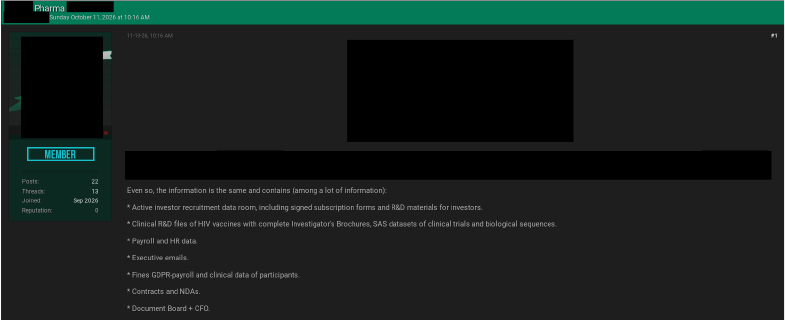
An underground forum user claimed access to systems associated with a biopharmaceutical organisation with historical HIV vaccine-development activities.
The advertised material reportedly included HIV vaccine clinical research files, Investigator Brochures, SAS clinical-trial datasets and biological sequences. Additional information included investor data-room documents, signed subscription forms, payroll and HR records, executive communications, financial information, contracts and non-disclosure agreements.
The listing is particularly significant because of the potential exposure of vaccine-development research and associated scientific information. The seller claimed to possess a larger dataset and offered a smaller sample as evidence of access. However, the authenticity, completeness and ownership of the advertised material remain unverified.
16 OCTOBER 2026 | HEALTHCARE PRODUCTS AND PHARMACEUTICAL DISTRIBUTION
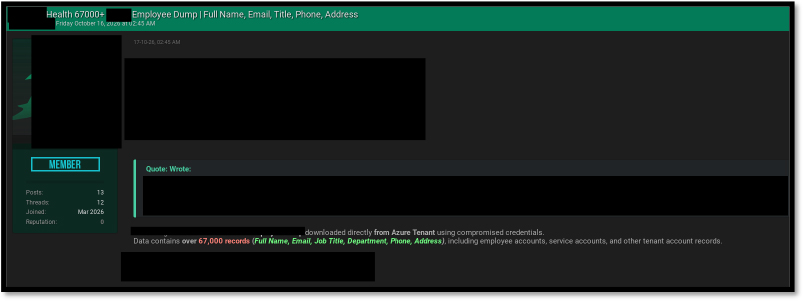
An underground listing advertised an employee and cloud-account database reportedly containing more than 67,000 records, allegedly obtained from a corporate Azure environment using compromised credentials.
The advertised information included employee names, email addresses, job titles, departments, phone numbers and residential addresses, alongside employee accounts, service accounts and other tenant-related records. A sample containing approximately 1,500 records was also offered.
The claimed exposure highlights potential risks associated with compromised cloud identities and unauthorised access to enterprise employee information and cloud environments.
1 NOVEMBER 2026 | TELEMEDICINE AND HEALTHCARE SERVICES
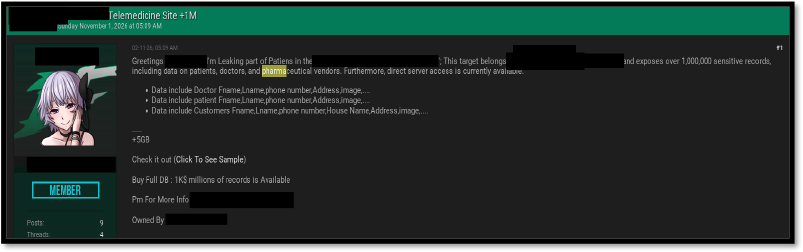
An underground listing advertised data allegedly associated with a Bangladesh-based telemedicine platform. The sellers claimed exposure of more than one million records and over 5 GB of information involving patients, medical professionals, customers and pharmaceutical vendors.
The advertised records reportedly included names, phone numbers, residential addresses and images. A subsequent listing also claimed that direct server access was available.
The inclusion of patient, medical professional and pharmaceutical vendor information makes the exposure relevant to the wider healthcare and pharmaceutical ecosystem. Both listings are treated as a single exposure lead to avoid duplicate reporting.
The collected intelligence identifies several areas of potential exposure across pharmaceutical organisations and their associated ecosystems:
A particularly notable aspect of the observed activity is the exposure of information beyond conventional customer databases. The advertised datasets reportedly include software source code, cloud infrastructure documentation, clinical research material, commercial intelligence and internal technical knowledge.
Overall, the findings indicate that underground exposure across the pharmaceutical ecosystem extends from proprietary research and corporate infrastructure to distribution operations and associated healthcare services. The presence of sensitive research, commercial information and alleged corporate access in underground listings highlights the importance of monitoring not only data-leak claims, but also the sale of compromised access and specialised pharmaceutical information.
Pharmaceutical organisations should adopt a risk-based security approach focused on protecting proprietary research, restricting unauthorised access and maintaining the resilience of critical business and manufacturing operations.
Strengthen Research and Intellectual Property Protection
Implement strict access controls across R&D repositories, clinical-trial databases and proprietary research environments. Monitor bulk data access, unusual downloads and unauthorised external transfers to detect potential intellectual property theft.
Secure Enterprise Identity and Cloud Infrastructure
Enforce phishing-resistant Multi-Factor Authentication (MFA), privileged access controls and regular credential rotation. Strengthen authentication, protect cloud secrets and monitor suspicious administrative activity, particularly across cloud and container environments.
Reduce Exposure to Exploitable Vulnerabilities
Maintain continuous visibility of internet-facing assets and prioritise remediation of actively exploited vulnerabilities. Ensure timely patching of vulnerable applications, archive utilities, remote-access services and exposed enterprise infrastructure.
Strengthen Third-Party and Manufacturing Security
Restrict external supplier and contractor access to approved systems through monitored, time-limited connections. Separate manufacturing Operational Technology (OT) from corporate networks and monitor access to production-critical systems.
Improve Ransomware Preparedness and Recovery
Maintain immutable, offline backups of research, clinical, and manufacturing data. Regularly test recovery procedures and establish incident-response plans that address both data exfiltration and system encryption.
Establish Continuous Threat Exposure Monitoring
Monitor Dark Web marketplaces, ransomware leak sites and underground forums for exposed credentials, corporate access, research information and pharmaceutical data. Validate relevant claims against internal telemetry and initiate investigations where potential exposure is identified.
The charts, technical tables and underground evidence screenshots are retained alongside the relevant analysis to preserve context. Underground listings and advertised access are presented as claims unless independently corroborated. Ransomware totals represent the records collected for this assessment; the group chart includes only groups associated with two or more victim entries.
The dataset identifies 96 victim records across 31 countries and 38 ransomware groups. The repeated-targeting chart displays 12 groups with at least two recorded victim entries; the remaining 26 groups, each associated with one entry, are excluded from that chart. November 2026 figures are an interim snapshot as of 18 November 2026.
