
CYFIRMA Research and Advisory Team would like to highlight ransomware trends and insights gathered while monitoring various forums. This includes multiple industries, geographies, and technologies that could be relevant to your organisation.
Type: Ransomware
Target Technologies: Windows OS
Introduction
CYFIRMA Research and Advisory Team has found Black Lotus Ransomware while monitoring various underground forums as part of our Threat Discovery Process.
Black Lotus Ransomware
Black Lotus is a file-encrypting ransomware that targets Windows systems, rendering files inaccessible and demanding payment for their recovery. Upon execution, the ransomware encrypts accessible files and appends the .black_lotus extension to their original filenames. For example, a file named 1.jpg is renamed to 1.jpg.black_lotus. Following encryption, the ransomware creates a ransom note named how2recovery.txt and modifies the desktop wallpaper to display an encryption notification. These activities are intended to disrupt access to affected files and pressure victims into complying with the attackers’ demands.
The ransomware employs an extortion mechanism in which attackers claim that encrypted files can only be restored using their proprietary decryptor and corresponding encryption key. The ransom message refers to network-wide encryption, suggesting potential interest in organizational environments where disruption to critical systems and shared resources could increase pressure on victims. However, the available evidence does not independently establish network-wide propagation, data exfiltration, or double-extortion capabilities.
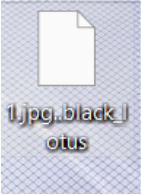
Screenshot: File encrypted by the Black Lotus ransomware (Source: Surface Web)
The ransom note, how2recovery.txt, informs victims that their network has been encrypted and that files bearing the .black_lotus extension cannot be recovered without the attackers’ decryptor and cipher key. Victims are instructed to initiate negotiations through Telegram or a Simplex-based communication channel and provide their assigned victim identifier when establishing contact.
The note further warns victims against modifying or renaming encrypted files, attempting recovery through third-party utilities, or contacting law enforcement agencies and incident response specialists. The attackers claim that these actions could result in permanent data loss or increased ransom demands. Additionally, the message uses time-based pressure tactics, stating that the ransom amount will increase with delays and that the decryptor will become unavailable after a specified deadline. These claims are intended to create urgency, discourage independent recovery efforts, and compel victims to negotiate directly with the attackers. The attackers’ statements do not guarantee successful decryption or recovery of affected files.
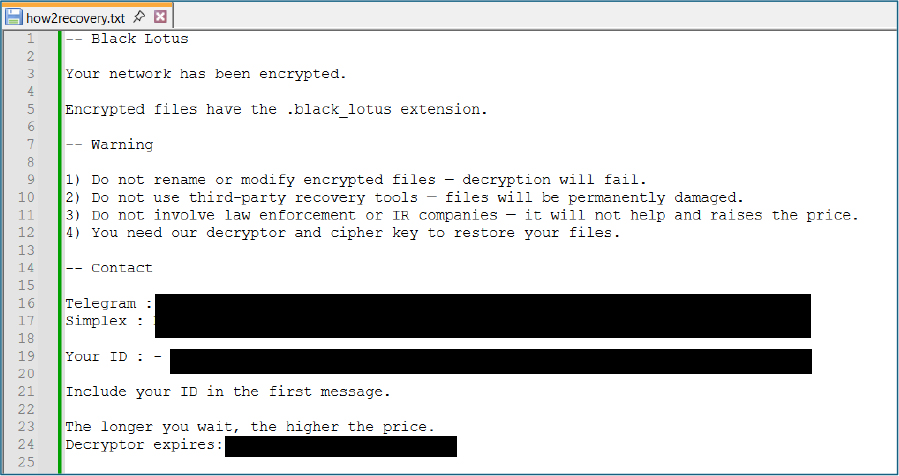
Screenshot: The appearance of Black Lotus Ransomware’s ransom note (how2recovery.txt) (Source: Surface Web)
The following are the TTPs based on the MITRE ATT&CK framework
| Tactic | Technique ID | Technique Name |
| Execution | T1047 | Windows Management Instrumentation |
| Execution | T1053 | Scheduled Task/Job |
| Execution | T1574 | Hijack Execution Flow |
| Privilege Escalation | T1053 | Scheduled Task/Job |
| Privilege Escalation | T1055 | Process Injection |
| Privilege Escalation | T1134 | Access Token Manipulation |
| Credential Access | T1056 | Input Capture |
| Discovery | T1033 | System Owner/User Discovery |
| Discovery | T1057 | Process Discovery |
| Discovery | T1082 | System Information Discovery |
| Discovery | T1083 | File and Directory Discovery |
| Discovery | T1124 | System Time Discovery |
| Collection | T1056 | Input Capture |
| Collection | T1560 | Archive Collected Data |
| Command and Control | T1071 | Application Layer Protocol |
| Impact | T1486 | Data Encrypted for Impact |
| Impact | T1490 | Inhibit System Recovery |
| Impact | T1491 | Defacement |
| Stealth | T1006 | Direct Volume Access |
| Stealth | T1027.002 | Obfuscated Files or Information: Software Packing |
| Stealth | T1036 | Masquerading |
| Stealth | T1055 | Process Injection |
| Stealth | T1070.004 | Indicator Removal: File Deletion |
| Stealth | T1134 | Access Token Manipulation |
| Stealth | T1564.003 | Hide Artifacts: Hidden Window |
| Stealth | T1574 | Hijack Execution Flow |
| Defense Impairment | T1685.001 | Disable or Modify Tools: Disable or Modify Windows Event Log |
| Defense Impairment | T1553.002 | Subvert Trust Controls: Code Signing |
Relevancy and Insights:
ETLM Assessment:
Black Lotus ransomware may evolve toward more sophisticated encryption and attack execution capabilities as its operators attempt to increase operational disruption and evade security controls. Future variants could incorporate enhanced anti-analysis mechanisms, executable obfuscation, and techniques designed to bypass endpoint security solutions. The ransomware may also develop capabilities to identify and terminate security-related processes, interfere with backup services, and remove recovery mechanisms before initiating encryption. Additionally, future versions could adopt faster or selective file-encryption techniques, allowing attackers to compromise larger volumes of data while reducing the time available for detection and response.
As the ransomware develops, its operators may expand beyond individual endpoint encryption to target enterprise networks, shared storage systems, and interconnected infrastructure. Potential attack developments include the exploitation of vulnerable internet-facing services, credential-based access, automated network discovery, and lateral movement to compromise additional systems within an organization. Future variants may also introduce data-exfiltration capabilities and adopt double-extortion techniques, combining file encryption with threats to disclose sensitive information. Furthermore, the operators could implement dedicated negotiation portals, automated victim communication, and rotating attack infrastructure to strengthen their extortion operations and complicate threat investigations. These developments represent possible evolutionary directions based on established ransomware trends rather than confirmed capabilities of Black Lotus. Their realization will depend on the operators’ technical capabilities, available resources, and ability to adapt to improving cybersecurity defenses.
Sigma rules:
title: Boot Configuration Tampering Via Bcdedit.EXE
tags:
– attack.impact
– attack.t1490
logsource:
category: process_creation
product: windows
detection:
selection_img:
– Image|endswith: ‘\bcdedit.exe’
– OriginalFileName: ‘bcdedit.exe’
selection_set:
CommandLine|contains: ‘set’
selection_cli:
– CommandLine|contains|all:
– ‘bootstatuspolicy’
– ‘ignoreallfailures’
– CommandLine|contains|all:
– ‘recoveryenabled’
– ‘no’
condition: all of selection_*
falsepositives:
– Unlikely
level: high
(Source: Surface Web)
IOCs:
Kindly refer to the IOCs section to exercise control of your security systems.
(Source: Surface Web)
STRATEGIC RECOMMENDATIONS
MANAGEMENT RECOMMENDATIONS
TACTICAL RECOMMENDATIONS
Type: Infostealer / Stealer
Objectives: Credential Theft and Data Exfiltration
Target Technology: Windows
Target Geography: Global
CYFIRMA collects data from various forums based on which the trend is ascertained. We identified a few popular malwares that were found to be distributed in the wild to launch cyberattacks on organizations or individuals.
Active Malware of the Week
This week, VeeraStealer Malware is in focus.
Overview of Operation VeeraStealer Malware
The analysis of the sample identified as VeeraStealer reveals a malicious program designed to obtain sensitive information and establish a sustained presence within compromised systems. Its behavior indicates a deliberate attempt to access valuable user and system data while operating discreetly, distinguishing it from legitimate software and routine system processes.
The malware demonstrates the ability to collect information stored on compromised devices, including browser credentials, saved wireless network details, and other locally available data. Its interaction with system configurations, registry settings, and local files further indicates an effort to gather information from multiple areas of the affected environment, potentially exposing sensitive personal and organizational information.
The sample also incorporates mechanisms to maintain its execution across system restarts and subsequent user log-ons. Alongside these activities, it employs concealment techniques intended to reduce its visibility and make its presence less noticeable. These capabilities could allow the malware to remain active on compromised systems without immediately attracting the attention of users or administrators.
Furthermore, the malware maintains communication with external infrastructure associated with the threat actor, enabling continued interaction with affected systems. The combination of information gathering, concealed execution, persistence, and external communication highlights VeeraStealer as a significant security threat, with the potential to expose sensitive information and undermine the security of compromised endpoints.
Attack Method
Upon execution on a Windows system, VeeraStealer establishes an initial execution environment by creating the mutexes G{C4F406E5-F024-4e3f-89A7-D5AB7663C3CD} and MSCTF.Asm.MutexDefault1. These mutexes prevent multiple instances of the malware from running simultaneously. The sample subsequently performs limited environment checks to identify relevant system conditions and may modify its execution flow or terminate when certain conditions are encountered. Its use of reflective, memory-based execution techniques complicates conventional static inspection. Additionally, memory and thread manipulation consistent with process injection enables malicious code to execute within the context of legitimate processes, potentially reducing its visibility to security monitoring mechanisms and application-control solutions.
To maintain execution across system restarts and user sessions, VeeraStealer establishes persistence through multiple Windows mechanisms. It creates scheduled tasks to trigger execution at predefined intervals or during system start-up and modifies the Windows Run registry key to initiate the payload whenever the affected user logs on. These mechanisms provide alternative execution paths, allowing the malware to regain execution even after interruptions. Its reliance on memory-based execution and concealed payload structures further complicates identification through conventional file-based security inspection.
The malware’s primary operational objective involves collecting sensitive information from the compromised host. Observed activities include accessing Windows credential stores, retrieving browser-stored passwords and authentication cookies, and reading locally available files that may contain valuable documents or configuration information. It also exports previously saved wireless network profiles in clear text through the command netsh wlan export profile key=clear, potentially exposing stored Wi-Fi credentials. In addition, its screen-capture functionality allows it to record the active desktop, potentially exposing confidential information displayed during user activity. These collection routines are supported by system and process discovery activities, which provide visibility into the host environment and the security tools operating on it.
Following information collection, VeeraStealer maintains communication with two external endpoints, including ip-api.com, as part of its network communication activity. The collected information is potentially prepared for transfer through these external connections. The combination of credential harvesting, browser data collection, local file access, screen capture, persistence, and process-level manipulation demonstrates a multi-stage information theft operation. These capabilities allow the malware to establish continued access to compromised Windows systems while gathering information that could be valuable to the threat actor.
The following are the TTPs based on the MITRE ATT&CK Framework for Enterprises
| Tactic | Technique | Technique Name |
| Execution | T1047 | Windows Management Instrumentation |
| T1059 | Command and Scripting Interpreter | |
| T1129 | Shared Modules | |
| T1574 | Hijack Execution Flow | |
| Persistence | T1112 | Modify Registry |
| T1053.005 | Scheduled Task/Job: Scheduled Task | |
| T1543 | Create or Modify System Process | |
| T1547.001 | Boot or Logon Autostart Execution: Registry Run Keys / Startup Folder | |
| Stealth | T1027.002 | Obfuscated Files or Information: Software Packing |
| T1036 | Masquerading | |
| T1140 | Deobfuscate/Decode Files or Information | |
| T1202 | Indirect Command Execution | |
| T1564.003 | Hide Artifacts: Hidden Window | |
| Credential Access | T1555.003 | Credentials from Password Stores: Credentials from Web Browsers |
| Discovery | T1033 | System Owner/User Discovery |
| T1497.001 | Virtualization/Sandbox Evasion: System Checks | |
| T1057 | Process Discovery | |
| T1082 | System Information Discovery | |
| T1083 | File and Directory Discovery | |
| T1087 | Account Discovery | |
| T1518 | Software Discovery | |
| T1614 | System Location Discovery | |
| Collection | T1113 | Screen Capture |
| T1125 | Video Capture | |
| Command and control | T1071 | Application Layer Protocol |
| T1573 | Encrypted Channel | |
| Impact | T1485 | Data Destruction |
| T1486 | Data Encrypted for Impact |
INSIGHTS
ETLM ASSESSMENT
From an ETLM perspective, the continued evolution of information-stealing malware such as VeeraStealer could increase the frequency and business impact of identity-driven cyber incidents. Organizations may face growing challenges in distinguishing legitimate user activity from actions performed through compromised accounts, particularly as stolen identities are increasingly used to access business applications, internal communication platforms, and sensitive corporate resources. For employees, the consequences could extend beyond the initial compromise, potentially involving misuse of professional identities, exposure of confidential communications, and unauthorized access to work-related services. Over time, such incidents may place greater pressure on organizational trust, business continuity, and incident response capabilities, while increasing the financial and operational consequences associated with compromised employee identities.
IOCs:
Kindly refer to the IOCs below to exercise controls on your security systems.
(Source: Open Surface)
YARA Rules
rule VeeraStealer_Malware
{
meta:
description = “Detection rule for the analyzed malware sample”
author = “CYFIRMA Research”
strings:
$hash1 = “c9b930126b19e2b1673d97d9080774d38a788404179f1c99ec6f8b817c02388d”
$hash2 = “b82bc79abd8fffd0156d6db5ff10b0a75192c033”
$hash3 = “4926a347a8de6a58310df67a858c41bc”
$s1 = “schtasks\” /create /tn \”WindowsUpdate\” /tr \”\\\”C:\\Users\\<USER>\\Desktop\\Veera.exe\\\” –auto\” /sc ONLOGON /f”
$s2 = “netsh\” wlan show profiles”
$s3 = “C:\\Windows\\system32\\sc.exe start wuauserv”
$s4 = “C:\\Windows\\system32\\wbem\\wmiprvse.exe -secured -Embedding”
$s5 = “C:\\Windows\\System32\\svchost.exe -k netsvcs -p”
$s6 = “C:\\Program Files (x86)\\Microsoft\\EdgeUpdate\\MicrosoftEdgeUpdate.exe\” /svc”
$s7 = “C:\\Windows\\System32\\svchost.exe -k NetworkService -p”
$s8 = “C:\\Windows\\system32\\svchost.exe -k LocalService -s W32Time”
$s9 = “C:\\Windows\\system32\\svchost.exe -k UnistackSvcGroup”
$s10 = “C:\\Windows\\system32\\lsass.exe”
$s11 = “C:\\Program Files\\Google\\Update\\1.3.36.372\\GoogleCrashHandler.exe”
$s12 = “C:\\Program Files\\Google\\Update\\GoogleUpdate.exe\” /ua /installsource core”
$s13 = “C:\\Program Files\\Google\\Update\\GoogleUpdate.exe\” /svc”
$s14 = “schtasks\” /create /tn \”WindowsUpdate\” /tr \”\\\”C:\\Users\\user\\AppData\\Local\\Temp\\23b31dec10796badd552312ef67c55a0.exe\\\” –auto\” /sc ONLOGON /f”
$s15 = “G{C4F406E5-F024-4e3f-89A7-D5AB7663C3CD}”
$s16 = “MSCTF.Asm.MutexDefault1”
$s17 = “RasPbFile”
$s18 = “C:\\Users\\<USER>\\AppData\\Local\\Temp\\vs_cefd73057212404fbdaa6b87c054c30f.png”
$s19 = “vs_cefd73057212404fbdaa6b87c054c30f.png”
$s20 = “C:\\Users\\<USER>\\AppData\\Local\\Temp\\v6d79f6fbb3\\4f0fcf86280f418f87e107578f94ff5a.db”
$s21 = “4f0fcf86280f418f87e107578f94ff5a.db”
$s22 = “C:\\Users\\<USER>\\AppData\\Local\\Temp\\v6d79f6fbb3\\fc34a0a2795746f78a136d1b9a3284b4.db”
$s23 = “fc34a0a2795746f78a136d1b9a3284b4.db”
$s24 = “VeeraStealer”
condition:
any of ($hash*) or
3 of ($s*)
}
Strategic Recommendations
Management Recommendations
Tactical Recommendations
Key Intelligence Signals:
Turla Group: Advancing Covert Cyber Espionage Capabilities
About the Threat Actor
Turla, also known as Snake and Uroburos, is a Russian-nexus cyberespionage group active since at least 2004. The group primarily conducts long-term intelligence-gathering operations against government, diplomatic, and other strategically significant organizations. Turla is known for using spear-phishing and watering hole attacks, along with sophisticated malware, such as Snake, Kazuar, ComRAT, and Carbon. Its operations focus on maintaining covert access, conducting surveillance, stealing sensitive information, and exfiltrating data while avoiding detection.
Details on Exploited Vulnerabilities
| CVE ID | Affected Products | CVSS Score | Exploit Links |
| CVE-2019-11072 | Lighttpd Web Server (versions before 1.4.54) | 9.8 | – |
| CVE-2022-22707 | Lighttpd Web Server | 5.9 | – |
| CVE-2024-20354 | Cisco Aironet Access Point (AP) Software | 7.4 | – |
| CVE-2024-20418 | Cisco Unified Industrial Wireless Software for Cisco Ultra-Reliable Wireless Backhaul (URWB) Access Points. | – | – |
| CVE-2025-52579 | Emerson ValveLink Products. | – | – |
TTPs based on the MITRE ATT&CK Framework
| Tactic | ID | Technique |
| Resource Development | T1587.001 | Develop Capabilities: Malware |
| Resource Development | T1583.006 | Acquire Infrastructure: Web Services |
| Resource Development | T1584.003 | Compromise Infrastructure: Virtual Private Server |
| Resource Development | T1584.004 | Compromise Infrastructure: Server |
| Resource Development | T1584.006 | Compromise Infrastructure: Web Services |
| Resource Development | T1588.002 | Obtain Capabilities: Tool |
| Resource Development | T1588.001 | Obtain Capabilities: Malware |
| Initial Access | T1189 | Drive-by Compromise |
| Initial Access | T1078.003 | Valid Accounts: Local Accounts |
| Initial Access | T1566.002 | Phishing: Spear phishing Link |
| Execution | T1106 | Native API |
| Execution | T1204.001 | User Execution: Malicious Link |
| Execution | T1059.003 | Command and Scripting Interpreter: Windows Command Shell |
| Execution | T1059.006 | Command and Scripting Interpreter: Python |
| Execution | T1059.007 | Command and Scripting Interpreter: JavaScript |
| Execution | T1059.005 | Command and Scripting Interpreter: Visual Basic |
| Persistence | T1078.003 | Valid Accounts: Local Accounts |
| Persistence | T1547.001 | Boot or Logon Autostart Execution: Registry Run Keys / Startup Folder |
| Persistence | T1547.004 | Boot or Logon Autostart Execution: Winlogon Helper DLL |
| Persistence | T1112 | Modify Registry |
| Persistence | T1546.003 | Event Triggered Execution: Windows Management Instrumentation Event Subscription |
| Persistence | T1546.013 | Event Triggered Execution: PowerShell Profile |
| Privilege Escalation | T1547.001 | Boot or Logon Autostart Execution: Registry Run Keys / Startup Folder |
| Privilege Escalation | T1547.004 | Boot or Logon Autostart Execution: Winlogon Helper DLL |
| Privilege Escalation | T1078.003 | Valid Accounts: Local Accounts |
| Privilege Escalation | T1546.003 | Event Triggered Execution: Windows Management Instrumentation Event Subscription |
| Privilege Escalation | T1546.013 | Event Triggered Execution: PowerShell Profile |
| Privilege Escalation | T1068 | Exploitation for Privilege Escalation |
| Privilege Escalation | T1055 | Process Injection |
| Privilege Escalation | T1055.001 | Process Injection: Dynamic-link Library Injection |
| Privilege Escalation | T1134.002 | Access Token Manipulation: Create Process with Token |
| Stealth | T1078.003 | Valid Accounts: Local Accounts |
| Stealth | T1134.002 | Access Token Manipulation: Create Process with Token |
| Stealth | T1140 | Deobfuscate/Decode Files or Information |
| Stealth | T1564.012 | Hide Artifacts: File/Path Exclusions |
| Stealth | T1036.005 | Masquerading: Match Legitimate Resource Name or Location |
| Stealth | T1055.001 | Process Injection: Dynamic-link Library Injection |
| Stealth | T1055 | Process Injection |
| Stealth | T1027.005 | Obfuscated Files or Information: Indicator Removal from Tools |
| Stealth | T1027.010 | Obfuscated Files or Information: Command Obfuscation |
| Stealth | T1027.011 | Obfuscated Files or Information: Fileless Storage |
| Defense Impairment | T1112 | Modify Registry |
| Defense Impairment | T1685 | Disable or Modify Tools |
| Defense Impairment | T1553.006 | Subvert Trust Controls: Code Signing Policy Modification |
| Credential Access | T1110 | Brute Force |
| Credential Access | T1555.004 | Credentials from Password Stores: Windows Credential Manager |
| Discovery | T1083 | File and Directory Discovery |
| Discovery | T1615 | Group Policy Discovery |
| Discovery | T1201 | Password Policy Discovery |
| Discovery | T1120 | Peripheral Device Discovery |
| Discovery | T1069.001 | Permission Groups Discovery: Local Groups |
| Discovery | T1069.002 | Permission Groups Discovery: Domain Groups |
| Discovery | T1057 | Process Discovery |
| Discovery | T1018 | Remote System Discovery |
| Discovery | T1087.001 | Account Discovery: Local Account |
| Discovery | T1087.002 | Account Discovery: Domain Account |
| Discovery | T1518.001 | Software Discovery: Security Software Discovery |
| Discovery | T1007 | System Service Discovery |
| Discovery | T1082 | System Information Discovery |
| Discovery | T1012 | Query Registry |
| Discovery | T1016 | System Network Configuration Discovery |
| Discovery | T1016.001 | System Network Configuration Discovery: Internet Connection Discovery |
| Discovery | T1049 | System Network Connections Discovery |
| Discovery | T1124 | System Time Discovery |
| Lateral Movement | T1021.002 | Remote Services: SMB/Windows Admin Shares |
| Lateral Movement | T1570 | Lateral Tool Transfer |
| Collection | T1213.006 | Data from Information Repositories: Databases |
| Collection | T1025 | Data from Removable Media |
| Collection | T1560.001 | Archive Collected Data: Archive via Utility |
| Collection | T1005 | Data from Local System |
| Command and Control | T1071.001 | Application Layer Protocol: Web Protocols |
| Command and Control | T1071.003 | Application Layer Protocol: Mail Protocols |
| Command and Control | T1090 | Proxy |
| Command and Control | T1090.001 | Proxy: Internal Proxy |
| Command and Control | T1105 | Ingress Tool Transfer |
| Command and Control | T1102 | Web Service |
| Command and Control | T1102.002 | Web Service: Bidirectional Communication |
| Exfiltration | T1567.002 | Exfiltration Over Web Service: Exfiltration to Cloud Storage |
Latest Developments Observed
Turla Group is suspected of targeting government organizations through a sophisticated malware toolset designed to compromise Microsoft Exchange servers and conduct covert cyberespionage. The group deployed a modular set of components, including CerealNeuron, a passive backdoor that uses the compromised Exchange server as an operator-accessible control point without relying on external command-and-control infrastructure, and CerealBox, which injects into the Exchange transport service to intercept and collect selected email communications. The toolset also enables operators to execute commands, retrieve mailbox data and attachments, query Active Directory, and access sensitive system information, while using in-memory execution, process injection, obfuscation, and other stealth techniques to evade detection. The activity appears aimed at long-term cyberespionage and intelligence collection, including the monitoring of sensitive government and institutional communications.
ETLM Insights
Turla Group is assessed as a Russia-linked state-sponsored advanced persistent threat (APT) group primarily engaged in long-term cyberespionage and strategic intelligence collection. The group demonstrates a mature and disciplined operational model, emphasizing stealth, persistence, and covert access to strategically valuable environments. Its continued development of specialized intrusion capabilities reflects an emphasis on maintaining access to sensitive networks while supporting intelligence-driven operations.
Looking ahead, Turla Group is likely to continue refining its cyberespionage capabilities through the development of specialized malware, advanced persistence mechanisms, and stealth-oriented intrusion techniques. Its demonstrated ability to exploit trusted enterprise environments and collect sensitive communications indicates a continued focus on covert intelligence gathering. This evolving operational approach positions the group as a persistent strategic cyberespionage threat to organizations handling sensitive government, diplomatic, defense, and national security information.
IOCs
Kindly refer to the IOCs Section to exercise controls on your security systems.
YARA Rules
rule Suspicious_EditorToolsPDF_Activity
{
meta:
description = “Detects files containing supplied network indicators and EditorToolsPDF-related executable or path indicators”
author = “CYFIRMA”
date = “2026-11-17”
reference_cves = “CVE-2019-11072, CVE-2022-22707, CVE-2024-20354, CVE-2024-20418, CVE-2025-52579”
note = “CVE identifiers are contextual references and are not used as detection signatures”
strings:
// IP addresses
$ip1 = “209.126.11.251” ascii wide
$ip2 = “176.57.184.97” ascii wide
$ip3 = “173.212.252.2” ascii wide
$ip4 = “167.86.118.69” ascii wide
$ip5 = “164.68.108.153” ascii wide
// Domains
$domain1 = “performance.now” ascii wide nocase
$domain2 = “lakihelppi.com” ascii wide nocase
$domain3 = “octoberctopus.co.za” ascii wide nocase
$domain4 = “sansaispa.com” ascii wide nocase
// Executable names
$exe1 = “converterddsnet.exe” ascii wide nocase
$exe2 = “viewpdf.exe” ascii wide nocase
// Supplied executable paths
$path1 = “C:\\Users\\User\\AppData\\Local\\Temp\\hdqmbgwo.vbg\\EditorToolsPDF\\converterddsnet.exe” ascii wide nocase
$path2 = “%LocalAppData%\\Programs\\EditorToolsPDF\\converterddsnet.exe” ascii wide nocase
$path3 = “C:\\Users\\User\\AppData\\Local\\Temp\\hdqmbgwo.vbg\\EditorToolsPDF\\viewpdf.exe” ascii wide nocase
condition:
(
any of ($ip*) or any of ($domain*)
)
and
(
any of ($exe*) or any of ($path*)
)
}
Strategic Recommendations
Management Recommendations
Tactical Recommendations
France blames Iran for massive hack
French authorities have officially blamed Iran for a recent wave of disruptive cyberattacks targeting industrial refrigeration systems across Europe. The digital sabotage struck over 700 French supermarkets, intentionally raising storage temperatures and ruining tens of millions of dollars’ worth of perishable food. In a dangerous escalation, the perpetrators also unsuccessfully targeted a French blood bank in an attempt to destroy critical medical supplies. Similar intrusions were reported at grocery chains in several neighboring European nations last week.
Paris has linked the campaign to Shahid Kaveh, an offensive cyber unit operating under the Electronic and Cyber Warfare Command of Iran’s Islamic Revolutionary Guard Corps (IRGC). In response, the Paris prosecutor’s office is actively pursuing international arrest warrants for the unit’s leadership.
Speaking at a G-7 summit, French Foreign Minister Jean-Noël Barrot warned that Tehran will face consequences for the operations. Calling the incident a major threat to national interests and public safety, Barrot noted that it represents the first large-scale cyberattack aimed specifically at physical sabotage on French soil. While U.S. officials have joined the investigation and noted that the breaches carry the technical signatures of previous Iranian operations, Washington has stopped short of issuing a formal attribution.
ETLM Assessment
Strategically, Tehran likely launched these sabotage operations to dramatically raise the economic and domestic costs for European nations and deter them from backing the United States in its war effort. Because Iran cannot match Western conventional military power directly, it relies on asymmetric cyber warfare to target vulnerable civilian infrastructure—such as food supply chains and medical storage—to sow public anxiety and inflict immediate financial pain. By demonstrating that support for Washington carries direct, tangible consequences on European soil, Iran aims to fracture Western cohesion and pressure U.S. allies into neutrality or restraint.
Russia’s digital infrastructure struggles with recovery from cyberattack
Two weeks after a major cyberattack crippled parts of its digital infrastructure, Russia’s federal statistics service, Rosstat, is still struggling to collect and publish core economic data—leaving policymakers without essential tools for governing.
Although Rosstat’s website was restored on November 5, large sections of its database remain inaccessible. After releasing a preliminary third-quarter GDP estimate on Friday, pages hosting the underlying Excel spreadsheets returned “404” errors by Saturday. Key inflation metrics have also stalled: the agency postponed its October consumer price report from November 13 to November 25 and has delayed weekly inflation figures for two consecutive weeks.
Data collection has been similarly disrupted. On November 10, Rosstat extended the deadline for businesses to file statistical reports by a week to November 20, citing temporary system restrictions. According to Bloomberg Intelligence economist Ekaterina Vlasova, because the Bank of Russia, regional authorities, and the finance and economy ministries depend heavily on Rosstat to set interest rates, draft budgets, and forecast growth, any serious interruption in data flow effectively impairs day-to-day government operations.
Rosstat previously acknowledged experiencing “targeted destructive cyberattacks” between October 29 and November 1, though it maintained that its databases were not compromised. However, the Belarusian opposition group Cyber Partisans and the Ukrainian hacker collective Silent Crow claimed responsibility for extracting roughly 23 terabytes of data from the agency—leaked records that, according to Bloomberg, indicate approximately 400,000 Russians have been killed fighting in Ukraine.
ETLM Assessment
In modern conflict, virtually every state institution—even seemingly administrative agencies like a national statistics bureau—becomes a legitimate strategic target, as paralyzing government operations directly undermines a regime’s ability to function and wage war. Beyond the immediate technical disruption to economic policymaking, the psychological impact of exposing hidden casualty figures carries immense weight in the information battlespace. Revealing the true scale of roughly 400,000 military deaths delivers a major morale boost to Ukrainian forces and civilians by offering tangible proof that their resistance is inflicting heavy, unsustainable losses on the invader. Conversely, piercing the Kremlin’s tightly controlled information bubble with stark mortality data risks eroding public support, fueling war weariness, and sapping morale among both Russian troops at the front and families back home.
Qilin Ransomware Impacts an Electronics Manufacturing Company from Japan
Summary:
CYFIRMA observed on a ransomware data leak site (DLS) on the dark web that a company from Japan was compromised by Qilin Ransomware. The compromised company is a Japanese trading and manufacturing-oriented company specialising in electrical wires, electronic materials, industrial components, and water-treatment technologies. The company initially focused on supplying electrical wires and magnet wires to Japanese manufacturers. It subsequently expanded into water filtration, environmental technologies, and observation equipment. It also maintains overseas business operations in Asia. The compromised data includes confidential and sensitive information belonging to the organization.
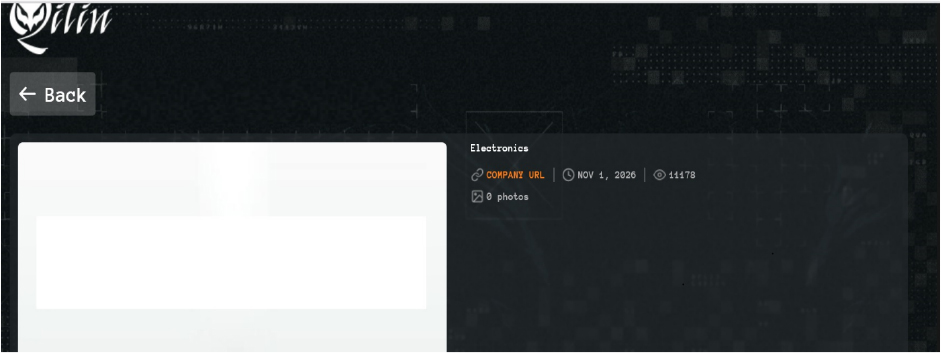
Source: Dark Web
Relevancy & Insights:
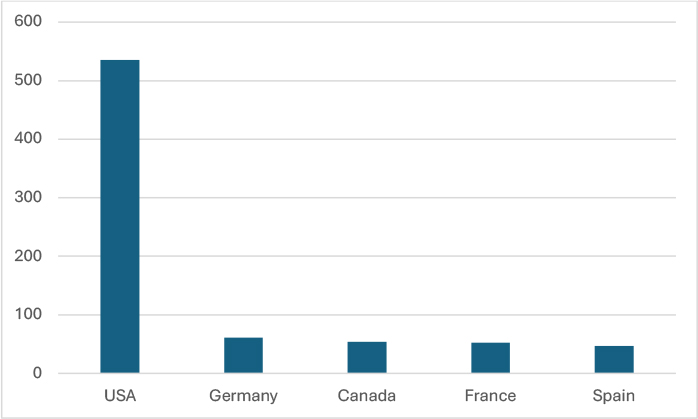
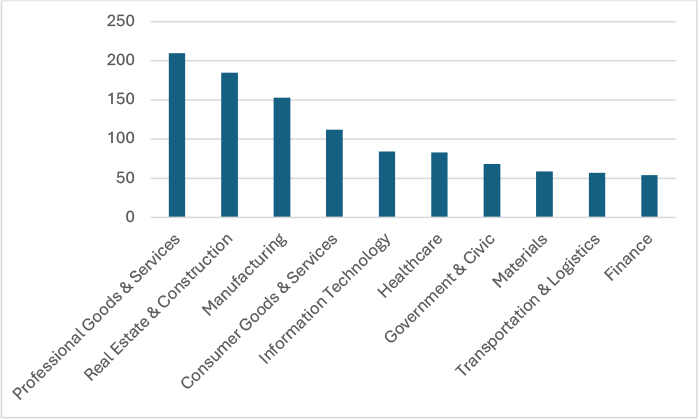
ETLM Assessment:
According to CYFIRMA’s assessment, Qilin ransomware poses a significant threat to organizations of all sizes. Its evolving tactics, including double extortion (data encryption and leak threats), cross-platform capabilities (Windows and Linux, including VMware ESXi), and a focus on speed and evasion, make it a particularly dangerous actor.
MedusaLocker Ransomware Impacts a Manufacturing Company from India
Summary:
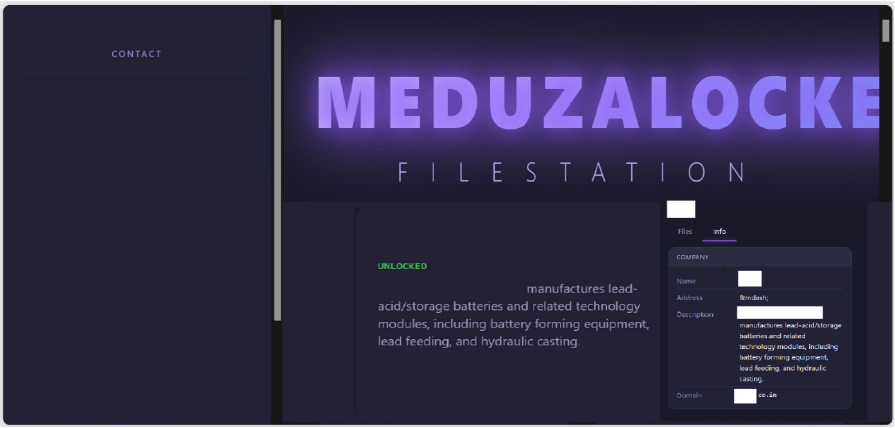
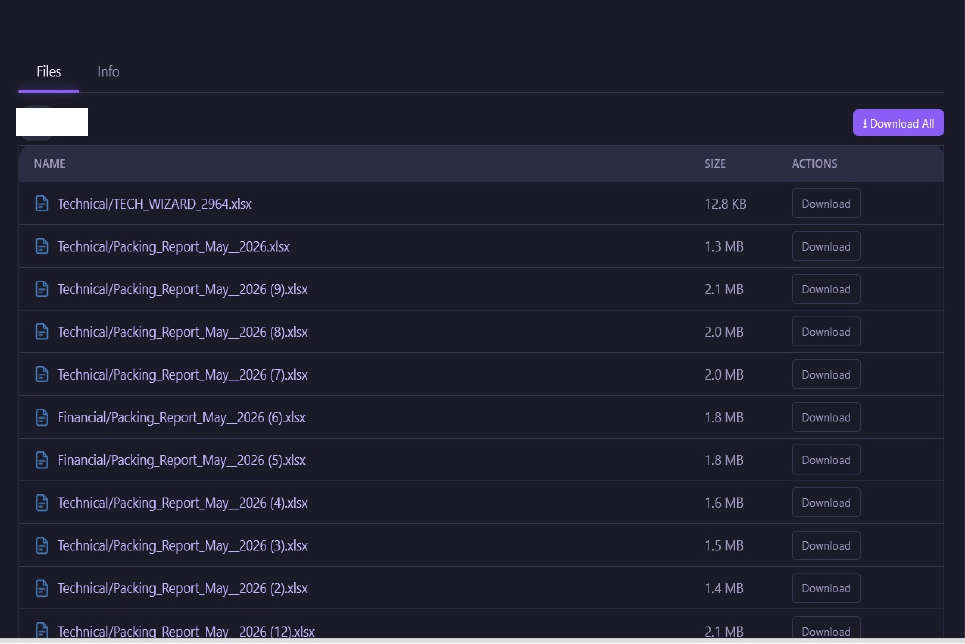
CYFIRMA observed on a ransomware data leak site (DLS) on the dark web that a company from India was compromised by MedusaLocker Ransomware. The compromised company is an Indian-based manufacturer of lead-acid/storage batteries and related technology modules, including battery forming equipment, lead feeding, and hydraulic casting. The compromised data reportedly includes multiple confidential business documents and internal spreadsheets across technical, financial, marketing, and reporting departments. The exposed files include technical and packing reports for May 2026 and July 2026, technical equipment-related documentation, financial packing reports, and financial indent records. Additionally, marketing-related CHA packing product documents and multiple internal CHA packing product reports were exposed. The filenames and directory structure indicate potential exposure of sensitive operational information, financial records, product and packaging details, technical documentation, and internal business reports, which could create risks of corporate data leakage, business disruption, and unauthorized disclosure of proprietary information.
Source: Dark Web
Relevancy & Insights:
ETLM Assessment:
According to CYFIRMA’s assessment, MedusaLocker ransomware represents a highly organized and financially motivated threat actor leveraging a combination of sophisticated technical methods, social engineering, and public shaming tactics to maximize extortion outcomes. Its affiliate-based RaaS model, combined with aggressive double extortion and a public-facing communication strategy, makes it a significant cybersecurity risk in 2025. Organizations are advised to adopt robust patch management, multi-factor authentication, network segmentation, and employee training to mitigate the risk posed by MedusaLocker attacks.
Vulnerability in Iperius Backup
Relevancy & Insights:
The flaw stems from insufficient separation between the elevated application interface and low-privileged local users. Programs launched through native Windows dialogs can inherit elevated permissions. INCIBE recommends upgrading to Iperius Backup 8.8.9.
Impact:
A local attacker with limited privileges could execute commands as SYSTEM or Administrator, potentially compromising the affected Windows host, backup operations, and protected information.
Affected Products:
https[:]//www[.]incibe[.]es/en/incibe-cert/notices/aviso/privilege-escalation-enters-iperius-backup
Recommendations:
Patch Management and Monitoring: Implement monitoring and detection mechanisms to identify unusual system behavior that might indicate an attempted exploitation of this vulnerability.
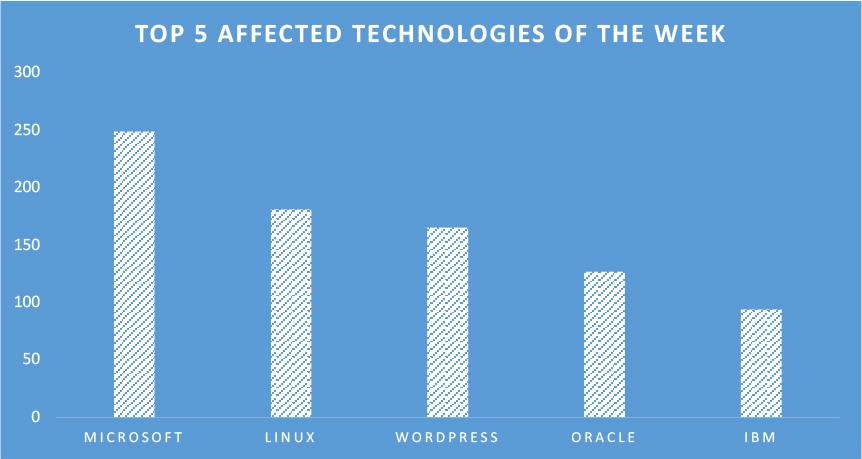
TOP 5 AFFECTED TECHNOLOGIES OF THE WEEK
This week, CYFIRMA researchers have observed significant impacts on various technologies due to a range of vulnerabilities. The following are the top 5 most affected technologies.
ETLM Assessment:
A vulnerability in Iperius Backup can pose significant risks to Windows endpoint security and the integrity of backup operations. This can impact various industries globally, including financial services, government, healthcare, and manufacturing, that rely on backup solutions to protect critical data. Insufficient separation of user privileges can allow a local attacker to gain SYSTEM or Administrator-level access and compromise an affected system. Ensuring the security of backup software is crucial to maintaining the integrity and availability of business data. Therefore, applying the recommended Iperius update is essential to protecting backup operations, enterprise systems, and business continuity across different regions and sectors.
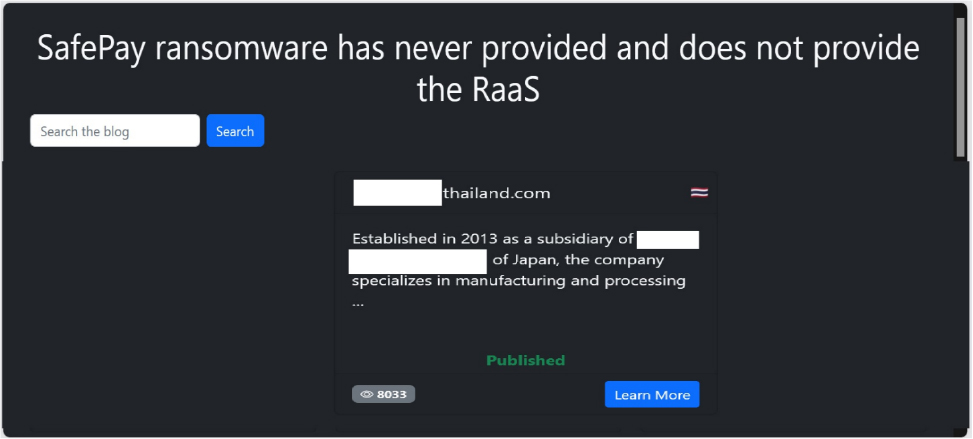
SafePay Ransomware attacked and published the data of a Manufacturing company from Thailand
Summary:
Recently, we observed that SafePay Ransomware attacked and published the data of a Manufacturing company from Thailand on its dark web website. The compromised company is a Japanese-owned industrial manufacturing company located in Samut Prakan, Thailand. Established in 2013 as a subsidiary of one of the companies of Japan, the company specialises in manufacturing and processing metal components for construction machinery, heavy equipment and industrial applications. Its production capabilities include precision machining, thick-plate welding, robotic welding, jig design and fabrication, hydraulic pressing and component assembly. The company manufactures parts and assemblies used in excavators, tractors, cranes, and other heavy construction equipment. Its machining operations use horizontal and vertical machining centers equipped for processing large and complex metal components. The company also performs welding operations using experienced technicians and robotic welding systems, with an emphasis on product quality, traceability, and dimensional accuracy. The compromised data reportedly includes a directory containing shared files and user-related information, along with an archived compressed file (.rar) of approximately 1 MB and a text-based file (.txt) of approximately 12 MB. Both files were uploaded on 12 November 2026. The exposed directory structure includes a “Share_all” folder and a “Users” folder, indicating potential exposure of shared organizational documents, user-related files, and internal business information.
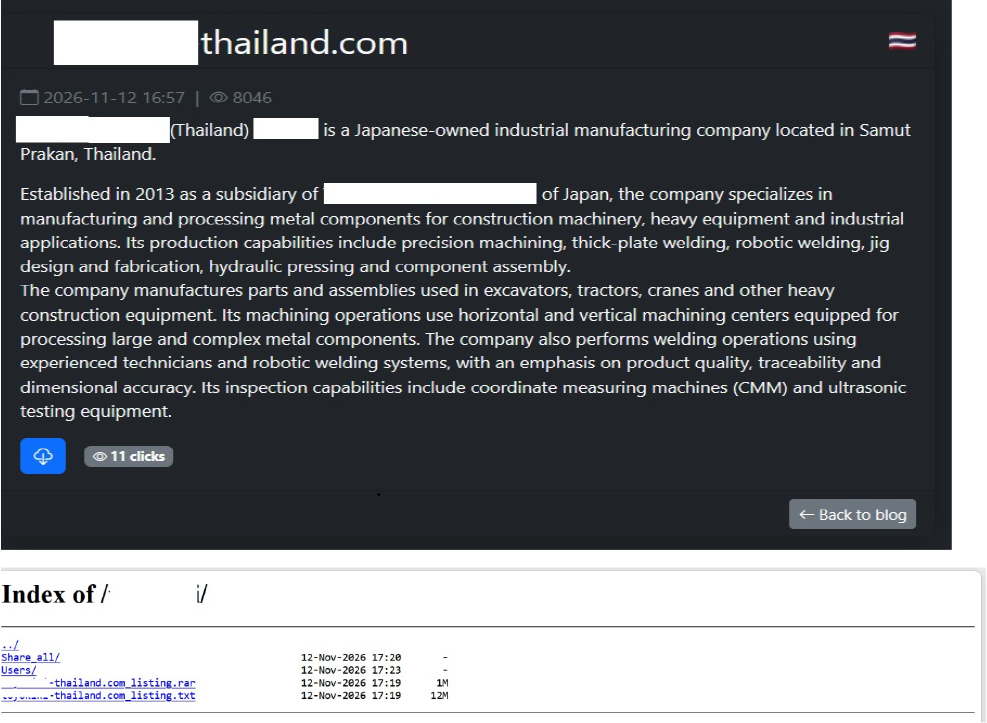
Source: Dark Web
Relevancy & Insights:
ETLM Assessment:
According to CYFIRMA’s assessment, SafePay represents a sophisticated, fast-moving ransomware threat capitalizing on VPN weaknesses and credential theft, employing effective double extortion tactics to maximize ransom payments. Organizations, especially in highly targeted sectors and regions, must prioritize layered defenses and active hunting for early detection.
Unauthorized Retail Database and Corporate Data Leak Advertised on a Leak Site
Summary
The CYFIRMA research team identified a post identified on a cybercrime forum advertises the alleged leakage of approximately 30 GB of data reportedly originating from a major retail organization operating in Thailand. The organization specializes in construction materials, home décor, furnishing products, tiles, sanitary ware, and kitchen-related products. Established in 1973, the retailer has developed into a significant player in Thailand’s home improvement and construction materials market.
According to the forum post, the seller claims to have obtained a substantial volume of organizational data and is advertising the alleged dataset as leaked information. However, the publicly visible post does not disclose the specific categories of compromised information, the number of affected records, or the exact systems from which the data was allegedly obtained.
Based on the information available in the advertisement, the incident involves:
If verified, the alleged data exposure could pose significant risks to the organization. Cybercriminals may exploit the information to conduct targeted phishing campaigns, business email compromise (BEC), social engineering attacks, credential harvesting, corporate espionage, and extortion attempts. If sensitive business or operational information is included, it could also expose internal processes, commercial activities, and business relationships to unauthorized parties.
The incident highlights the continuing threat of unauthorized data exposure affecting organizations in the retail and construction materials sectors. Organizations handling substantial volumes of business and customer information should strengthen their cybersecurity posture through the following measures:
The authenticity of the alleged 30 GB dataset and the extent of the compromise remain unverified at the time of reporting. This assessment is based solely on information visible in the cybercrime forum advertisement. The specific contents of the allegedly leaked data have not been independently confirmed.
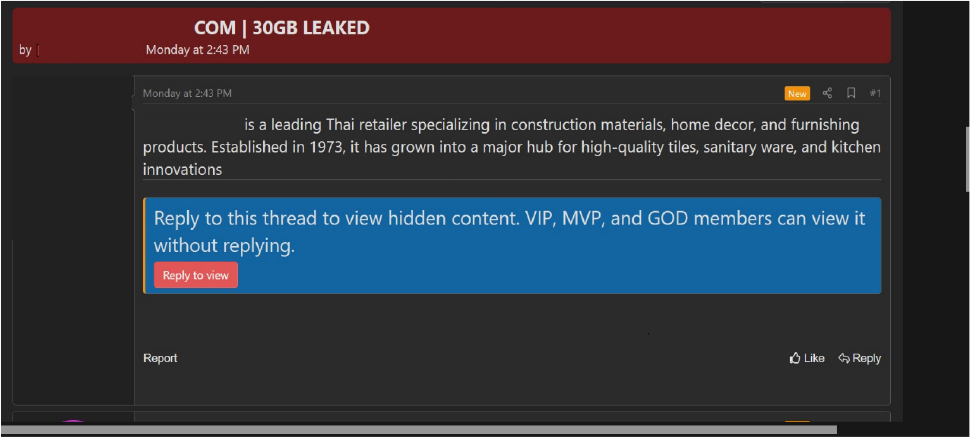
Source: Underground Forums
Relevancy & Insights:
Financially motivated cybercriminals are continuously looking for exposed and vulnerable systems and applications to exploit. A significant number of these malicious actors congregate within underground forums, where they discuss cybercrime and trade stolen digital assets. Operating discreetly, these opportunistic attackers target unpatched systems or vulnerabilities in applications to gain access and steal valuable data. Subsequently, the stolen data is advertised for sale within underground markets, where it can be acquired, repurposed, and utilized by other malicious actors in further illicit activities.
ETLM Assessment:
The threat actor is assessed as an active and capable cybercriminal entity primarily involved in data-leak and information-extortion activities, with multiple indications of unauthorized access to systems and the subsequent dissemination or sale of compromised data through underground forums. Their activities demonstrate the evolving sophistication of organized cybercriminal networks and highlight the increasing risk of sensitive information being exploited for financial gain, fraud, and follow-on attacks. Organizations should strengthen their cybersecurity posture through continuous monitoring, proactive threat intelligence, robust access controls, enhanced data protection, and timely defensive measures to safeguard sensitive information and critical infrastructure.
Recommendations: Enhance the cybersecurity posture by:
The CYFIRMA research team identified a post on a cybercrime forum advertising the availability of data allegedly stolen from a South Korean-based enterprise AI solutions provider. According to the forum post, the organization reportedly experienced a security breach in November 2026, resulting in the unauthorized theft of portions of its proprietary source code.
Based on the information shared in the forum post, the allegedly compromised data includes:
According to the advertisement, the individual behind the post claims to have uploaded the stolen data for download. A sample identified as a tree file was also referenced in the forum post, apparently to demonstrate the availability of the compromised material. However, the complete contents and volume of the allegedly stolen source code have not been disclosed.
If verified, the exposure of proprietary source code could present significant risks to the affected organization. Cybercriminals may analyze the stolen code to identify software vulnerabilities, authentication weaknesses, insecure configurations, and exploitable application components. The compromised intellectual property could also be leveraged for software cloning, unauthorized product development, competitive intelligence gathering, and targeted cyberattacks.
Potential consequences include:
This incident highlights the growing security risks associated with the exposure of proprietary source code and enterprise AI development environments. Organizations should strengthen source code repository security, enforce multi-factor authentication, implement strict access controls, encrypt sensitive development assets, continuously monitor repository access, and maintain secure backup infrastructure. Additionally, organizations should conduct regular code security assessments, implement secrets scanning, monitor unauthorized repository access, and establish effective incident response procedures to minimize the impact of similar incidents.
The authenticity and completeness of the allegedly compromised source code remain unverified at the time of reporting. This assessment is based solely on information published in the cybercrime forum advertisement and has not been independently confirmed.
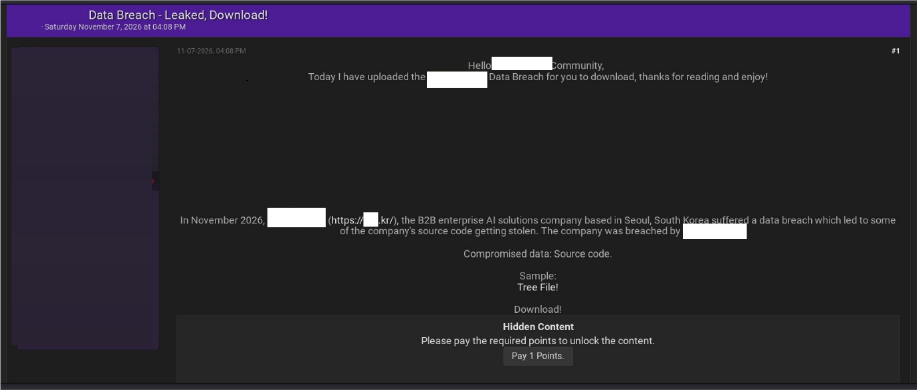
Source: Underground Forums
STRATEGIC RECOMMENDATIONS
MANAGEMENT RECOMMENDATIONS
TACTICAL RECOMMENDATIONS
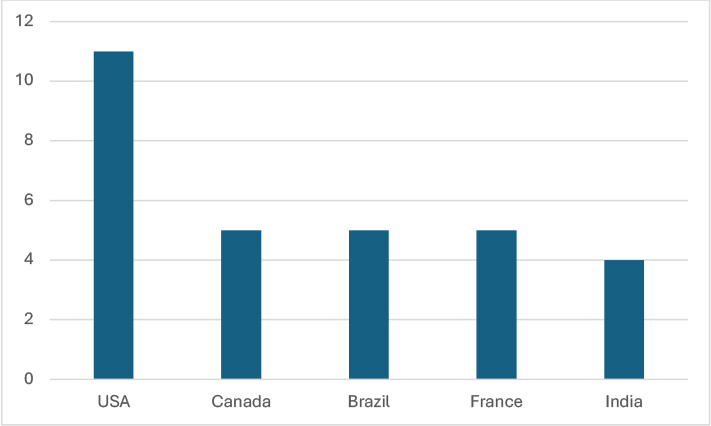
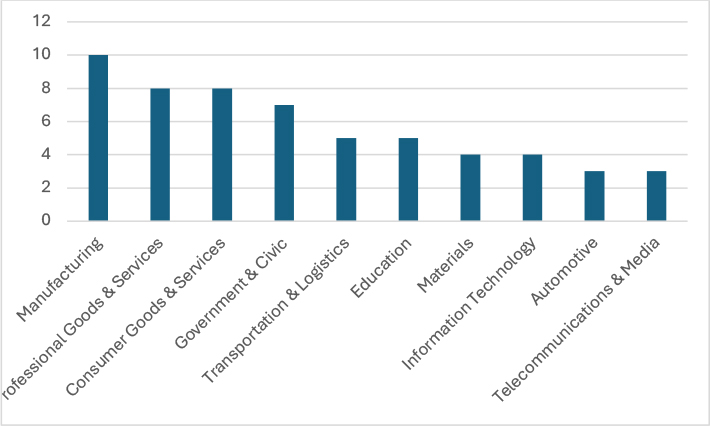
Please find the Geography-Wise and Industry-Wise breakup of cyber news for the last 5 days as part of the situational awareness pillar.
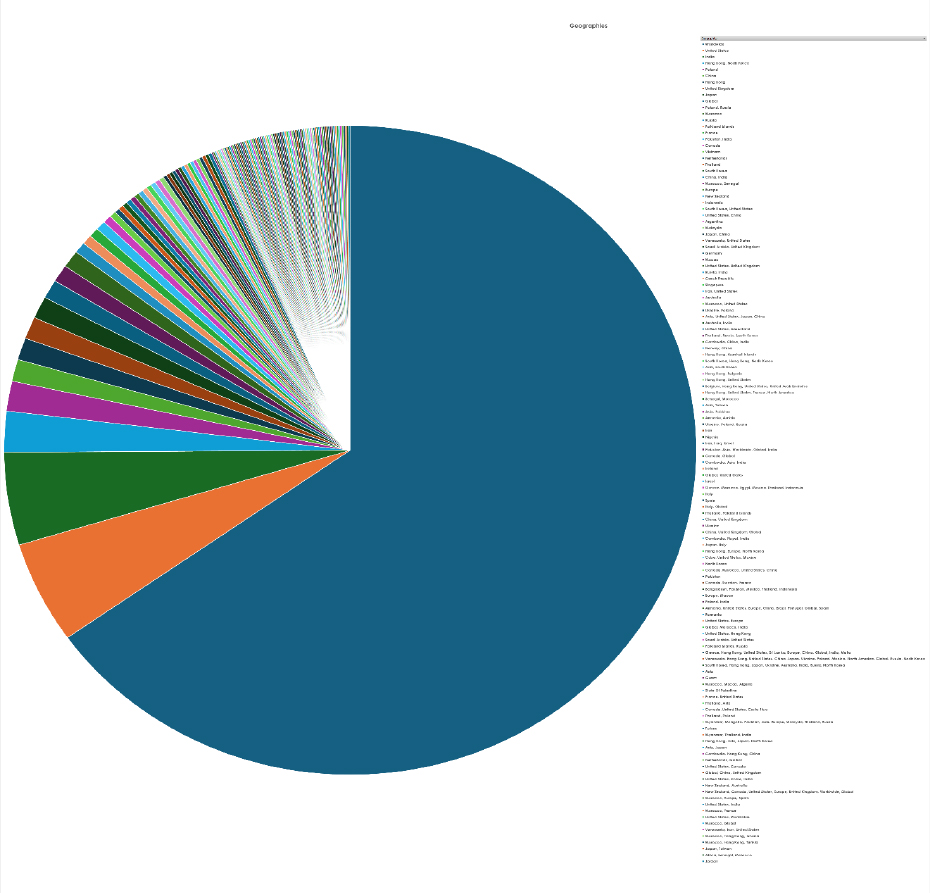
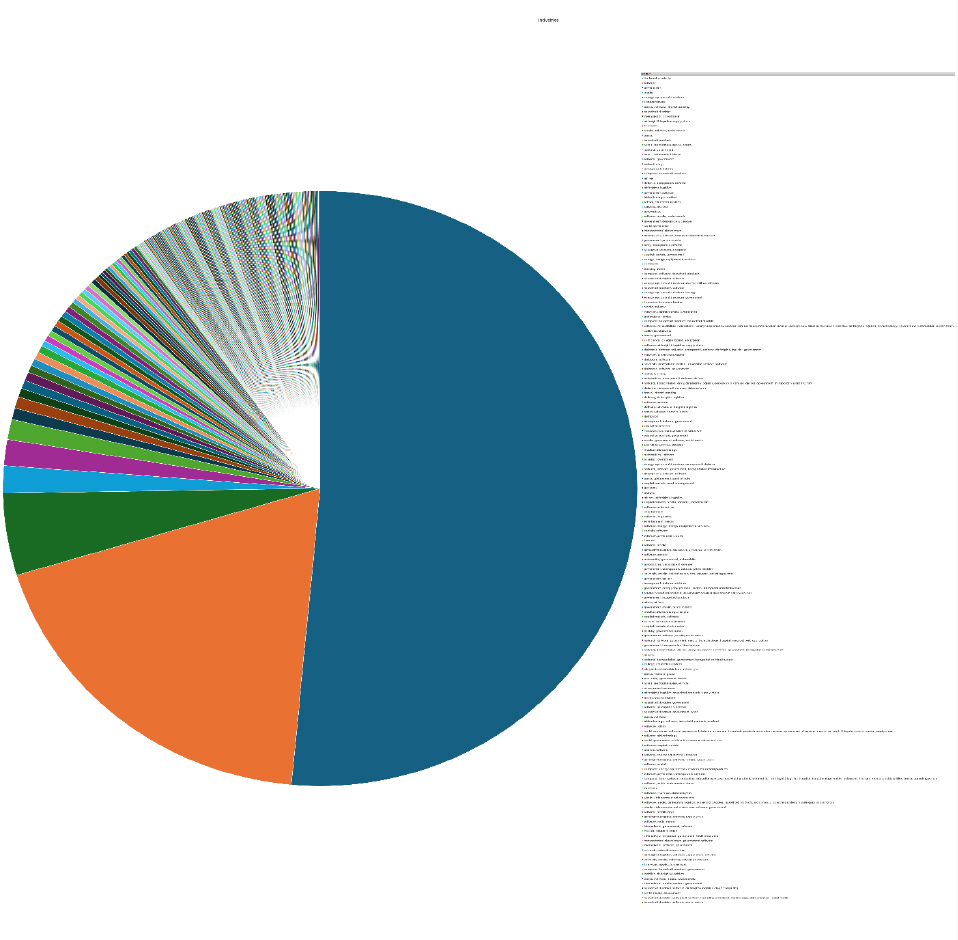
For situational awareness, intelligence, and specific insights mapped to your organisation’s geography, industry, and technology, please access DeCYFIR.
