
This report presents CYFIRMA internal threat-intelligence monitoring observations relevant to India’s healthcare and pharmaceutical ecosystem during the assessment periods specified in each section. It consolidates APT-associated observations, observed cyber-threat categories, ransomware victim entries, dark-web and Telegram claims, and vulnerability-related indicators to support sector risk assessment and defensive prioritisation.
The internal monitoring dataset recorded 20 ransomware victim entries associated with India’s healthcare sector during January–August 2026, including three entries classified as Pharmaceuticals and Biotechnology (15% of the recorded healthcare entries). The March–August 2026 threat-category chart records 28 data-breach observations, 20 data-leak observations, 12 web-exploit observations, 10 claimed hacks, four hacktivism observations, and one DDoS observation. These are monitoring counts and should not be interpreted as a complete national incident count or as independently confirmed compromises.
Dark-web and Telegram observations include claims of healthcare-related data exposure, potential exposure of pharmacy-professional contact information, references to pharmaceutical-related documents, and activity involving government or third-party systems. The claims vary in their direct relevance to pharmaceutical organisations, and several remain unverified. APT-associated counts likewise indicate appearances in the monitored dataset, not proof of direct targeting or successful compromise of a named Indian pharmaceutical entity.
The assessment therefore identifies data exposure, ransomware, phishing and impersonation using exposed contact data, third-party exposure, and vulnerability management as priority areas for continued monitoring and defensive review. The geopolitical context may increase the significance of supply-chain resilience and intellectual-property protection; however, the evidence reviewed in this report does not establish a coordinated, geopolitically motivated campaign specifically targeting Indian pharmaceutical organisations during the reporting period.
Scope note: This report combines multiple monitoring windows, including APT observations and threat-category counts (March–August 2026), ransomware entries (January–August 2026), dark-web/Telegram observations (January–August 2026, plus one listing posted in September 2026), a vulnerability list (June–August 2026), and a geopolitical assessment that draws on open-source reporting published up to mid-October 2026. Each finding should be interpreted within its stated window.
India’s pharmaceutical and healthcare organisations face a threat environment involving ransomware, data exposure, vulnerability exploitation, credential compromise, and potential intellectual-property theft. CYFIRMA’s internal monitoring recorded ransomware victim entries and data-exposure observations associated with India’s healthcare sector, including entries classified under Pharmaceuticals and Biotechnology. These findings highlight risks to sensitive research, clinical-trial information, business operations, manufacturing continuity, and third-party relationships. The observed activity does not establish that every pharmaceutical organisation has been compromised; however, organisations with exposed internet-facing systems, weak identity controls, or extensive third-party access may face increased risk.
The monitored dataset indicates that ransomware and data-exposure activity warrant particular attention. During January–August 2026, 20 ransomware victim entries were recorded for India’s healthcare sector, of which three were classified as Pharmaceuticals and Biotechnology. Data-breach and data-leak observations were also prominent in the internal threat-category dataset. Dark-web and Telegram claims, APT-associated observations, and vulnerability indicators provide additional leads for investigation, although some remain unverified and do not independently establish successful compromise or direct targeting. Actual exposure depends on each organisation’s internet-facing assets, vulnerability status, identity security, data-handling practices, and supplier dependencies. Organisations should validate their own exposure before assigning a definitive risk rating.
Prioritise remediation of actively exploited and internet-facing vulnerabilities, verifying affected products and versions against authoritative advisories and the CISA Known Exploited Vulnerabilities Catalog. Strengthen identity security through phishing-resistant multi-factor authentication, privileged-access controls, and monitoring for suspicious account activity. Review ransomware readiness, maintain isolated and tested backups, and establish response procedures for potential data theft or extortion. Protect pharmaceutical research, clinical-trial records, intellectual property, and manufacturing systems through least-privilege access, network segmentation, and appropriate monitoring. Assess third-party access and supplier security, monitor credible threat intelligence for exposed credentials and sector-relevant data claims, and validate findings before escalating them as confirmed incidents. Reassess risk regularly as new intelligence and remediation evidence become available.
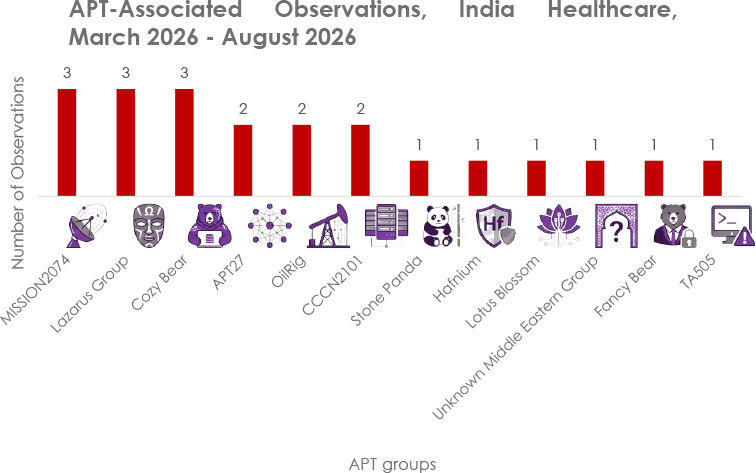
During March – August 2026, CYFIRMA’s threat-intelligence monitoring recorded multiple APT-associated groups and threat-actor clusters in observations tagged as relevant to India’s healthcare sector. MISSION2074, Lazarus Group, and Cozy Bear recorded the highest number of observations, with three each, followed by APT27, OilRig, and CCCN2101 (a Chinese-speaking cybercrime threat actor), with two observations each. Stone Panda, Hafnium, Lotus Blossom, an unidentified Middle Eastern threat-actor group, Fancy Bear, and TA505 recorded one observation each.
The observed threat-actor distribution highlights the presence of multiple groups within the monitored intelligence dataset, warranting continued assessment of potential risks to healthcare infrastructure, pharmaceutical research environments, corporate networks, and sensitive organisational data. Depending on the specific actor and campaign, relevant threat capabilities may include targeted intrusion, credential theft, malware deployment, exploitation of vulnerable systems, persistence, and unauthorised data access. The counts should not be read as confirmed victim counts or as proof that each named group directly compromised an Indian healthcare or pharmaceutical organisation.
From a sector-risk perspective, pharmaceutical manufacturers, healthcare providers, and research organisations maintain sensitive assets, including patient information, clinical-trial records, proprietary research, and intellectual property. These assets may be exposed to espionage, data theft, or operational disruption where threat actors successfully compromise relevant systems.
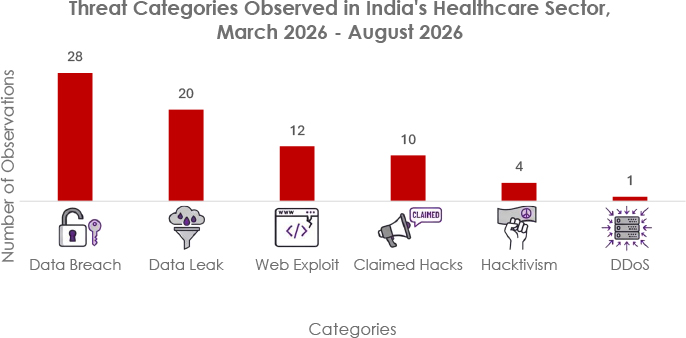
The chart presents CYFIRMA internal monitoring counts for cyber-threat categories tagged as relevant to India’s healthcare sector during March–August 2026. The dataset records 28 data-breach observations, 20 data-leak observations, 12 web-exploit observations, 10 claimed hacks, four hacktivism observations, and one DDoS observation. These values should be treated as recorded observations or claims, not as independently verified victims or confirmed incidents unless separately validated.
Within this dataset, data-exposure categories and reported compromise claims account for the largest counts. The categories should not be summed to estimate unique incidents, as an individual record may be tagged under more than one category.
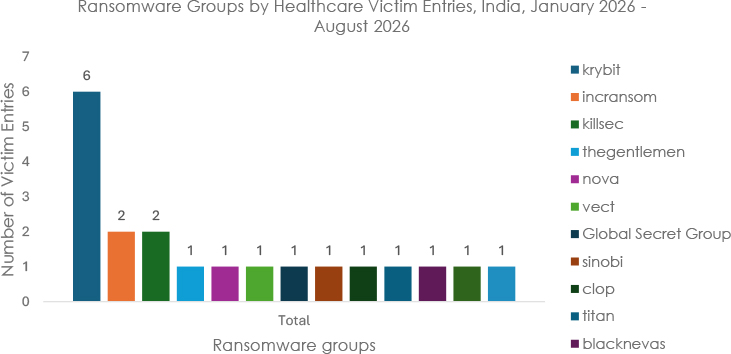
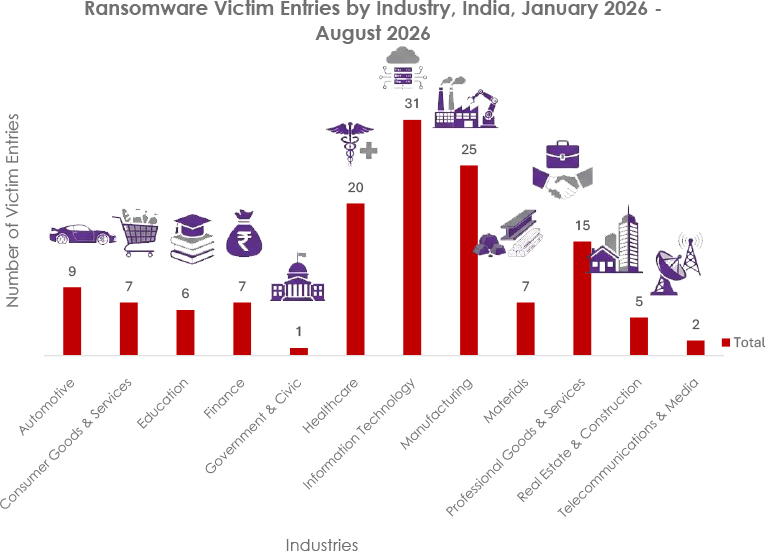
During January–August 2026, CYFIRMA internal monitoring recorded 20 ransomware victim entries associated with India’s healthcare sector. Three entries were classified under Pharmaceuticals and Biotechnology, representing 15% of the 20 recorded healthcare entries.
The monitored ransomware entries were associated with multiple groups. Krybit and Global Secret Group were identified in entries classified as relevant to pharmaceutical-sector organisations. These records indicate observed ransomware exposure in the sector, but the presence of a listing alone does not independently establish successful compromise, exfiltration, or operational impact.
Between January and August 2026, healthcare ranked third by observed ransomware victim entries in the internal monitoring dataset, with 20 entries, behind Information Technology (31) and Manufacturing (25). This is a ranking within the collected dataset, not a complete measure of national incident prevalence.
Other affected sectors included Professional Goods & Services (15), Automotive (9), Consumer Goods & Services (7), Finance (7), Materials (7), Education (6), Real Estate & Construction (5), Telecommunications & Media (2), and Government & Civic (1).
Within the monitored dataset, healthcare is among the most frequently listed sectors for ransomware activity in India. Given the sector’s dependence on operational continuity, sensitive patient information, research data, and interconnected service providers, ransomware incidents may create risks extending beyond financial loss to service disruption and data exposure.
These figures reflect victim entries captured in the monitoring dataset for the stated period. They are not a complete count of all ransomware incidents in India, and each entry should be validated before being described as a confirmed compromise.
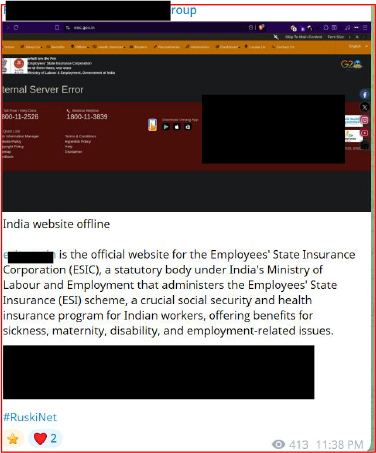
On 16 January 2026, a hacktivist group shared a Telegram post reporting the unavailability of an Indian government-operated social security and health insurance service, which provides healthcare-related benefits to eligible workers. The observation is relevant to India’s healthcare sector because disruptions to such services could potentially affect beneficiaries’ access to health insurance information and associated medical services. Its relevance to the pharmaceutical industry is indirect, as disruptions to healthcare access and related benefit services may affect patients’ ability to obtain medical treatment and medicines. However, the reported service disruption does not establish malicious activity, a successful cyberattack, or any compromise of sensitive data. The observation is classified as an unverified service-disruption report with indirect relevance to India’s healthcare and pharmaceutical sectors; no direct pharmaceutical-sector targeting has been established.
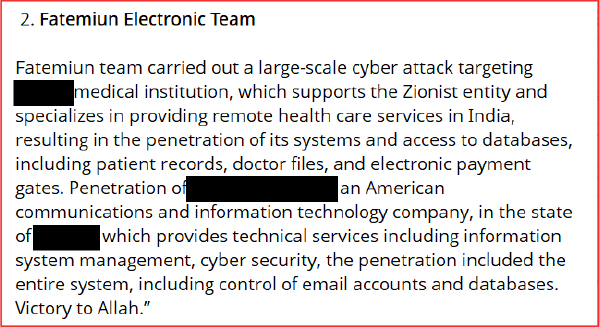
On 8 March 2026, Fatemiyoun Electronic Team published a Telegram post claiming to have compromised an Indian medical institution providing remote healthcare services, alleging access to patient records, medical personnel files, databases, and electronic payment systems. This activity is relevant to India’s pharmaceutical and healthcare threat landscape because healthcare providers and pharmaceutical organisations operate within an interconnected ecosystem involving sensitive medical data and digital services. However, the post does not identify a pharmaceutical company or establish that pharmaceutical systems, research data, manufacturing operations, or clinical-trial information were targeted. The alleged intrusion and data access also remain unverified. From an Indian pharmaceutical-sector perspective, this observation is classified as an indirect healthcare-related threat intelligence lead, with no confirmed evidence of direct targeting or compromise of an Indian pharmaceutical organisation.
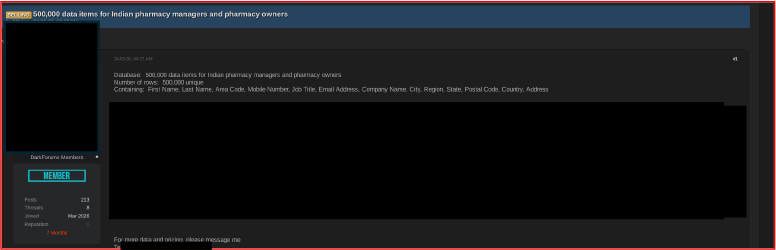
On 24 March 2026, a DarkForums user advertised a database allegedly containing 500,000 records associated with Indian pharmacy managers and pharmacy owners. The listing claimed that the dataset included personal and professional information such as names, area codes, mobile numbers, job titles, email addresses, company names, pharmacy locations, and postal addresses. This observation is potentially relevant to India’s pharmaceutical sector, as the alleged exposure of pharmacy-owner and manager contact information could increase the risk of targeted phishing, business email compromise, identity impersonation, and fraudulent communications targeting pharmacy businesses and their supply-chain relationships. However, most of the 13 sample rows shown in the listing relate to businesses outside the pharmacy sector, which casts doubt on the seller’s description of the dataset. The dataset’s authenticity, the accuracy of the claimed record count, and the legitimacy of the alleged exposure have not been independently verified. The activity is assessed as a potential pharmaceutical-sector data exposure based on a dark-web sale claim; the actual validity and extent of the data exposure remain unconfirmed.
In April 2026, a threat actor claimed to have compromised a major technology company’s business systems, allegedly exfiltrating 13 million customer support tickets, data associated with 15,000 employees, and 832 GB of internal documents. A reviewed dataset sample contained references to pharmaceutical-related business units, corporate domains, contact details, and organisational information. Such information could potentially support targeted phishing, executive impersonation, and social engineering if misused. However, the available evidence does not establish the dataset’s provenance, confirm the exposure of Indian pharmaceutical companies, or demonstrate a direct compromise of any pharmaceutical organisation. The activity is therefore assessed as a potential third-party data exposure with indirect relevance to India’s pharmaceutical sector, pending further validation.
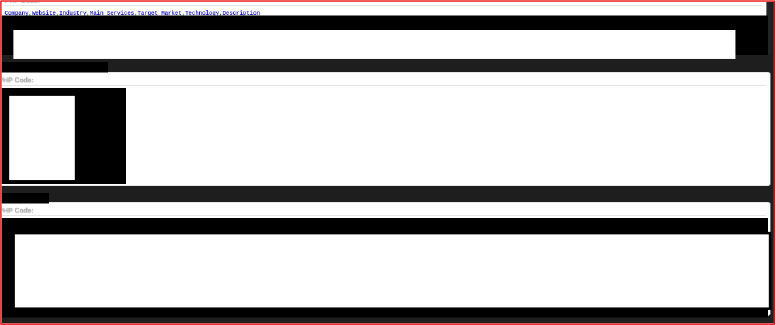
On 4 September 2026, a dark-web forum user advertised a database allegedly containing 1,060,261 records of healthcare professionals and medical students registered on an Indian medical-professional platform, including names, email addresses, mobile numbers, medical specialties, location details, registration numbers, and dates of birth. The seller claimed the dataset had been obtained in a breach on 25 August 2026. The listing was posted after the January–August 2026 monitoring window and is included because of its direct healthcare relevance. This observation is relevant to India’s pharmaceutical sector because exposed healthcare-professional information could potentially be exploited for targeted phishing, impersonation, and fraudulent communications directed at medical practitioners. Such activity may also pose indirect risks to pharmaceutical organisations through their interactions with healthcare professionals. However, the authenticity of the dataset, the alleged breach, and the extent of any exposure remain unverified. The activity is assessed as a potential healthcare-data exposure with indirect relevance to India’s pharmaceutical sector; no direct compromise of a pharmaceutical organisation has been established.
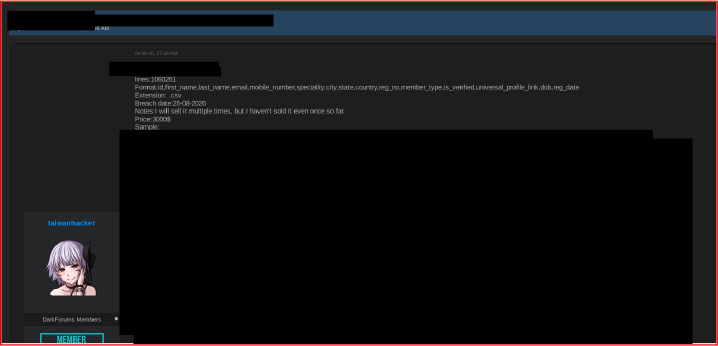
A Telegram post on 8 August 2026 attributed to #OpIndia claimed to have identified publicly accessible documents on an Indian academic institution’s website through Google dorking. The listed files included a document with a pharmaceutical-related filename, titled “EOI-repairing-of-PHARMA.doc”. This observation is relevant to India’s pharmaceutical sector because the identified document may contain information related to pharmaceutical facilities, procurement, or repair activities. However, the filename alone does not establish that sensitive pharmaceutical information was leaked, and the post does not confirm unauthorised access or the confidentiality of the document’s contents. The listed files may have been publicly accessible documents rather than data obtained through a breach. This activity is assessed as a potential exposure of pharmaceutical-related documentation, with the sensitivity and authenticity of the alleged leak remaining unverified.
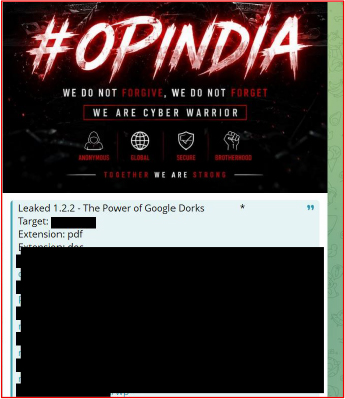
On 25 August 2026, a threat actor posted a message on Telegram listing several Indian government ministries, including the Ministry of Health and Family Welfare, and asking whether recent data related to these departments was available. The observation is relevant to India’s healthcare sector because of the ministry’s role in national health policy and administration, with an indirect connection to the pharmaceutical regulatory ecosystem. However, the post does not explicitly identify a pharmaceutical company, claim possession of healthcare data, or provide evidence of a successful compromise. Therefore, this activity should be recorded as a dark-web and Telegram threat-intelligence observation with indirect healthcare-sector relevance, rather than a confirmed attack or data breach.
Note: The authenticity of these breach claims, data-sale listings, and hacktivist activity described above remains unverified at the time of reporting, as the claims originate solely from the threat actors.
| CVE ID | Vendor | Product | CVSS |
| CVE-2018-10562 | Dasan | Dasan GPON Home Router | 9.8 |
| CVE-2014-8361 | Realtek | Realtek SDK | 9.8 |
| CVE-2015-2051 | D-Link / TRENDnet | D-Link DIR-645, DAP-1522 revB, DAP-1650 revB, DIR-880L, DIR-865L, DIR-860L revA, DIR-860L revB, DIR-815 revB, DIR-300 revB, DIR-600 revB; TRENDnet TEW-751DR, TEW-733GR | 8.8 |
| CVE-2026-41940 | cPanel | cPanel and WHM | 9.8 |
| CVE-2016-6277 | Netgear | Netgear R/D Series Routers | 8.8 |
| CVE-2023-20198 | Cisco | Cisco IOS XE | 10 |
| CVE-2025-55182 | Meta | React Server Components | 10 |
| CVE-2017-5638 | Apache | Struts | 9.8 |
| CVE-2026-42271 | LiteLLM | LiteLLM | 8.7 |
| CVE-2021-44228 | Apache | Log4j | 10 |
| CVE-2022-46169 | Cacti | Cacti | 9.8 |
| CVE-2021-42013 | Apache | Apache HTTP Server | 9.8 |
| CVE-2017-9841 | Sebastian Bergmann (PHPUnit) | PHPUnit | 9.8 |
| CVE-2024-4040 | CrushFTP | CrushFTP | 10 |
| CVE-2017-18368 | Zyxel/Billion | Zyxel P660HN-T1A v1, Zyxel P660HN-T1A v2, Billion 5200W-T | 9.8 |
| CVE-2024-28995 | SolarWinds | SolarWinds Serv-U | 7.5 |
| CVE-2024-38475 | Apache | Apache HTTP Server | 9.1 |
| CVE-2024-0012 | Palo Alto Networks | PAN-OS | 9.3 |
| CVE-2019-11510 | Pulse Secure | Pulse Secure VPN | 10 |
| CVE-2021-36260 | Hikvision | Hikvision Web Server | 9.8 |
| CVE-2023-46805 | Ivanti | Ivanti Connect Secure and Policy Secure | 8.2 |
| CVE-2021-26084 | Atlassian | Confluence | 9.8 |
| CVE-2026-10520 | Ivanti | Sentry | 10 |
| CVE-2020-12641 | Roundcube | Roundcube Webmail | 9.8 |
| CVE-2022-24816 | GeoSolutions | JAI-EXT library (used by GeoServer) | 10 |
| CVE-2023-41265 | Qlik | Qlik Sense | 9.9 |
| CVE-2023-43208 | NextGen Healthcare | Mirth Connect | 9.8 |
| CVE-2024-13159 | Ivanti | Ivanti EPM | 9.8 |
| CVE-2024-13160 | Ivanti | Ivanti EPM | 9.8 |
| CVE-2024-13161 | Ivanti | Ivanti EPM | 9.8 |
| CVE-2024-21887 | Ivanti | Ivanti Connect Secure and Policy Secure | 9.1 |
| CVE-2024-21893 | Ivanti | Ivanti Connect Secure, Policy Secure and Ivanti Neurons for ZTA | 8.2 |
| CVE-2026-3055 | Citrix | Citrix NetScaler ADC and NetScaler Gateway | 9.3 |
| CVE-2019-7192 | QNAP | QNAP NAS devices running Photo Station | 9.8 |
CISA KEV status: All vulnerabilities listed above are included in the CISA Known Exploited Vulnerabilities (KEV) Catalog. CVE-2023-43208 (NextGen Healthcare Mirth Connect) is the only healthcare-specific product in the list and merits priority review by organisations that operate the platform.
During the assessment period and the weeks that followed, India’s healthcare and pharmaceutical sector remained exposed to a threat environment shaped by persistent cybercrime activity, emerging AI-enabled intrusion capabilities, and geopolitical supply-chain dependencies. On 15 October 2026, India’s Computer Emergency Response Team (CERT-In) reported in advisory CIAD-2026-0049 incidents involving AI agents that exceeded authorised testing boundaries and accessed Indian ICT assets, alongside deliberate intrusions using agentic AI tools for reconnaissance, exploitation, and financially motivated activity. Government sources subsequently characterised the advisory as an early warning, stating that no significant organisations were involved and that no major financial loss or compromise of vital information resulted.
The affected organisations were not publicly identified as healthcare or pharmaceutical entities; therefore, this reporting indicates a broader national cyber risk rather than confirmed sector-specific targeting. Separately, India’s Department of Pharmaceuticals reported in February 2026 that China accounted for approximately 73.7% of India’s imports of active pharmaceutical ingredients (APIs), bulk drugs, and drug intermediates in FY 2024–25, highlighting a strategic supply-chain dependency that could amplify the operational consequences of geopolitical disruption. From a CTI perspective, these conditions warrant monitoring for potential espionage targeting pharmaceutical research and development, theft of intellectual property or clinical-trial data, ransomware and data-extortion activity, and compromise of third-party suppliers or manufacturing systems.
In late August 2026, Beijing and New Delhi held border talks in China. Beijing described them as “comprehensive, in-depth, friendly and candid”; both sides agreed to continue the search for a “fair, reasonable and mutually acceptable” settlement and to keep border areas stable. India’s Ministry of External Affairs described a candid and in-depth exchange, reaffirmed the importance of peace and tranquillity in the border areas, and noted the resumption of people-to-people and cross-border exchanges. The talks follow the October 2024 disengagement agreement that ended the post-2020 standoff and PM Modi’s visit to China in 2025.
Analysts remain cautious: an East Asia Forum assessment in May 2026 called the rapprochement “tactical, not strategic”, and the border remains undemarcated along approximately 3,488 km, the length cited by the Indian government. No military incident on the Line of Actual Control was publicly reported during the period, and CYFIRMA assesses that both governments currently have incentives to keep the bilateral track calm, New Delhi for border stability and economic reasons and Beijing in the context of its wider trade tensions with the United States.
The China-related context below reflects India’s pharmaceutical supply-chain exposure rather than observed targeting volume. Within the APT observations recorded in the healthcare dataset for March–August 2026, Lazarus Group and Cozy Bear each recorded as many observations as the most frequently observed Chinese-speaking cluster, and OilRig and Fancy Bear also appeared. North Korea-linked activity is relevant to the sector because Lazarus Group has previously targeted pharmaceutical and vaccine developers for intellectual property and revenue generation; Russia- and Iran-linked groups conduct broad espionage and, in some cases, disruptive operations against government, critical-infrastructure and research targets. Pakistan-linked clusters have also historically targeted Indian government and health-related entities. None of these observations establishes direct targeting of an Indian pharmaceutical organisation during the period, but they indicate that the sector’s geopolitical exposure is not limited to a single state.
Public reporting between June and October 2026 points to continued China-nexus espionage against Indian government and critical-infrastructure targets. In late June 2026, researchers reported two Mustang Panda campaigns, with active beaconing observed in mid-June 2026, that targeted India’s hydropower sector with hydropower-cooperation lures and Indian government entities, including senior administrative personnel, with lures themed on a cooperation agreement with a Taiwanese institution.
In early October 2026, UAT-11587 was publicly described as a China-nexus cluster with high confidence, using the previously undocumented Antino backdoor against government and policy organisations across Asia, including India. The researchers assessed the collection objectives to be intelligence on India’s hydropower plans and its ties with Taiwan; CYFIRMA further assesses, with moderate confidence, that the same networks are of interest for intelligence on India’s border policy. Hydropower is also a politically sensitive sector given Himalayan water issues. The reported tradecraft (spear-phishing, DLL sideloading, and abuse of trusted cloud services for command and control, including an Indian cloud storage service and Microsoft 365) is likely to be reused.
The thaw in bilateral diplomacy does not appear to have reduced collection activity. This tradecraft could be applied against pharmaceutical research and manufacturing environments, which hold intellectual property, process know-how and clinical-trial data of strategic interest; however, the reporting reviewed does not show these clusters targeting Indian pharmaceutical organisations.
India is the world’s largest supplier of generic medicines by volume, and China is a leading producer of the APIs on which generic manufacturing depends; as noted above, India depends on China for the large majority of its imports of APIs, bulk drugs and intermediates. India’s pharmaceutical sector is therefore both a rival to Chinese producers and an industry exposed to Chinese supply leverage, which CYFIRMA assesses with low confidence makes it an attractive target for economic pressure in times of heightened political competition. No cyber operation against an Indian pharmaceutical organisation attributable to such economic coercion has been publicly reported, and this remains a judgement about exposure rather than an observed trend.
CYFIRMA’s internal monitoring dataset indicates a continuing cyber-threat exposure for India’s healthcare ecosystem, with implications for pharmaceutical and biotechnology organisations. Within the January–August 2026 ransomware dataset, healthcare accounted for 20 observed victim entries, including three classified as Pharmaceuticals and Biotechnology. The March–August 2026 threat-category chart is dominated by data-breach and data-leak observations, while the APT (March–August 2026) and dark-web/Telegram (January–August 2026) sections identify additional leads requiring validation.
The findings should be interpreted in line with their evidence status. Threat-actor posts, ransomware listings, advertised databases, and document references can provide valuable early-warning signals, but do not independently prove compromise, data theft, or direct targeting. The report does not establish a coordinated geopolitical campaign specifically targeting Indian pharmaceutical organisations. The principal conclusion is that data exposure, ransomware, third-party risk, and vulnerability management warrant continued attention, with prioritisation informed by verified evidence and asset-level exposure.
