

Strategic Insights into Sustained Ransomware Pressure, OT/ICS Vulnerabilities, and Supply Chain Cyber Risk Across South Asian Industrial Hubs
EXECUTIVE THREAT INTELLIGENCE ASSESSMENT | JAN – SEP 2026 | DATA THROUGH 15 SEP 2026
Manufacturing is becoming a high-value cyber target as IT, OT, cloud, and supply-chain ecosystems converge.
Threat Environment
South Asia’s manufacturing ecosystem faces an escalating threat landscape, driven by high-volume ransomware, industrial espionage targeting intellectual property (IP), and supply chain compromise.
Dominant Adversary Objective
Dual focus: financially motivated ransomware syndicates seeking operational-disruption payouts, alongside nation-state APTs targeting industrial designs, pharmaceutical formulas, and defense supply chains.
Operational Shift
Intrusion methods increasingly pair phishing-led initial access with identity compromise, trusted vendor/supply chain exploitation, and living-off-the-land (LotL) execution across converged IT/OT networks.
Manufacturing Sector Specific Risk
Compromise of enterprise systems can potentially extend into production planning, engineering environments, manufacturing execution systems, and industrial networks, increasing the potential for operational disruption.
Forward Outlook
Intensifying threat pressure; legacy industrial control systems (ICS) and unpatched edge devices will remain high-value vectors as digital manufacturing expands under regional industrial policy initiatives.
India and SAARC’s manufacturing ecosystem is increasingly exposed to cyber operations that can affect not only information assets, but also production continuity, engineering IP, supplier relationships, and operational resilience.
Nation-State Actors
Focused on stealing advanced manufacturing designs, formulations (pharmaceuticals), and defense blueprints.
Cyber Criminals
Motivated by ransomware payments; target “Just-in-Time” manufacturing models to maximize pressure.
Insider Threats
Disgruntled employees or contractors stealing or manipulating IP or sabotaging systems.
Hacktivists
Targeting manufacturing sectors linked to geopolitical disputes (e.g., defense contractors).
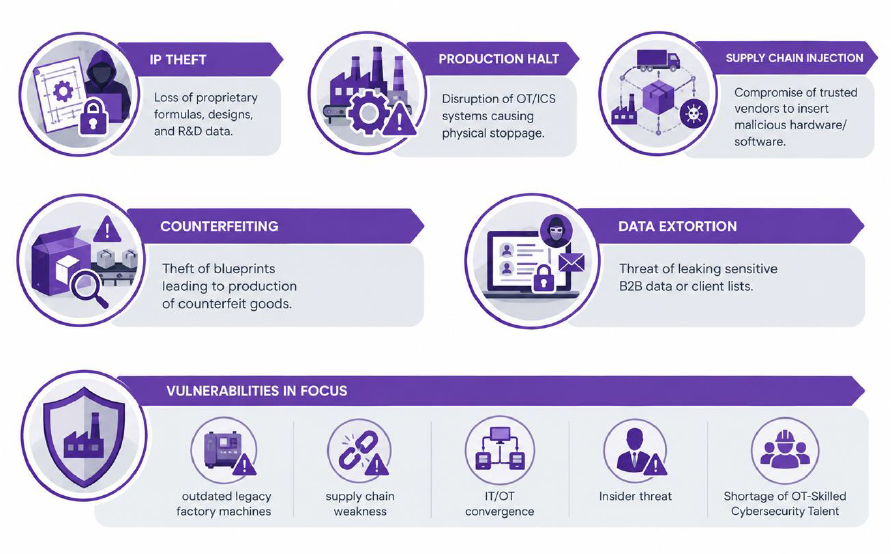
THREAT CHATTER: INCREASING
Telegram | Dark Web Forums | Leak Sites
Focus on selling access to Indian industrial networks.
MALWARE TRENDS: EVOLVING
Increase in ICS-targeted malware.
Use of Stealers to access CAD/PLC files.
RANSOMWARE ACTIVITY: HIGH
Groups including thegentlemen, worldleaks and dragonforce active in the region.
VULNERABILITY EXPOSURE: ELEVATED
Unpatched legacy SCADA/PLC systems widely exposed in the SAARC region, supply-chain weakness, IT/OT convergence, insider threat, and a shortage of OT-skilled cybersecurity talent.
AI THREATS : AI-Assisted Phishing | Reconnaissance | Deepfakes | Malware Development | Automation
India’s manufacturing sector faces sustained pressure from financially motivated ransomware groups looking to exploit the low tolerance for downtime, while nation-state actors continue stealthy campaigns to siphon R&D and intellectual property critical to India’s economic growth.
Rating scale: Low / Moderate / Elevated / High / Very High. Trend descriptors (Increasing, Evolving) indicate direction since the previous assessment.
Intellectual Property & Strategic Imperative
Manufacturers hold vital designs and R&D data that state-sponsored actors target to fast-track domestic innovation and undermine competitive initiatives like “Make in India”.
Digital Transformation & Industry 4.0
Rapid adoption of smart factory tech, IIoT (Industrial IoT), and cloud ERPs drastically expands the attack surface with new digital entry points.
IT–OT Convergence & Legacy Vulnerabilities
Merging corporate IT with industrial operational networks can create potential pathways toward plant environments, where unpatched legacy equipment is exposed.
Global Supply-Chain Integration
As critical nodes in global pharma, electronics, and automotive networks, compromising one manufacturer opens doors to breach interconnected partners.
Operational Leverage & Disruption Impact
High-uptime production lines are extremely sensitive to downtime, giving threat actors maximum leverage for extortion or operational sabotage.
Macro-Economic & Geopolitical Significance
Representing key pillars of GDP and stability, industrial targets in geopolitically sensitive markets across South Asia may be targeted to inflict broader economic and political destabilization.
NATION-STATE / ESPIONAGE ACTORS
Objective: Industrial intelligence, strategic information, and technology acquisition.
Targets: R&D, engineering, semiconductor, advanced manufacturing, and strategic industries.
RANSOMWARE OPERATORS
Objective: Financial extortion.
Targets: Enterprise IT, production-supporting infrastructure, corporate data, and critical business systems.
CYBERCRIMINALS
Objective: Credential theft, fraud, data theft, and monetization.
INITIAL ACCESS BROKERS
Objective: Sell compromised corporate access to downstream threat actors.
HACKTIVISTS
Objective: Ideological disruption, visibility, and geopolitical messaging.
AI-ENABLED THREAT ACTORS
AI increasingly supports:
Reconnaissance | Phishing | Social Engineering | Content Generation | Malware Development
APT41 (China-aligned):
Objective: IP Theft & Supply Chain.
Target: High-tech, Electronics, Pharma.
TTPs: Spear-phishing, Supply Chain Software Compromise.
Lazarus Group (North Korea-aligned):
Objective: Financial Gain & Espionage.
Target: Defense Manufacturing.
TTPs: Fake job-offer lures, recruiter personas, and social engineering.
APT36 / Transparent Tribe (Pakistan-aligned):
Objective: Espionage.
Target: Defense, Government, Diplomatic
TTPs: Phishing, RATs, Credential Access
Profiles reflect each group’s established targeting and tradecraft as documented in public reporting and CYFIRMA research (see MITRE ATT&CK: APT41 – G0096; Lazarus Group – G0032; Transparent Tribe – G0134). They are included as relevant threat actor profiles for the sector and do not indicate confirmed activity against India/SAARC manufacturing within this reporting period unless stated.
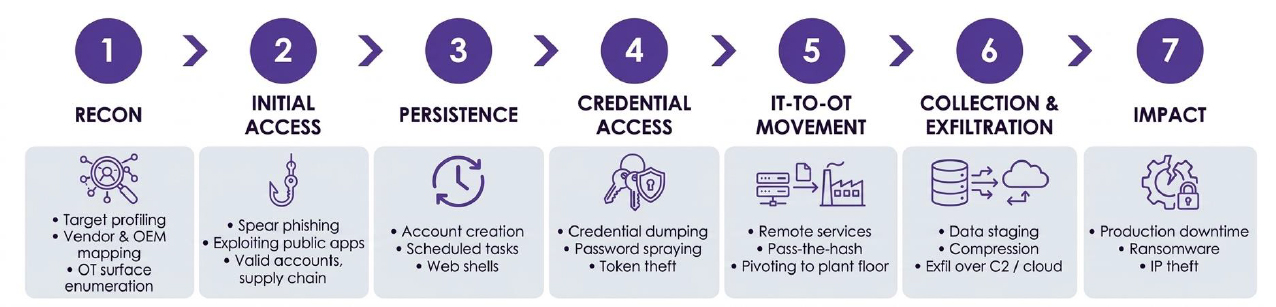
TOP TRADECRAFT TRENDS
Threat actors increasingly exploit IT-OT convergence, seeking pathways from corporate networks toward plant-floor and vendor-connected systems where segmentation and access controls permit. Broader autonomous, AI-driven operational use remains an emerging trend across the region.
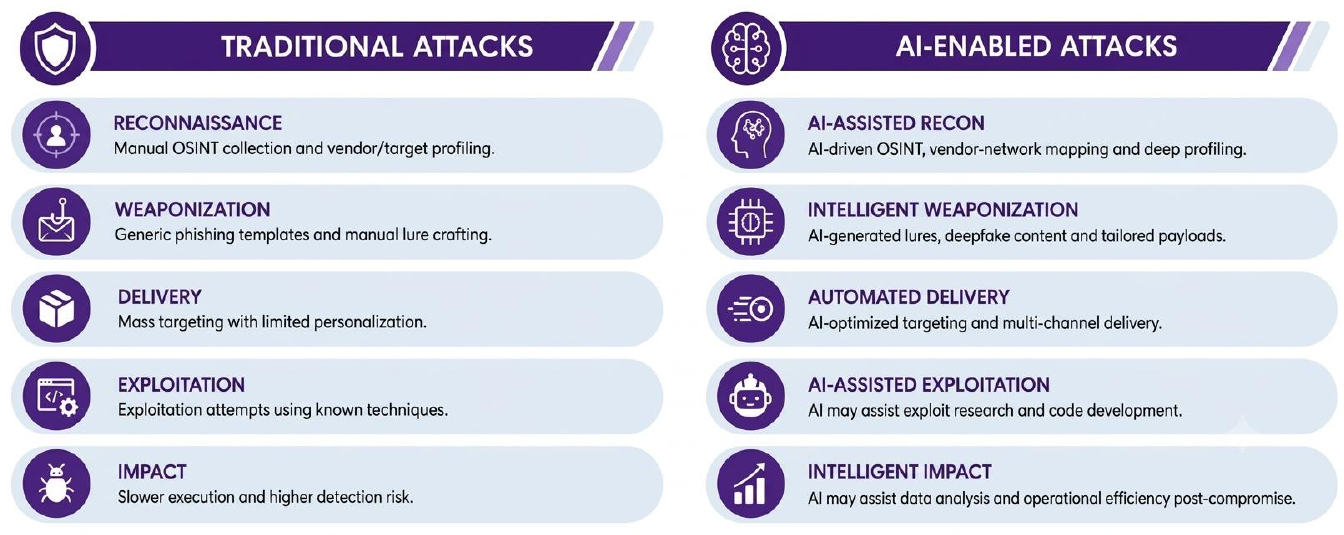
Current intelligence indicates AI-assisted capabilities are primarily enhancing reconnaissance, phishing and content generation, while autonomous operations remain an emerging capability.
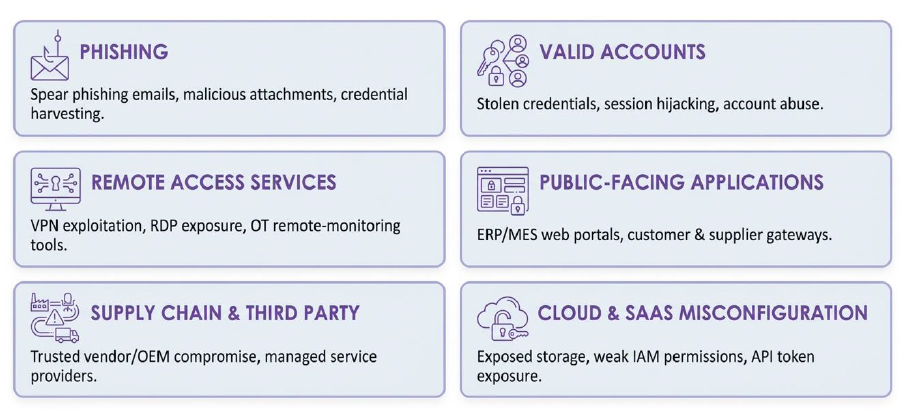
KEY OBSERVATIONS
Threat actors increasingly combine phishing-led initial access with credential abuse and trusted third-party access, relying on identity compromise rather than malware alone to achieve stealthier and more persistent footholds inside manufacturing networks.
OBSERVED ACTIVITY PATTERNS — 1 JAN – 15 SEP 2026
GROUPS OBSERVED — INDIAN MANUFACTURING
Double Extortion Standard
Ransomware syndicates combine encryption with data theft and public leak-site pressure against manufacturers.
Fragmented Ecosystem
A mix of established and emerging groups indicates a broad, highly active threat landscape.
Production Downtime Leverage
Operational disruption gives attackers direct financial leverage over manufacturers.
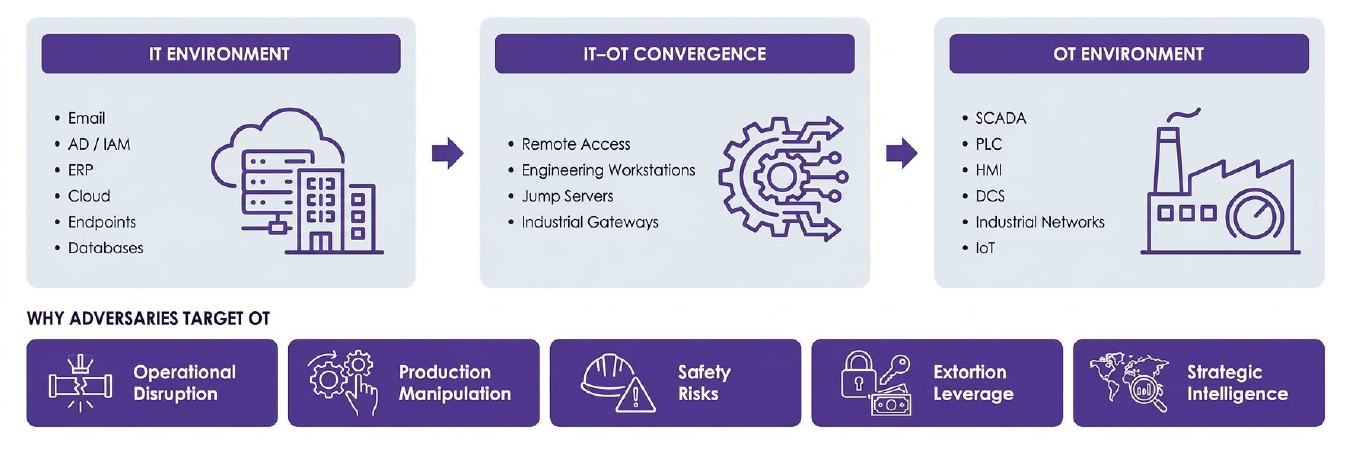
KEY OBSERVATION
The compromise of enterprise IT does not automatically imply OT compromise; however, interconnected architectures and remote-access pathways can create potential routes toward industrial environments.
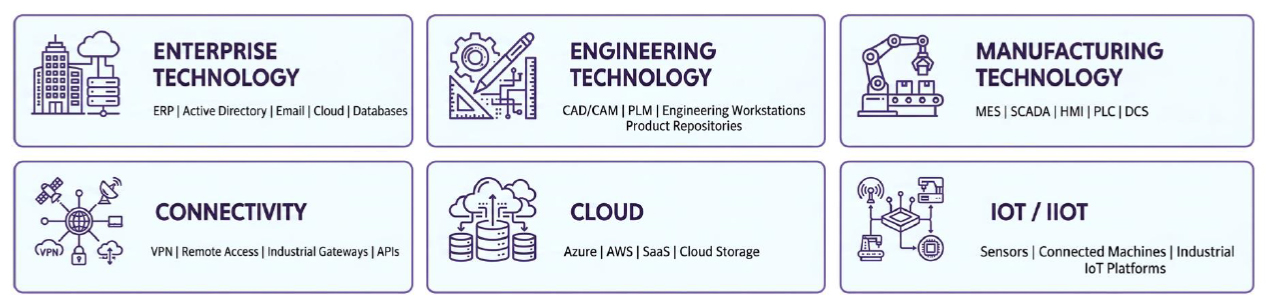
WHY THESE TECHNOLOGIES MATTER

Enterprise IT, engineering systems, and plant-floor technology increasingly intersect within a single connected environment, widening the technology surface adversaries can target.
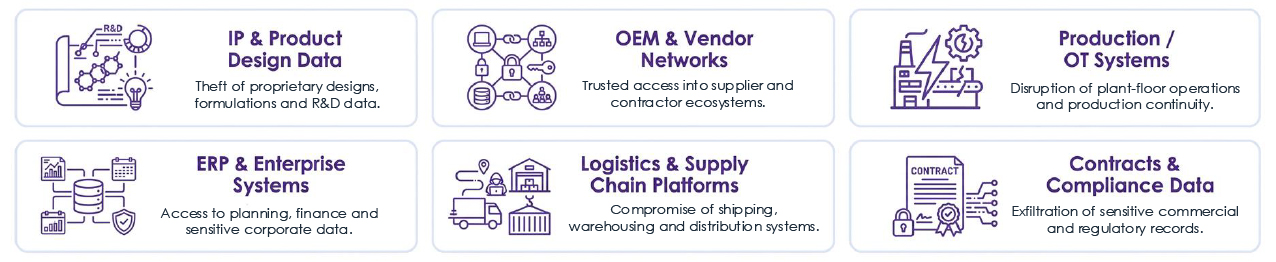
THREAT PRIORITY TIERING

Protecting high-value industrial assets, identity infrastructure and the third-party vendor ecosystem is essential to reducing exposure, production disruption, and strategic cyber risk across manufacturing.
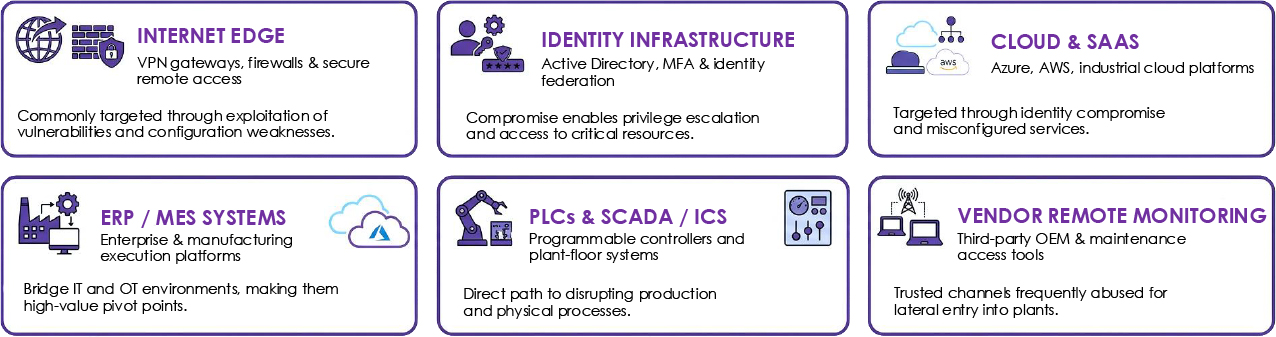
WHY THREAT ACTORS TARGET THESE TECHNOLOGIES

In converged IT-OT environments, a compromised credential or misconfigured service can create a potential pathway toward plant-floor environments where connectivity, trust relationships, and access controls permit — making integrated visibility across both domains a top priority.
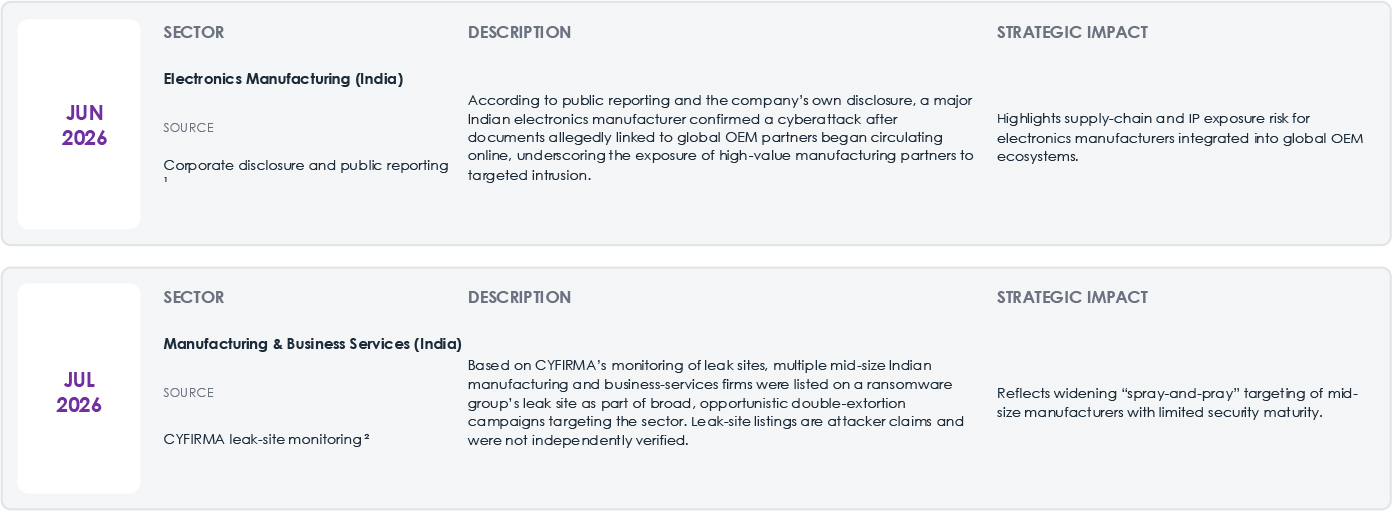
Both incidents illustrate a consistent pattern: high-value OEM-linked manufacturers face targeted exposure, while the broader mid-size manufacturing base faces sustained, opportunistic ransomware pressure. Early detection and vendor-risk management remain critical.
¹ Public reporting and the affected company’s own disclosure, June 2026. ² CYFIRMA monitoring of ransomware leak sites, July 2026; listings are attacker claims and were not independently verified.
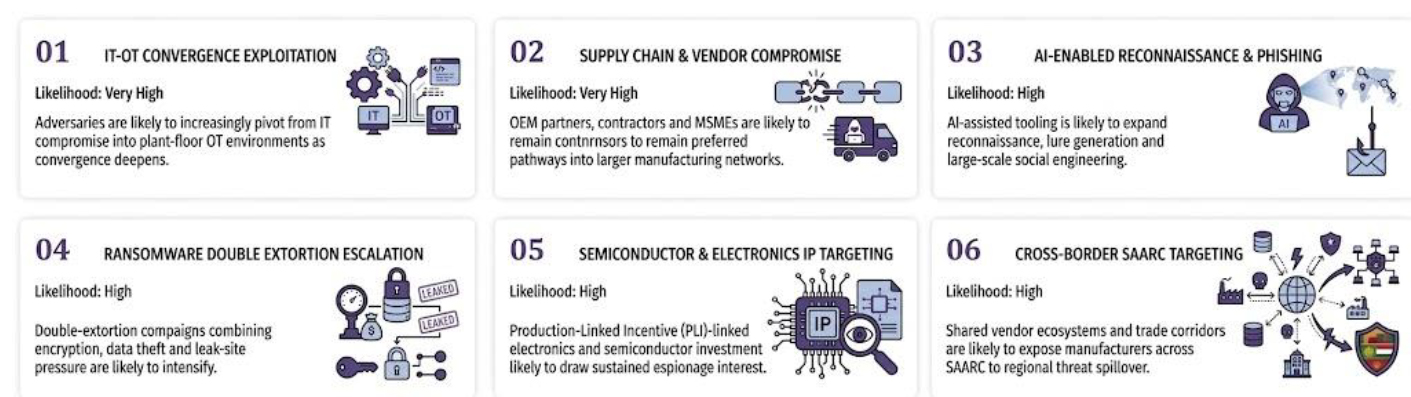

Likelihood scale: Low / Medium / High / Very High, based on the intelligence available as at 15 September 2026.
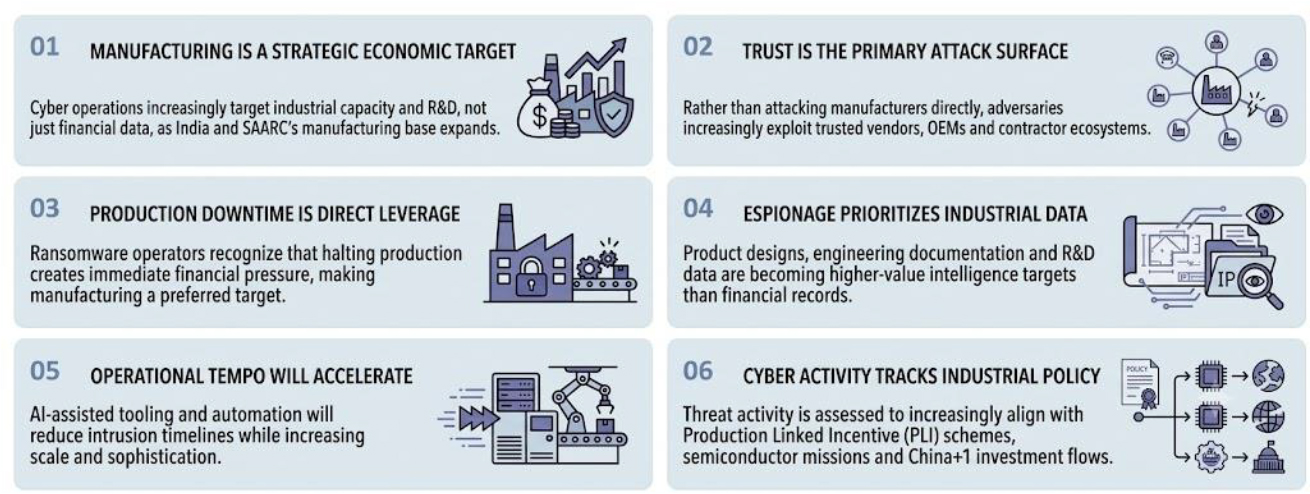
CYFIRMA assessment: future operations are likely to prioritize strategic access, information superiority, and production leverage over immediate disruption alone. References to PLI schemes, semiconductor missions, and China+1 investment reflect an assessment that their rising strategic value increases adversary interest — not a demonstrated causal relationship.
OVERALL OUTLOOK HIGH Threat Environment
01. IDENTITY-CENTRIC SECURITY
Shift investments towards protecting identities, privileged access, and authentication infrastructure across IT and OT.
02. OT / IT SEGMENTATION
Enforce network segmentation and Zero Trust principles between corporate IT and plant-floor OT environments.
03. SUPPLY CHAIN ASSURANCE
Strengthen security governance across vendors, OEMs, and third-party ecosystems supporting production.
04. RANSOMWARE RESILIENCE
Build tested backup, recovery, and incident-response capability to withstand double-extortion campaigns.
05. AI SECURITY READINESS
Develop governance, detection, and response capabilities to address AI-enabled cyber operations.
06. REGIONAL INTELLIGENCE SHARING
Build coordinated threat-intelligence sharing across manufacturers and CERTs within the SAARC region.
Manufacturing’s evolving threat landscape requires a transition from reactive cybersecurity towards intelligence-led, resilience-driven defense that integrates OT security, supply-chain assurance, and continuous threat visibility.
30 DAYS IMMEDIATE PRIORITIES
60 DAYS TACTICAL PRIORITIES
90 DAYS STRATEGIC PRIORITIES
EXPECTED OUTCOME
Manufacturing Remains a Strategic Target
Nation-state and financially motivated adversaries continue prioritizing manufacturing for IP and production leverage.
Identity Underpins Persistence
Once initial access is gained, identity compromise and valid-account abuse are increasingly the preferred path to persistence, privilege, and lateral movement.
Supply Chains Expand Risk
Trusted vendor and OEM ecosystems increasingly provide indirect access into protected manufacturing environments.
AI Is Reshaping Cyber Operations
AI-enabled capabilities are accelerating reconnaissance, phishing, and intrusion operations.
Downtime Outweighs Data Alone
Observed activity shows production disruption, not just data theft, driving attacker leverage.
Resilience Requires Intelligence
Future cyber resilience depends on integrating continuous threat intelligence into strategic decision-making.
FINAL INTELLIGENCE ASSESSMENT
Manufacturing’s cyber threat landscape across India and SAARC will remain dominated by ransomware-driven production disruption and identity-focused espionage. Organizations adopting intelligence-led security and OT-aware resilience will be best positioned to counter evolving threats. This assessment is based on the intelligence available to CYFIRMA as at 15 September 2026 and is subject to each organization’s own controls, visibility, and monitoring.
