

Ransomware activity during August 2026 underscored the continued evolution of the threat landscape from isolated malware campaigns into a mature, service-driven criminal ecosystem capable of sustaining large-scale operations across multiple regions and sectors. With 1,046 publicly claimed victims (+18.2% versus July’s 885), activity remained elevated relative to historical baselines, reflecting resilient ransomware-as-a-service (RaaS) operations and competition among leading brands.
Qilin led monthly activity with 150 claimed victims, followed by The Gentlemen (95), Cl0p (90), and INC Ransom (37). Organizations in Professional Goods & Services, Manufacturing, Healthcare, Real Estate & Construction, Information Technology, and Consumer Goods & Services experienced the highest levels of targeting.
Data theft, edge/VPN abuse, identity compromise, and multi-layered extortion continued to shape outcomes. Organizations should strengthen identity security and edge-device hardening, accelerate remediation, and improve visibility and proactive threat intelligence.
Welcome to the August 2026 Ransomware Threat Report. This report delivers a detailed analysis of the ransomware landscape, highlighting the emergence of new ransomware groups, evolving attack techniques, and notable shifts in targeted industries. By examining key trends, tactics, and significant incidents, this report aims to support organizations and security teams in understanding the current threat environment.
The figures in this report cover the period 1–31 August 2026 and are drawn from CYFIRMA’s monitoring of ransomware group leak sites and public disclosures. Victim counts reflect claims made by the threat actors themselves and have not been independently verified; they may include re-posted, duplicated, disputed, or historical victims, and they exclude incidents that were resolved without public disclosure. Counts should therefore be read as a measure of publicly claimed activity rather than of total ransomware incidence.
Forward-looking judgments in the ETLM Assessment subsections carry a confidence value on the following scale. High: the judgment is supported by multiple corroborating sources and by consistently observed activity. Moderate: the judgment is supported by activity observed during the reporting period and by consistent operator behavior in prior campaigns, but alternative outcomes remain plausible. Low: the judgment rests on limited or single-source reporting, or on inference from analogous activity.
Throughout August 2026, there was notable activity from several ransomware groups. Here are the trends regarding the top 10:
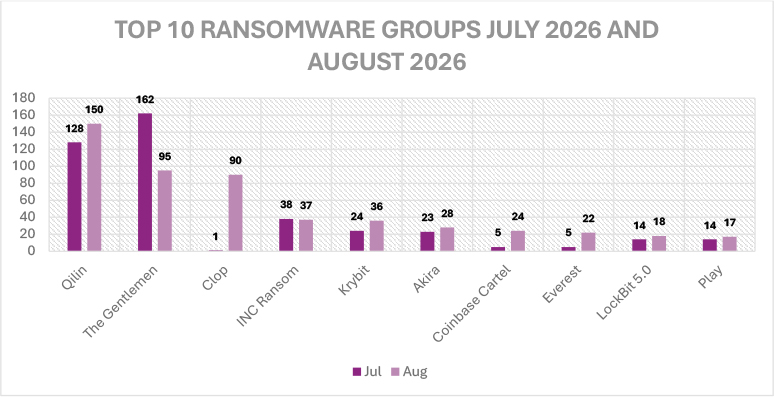
The July–August 2026 data indicate continued redistribution of ransomware activity. Leading operators were Qilin (128 → 150), The Gentlemen (162 → 95), Clop (1 → 90), INC Ransom (38 → 37), Krybit (24 → 36), Akira (23 → 28), Coinbase Cartel (5 → 24), Everest (5 → 22), LockBit 5.0 (14 → 18) and Play (14 → 17). Overall, the RaaS ecosystem remains highly resilient, with operational capacity shifting among leaders and newcomers rather than signaling a sustained decline in overall ransomware threat.
The two largest movements warrant separate treatment. Clop’s rise from 1 to 90 claimed victims is consistent with the group’s established pattern of publishing a campaign’s victims in batches rather than continuously, and should not be read as a ninetyfold increase in operational tempo. The Gentlemen’s decline from 162 to 95 follows an unusually high July figure; on the data available, it is not possible to distinguish reduced activity from delayed disclosure.
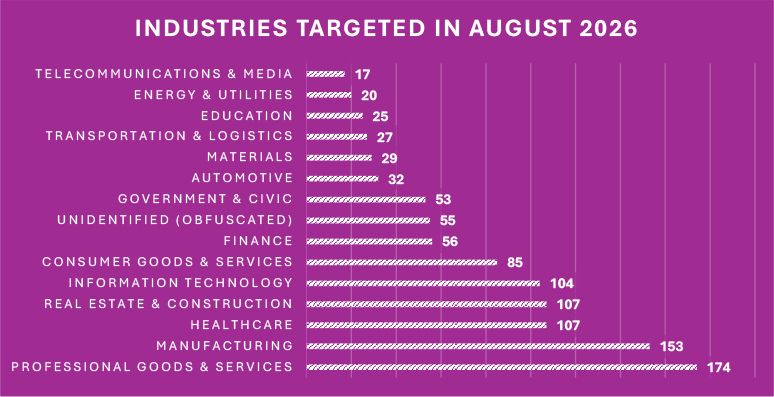
In August 2026, ransomware activity continued to focus on sectors where operational disruption and data theft maximize extortion. Professional Goods & Services (174), Manufacturing (153), Healthcare (107), Real Estate & Construction (107), Information Technology (104), Consumer Goods & Services (85), Finance (56), Unidentified (Obfuscated) (55), Government & Civic (53), and Automotive (32) were among the most targeted. Operators continue to prioritize industries where business disruption and sensitive information exposure increase the likelihood of successful extortion.
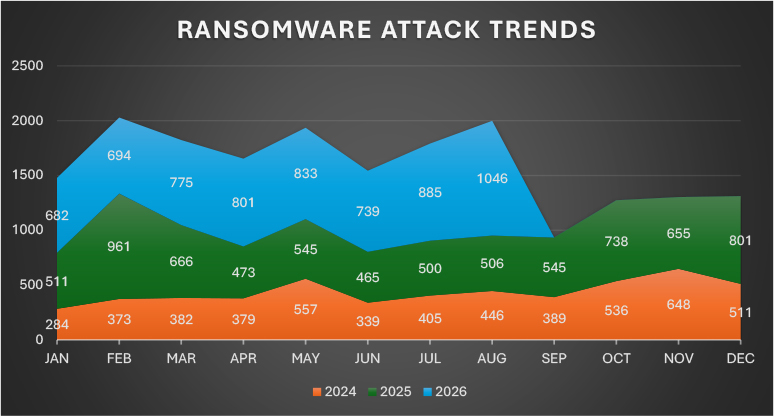
Ransomware activity remained elevated into 2026. Publicly disclosed incidents totaled 1,046 in August, compared with 885 in July. The chart covers 2024 to 2026, the years for which a complete monthly series is available, and months after August 2026 are not yet reported. Multi-year volumes continue to show that RaaS operations remain active and adaptable across industries and regions.
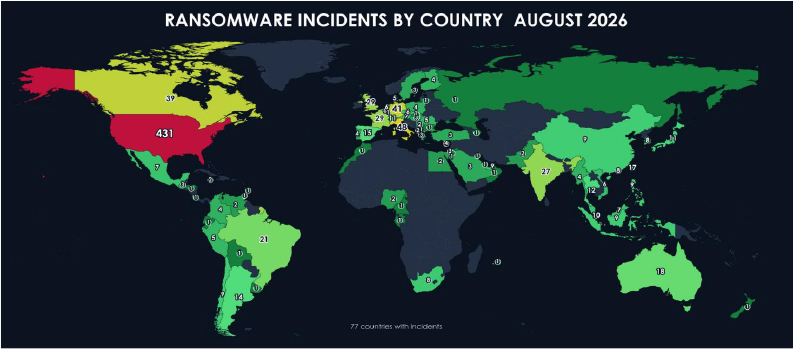
Ransomware activity in August 2026 remained geographically concentrated in the United States, which accounted for 431 of the 1,046 publicly claimed victims (41%). Other frequently affected countries were Italy (48), Germany (41), Canada (39), France (29), the United Kingdom (29), and India (27). Victims were identified in 77 countries in total. Operators continue to prioritize digitally mature economies while maintaining a broad international footprint.
Post-Disclosure Industrialization of High-Impact Edge Vulnerability Chains into Ransomware Access Pipelines
This activity demonstrates the evolution of ransomware initial access from opportunistic n-day scanning toward sustained industrialization of freshly disclosed edge appliance exploit chains. According to public reporting, during August 2026 operators linked to INC Ransom continued weaponizing the SonicWall Secure Mobile Access (SMA) 1000 chain combining CVE-2026-15409 server-side request forgery with CVE-2026-15410 local privilege escalation, converting unauthenticated perimeter compromise into root on remote access gateways. Public proof-of-concept (PoC) material and listing in the Known Exploited Vulnerabilities (KEV) catalog compressed the time between disclosure and broader affiliate or Initial Access Broker reuse, showing how ransomware ecosystems now treat critical VPN appliance flaws as durable access inventory rather than one-week news events.
ETLM Assessment:
Ransomware operators and access brokers are expected to keep recycling high-impact edge vulnerability chains well after vendor patches ship, especially where enterprises delay concentrator upgrades. Future campaigns will likely prioritize appliances that expose privileged authentication paths, then resell or reuse established footholds across multiple affiliates. Organizations should treat emergency patching as incomplete without compromise assessment of internet-facing VPN and remote-access estates. Confidence: Moderate – based on exploitation activity observed during the reporting period and on consistent operator behavior in prior edge-appliance campaigns.
Shift from Patch-and-Forget Remediation to Persistence-Aware Appliance Eviction
This development highlights a technical evolution in ransomware-enabling edge compromise where superficial firmware updates fail to remove attacker control. According to public reporting published in early August 2026, implants such as ROOTRUN and KNUCKLEBALL, modified init scripts, setuid helpers, and NGINX Unit changes can survive reboot and may persist after a hotfix if operators do not rebuild the appliance. This changes the defensive assumption that applying the vendor’s SNWLID-series patches alone ends the intrusion, and reframes ransomware pre-positioning as a firmware-and-filesystem persistence problem on the gateway itself.
ETLM Assessment:
Threat actors are expected to invest further in appliance-resident persistence that outlives routine patch cycles, forcing defenders to validate integrity of VPN concentrators rather than trusting version strings. Re-imaging, credential and session rotation, and out-of-band configuration rebuilds will become standard eviction steps after edge ransomware staging. Detection programs should hunt for unexpected init modifications, Java injection artifacts, and anomalous localhost service tunneling on remote-access appliances. Confidence: Moderate – based on implant behavior documented in public reporting for this appliance family; the extent of persistence across other vendors is untested.
Trusted-Process Injection on VPN Appliances as a Ransomware Staging Technique
This activity demonstrates the evolution of ransomware tooling toward living-off-the-appliance tradecraft that injects into vendor-trusted runtimes. KNUCKLEBALL-style loaders inject malicious Java agents into legitimate SonicWall Java Virtual Machine (JVM) processes via the Java Attach API, reducing standalone binary footprints while executing inside signed application contexts. Companion tunnels such as Suo5 and ORANGETAIL then provide covert proxying from the concentrator into internal networks, aligning edge compromise with classic ransomware needs for stealthy command and control (C2), credential reuse, and lateral movement without noisy new services.
ETLM Assessment:
Ransomware-adjacent actors are likely to expand memory-resident and process-injection techniques on network appliances where endpoint detection and response (EDR) visibility is weak or absent. Future tooling may further abuse vendor JVMs, management daemons, and embedded proxies as default staging platforms. Defenders should instrument appliance processes, listening ports, and outbound tunnel telemetry with the same priority historically reserved for Windows endpoints. Confidence: Low – extrapolated from a limited set of observed tooling samples on one vendor’s appliances rather than from activity observed across multiple platforms.
Credential and MFA Seed Harvesting from Remote Access Gateways as Pre-Encryption Capital
This incident demonstrates the continued evolution of ransomware operations toward treating VPN concentrators as identity vaults rather than mere perimeter hop points. Observed SMA intrusion flows capture stored credentials, active session databases, and one-time password (OTP) seed material, then pivot toward domain controllers and privileged internal systems. By converting edge root into durable identity compromise, operators shorten later encryption campaigns and enable access resale even when the original appliance is later patched.
Ransomware ecosystems are expected to keep prioritizing MFA seed theft, session database exfiltration, and Lightweight Directory Access Protocol (LDAP) sniffing from remote-access infrastructure as high-value post-exploitation objectives. Organizations that only rotate passwords after an appliance incident will remain exposed if seed and session material survive. Conditional access hardening, hardware-backed MFA, and rapid identity invalidation after edge compromise should be treated as core ransomware controls. Confidence: Moderate – based on intrusion flows observed during the reporting period; the proportion of campaigns that reach seed and session material is not established.
Initial Access Broker Monetization of Unpatched and Still-Compromised VPN Estates
This activity highlights the evolution of ransomware supply chains in which edge exploit success is monetized through access brokerage rather than immediate encryption alone. During August 2026, public assessments noted that many SMA devices remained unpatched or previously compromised, creating a reusable pool of footholds for Initial Access Brokers feeding ransomware affiliates. The technical signal is inventory reuse: once root and credential material exist on a concentrator, the same beachhead can support multiple downstream ransomware brands over time.
Access brokers are likely to expand catalogs of pre-compromised VPN and remote-access appliances as a primary product line for ransomware affiliates. This will sustain high campaign volume even when a specific RaaS brand is disrupted. Continuous external exposure management and broker-focused intelligence on appliance footholds will matter as much as brand-centric ransomware tracking. Confidence: Moderate – based on assessments of unpatched and previously compromised estates; broker catalog composition has not been independently verified.
Secondary Social Engineering Against Already-Compromised Victims During Extortion Windows
This campaign illustrates an evolution in ransomware monetization support techniques where technical compromise is followed by opportunistic human-layer fraud against the same victims. Public reporting tied to early August 2026 INC Ransom-linked disclosure waves described victims receiving emails and phone calls from unknown parties posing as ransomware assistance providers. This extends the attack surface beyond encryption and leak sites into trust abuse during crisis response, increasing the chance of further credential exposure or payment diversion while technical recovery is underway.
ETLM Assessment:
Operators and adjacent fraud networks are expected to increasingly couple technical ransomware events with impersonation of incident responders, insurers, and negotiators. Organizations should pre-establish authenticated communication channels with retained digital forensics and incident response (DFIR) and legal partners and treat unsolicited ransomware help offers as hostile by default. Security awareness for executives and helpdesk staff must cover crisis-time social engineering, not only routine phishing. Confidence: Low – based on victim-reported accounts relayed in public reporting that have not been independently corroborated.
Expansion of Extended Windows of Exposure on Third-Party Managed Remote Access Infrastructure
This activity demonstrates how ransomware-enabling conditions evolve when VPN concentrators are operated by managed service providers or fragmented ownership models. Public assessments published in early August 2026 emphasized that mean time to detect (MTTD) and mean time to respond (MTTR) for concentrator compromise can vary widely across third-party-managed estates, lengthening the window during which implants, tunnels, and stolen identity material remain usable. The technical implication is that ransomware risk concentrates where patch authority, logging ownership, and eviction responsibility are split across organizations.
ETLM Assessment:
Ransomware operators will continue targeting environments where edge ownership is outsourced, and response authority is ambiguous, because delayed eviction preserves access value. Contracts and operating models for managed VPN services should require emergency patch service-level agreements (SLAs), shared telemetry, and re-image rights after suspected compromise. Enterprises should inventory who can rebuild each concentrator within hours, not days. Confidence: Moderate – based on reported detection and response times across managed estates; the underlying sample is small.
Continued Maturation of User-Executed Clipboard Initial Access Feeding Ransomware Chains
This activity highlights the ongoing evolution of ransomware initial access away from attachment-centric phishing toward user-executed clipboard and Run-dialog tradecraft commonly labeled ClickFix. Operators and brokers continue inducing victims to paste and run commands that bootstrap PowerShell, living-off-the-land binaries (LOLBins), or trusted runtimes, bypassing browser download controls and many email security stacks. When chained to loaders and later ransomware affiliates, the technique shows how social engineering has been engineered into a reliable technical delivery path rather than a one-off lure.
ETLM Assessment:
Ransomware and initial access ecosystems are expected to keep refining ClickFix-style prompts, including further automation that reduces manual paste steps and abuses signed scripting runtimes. Controls that only inspect downloaded files will miss this class of intrusion. Defenders should restrict Win+R and script host abuse, alert on unusual PowerShell and rundll32 child chains from user sessions, and treat fake CAPTCHA or fix prompts as high-fidelity phishing indicators. Confidence: High – ClickFix-style delivery is repeatedly observed across multiple criminal ecosystems and is well documented in public reporting.
Overall Ransomware Trends (August 2026)
Industry studies of ransomware business impact provide useful context for interpreting the operational risk signaled by August 2026 activity. According to Cybereason’s Ransomware: The True Cost to Business study (2022), approximately 31% of surveyed organizations were forced to temporarily or permanently suspend operations following a ransomware attack. The same Cybereason study reported that nearly 40% of affected organizations laid off staff, and 35% experienced C-level executive resignations in the aftermath of an attack.
Sources: Cybereason, Ransomware: The True Cost to Business (2022 study / press summary), including findings on operational suspension (31%), workforce reductions (nearly 40%), and C-level resignations (35%).
Impact Assessment
Ransomware remains a major threat to both organizations and individuals, locking critical data and demanding payment for its release. The consequences extend well beyond the ransom, often leading to costly recovery efforts, extended downtime, reputational harm, and potential regulatory fines. Such disruptions can destabilize operations and erode stakeholder trust. Addressing this growing risk demands a proactive cybersecurity posture and stronger collaboration between public and private sectors to build resilience against future attacks.
Victimology
Cybercriminals are increasingly targeting industries that manage vast amounts of sensitive data, ranging from personal and financial information to proprietary assets. Sectors such as professional services, manufacturing, real estate and construction, healthcare, information technology, consumer services, finance, and government remain frequently targeted, reflecting the scale and complexity of their digital estates. Observed targeting is concentrated in economically advanced regions, particularly the United States. The pattern is consistent with operators selecting victims where encryption of critical systems and disruption of production are most likely to compel payment, although motive is inferred from targeting behavior rather than directly established.
Ransomware in August 2026 remains an enduring, multi-stage business threat. On the intelligence available at the time of writing, 1,046 publicly claimed victims, Qilin’s position at the head of the rankings, and continued evolution in access, extortion, and affiliate models indicate that overall risk remains high even as brand rankings shift. Resilience depends on identity and edge hardening, early lateral-movement detection, governance readiness, and preparation for both encryption and leak-driven outcomes.
