

CYFIRMA Research and Advisory Team would like to highlight ransomware trends and insights gathered while monitoring various forums. This includes multiple – industries, geography, and technology – that could be relevant to your organization.
Type: Ransomware
Target Technologies: Windows
Introduction:
CYFIRMA Research and Advisory Team has found BL4CK SP1D3R Ransomware while monitoring various underground forums as part of our Threat Discovery Process.
BL4CK SP1D3R Ransomware
Researchers identified BL4CK SP1D3R as ransomware after analyzing new malware samples. The threat encrypts files and appends the .bl4ck extension to affected filenames, preventing normal access to stored data. After completing encryption, it drops a ransom note named BL4CK_SP1D3R_README.txt, changes the desktop wallpaper, and instructs victims to locate R3ADM3.TXT within encrypted directories. The malware states that each victim’s data is encrypted with a unique key and displays a machine identifier for victim identification.
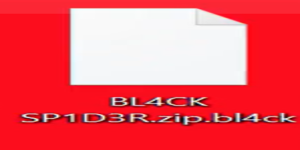
Screenshot: File encrypted by ransomware (Source: Surface Web)
The ransom note instructs victims to establish contact with the operators and provide the assigned machine ID to receive further payment and recovery instructions. It also claims that files were stolen before encryption, indicating a double-extortion approach that combines data theft with file encryption. Additionally, the note warns against renaming encrypted files, using third-party recovery utilities, or rebooting the system, claiming these actions could result in permanent data loss.
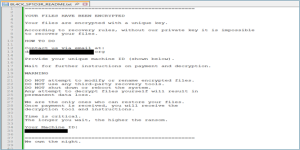
Screenshot: The appearance of BL4CK SP1D3R’s ransom note (BL4CK_SP1D3R_README.txt) (Source: Surface Web)
BL4CK SP1D3R leaves multiple indicators of compromise, including the .bl4ck file extension, the BL4CK_SP1D3R_README.txt ransom note, references to R3ADM3.TXT within encrypted folders, and a modified desktop wallpaper displaying the attackers’ message. These artifacts can assist incident responders in identifying affected systems, correlating the ransomware activity, and supporting forensic investigation during incident response.

Screenshot: The appearance of BL4CK SP1D3R’s wallpaper
The following are the TTPs based on the MITRE ATT&CK Framework
| Tactic | Technique ID | Technique Name |
| Execution | T1059 | Command and Scripting Interpreter |
| Execution | T1129 | Shared Modules |
| Persistence | T1543.003 | Create or Modify System Process: Windows Service |
| Privilege Escalation | T1543.003 | Create or Modify System Process: Windows Service |
| Discovery | T1007 | System Service Discovery |
| Discovery | T1012 | Query Registry |
| Discovery | T1033 | System Owner/User Discovery |
| Discovery | T1057 | Process Discovery |
| Discovery | T1082 | System Information Discovery |
| Discovery | T1083 | File and Directory Discovery |
| Discovery | T1135 | Network Share Discovery |
| Discovery | T1497.001 | Virtualization/Sandbox Evasion: System Checks |
| Discovery | T1518 | Software Discovery |
| Collection | T1074 | Data Staged |
| Command and Control | T1071 | Application Layer Protocol |
| Impact | T1489 | Service Stop |
| Impact | T1490 | Inhibit System Recovery |
| Stealth | T1027 | Obfuscated Files or Information |
| Stealth | T1070.004 | Indicator Removal: File Deletion |
| Stealth | T1202 | Indirect Command Execution |
| Stealth | T1497.001 | Virtualization/Sandbox Evasion: System Checks |
| Stealth | T1564.003 | Hide Artifacts: Hidden Window |
| Defense Impairment | T1222 | File and Directory Permissions Modification |
Relevancy and Insights:
ETLM Assessment:
CYFIRMA assesses that BL4CK SP1D3R currently combines file encryption with claimed data exfiltration, reflecting the ongoing evolution of ransomware beyond simple file-locking attacks. Modern ransomware campaigns increasingly rely on double-extortion techniques that encrypt data while simultaneously collecting sensitive information to increase pressure on victims. As ransomware operations continue to mature, future variants are expected to improve automation across different stages of an attack, including victim profiling, data collection, encryption workflows, and post-encryption communication, making incidents more coordinated and operationally efficient.
The ransomware already employs multiple mechanisms to notify victims, including modified file extensions, ransom notes, desktop wallpaper changes, and folder-specific recovery instructions. Future developments are likely to expand these capabilities by introducing stronger anti-analysis and defense-evasion techniques, broader targeting of network-connected storage, virtualized environments, and backup repositories, as well as more sophisticated methods for maintaining access during an intrusion. Ransomware operators are also expected to continue integrating encryption, data theft, and automated deployment into a unified attack chain, increasing the complexity of incident response and forensic investigations while reducing the time required to execute large-scale compromises.
Sigma rule:
title: System File Execution Location Anomaly
description:
Detects the execution of a Windows system binary that is usually located in the system folder from an uncommon location.
tags:
– attack.stealth
logsource:
category: process_creation
product: windows
detection:
selection:
Image|endswith:
– ‘\atbroker.exe’
– ‘\audiodg.exe’
– ‘\bcdedit.exe’
– ‘\bitsadmin.exe’
– ‘\certreq.exe’
– ‘\certutil.exe’
– ‘\cmstp.exe’
– ‘\conhost.exe’
– ‘\consent.exe’
– ‘\cscript.exe’
– ‘\csrss.exe’
– ‘\dashost.exe’
– ‘\defrag.exe’
– ‘\dfrgui.exe’ # Was seen used by Lazarus Group – https://asec.ahnlab.com/en/39828/
– ‘\dism.exe’
– ‘\dllhost.exe’
– ‘\dllhst3g.exe’
– ‘\dwm.exe’
– ‘\eventvwr.exe’
– ‘\fsquirt.exe’ # was seen used by sidewinder APT – https://securelist.com/sidewinder-apt/114089/
– ‘\finger.exe’
– ‘\logonui.exe’
– ‘\LsaIso.exe’
– ‘\lsass.exe’
– ‘\lsm.exe’
– ‘\msiexec.exe’
– ‘\ntoskrnl.exe’
– ‘\powershell_ise.exe’
– ‘\powershell.exe’
– ‘\pwsh.exe’
– ‘\regsvr32.exe’
– ‘\rundll32.exe’
– ‘\runonce.exe’
– ‘\RuntimeBroker.exe’
– ‘\schtasks.exe’
– ‘\services.exe’
– ‘\sihost.exe’
– ‘\smartscreen.exe’
– ‘\smss.exe’
– ‘\spoolsv.exe’
– ‘\svchost.exe’
– ‘\taskhost.exe’
– ‘\taskhostw.exe’
– ‘\Taskmgr.exe’
– ‘\userinit.exe’
– ‘\werfault.exe’
– ‘\werfaultsecure.exe’
– ‘\wininit.exe’
– ‘\winlogon.exe’
– ‘\winver.exe’
– ‘\wlanext.exe’
– ‘\wmic.exe’
– ‘\wscript.exe’
– ‘\wsl.exe’
– ‘\wsmprovhost.exe’ # Was seen used by Lazarus Group –
filter_main_generic:
Image|startswith:
– ‘C:\$WINDOWS.~BT\’
– ‘C:\$WinREAgent\’
– ‘C:\Windows\SoftwareDistribution\’
– ‘C:\Windows\System32\’
– ‘C:\Windows\SystemTemp\’
– ‘C:\Windows\SysWOW64\’
– ‘C:\Windows\uus\’
– ‘C:\Windows\WinSxS\’
filter_optional_system32:
Image|contains: ‘\SystemRoot\System32\’
filter_main_powershell:
Image|contains:
– ‘C:\Program Files\PowerShell\7\’
– ‘C:\Program Files\PowerShell\7-preview\’
– ‘C:\Program Files\WindowsApps\Microsoft.PowerShellPreview’
– ‘\AppData\Local\Microsoft\WindowsApps\Microsoft.PowerShellPreview’ # pwsh installed from Microsoft Store
Image|endswith: ‘\pwsh.exe’
filter_main_wsl_programfiles:
Image|startswith:
– ‘C:\Program Files\WindowsApps\MicrosoftCorporationII.WindowsSubsystemForLinux’
– ‘C:\Program Files\WSL\’
Image|endswith: ‘\wsl.exe’
filter_main_wsl_appdata:
Image|startswith: C:\Users\’
Image|contains: ‘\AppData\Local\Microsoft\WindowsApps\’
Image|endswith: ‘\wsl.exe’
condition: selection and not 1 of filter_main_* and not 1 of filter_optional_*
falsepositives:
– Unknown
level: high
regression_tests_path: regression_data/rules/windows/process_creation/proc_creation_win_susp_system_exe_anomaly/info.yml
(Source: Surface Web)
IOCs:
Kindly refer to the IOCs section to exercise control of your security systems (Source: Surface Web)
STRATEGIC RECOMMENDATIONS
MANAGEMENT RECOMMENDATIONS
TACTICAL RECOMMENDATIONS
Type: Banking Trojan
Objectives: Credential Theft
Target Technology: Android
Target Geography: Global
CYFIRMA collects data from various forums based on which the trend is ascertained. We identified a few popular malwares that were found to be distributed in the wild to launch cyberattacks on organizations or individuals.
Active Malware of the week
This week “GoldDigger” Android Malware is in focus.
Overview of Operation GoldDigger Android Malware
The analyzed GoldDigger Android malware is a sophisticated mobile threat designed to compromise Android devices and collect sensitive user information. By masquerading as a legitimate application, it deceives users into granting extensive permissions that enable unauthorized access to valuable device resources. Its primary objective is to facilitate financial fraud, credential theft, and long-term access to infected devices while remaining difficult for users to identify.
The malware demonstrates a broad range of capabilities that support surveillance and information theft. It can gather personal and device-related data, monitoring user activity, and interacting with sensitive system features to obtain information that can be exploited by threat actors. These capabilities indicate that the malware is intended to maximize the amount of valuable data collected from each compromised device.
The application also incorporates multiple techniques to reduce the likelihood of detection and maintain its presence on infected systems. Its use of code protection, persistence mechanisms, and concealed communication methods reflects a mature and well-developed malware framework that has been designed to operate discreetly while supporting remote attacker objectives.
Overall, GoldDigger represents a significant threat to both individual users and organizations due to its focus on financial theft and unauthorized access to sensitive information. The malware highlights the growing sophistication of Android-based threats and reinforces the importance of installing applications only from trusted sources, carefully reviewing requested permissions, and deploying mobile security solutions capable of detecting malicious behavior.
Attack Method
The GoldDigger Android malware is typically delivered as a seemingly legitimate application that persuades users to install it manually. Once executed, it requests an extensive set of permissions that grant access to sensitive device resources, including SMS messages, contacts, phone state, storage, location, camera, microphone, and accessibility services. By obtaining these privileges during installation or runtime, the malware establishes a foundation for extensive monitoring and control of the infected device.
Following successful installation, the malware leverages Android Accessibility Services and other privileged APIs to monitor user interactions, collect sensitive information, and facilitate unauthorized actions on behalf of the victim. It can harvest credentials, intercept messages, retrieving device information, monitoring clipboard contents, and collecting data from installed applications. The malware also maintains communication with remote command-and-control (C2) infrastructure, enabling operators to receive stolen information, issue commands, and update malicious functionality as required.
To improve its survivability, GoldDigger incorporates several defense-evasion and persistence mechanisms. The application utilizes code obfuscation to complicate reverse engineering, supports multiple processor architectures through bundled native libraries, and permits clear text network communication for interaction with external infrastructure. Additionally, numerous exported activities, services, broadcast receivers, and content providers increase the malware’s operational flexibility while enabling interaction with other applications and system components.
The overall attack methodology demonstrates a multi-stage infection strategy focused on credential theft, financial fraud, and persistent remote access. By combining excessive permission abuse, accessibility service exploitation, covert data collection, and continuous communication with attacker-controlled infrastructure, GoldDigger enables long-term surveillance of compromised devices while providing threat actors with the capability to expand their operations through additional commands or payloads.
Following are the TTPs based on the MITRE Attack Framework for Mobile
| Tactic | Technique | Technique Name |
| Defense Evasion | T1406 | Obfuscated Files or Information |
| T1407 | Download New Code at Runtime | |
| T1632 | Subvert Trust Controls | |
| T1414 | Clipboard Data | |
| T1517 | Access Notifications | |
| Discovery | T1420 | File and Directory Discovery |
| T1421 | System Network Connections Discovery | |
| T1430 | Location Tracking | |
| T1418 | Software Discovery | |
| Collection | T1636:003 | Protected User Data: Contact List |
| T1636:004 | Protected User Data: SMS Messages | |
| T1512 | Video Capture | |
| T1513 | Screen Capture | |
| Command and Control | T1437 | Application Layer Protocol |
INSIGHTS
ETLM ASSESSMENT
For ETLM Perspective the increasing sophistication of Android malware such as GoldDigger indicates that mobile devices will continue to be a primary target for cybercriminals as organizations expand their reliance on mobile applications, remote work, and cloud-based services. As employees increasingly use smartphones to access corporate resources, authentication platforms, and financial applications, successful compromises of these devices could provide threat actors with opportunities to access sensitive business information and disrupt organizational operations.
The continued growth of mobile-centric attack campaigns is also expected to blur the boundaries between personal and enterprise security, as a single compromised device may expose both individual and corporate assets. This evolving threat landscape is likely to increase the operational impact of mobile malware on organizations by facilitating credential compromise, unauthorized access, and data exposure through trusted mobile ecosystems, making mobile security an increasingly important component of enterprise cyber resilience.
IOCs:
Kindly refer to the IOCs Section to exercise controls on your security systems. (Source: Surface Web)
YARA Rule
rule ANDROID_GoldDigger_Banker_Infostealer
{
meta:
description = “Detects GoldDigger Android Banking Trojan / Infostealer”
author = “CYFIRMA”
date = “2026-07-14″
strings:
/* Sample SHA256 */
$hash = ” bba9bc21a322ea0e1737c5fa64057d12f133a3ebed6007ffed979b3d6099f6aa”
/* Android Manifest Indicators */
$manifest = “AndroidManifest.xml”
$apk = “classes.dex”
/* Dangerous Permissions */
$perm1 = “android.permission.BIND_ACCESSIBILITY_SERVICE”
$perm2 = “android.permission.RECEIVE_SMS”
$perm3 = “android.permission.READ_SMS”
$perm4 = “android.permission.SEND_SMS”
$perm5 = “android.permission.READ_CONTACTS”
$perm6 = “android.permission.READ_CALL_LOG”
$perm7 = “android.permission.RECORD_AUDIO”
$perm8 = “android.permission.CAMERA”
$perm9 = “android.permission.ACCESS_FINE_LOCATION”
$perm10 = “android.permission.READ_EXTERNAL_STORAGE”
$perm11 = “android.permission.WRITE_EXTERNAL_STORAGE”
/* Accessibility Abuse */
$acc1 = “AccessibilityService”
$acc2 = “BIND_ACCESSIBILITY_SERVICE”
/* Data Theft Indicators */
$ioc1 = “content://sms”
$ioc2 = “content://contacts”
$ioc3 = “content://call_log”
$ioc4 = “clipboard” ascii
$ioc5 = “getInstalledPackages”
$ioc6 = “TelephonyManager”
$ioc7 = “UsageStatsManager”
/* Network Indicators */
$http1 = “http://”
$http2 = “https://”
/* Native Libraries */
$lib1 = “lib/arm64-v8a/”
$lib2 = “lib/armeabi-v7a/”
$lib3 = “lib/x86/”
$lib4 = “lib/x86_64/”
condition:
uint32(0) == 0x04034B50 and
(
$hash or
(
$manifest and
$apk and
5 of ($perm*) and
3 of ($ioc*) and
any of ($acc*) and
any of ($lib*) and
any of ($http*)
)
)
}
Strategic Recommendations
MANAGEMENT RECOMMENDATION
TACTICAL RECOMMENDATION
Key Intelligence Signals:
Silver Fox: Evolving Malware Delivery and Persistent Intrusion Capabilities
About the Threat Actor
Silver Fox is believed to have been active since at least 2019–2020 and has demonstrated a steady evolution in both its tooling and targeting strategies. The threat actor has exhibited increasingly aggressive operations while expanding its operational footprint across multiple countries in the Asia-Pacific (APAC) region.
TTPs based on MITRE ATT&CK Framework
| Tactic | ID | Technique |
| Resource Development | T1583.001 | Acquire Infrastructure: Domains |
| Resource Development | T1583.006 | Acquire Infrastructure: Web Services |
| Initial Access | T1189 | Drive-by Compromise |
| Initial Access | T1566.002 | Phishing: Spearphishing Link |
| Execution | T1204.002 | User Execution: Malicious File |
| Execution | T1053 | Scheduled Task/Job |
| Execution | T1129 | Shared Modules |
| Execution | T1569.002 | System Services: Service Execution |
| Execution | T1053.005 | Scheduled Task/Job: Scheduled Task |
| Execution | T1047 | Windows Management Instrumentation |
| Persistence | T1543.003 | Create or Modify System Process: Windows Service |
| Persistence | T1053.005 | Scheduled Task/Job: Scheduled Task |
| Persistence | T1546.003 | Event Triggered Execution: Windows Management Instrumentation Event Subscription |
| Privilege Escalation | T1543.003 | Create or Modify System Process: Windows Service |
| Privilege Escalation | T1055 | Process Injection |
| Privilege Escalation | T1548 | Abuse Elevation Control Mechanism |
| Privilege Escalation | T1053.005 | Scheduled Task/Job: Scheduled Task |
| Privilege Escalation | T1546.003 | Event Triggered Execution: Windows Management Instrumentation Event Subscription |
| Stealth | T1140 | Deobfuscate/Decode Files or Information |
| Stealth | T1036 | Masquerading |
| Stealth | T1055 | Process Injection |
| Stealth | T1027 | Obfuscated Files or Information |
| Discovery | T1016 | System Network Configuration Discovery |
| Discovery | T1082 | System Information Discovery |
| Discovery | T1083 | File and Directory Discovery |
| Collection | T1114 | Email Collection |
| Command and Control | T1102 | Web Service |
| Command and Control | T1071 | Application Layer Protocol |
| Command and Control | T1573 | Encrypted Channel |
| Command and Control | T1105 | Ingress Tool Transfer |
| Exfiltration | T1041 | Exfiltration Over C2 Channel |
| Impact | T1565.002 | Data Manipulation: Transmitted Data Manipulation |
Latest Developments Observed
ETLM Insights
Silver Fox is assessed to be a financially motivated threat actor whose operations demonstrate an increasingly structured intrusion model focused on establishing long-term access to targeted environments while supporting information theft and broader intelligence-driven objectives. Recent activity indicates a shift toward more selective victim targeting and customized intrusion capabilities, reflecting a gradual evolution in the group’s operational maturity.
Operationally, the threat actor demonstrates a persistence-oriented intrusion methodology centered on trusted delivery channels, staged malware deployment, and resilient command-and-control communications to establish and maintain covert access within victim environments. Its tradecraft reflects an emphasis on operational persistence, adaptive payload delivery, and sustained post-compromise activity while minimizing detection opportunities.
The threat actor’s operations reflect a deliberate approach:
Looking ahead, the threat actor is likely to continue strengthening its intrusion capabilities through increasingly customized malware delivery and resilient operational infrastructure. This evolving operational model positions Silver Fox as a persistent threat capable of sustaining long-term unauthorized access and information collection against high-value organizations.
IOCs:
Kindly refer to the IOCs section to exercise control of your security systems.
YARA Rules
rule IOC_SilverFox_Win32_Campaign
{
meta:
description = “Detects Silver Fox campaign indicators based on observed domains, IP addresses, and Win32 executable artifact”
author = “CYFIRMA”
date = “2026-07-14”
version = “1.0”
reference = “Silver Fox IOC”
strings:
/* Domains */
$domain1 = “fzdoor.vip” ascii nocase
$domain2 = “amvcoins.vip” ascii nocase
$domain3 = “jinmai.vip” ascii nocase
$domain4 = “betooo.vip” ascii nocase
/* IP Addresses */
$ip1 = “43.128.54.184” ascii
$ip2 = “207.56.138.28” ascii
$ip3 = “108.187.42.63” ascii
$ip4 = “108.187.37.85” ascii
$ip5 = “154.82.81.205” ascii
/* File Indicator */
$file1 = “win32.exe” ascii nocase
condition:
any of ($domain*) or
any of ($ip*) or
$file1
}
Recommendations
Strategic Recommendations
Management Recommendations
Tactical Recommendations
Western intelligence warn against Russian critical infrastructure hacking
ETLM Assessment:
By quietly compromising routers at power plants, water facilities, and transit hubs, hackers are essentially planting digital landmines. They do not want to trigger an outage today; they want to ensure that if a direct military conflict ever breaks out between Russia and NATO, they already have access to the “off switches” of Western society. This also serves as a form of asymmetric deterrence. By demonstrating the ability to quietly infiltrate the power grid or aviation networks of a Western country, Moscow sends a silent but clear warning to foreign policymakers.
France will summon Russia’s ambassador in the coming days regarding the campaign while authorities in Paris are preparing to sanction nine individuals and four entities responsible for taking part in the campaign.
Chinese APT targets US and Canadian universities
ETLM Assessment:
Deadlock Ransomware Impacts a Manufacturing Company from Indonesia
Summary:
CYFIRMA observed on a ransomware data leak site (DLS) on the dark web that a company from Indonesia was compromised by Deadlock Ransomware. The Compromised company is an Indonesian manufacturer and distributor of plastic piping systems, serving residential, commercial, industrial, and infrastructure markets. Founded in 1979 and headquartered in Jakarta, Indonesia, the company is recognized as one of Indonesia’s major producers of piping solutions and related products. The compromised data includes confidential and sensitive information belonging to the organization. The total size of the compromised data is approximately 400 GB.
The following screenshot was observed published on the dark web:
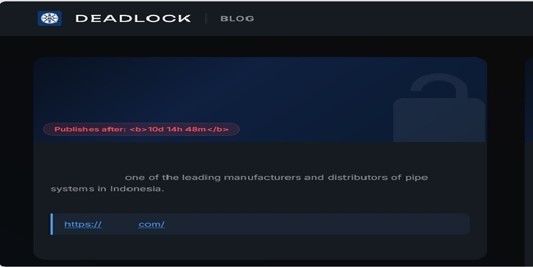
Source: Dark Web
Relevancy & Insights:
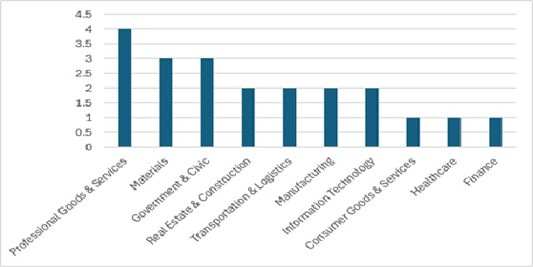
ETLM Assessment:
The Gentlemen Ransomware Impacts a FinTech company from Singapore
Summary:
CYFIRMA observed on a ransomware data leak site (DLS) in the dark web that a company from Singapore was compromised by The Gentlemen Ransomware. The compromised company is a is a Singapore-based fintech company specializing in collateral, compliance, and risk management software for structured commodity finance. Founded by seasoned banking professionals, the firm provides cutting-edge technology that helps global banks and direct lenders reliably track assets and mitigate risks. With a strong international presence across Europe and Australia, the company solutions empower financial institutions to navigate complex commodity markets efficiently. The data, which has been breached, has not yet appeared on the leak site, indicating that negotiations between the affected party and the ransomware group may be underway. The compromised data includes confidential and sensitive information belonging to the organization. [MISSING IMAGE: , ]
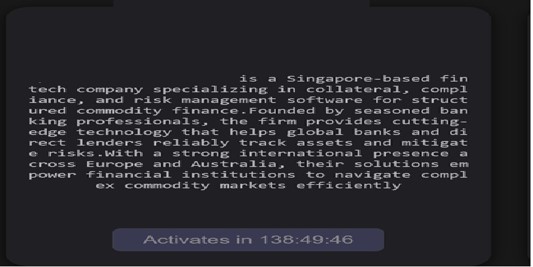
Source: Dark Web
Relevancy & Insights:
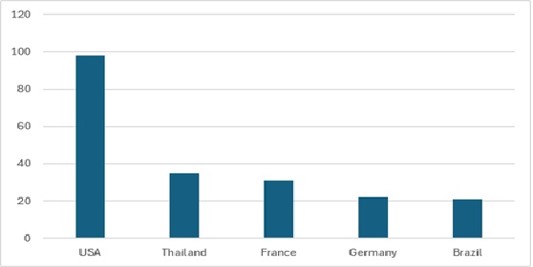
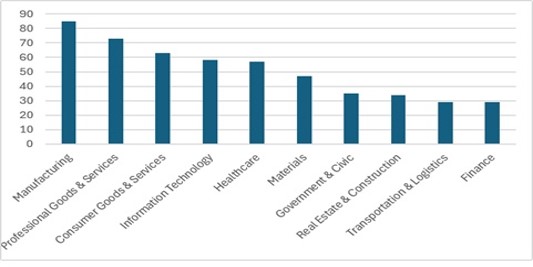
ETLM Assessment:
Vulnerability in Dassault Systèmes DELMIA Apriso
Relevancy & Insights:
Impact:
Affected Products: https[:]//www[.]3ds[.]com/trust-center/security/security-advisories/cve-2026-9695
Recommendations:
Monitoring and Detection: Implement monitoring and detection mechanisms to identify unusual system behavior that might indicate an attempted exploitation of this vulnerability.
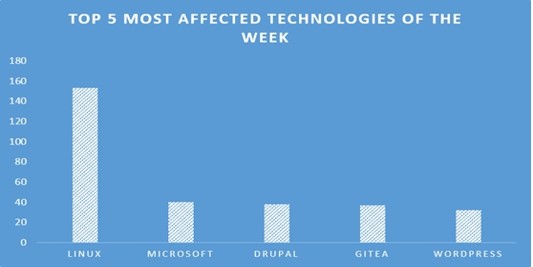
TOP 5 AFFECTED PRODUCTS OF THE WEEK
This week, CYFIRMA researchers have observed significant impacts on various technologies due to a range of vulnerabilities. The following are the top 5 most affected technologies.
ETLM Assessment:
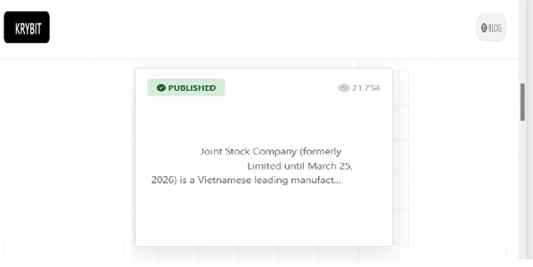
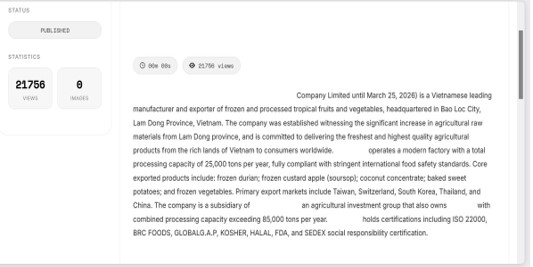
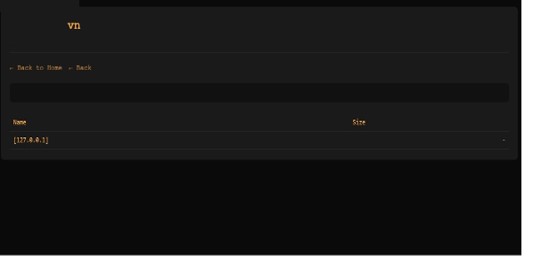
Krybit Ransomware attacked and published the data of a Manufacturing company from Vietnam
Summary:
Source: Dark Web
Relevancy & Insights:
ETLM Assessment:
Unauthorized Financial Services Customer Database Advertised on a Leak Site
Summary:
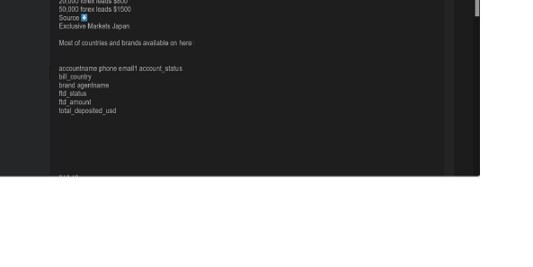
The CYFIRMA research team identified a post on a dark web forum advertising the sale of an alleged customer database associated with a Japan-based foreign exchange (FX) and cryptocurrency trading platform. According to the advertisement, the seller claims to possess a large volume of customer lead information and is offering the dataset in multiple record quantities at different price points.
The forum post indicates that the dataset is marketed as an exclusive collection of Japanese financial trading leads and includes sample records intended to demonstrate possession of the data. The advertisement also claims that additional datasets covering various countries and brands are available through the same marketplace.
Potentially Exposed Information
Based on the information shared in the forum advertisement, the allegedly compromised dataset may contain:
The disclosure of customer contact information, account status, and financial activity data may further enable attackers to identify high-value victims for investment fraud, cryptocurrency scams, and other financially motivated cybercriminal operations.
The authenticity of the alleged dataset remains unverified at the time of reporting. This assessment is based solely on information published in the dark web forum advertisement and has not been independently confirmed.
Source: Underground Forums
Unauthorized Industrial Manufacturing Database Advertised on a Leak Site
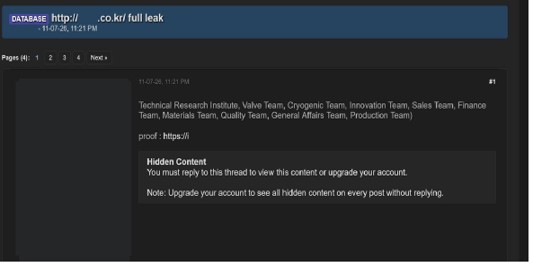
Summary: The CYFIRMA research team identified a post on a dark web forum advertising the alleged sale of a database belonging to a South Korean industrial manufacturing organization specializing in heavy engineering and industrial equipment. The forum post claims that a complete organizational database has been compromised and is being offered for sale.
According to the advertisement, the leaked data allegedly originates from multiple internal business units across the organization. The post references several operational and administrative departments, including:
The advertisement further claims that screenshots have been published as proof of possession, while the complete dataset remains accessible only to authorized buyers through the cybercrime forum.
The disclosure of technical research, engineering documentation, production-related information, and employee records could further increase the organization’s exposure to operational disruption and competitive intelligence risks.
The authenticity of the alleged dataset remains unverified at the time of reporting. This assessment is based solely on information published in the dark web forum advertisement and has not been independently confirmed.
Source: Underground Forums
Relevancy & Insights:
ETLM Assessment:
Recommendations: Enhance the cybersecurity posture by
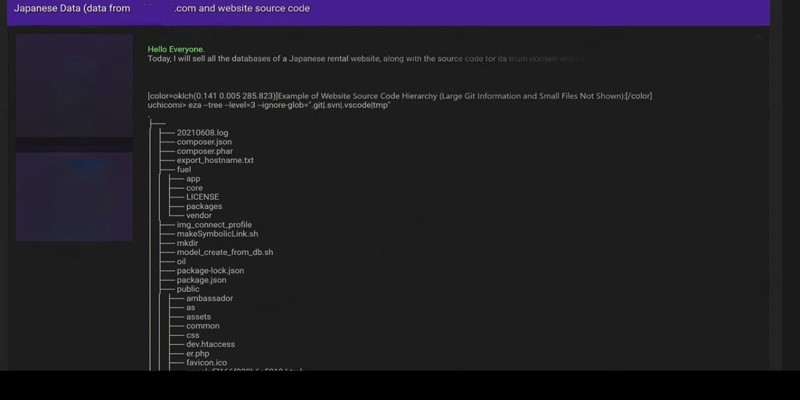
The CYFIRMA research team identified a post on a dark web forum advertising the sale of an alleged database and website source code belonging to a Japanese online property rental platform. According to the advertisement, the seller claims to possess the complete database associated with the platform, along with the source code of its primary website.
The forum post also includes what appears to be a partial directory structure of the web application as proof of possession, indicating that the compromised data may include application files, configuration files, development resources, and source code repositories. The complete dataset is advertised for sale through a cybercrime forum.
Potentially Exposed Information
Based on the information shared in the forum advertisement, the allegedly compromised data may include:
The disclosure of website source code and application architecture could enable attackers to identify security weaknesses, develop customized exploits, bypass security controls, and compromise additional corporate systems. Exposure of customer databases may further increase the risk of identity theft, fraud, and unauthorized access to user accounts.
The authenticity of the alleged dataset remains unverified at the time of reporting. This assessment is based solely on information published in the dark web forum advertisement and has not been independently confirmed.
Source: Underground Forums
STRATEGIC RECOMMENDATION
MANAGEMENT RECOMMENDATION
TACTICAL RECOMMENDATION
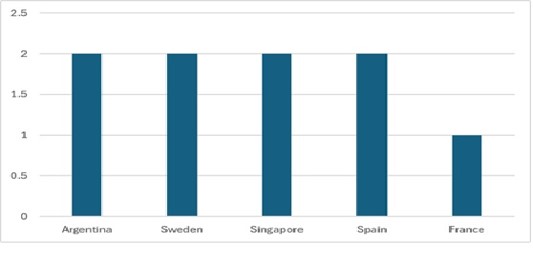
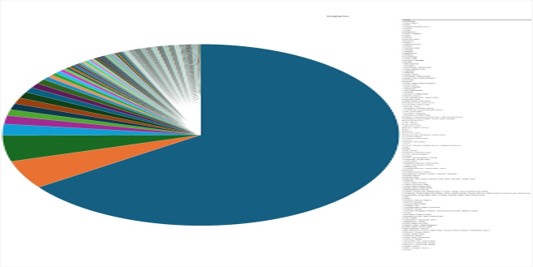
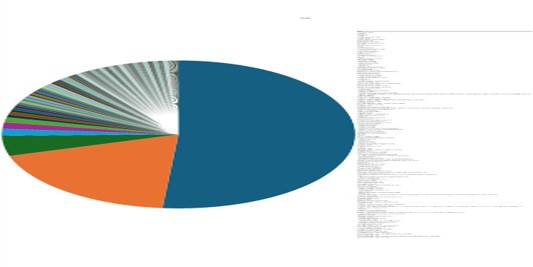
Please find the Geography-Wise and Industry-Wise breakup of cyber news for the last 5 days as part of the situational awareness pillar.
Geography-Wise Graph
Industry-Wise Graph
For situational awareness intelligence and specific insights mapped to your organisation’s geography, industry, technology, please access DeCYFIR.
