

Ransomware activity during June 2026 underscored the continued evolution of the threat landscape from isolated malware campaigns into a mature, service-driven criminal ecosystem capable of sustaining large-scale operations across multiple regions and sectors. With 778 publicly disclosed victims, activity remained significantly above historical levels, reflecting the enduring effectiveness of ransomware-as-a-service (RaaS) models and the growing specialization of cybercriminal networks. Organizations within Professional Goods & Services, Manufacturing, Information Technology, Healthcare, and Real Estate & Construction experienced the highest levels of targeting, demonstrating attackers’ preference for environments where operational disruption, sensitive information exposure, and business continuity pressures can be leveraged to maximize extortion outcomes. The reporting period also highlighted a notable shift in intrusion methodologies, with threat actors increasingly exploiting identity-related weaknesses, incomplete remediation efforts, misconfigurations, trusted relationships, and internet-facing infrastructure rather than relying exclusively on traditional vulnerability exploitation. Several incidents demonstrated a growing emphasis on long-term access, privilege escalation, defense evasion, and reconnaissance activities designed to establish strategic positioning before monetization occurs. Simultaneously, data theft continued to expand as a primary objective, with intellectual property, source code repositories, customer records, educational datasets, and other high-value information assets increasingly serving as the basis for extortion, often reducing the need for disruptive encryption activities altogether. The continued targeting of software development environments, cloud platforms, hosting infrastructure, supply chains, and shared-service ecosystems further illustrates how attackers are seeking opportunities to amplify impact through a single compromise. Additionally, the growing role of Initial Access Brokers (IABs), anonymization providers, malware-signing services, hosting operators, and other specialized criminal service providers highlights the increasing professionalization and operational efficiency of the ransomware economy. Collectively, these developments demonstrate that modern ransomware operations are becoming more persistent, intelligence-driven, and data-focused, requiring organizations to strengthen cyber resilience through improved identity security, accelerated remediation processes, enhanced visibility, supply-chain risk management, and proactive threat intelligence capabilities to mitigate both immediate and long-term business risk.
Welcome to the APR 2026 Ransomware Threat Report. This report delivers a detailed analysis of the ransomware landscape, highlighting the emergence of new ransomware groups, evolving attack techniques, and notable shifts in targeted industries. By examining key trends, tactics, and significant incidents, this report aims to support organizations and security teams in understanding the current threat environment. As ransomware campaigns continue to grow in complexity, this report serves as a vital resource for anticipating future threats and strengthening proactive cybersecurity strategies.
Throughout June 2026, there was notable activity from several ransomware groups. Here are the trends regarding the top 10:
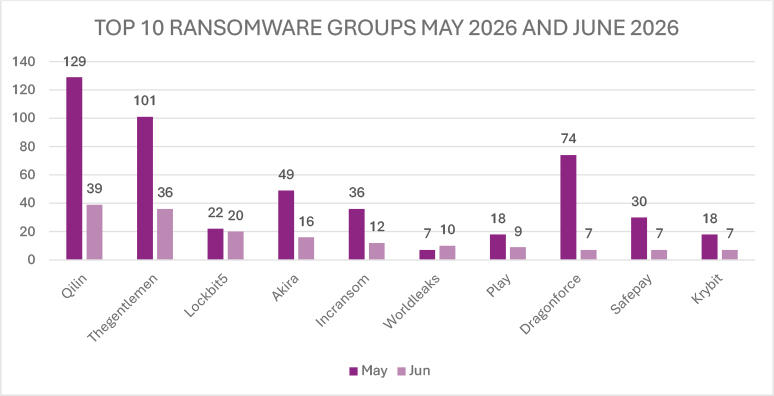
The May–June 2026 data indicates a significant shift in ransomware activity across the threat landscape. Qilin remained the most active ransomware group despite a substantial decline in publicly disclosed victims, dropping from 129 incidents in May to 39 in June, while Thegentlemen followed a similar trend, decreasing from 101 to 36 incidents. Most established ransomware groups also recorded lower activity during June, including Dragonforce (74→7), Akira (49→16), Incransom (36→12), Safepay (30→7), LockBit5 (22→20), and Play (18→9). In contrast, WorldLeaks was the only group within the top ten to register an increase, rising from 7 incidents in May to 10 in June, indicating growing operational momentum. Krybit maintained a relatively consistent presence with 7 incidents in June, down from 18 in May. Overall, June witnessed a broad reduction in publicly disclosed ransomware activity among leading groups; however, the continued dominance of established operators alongside the emergence of expanding actors such as WorldLeaks suggests that the ransomware-as-a-service (RaaS) ecosystem remains highly resilient, with operational activity continuing to shift between threat groups rather than indicating a sustained decline in the overall ransomware threat.
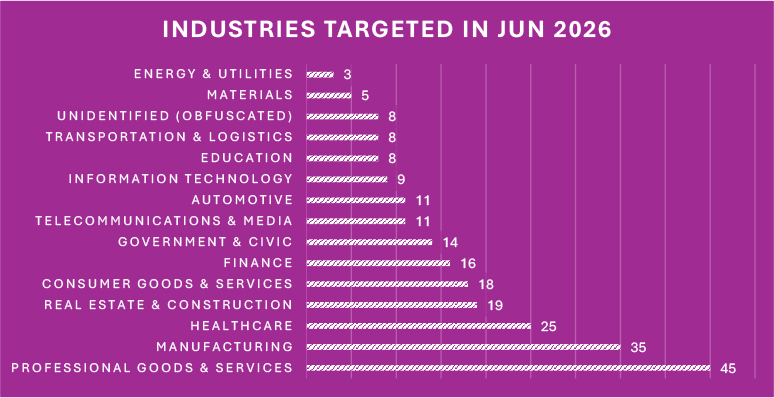
In June 2026, ransomware activity continued to focus on sectors where operational disruption and data theft are most likely to maximize financial extortion. Professional Goods & Services remained the most targeted industry with 45 incidents, followed by Manufacturing (35) and Healthcare (25), reflecting continued adversary interest in organizations that rely on uninterrupted operations and manage high-value or sensitive data. Real Estate & Construction (19), Consumer Goods & Services (18), Finance (16), and Government & Civic (14) also experienced notable levels of targeting. Moderate activity was observed across Telecommunications & Media (11), Automotive (11), Information Technology (9), Education (8), Transportation & Logistics (8), and Unidentified (Obfuscated) victims (8). Materials (5) and Energy & Utilities (3) recorded comparatively fewer incidents during the month. Overall, the distribution indicates that ransomware operators continue to prioritize industries where business disruption, critical service dependencies, and the potential exposure of sensitive information can increase the likelihood of successful extortion, despite the overall decline in publicly disclosed ransomware incidents during June.
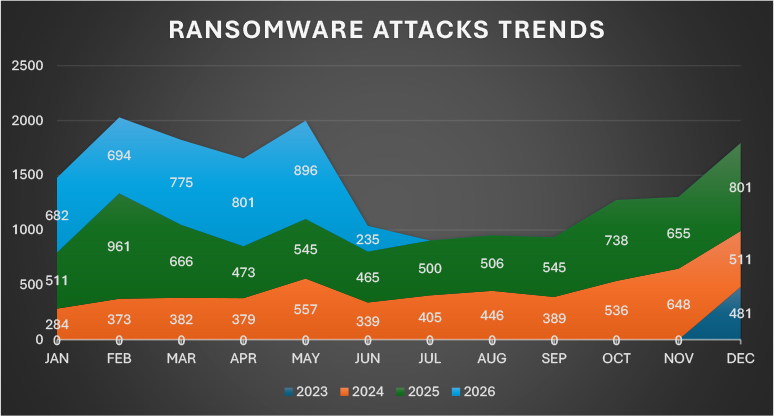
Ransomware activity remained at historically elevated levels during the first half of 2026, although June recorded a notable decline to 235 publicly disclosed incidents, compared with 896 in May, 801 in April, 775 in March, 694 in February, and 682 in January. Despite this sharp month-over-month reduction, ransomware volumes during the first five months of 2026 remained significantly higher than most corresponding months in 2024 and generally exceeded 2025 levels, with May 2026 (896 incidents) representing the highest monthly total across the entire dataset. While the decrease observed in June may reflect reporting delays, operational regrouping by major ransomware groups, or a temporary slowdown in public disclosures, it does not necessarily indicate a sustained reduction in ransomware risk. Overall, the multi-year trend continues to demonstrate that ransomware-as-a-service (RaaS) operations remain highly active and adaptable, with threat actors maintaining the capability to rapidly scale campaigns across multiple industries and geographic regions.
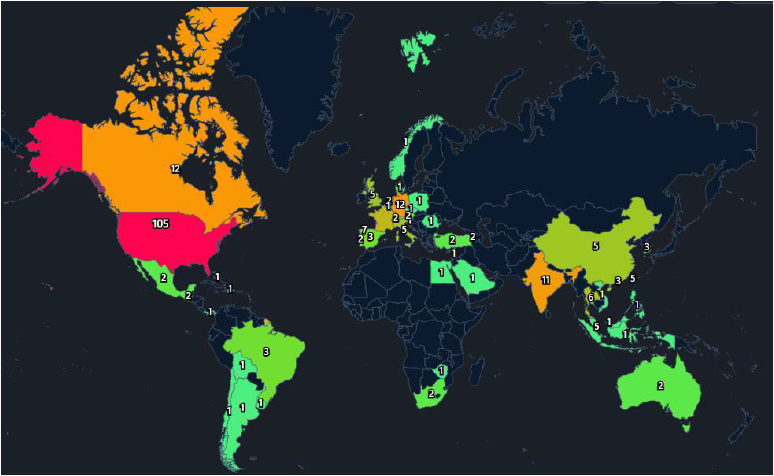
Ransomware activity in June 2026 remained geographically concentrated in the United States, which recorded 105 publicly disclosed incidents, significantly exceeding any other country and reinforcing its position as the primary target for ransomware operations. A second tier of affected countries included Canada (12), Germany (12), and India (11), followed by France (7) and Thailand (6). Moderate activity was also observed across the United Kingdom (5), Italy (5), Taiwan (5), China (5), and Singapore (5), demonstrating the continued global reach of ransomware campaigns. Lower but consistent levels of targeting were recorded across Europe, Asia-Pacific, the Americas, the Middle East, and Africa, with several countries reporting between one and three incidents. One victim remained unidentified (obfuscated), highlighting the ongoing challenges associated with attribution and public disclosure. Overall, the geographic distribution indicates that ransomware operators continue to prioritize organizations in digitally mature economies while maintaining a broad international footprint, reflecting the persistent global nature of ransomware-as-a-service (RaaS) operations despite the overall decline in publicly disclosed incidents during June.
Advancing Tradecraft in Access Brokerage Operations
This campaign illustrates a significant evolution in the ransomware ecosystem, where specialized threat actor group KongTuke functions as an Initial Access Broker (IAB) rather than conducting ransomware deployment directly. Instead of relying on widely available malware or straightforward phishing campaigns, the group employs a layered intrusion strategy combining ClickFix social engineering, custom malware families (Mistic and ModeloRAT), DLL side-loading, DNS-based payload retrieval, and memory-only execution to establish stealthy, persistent access. The introduction of Mistic further demonstrates a shift toward purpose-built tooling designed to evade endpoint detection through in-memory payload execution, self-deletion capabilities, and the abuse of trusted Microsoft binaries. The observed linkage between KongTuke and Qilin ransomware highlights the increasing specialization within the ransomware ecosystem, where access brokers focus on compromising environments and monetizing that access by supplying ransomware affiliates, enabling more scalable, resilient, and difficult-to-disrupt ransomware operations.
ETLM Assessment:
This model is expected to mature into a highly specialized access brokerage ecosystem where custom malware, fileless execution, and trusted application abuse become standard components of pre-ransomware operations. Initial access brokers are likely to expand the use of AI-assisted social engineering, legitimate communication platforms, and stealth-focused malware capable of dynamically adapting to enterprise defenses. Collaboration between access brokers and ransomware affiliates will likely become increasingly automated, reducing the time between initial compromise and ransomware deployment while enabling more targeted extortion campaigns. As custom access frameworks continue to evolve, defenders should anticipate greater operational separation between initial access, lateral movement, credential theft, and ransomware execution, making attribution more difficult and requiring organizations to detect and disrupt attacks much earlier in the intrusion lifecycle.
Escalating Dynamics of the Regional Ransomware Ecosystem
The INTERPOL assessment highlights the evolution of ransomware from isolated financially motivated attacks into a mature, industrialized cybercrime ecosystem operating at regional scale. Rather than acting as standalone campaigns, ransomware operations increasingly leverage the Ransomware-as-a-Service (RaaS) model, enabling specialized threat actors to collaborate across the intrusion lifecycle while lowering the barrier to entry for affiliates. The report further demonstrates how ransomware operators are integrating AI-driven social engineering, deepfake technologies, phishing, information stealers, and regulatory pressure into extortion operations to maximize compromise rates and victim coercion. The widespread targeting of critical sectors such as real estate, manufacturing, and financial services, combined with the convergence of organized crime syndicates, ransomware operators, and AI-enabled fraud, reflects the growing professionalization and commercialization of cybercrime across the Asia-Pacific region. This shift illustrates that ransomware is no longer solely a malware-driven threat but part of a broader ecosystem where credential theft, business email compromise, AI-enabled deception, and data extortion collectively support financially motivated operations.
ETLM Assessment:
The regional threat landscape is expected to continue evolving toward highly coordinated cybercriminal ecosystems where ransomware, AI-enabled fraud, phishing, information stealers, and organized crime operate as interconnected services rather than isolated threats. The continued adoption of generative AI will likely enable increasingly convincing impersonation campaigns, automated phishing infrastructure, multilingual social engineering, and scalable fraud operations that complement ransomware deployment. Simultaneously, RaaS platforms are expected to expand collaboration with initial access brokers, credential theft operators, and data extortion specialists, accelerating attack timelines and increasing operational sophistication. As digital transformation and cloud adoption continue across the Asia-Pacific region, adversaries will likely prioritize critical infrastructure, financial institutions, manufacturing, and government entities while exploiting regulatory compliance requirements, supply chain dependencies, and identity-based attack vectors to maximize extortion pressure and financial impact.
Advancing Defense Evasion in the Ransomware Ecosystem
This activity demonstrates a significant evolution in ransomware operations, where the threat actor group The Gentlemen has transformed defense evasion into a centralized service within its Ransomware-as-a-Service (RaaS) ecosystem. Rather than requiring affiliates to independently disable endpoint protections, the operators now provide a standardized suite of EDR-killing utilities built around the GentleKiller framework, alongside integrated third-party tools such as HexKiller, ThrottleBlood, and HavocKiller. The framework leverages Bring Your Own Vulnerable Driver (BYOVD) techniques, trusted Microsoft-signed drivers, binary obfuscation, and impersonation of legitimate security vendors to terminate more than 400 security processes across numerous endpoint protection platforms. Notably, The Gentlemen rapidly operationalizes newly disclosed BYOVD proof-of-concept exploits within days of public release, demonstrating an increasingly agile development cycle that enables affiliates to bypass modern endpoint defenses with minimal technical expertise. This reflects a broader shift in the ransomware landscape from simply delivering encryptors to providing fully managed offensive capabilities that standardize sophisticated defense-evasion techniques and lower the operational barrier for affiliates.
ETLM Assessment:
The continued centralization of advanced offensive tooling within RaaS platforms is likely to accelerate the professionalization of ransomware operations, with operators increasingly delivering complete attack frameworks rather than standalone malware. Future ransomware ecosystems are expected to integrate automated EDR bypass capabilities, rapid weaponization of newly disclosed vulnerabilities, kernel-level privilege abuse, and modular credential theft directly into affiliate toolkits, significantly reducing the time between initial access and ransomware deployment. As BYOVD techniques continue to exploit trusted driver ecosystems and legitimate system components, threat actors will likely diversify their abuse of signed drivers, firmware-level weaknesses, and endpoint management tools to defeat increasingly sophisticated security controls. This evolution will enable less experienced affiliates to execute highly advanced attacks while making detection, attribution, and disruption substantially more challenging for defenders.
Operational Maturation of the INC Ransomware Ecosystem
This activity demonstrates the rapid maturation of the threat actor group INC from an emerging ransomware operation into a highly scalable Ransomware-as-a-Service (RaaS) ecosystem capable of sustaining large-scale victimization across multiple industries. Following the disruption of major RaaS operations such as LockBit and BlackCat, INC successfully capitalized on the migration of experienced affiliates, enabling rapid expansion and operational growth. The group has continuously modernized its capabilities by rewriting its Windows and Linux/ESXi encryptors in Rust to improve portability, performance, and resistance to reverse engineering, while simultaneously enhancing post-compromise tooling through updated credential dumpers targeting modern Veeam backup deployments. Rather than relying on novel exploitation techniques, INC combines proven intrusion methods including Initial Access Broker (IAB)-sourced credentials, exploitation of internet-facing vulnerabilities, LOLBins, commercial remote management tools, BYOVD-based defense evasion, and double extortion into a streamlined attack framework. The emergence of related ransomware families such as Lynx and Sinobi through code reuse further reflects the increasing commercialization and modularization of ransomware development, where ransomware codebases evolve into reusable criminal platforms supporting multiple affiliated operations.
ETLM Assessment:
INC’s continued growth indicates that future ransomware success will increasingly depend on operational efficiency, affiliate scalability, and rapid adaptation rather than exclusively on sophisticated malware innovation. The group is likely to further expand its affiliate ecosystem by continuously refining cross-platform payloads, integrating additional credential theft and defense-evasion capabilities, and accelerating the exploitation of newly disclosed edge-device vulnerabilities for initial access. The growing reliance on Rust-based malware, BYOVD techniques, commercial remote management tools, and code-sharing across ransomware families suggests that future campaigns will become more resilient, portable, and difficult to analyze. As ransomware operators continue to industrialize proven attack methodologies while leveraging supply chain relationships and critical business dependencies, organizations should expect broader multi-victim campaigns, faster operational execution, and increasing collateral impact across interconnected enterprise environments.
Refining Covert Command-and-Control Tradecraft
This activity demonstrates the continued evolution of the threat actor group DragonForce from a conventional ransomware-as-a-service (RaaS) operation into a highly sophisticated intrusion ecosystem emphasizing long-term persistence, stealth, and post-compromise resilience. The deployment of the custom Go-based Backdoor.Turn malware marks a notable advancement in command-and-control (C2) tradecraft by abusing legitimate Microsoft Teams TURN relay infrastructure to disguise malicious communications as trusted Microsoft traffic, significantly reducing network-level detection opportunities. Combined with DLL side-loading, Bring Your Own Vulnerable Driver (BYOVD) techniques, process injection, credential theft, Active Directory reconnaissance, and the strategic deployment of a persistent backdoor even after ransomware execution, DragonForce demonstrates a shift beyond traditional encryption-focused attacks toward maintaining enduring access that can support future operations or be monetized through access resale. This progression aligns with the group’s transition from a RaaS model to a more structured cartel-style operation capable of developing bespoke malware and continuously enhancing its offensive capabilities.
ETLM Assessment:
DragonForce’s adoption of trusted cloud services and enterprise communication infrastructure for covert C2 communications signals a broader shift toward living-within-trusted-services, where legitimate platforms are increasingly weaponized to evade conventional security monitoring. Future campaigns are likely to expand the abuse of collaboration platforms, cloud services, identity infrastructure, and encrypted protocols alongside advanced BYOVD techniques, custom malware, and memory-resident implants to establish highly resilient post-compromise persistence. As ransomware groups continue evolving into organized cybercriminal enterprises with dedicated malware development capabilities, defenders should anticipate longer dwell times, greater emphasis on covert access retention, and increasing separation between initial compromise, persistence, data theft, and ransomware deployment, making early-stage detection and behavioral analytics increasingly critical for disrupting attacks before encryption occurs.
Adaptive Evolution of ClickFix-Driven Ransomware Delivery
This activity highlights the continued evolution of the ransomware ecosystem, where threat actor groups are rapidly adapting initial access techniques in response to defensive disruptions while adopting increasingly modular malware delivery architectures. Rather than relying on a single malware loader or code-signed installers, multiple ClickFix campaigns now employ distinct loader frameworks—including BabaDeda Loader, Lorem Ipsum Loader, and Potemkin—that separate payload delivery, storage, execution, persistence, and command-and-control into independent components, significantly enhancing flexibility and evasion. The threat actor group Vanilla Tempest (also known as Rapid Brigantine) exemplifies this shift by abandoning its previous signed-installer delivery model following Microsoft’s disruption of its malware-signing ecosystem and rapidly transitioning to ClickFix lures hosted on compromised WordPress sites. Simultaneously, loader frameworks increasingly leverage in-memory execution, DLL side-loading, external payload storage, dynamic C2 discovery, browser credential theft, and trusted Windows processes to establish stealthy footholds before deploying ransomware families such as Rhysida, BlackCat, Zeppelin, Quantum Locker, and LockBit. This demonstrates that ransomware operators are evolving beyond monolithic malware toward modular intrusion platforms capable of rapidly replacing individual components without disrupting the overall attack chain, making their operations more resilient against law enforcement actions and defensive countermeasures.
ETLM Assessment:
ClickFix is likely to remain one of the dominant initial access techniques due to its ability to exploit user trust rather than software vulnerabilities, while modular loader ecosystems will continue to evolve into highly interchangeable malware delivery platforms. Threat actors are expected to further integrate cloud-hosted infrastructure, legitimate collaboration platforms, dynamic payload retrieval, AI-assisted social engineering, and memory-resident execution to reduce forensic visibility and accelerate post-compromise activities. As ransomware operators increasingly decouple malware delivery, persistence, credential theft, lateral movement, and ransomware deployment into specialized components, they will be able to rapidly adapt individual stages of the attack in response to defensive actions without redesigning entire campaigns. This modular approach, combined with the growing collaboration between malware developers, initial access brokers, and ransomware affiliates, will continue to shorten attack timelines, improve operational resilience, and increase the scalability of ransomware operations across diverse enterprise environments.
Disrupting the Financial Backbone of the Ransomware Economy
This development highlights the evolution of the ransomware ecosystem beyond malware deployment into a highly organized financial infrastructure designed to sustain long-term criminal operations. Rather than relying on conventional cryptocurrency mixers alone, ransomware operators increasingly depend on dedicated laundering services such as AudiA6 to obscure illicit proceeds through industrial-scale money laundering networks. By leveraging thousands of fraudulent Know Your Customer (KYC) accounts, money mule networks, chain-hopping techniques, decentralized exchanges, and rapid cryptocurrency mixing services, AudiA6 enabled ransomware groups to efficiently convert extortion payments into seemingly legitimate assets while minimizing traceability. Its reported links to more than 15 ransomware investigations demonstrate how specialized financial service providers have become critical enablers of the ransomware ecosystem, supporting multiple threat actor groups without directly participating in intrusions. The coordinated law enforcement disruption of AudiA6 reflects a growing strategic focus on targeting the financial infrastructure that underpins ransomware operations rather than solely pursuing individual ransomware operators, recognizing that disrupting illicit cash-out mechanisms can significantly weaken the broader cybercriminal ecosystem.
ETLM Assessment:
As international law enforcement intensifies efforts against centralized cryptocurrency laundering services, ransomware operators are likely to further diversify their financial operations by increasingly adopting decentralized finance (DeFi) platforms, cross-chain bridges, privacy-focused cryptocurrencies, peer-to-peer exchanges, and distributed laundering networks that reduce dependence on single infrastructure providers. Future cybercriminal ecosystems are also expected to become more decentralized, with specialized laundering services, money mule networks, and illicit financial brokers operating independently while servicing multiple ransomware and cybercrime groups. This evolution will likely drive greater operational resilience, making financial attribution and asset recovery increasingly challenging despite continued global cooperation. At the same time, coordinated disruptions targeting cybercriminal financial infrastructure are expected to remain a key defensive strategy, compelling ransomware operators to continuously adapt their laundering techniques while increasing the operational complexity and cost of monetizing illicit proceeds.
Industrialization of the Ransomware Affiliate Ecosystem
This activity illustrates the transformation of the threat actor group The Gentlemen from a successful ransomware affiliate into an independent, enterprise-grade Ransomware-as-a-Service (RaaS) operator with a mature and highly structured criminal ecosystem. Originally operating under established RaaS programs such as LockBit, Qilin, and Medusa, the group leveraged prior operational experience to build its own platform featuring cross-platform ransomware, dedicated affiliate support, custom EDR bypass tools, AI-assisted malware development, and a comprehensive attack toolkit spanning the entire intrusion lifecycle. Unlike traditional ransomware groups focused primarily on malware deployment, The Gentlemen has adopted a service-oriented operating model that provides affiliates with technical support, standardized offensive tooling, flexible profit-sharing, and rapid feature development, significantly lowering the barrier to executing sophisticated ransomware attacks. The group’s ability to release same-day patches, integrate newly disclosed vulnerabilities into its exploitation pipeline, support Windows, Linux, ESXi, and LVM environments, and enable worm-like propagation through automated lateral movement demonstrates an increasingly agile development cycle comparable to legitimate software organizations. This evolution reflects the broader commercialization of ransomware, where operators function as full-scale cybercriminal enterprises delivering complete intrusion capabilities rather than simply providing encryption malware.
ETLM Assessment:
The evolution of The Gentlemen indicates that future ransomware operations will increasingly resemble mature software-as-a-service businesses, characterized by continuous development, dedicated customer support for affiliates, modular offensive tooling, and rapid adaptation to defensive countermeasures. The integration of AI into malware development and post-exploitation workflows is likely to accelerate the creation of customized attack capabilities, while automated propagation, cross-platform payloads, and advanced defense-evasion frameworks will further reduce the technical expertise required by affiliates. RaaS operators are also expected to expand their use of enterprise-style management structures, exploit supply chain and virtualization platforms more aggressively, and combine vulnerability exploitation, credential theft, wormable propagation, and multi-channel extortion into highly coordinated campaigns. As these ecosystems continue to professionalize, defenders should anticipate faster operational cycles, greater scalability, and increasingly resilient ransomware infrastructures capable of rapidly recovering from law enforcement disruptions and defensive innovations.
Emerging Precision in Ransomware Execution
This activity demonstrates the emergence of a more targeted and operationally refined ransomware model, where the threat actor group Prinz Eugen emphasizes precision over scale. Unlike many contemporary ransomware operations that rely on the Ransomware-as-a-Service (RaaS) model and broad affiliate networks, Prinz Eugen appears to maintain direct control over its intrusions through hands-on-keyboard operations using legitimate Remote Monitoring and Management (RMM) software, stolen Remote Desktop Protocol (RDP) credentials, and native administrative tools. The ransomware introduces a victim-impact-focused encryption strategy by prioritizing recently modified files, increasing operational disruption while minimizing encryption time. Its use of modern cryptographic implementations, self-deletion, secure memory sanitization, and the complete absence of an on-host ransom note further reflects a shift toward stealthier post-compromise operations that reduce forensic artifacts and evade automated detection. By moving extortion communications entirely outside the compromised environment, the group minimizes indicators of compromise while maintaining pressure on victims through direct engagement, illustrating how ransomware operators are increasingly optimizing both technical execution and operational security.
ETLM Assessment:
Prinz Eugen’s operational approach suggests that future ransomware campaigns may increasingly prioritize precision, stealth, and manual control over mass-scale automation. Threat actors are likely to expand the use of legitimate enterprise administration tools, selective encryption strategies based on business value, and memory-safe programming languages to improve operational reliability while reducing detection opportunities. The continued movement of ransom negotiations away from compromised systems, combined with enhanced anti-forensic techniques such as secure key destruction, self-removal, and minimal on-host artifacts, will make incident response and forensic reconstruction significantly more challenging. As these techniques become more widely adopted, ransomware operations are expected to become increasingly difficult to detect during the early stages of compromise, reinforcing the need for behavioral monitoring, identity security, and proactive detection of hands-on-keyboard activity rather than reliance on traditional ransomware indicators.
Specialization of Initial Access in the Ransomware Supply Chain
This activity highlights the continued specialization of the ransomware ecosystem, where the threat actor group KongTuke operates as a dedicated Initial Access Broker (IAB), focusing on establishing and maintaining covert access rather than deploying ransomware directly. The introduction of the custom Mistic backdoor reflects an evolution toward purpose-built persistence frameworks designed for long-term, low-visibility operations. By combining DLL side-loading, memory-only payload execution, Beacon Object File (BOF) support, credential harvesting, ClickFix-based delivery, and self-removal capabilities, Mistic enables operators to maintain stealthy access while dynamically expanding post-exploitation functionality without leaving artifacts on disk. The malware’s ability to blend into legitimate Microsoft endpoint security components and integrate with an extensive ecosystem of loaders, payloads, and legitimate runtimes demonstrates an increasingly modular access platform capable of supporting multiple ransomware threat actor groups, including Qilin, Interlock, Rhysida, Akira, 8Base, and Black Basta. This reflects a broader shift in ransomware operations where initial access, persistence, credential theft, and ransomware deployment are increasingly separated into specialized services that maximize operational efficiency and monetization.
ETLM Assessment:
The continued evolution of access brokers such as KongTuke suggests that future ransomware operations will increasingly rely on sophisticated persistence frameworks capable of remaining undetected for extended periods before access is monetized or transferred to ransomware affiliates. Custom backdoors are expected to become more modular, memory-resident, and extensible through in-memory plugins such as Beacon Object Files, allowing threat actors to rapidly introduce new capabilities without modifying the core malware. As ClickFix and similar social engineering techniques continue to mature, access brokers will likely combine trusted software abuse, legitimate development frameworks, cloud-based infrastructure, and AI-assisted deception to improve compromise success rates while reducing forensic visibility. This growing separation between initial access providers and ransomware deployment teams will further industrialize the cybercrime ecosystem, shorten attack preparation timelines, and enable ransomware affiliates to launch highly targeted intrusions with increasingly sophisticated pre-positioned access.
Advancing Covert Persistence Through Trusted Infrastructure
This activity demonstrates the continued evolution of the threat actor group DragonForce toward highly sophisticated post-compromise operations that emphasize stealth, persistence, and long-term access rather than immediate ransomware deployment. The group’s custom Go-based Backdoor.Turn malware represents the first publicly documented case of malware abusing Microsoft Teams’ TURN relay infrastructure to conceal command-and-control (C2) communications within trusted enterprise traffic, significantly reducing the likelihood of network-based detection. Beyond this novel communication channel, DragonForce combines DLL side-loading, Bring Your Own Vulnerable Driver (BYOVD) techniques, kernel-level privilege escalation, rogue account creation, firewall manipulation, browser credential theft, and Active Directory reconnaissance to establish resilient persistence before and even after ransomware deployment. The deployment of Backdoor.Turn following encryption further indicates that the group values maintaining covert access for future operations, data theft, or resale to other cybercriminals, illustrating a broader shift from one-time ransomware attacks toward sustained access operations. This evolution reflects the maturation of ransomware groups into well-organized criminal enterprises capable of developing bespoke malware and weaponizing legitimate enterprise infrastructure to evade increasingly mature security defenses.
ETLM Assessment:
The successful abuse of trusted collaboration platforms such as Microsoft Teams demonstrates that future ransomware campaigns are likely to increasingly exploit legitimate cloud services, enterprise communication platforms, and encrypted protocols to blend malicious activity with normal business operations. Threat actors are expected to further expand the use of custom persistence frameworks, BYOVD techniques, memory-resident malware, and trusted infrastructure to establish covert long-term access that remains active well beyond the initial ransomware incident. As ransomware groups continue adopting cartel-style organizational models with dedicated malware development capabilities, defenders should anticipate longer dwell times, greater emphasis on post-encryption persistence, and increasing use of legitimate services for command-and-control, making behavioral analytics, identity monitoring, and cloud traffic inspection essential for detecting advanced ransomware intrusions before they progress to large-scale extortion.
Convergence of Credential Theft and Ransomware Operations
This activity highlights the continued evolution of the ransomware ecosystem toward integrated, intelligence-driven intrusion operations, where credential theft campaigns serve as strategic enablers for subsequent ransomware deployment. The linkage between the threat actor groups INC and Lynx and the large-scale FortiBleed campaign demonstrates how ransomware operators are increasingly investing in dedicated credential harvesting infrastructure rather than relying solely on opportunistic access brokers or phishing campaigns. By compromising thousands of FortiGate firewalls, deploying custom packet-sniffing malware to capture VPN credentials, conducting credential-stuffing operations, and maintaining persistent backdoor accounts, the operators established a scalable pipeline for acquiring valid enterprise access. The discovery of ransomware negotiation panel access, victim overlap between FortiBleed and INC leak sites, and evidence of organized operational roles further indicates that credential theft, access management, victim selection, and ransomware execution are becoming tightly integrated components of a coordinated criminal enterprise. This reflects a broader shift from opportunistic ransomware attacks toward pre-positioned access operations designed to maximize success rates, reduce intrusion timelines, and enable highly targeted extortion campaigns.
ETLM Assessment:
The FortiBleed campaign suggests that future ransomware operations will increasingly prioritize large-scale credential acquisition and long-term access development before launching encryption or extortion activities. Threat actors are likely to expand the use of custom network interception tools, exploitation of edge devices, zero-day vulnerabilities, and persistent backdoor mechanisms to continuously harvest enterprise credentials and maintain access across thousands of organizations simultaneously. As ransomware groups further integrate credential theft, infrastructure management, vulnerability exploitation, and extortion into unified operational workflows, organizations should expect more intelligence-driven victim selection, faster post-compromise execution, and greater collaboration between specialized criminal teams. This convergence will make identity security, privileged access protection, edge-device monitoring, and rapid credential rotation increasingly critical to disrupting ransomware attacks before they transition from reconnaissance and credential harvesting to full-scale network compromise and data extortion.
Evolution of Multi-Layered Extortion Strategies
This activity demonstrates the continued evolution of ransomware from simple data encryption toward highly structured, multi-layered extortion models designed to maximize financial leverage. The threat actor group Blackfield employs a flexible monetization strategy that extends beyond demanding payment for data decryption by introducing multiple revenue-generating options, including charging victims for negotiation deadline extensions and offering stolen data for direct sale to third parties. This approach reflects an increasingly commercialized ransomware ecosystem where stolen data itself has become a standalone commodity independent of encryption. The attack against Nidec also illustrates the growing focus on high-value multinational enterprises with complex global operations, where operational disruption, reputational damage, and potential regulatory consequences significantly increase the pressure to negotiate. By combining traditional ransomware tactics with data leak marketplaces and time-based financial incentives, Blackfield demonstrates how ransomware operators are evolving into sophisticated extortion enterprises that continuously diversify monetization methods to maximize returns from a single compromise.
ETLM Assessment:
Ransomware groups are likely to continue expanding their extortion models beyond conventional encryption by introducing increasingly flexible and profit-driven monetization mechanisms tailored to each victim. Future campaigns may incorporate dynamic ransom pricing based on victim size, auction-style sales of stolen data, paid negotiation extensions, selective disclosure of sensitive information, and targeted sales to competitors or other criminal actors. As attackers increasingly treat stolen corporate data as a marketable asset, organizations should expect extortion campaigns to persist even when encryption is successfully mitigated or backups are available. This continued shift toward data-centric extortion, combined with attacks against globally distributed enterprises and their subsidiaries, will increase the financial, operational, and reputational impact of ransomware incidents while reinforcing the importance of data governance, rapid incident response, and proactive protection of sensitive information across interconnected business environments.
Based on available public reports, approximately 31% of enterprises are compelled to halt their operations, either temporarily or permanently, in the aftermath of a ransomware onslaught. The ripple effects extend beyond operational disruptions, as detailed by additional metrics:
Impact Assessment
Ransomware remains a major threat to both organizations and individuals, locking critical data and demanding payment for its release. The consequences extend well beyond the ransom, often leading to costly recovery efforts, extended downtime, reputational harm, and potential regulatory fines. Such disruptions can destabilize operations and erode stakeholder trust. Addressing this growing risk demands a proactive cybersecurity posture and stronger collaboration between public and private sectors to build resilience against future attacks.
Victimology
Cybercriminals are increasingly targeting industries that manage vast amounts of sensitive data ranging from personal and financial information to proprietary assets. Sectors such as manufacturing, real estate, healthcare, FMCG, e-commerce, finance, and technology remain high on the threat radar due to their complex and extensive digital infrastructures. Adversaries strategically exploit vulnerabilities in economically advanced regions, launching well-planned attacks designed to encrypt critical systems and extract significant ransom payments. These operations are calculated to yield maximum financial returns.
Ransomware entering 2026 is no longer a discrete cyber incident but an enduring, multi-stage business threat that blends elements of cybercrime, espionage tradecraft, and economic coercion. The continued separation of access, execution, and extortion, combined with browser-based trust abuse, engineered delivery artifacts, and long-lived access infrastructure, has significantly eroded the effectiveness of exploit-centric and signature-driven defences. At the same time, the scale and complexity of affiliate-driven operations introduce inherent fragility, creating opportunities for disruption beyond traditional endpoint containment, particularly at the levels of access brokerage, backend infrastructure, and coordination workflows. For organizations, resilience in this environment will depend less on preventing individual intrusions and more on governance readiness, third-party risk management, user interaction telemetry, and executive decision preparedness. As ransomware groups continue to evolve toward stealth, optionality, and psychological leverage, proactive external threat landscape management and cross-functional response planning will be critical to reducing both operational impact and long-term business risk.
