

The FIFA World Cup 2026 is expected to face a heightened cyber threat environment due to its global visibility, extensive digital infrastructure, and geopolitical significance. As the tournament will be hosted across the United States, Canada, and Mexico, it presents an attractive target for cybercriminals, hacktivist groups, and nation-state-aligned threat actors seeking financial gain, disruption, intelligence collection, or geopolitical influence.
Key risks include phishing campaigns, fake ticketing platforms, credential theft, ransomware attacks, DDoS activity targeting broadcasters and streaming services, disinformation campaigns, and attacks against transportation, telecommunications, hospitality, and smart stadium infrastructure. The tournament may also become a focal point for cyber operations linked to geopolitical tensions involving Russia, Iran, and China, including disruptive attacks, influence operations, and strategic espionage activity.
This assessment additionally identifies emerging World Cup-themed malicious infrastructure, including fraudulent ticketing websites and phishing domains targeting fans and visitors. The growing use of AI-enabled social engineering and disinformation further increases the likelihood of large-scale cyber-enabled fraud and public manipulation during the event period.
Given the scale and international attention surrounding FIFA World Cup 2026, organizations supporting the tournament should anticipate elevated cyber activity and strengthen monitoring, infrastructure security, third-party risk management, and incident response preparedness ahead of the event.
The FIFA World Cup 2026 is expected to attract significant cyber threat activity due to its global visibility, extensive digital infrastructure, and large international audience. Threat actors are likely to exploit the tournament through financially motivated scams, disruptive cyber operations, and attacks targeting media and communication infrastructure. High-profile sporting events historically create opportunities for cybercriminal groups, hacktivists, and nation-state-aligned actors to conduct phishing campaigns, infrastructure disruption, and influence operations at scale.
This section focuses on three prominent cyber threat areas associated with the tournament:
Major international sporting events consistently generate a surge in phishing campaigns, fake ticketing operations, and fraudulent hospitality schemes targeting fans and tourists. Due to the global popularity of the FIFA World Cup 2026, threat actors are expected to aggressively exploit public interest through impersonation domains, counterfeit ticketing portals, fake travel packages, and malicious payment platforms designed to steal financial information and user credentials.
Cybercriminals commonly leverage urgency-based social engineering techniques such as “limited ticket availability”, “exclusive hospitality access”, or “priority booking confirmation” to manipulate victims into interacting with malicious websites. These campaigns are often distributed through phishing emails, sponsored advertisements, SMS messages, social media promotions, and messaging platforms.
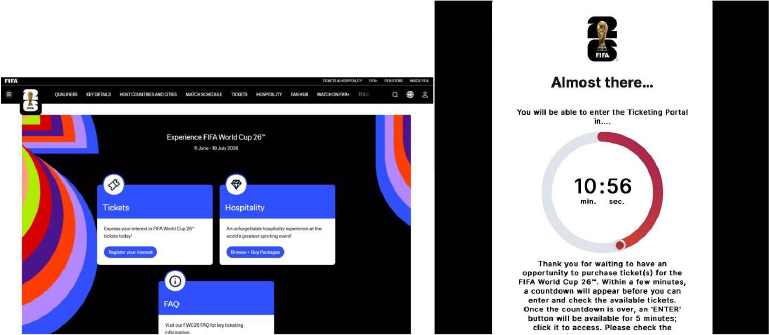
The images above demonstrate the type of branding and presentation style used within the official FIFA World Cup 2026 web infrastructure. Threat actors frequently imitate similar layouts, logos, typography, and navigation elements to create convincing phishing pages capable of deceiving users into believing they are interacting with legitimate FIFA services.
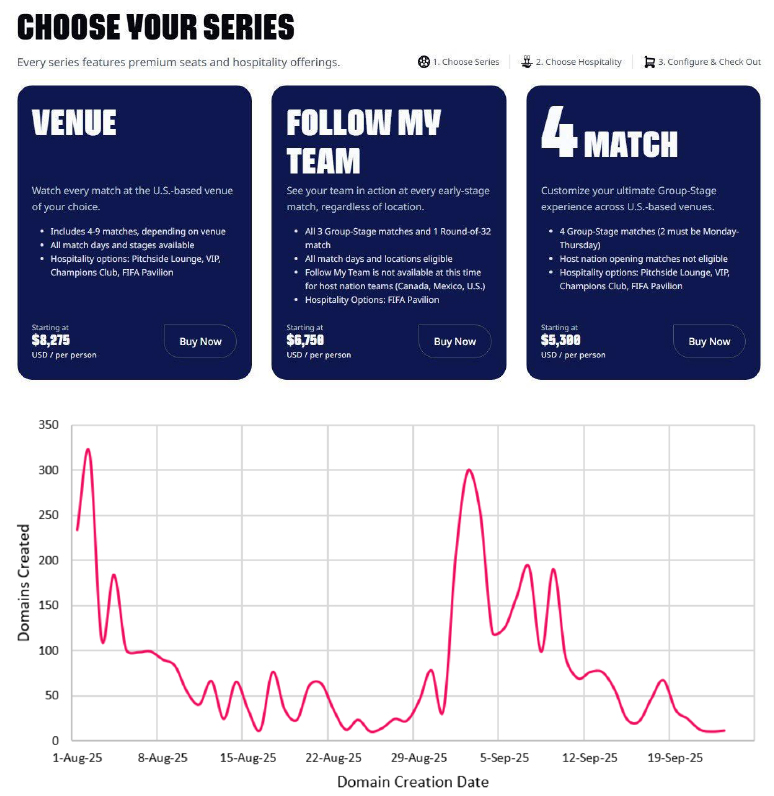
Analysis of FIFA World Cup 2026-themed domain registrations identified several spikes in activity during August and September 2025, with peak registrations exceeding 300 domains per day. These surges may indicate coordinated efforts by threat actors to establish phishing infrastructure, fake ticketing platforms, and impersonation websites. Domain age analysis further revealed that many of the identified domains were recently registered, a common characteristic of phishing and fraud campaigns. The combination of high registration volumes and many newly created domains suggests that malicious infrastructure is already being established ahead of the tournament.
Attackers may specifically target:
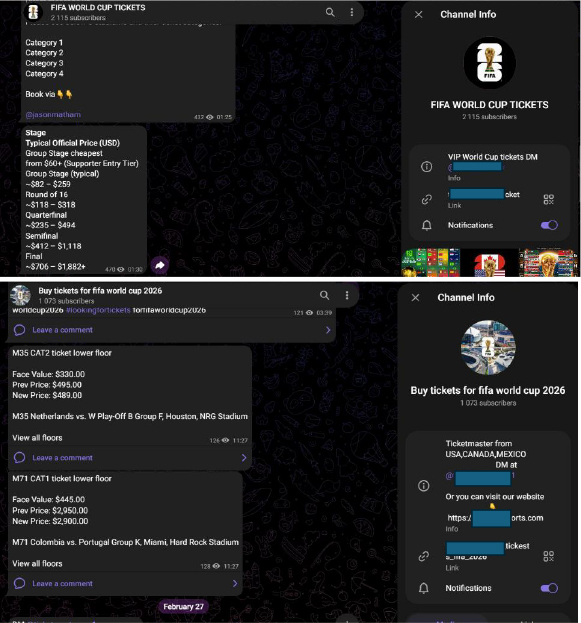
Observed malicious infrastructure associated with FIFA-themed phishing activity indicates that attackers have already begun registering deceptive domains and fake ticketing platforms ahead of the tournament. These domains are likely intended to harvest:
Additionally, cloned FIFA interfaces may be combined with fake customer support channels or AI-generated phishing emails to increase legitimacy and improve victim conversion rates. The growing accessibility of AI-generated content further increases the likelihood of highly convincing multilingual scams targeting international audiences.
Given the expected global demand for tournament tickets and hospitality access, FIFA-related phishing and ticket fraud campaigns are likely to intensify significantly as the event approaches, particularly around ticket release dates, match announcements, and high-profile fixtures.
The FIFA World Cup 2026 presents a highly attractive target for Distributed Denial-of-Service (DDoS) attacks due to its global visibility, extensive digital footprint, and reliance on uninterrupted online services. DDoS attacks remain one of the most accessible and effective methods for threat actors seeking to disrupt operations, generate media attention, or advance political and ideological objectives during high-profile international events.
The tournament ecosystem will depend on a wide range of internet-facing services, including official FIFA websites, ticketing platforms, streaming services, mobile applications, telecommunications providers, transportation networks, and hospitality systems. Disruption of any of these services during critical periods could negatively impact fan experience, operational continuity, and public confidence.
Potential Targets
Threat actors may seek to disrupt:
Threat Actor Assessment
The likelihood of DDoS activity during FIFA World Cup 2026 is elevated due to the event’s symbolic significance and global audience. Nation-state-aligned hacktivist groups, particularly those associated with Russia and Iran, have historically used DDoS campaigns to target government entities, public-facing services, transportation networks, and critical infrastructure during periods of geopolitical tension.
In addition to politically motivated actors, cybercriminal groups may launch disruptive attacks against online services to extort organizations, generate publicity, or exploit service outages for fraudulent activities.
Broadcast and Streaming Ecosystem Risks
The global demand for live match broadcasts makes media and streaming infrastructure a particularly attractive target. Broadcasters, streaming platforms, and supporting CDN providers may face attempts to disrupt service availability during high-profile matches, particularly during the opening ceremony, knockout rounds, and final fixtures.
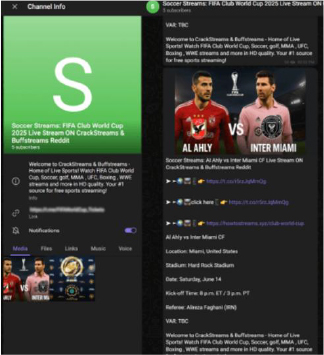
Furthermore, the presence of FIFA-themed streaming communities on platforms such as Telegram demonstrates an active ecosystem promoting unauthorized access to live sporting content. As illustrated in the image above, channels advertising unofficial FIFA streams and third-party viewing links continue to attract users seeking alternative viewing options.
While these channels do not directly indicate DDoS activity, they highlight an environment that may facilitate malicious activity, including phishing campaigns, malware distribution, traffic diversion, and the promotion of unauthorized streaming platforms. Service disruptions affecting legitimate broadcasters could potentially increase reliance on such unofficial channels, amplifying both cybersecurity and fraud-related risks.
Potential Impact
Successful DDoS attacks could result in:
Assessment
DDoS attacks are assessed as one of the most probable disruptive cyber threats facing the FIFA World Cup 2026. The combination of global visibility, extensive online infrastructure, geopolitical tensions, and high-profile broadcasting operations creates a favourable environment for threat actors seeking maximum operational and media impact. While no direct evidence currently indicates planned attacks against tournament infrastructure, historical trends and the growing ecosystem surrounding unofficial streaming services suggest that broadcasters, streaming providers, and public-facing FIFA platforms will remain attractive targets throughout the event lifecycle.
The global demand for live FIFA broadcasts creates a significant opportunity for cybercriminals to exploit users seeking online streaming services. Analysis identified several football and FIFA-themed streaming domains that have been flagged as malicious by multiple security vendors, indicating the presence of potentially harmful infrastructure associated with unauthorized sports broadcasting.
Examples observed during this assessment include domains such as:
These domains have been identified by multiple security vendors for malicious or suspicious activity. Such platforms frequently impersonate legitimate streaming services or promote unauthorized broadcasts while attempting to monetize visitors through phishing campaigns, malicious advertisements, credential harvesting, malware delivery, or fraudulent subscription schemes.
The existence of FIFA-themed malicious streaming infrastructure demonstrates that threat actors are already leveraging public interest in football-related content to attract users. As FIFA World Cup 2026 approaches and viewership demand increases, similar domains are likely to proliferate, particularly around high-profile matches and ticket sales periods.
Risks to Broadcast and Media Operations
Beyond targeting individual users, malicious streaming ecosystems can indirectly impact legitimate broadcasters and media organizations. Unauthorized streaming communities often benefit from disruptions affecting official broadcast channels, creating incentives for threat actors to conduct or support activities that reduce the availability of legitimate streaming services.
Potential risks include:
Assessment
The identification of multiple FIFA and football-themed domains flagged by security vendors indicates that malicious streaming infrastructure is already present within the broader football ecosystem. While no direct evidence of planned attacks against FIFA World Cup 2026 broadcast infrastructure was identified during this assessment, the combination of malicious streaming domains, unauthorized broadcast communities, and the tournament’s global visibility suggests an elevated risk of cyber activity targeting broadcasters, streaming providers, and media distribution networks throughout the event lifecycle.
IOCs
| Domain | Detection Count | Primary Classification | Action |
| fifa-online[.]com | 4 / 90 | Malicious (Phishing / Typosquatting) | Monitor |
| fifalive-sjb[.]com | 18 / 90 | Malicious (Phishing / Typosquatting) | Monitor |
| footballtv[.]online | 8 / 90 | Suspicious (Spam / Illegal Streaming) | Monitor |
The FIFA World Cup 2026 is expected to face an elevated cyber threat environment due to its global visibility, extensive digital infrastructure, and geopolitical significance. As one of the largest international sporting events, the tournament presents an attractive target for cybercriminals, hacktivist groups, and nation-state-aligned actors seeking financial gain, disruption, intelligence collection, or influence. The convergence of large-scale online engagement, critical event operations, and heightened geopolitical tensions increases the overall cyber risk surrounding the tournament.
Analysis conducted during this assessment identified active FIFA-related phishing and fraud infrastructure, including suspicious ticketing domains, impersonation websites, and malicious streaming platforms. Significant spikes in FIFA-themed domain registrations were observed, suggesting that threat actors are already preparing infrastructure to exploit growing public interest in the event. Several football and FIFA-related streaming domains were also found to have been flagged by multiple security vendors, highlighting the risks associated with unauthorized broadcast services and online scams targeting fans.
Beyond phishing and fraud, DDoS attacks remain one of the most likely disruptive threats facing the tournament. Public-facing platforms such as ticketing portals, official FIFA websites, streaming services, and broadcaster infrastructure may become targets for cybercriminal and hacktivist operations seeking maximum visibility and operational impact. The increasing use of AI-generated content and social engineering techniques further raises the risk of large-scale phishing campaigns, misinformation, and brand impersonation activity during the event period.
As the tournament approaches, cyber threat activity is expected to increase in both volume and sophistication. Proactive monitoring of malicious infrastructure, enhanced DDoS resilience, protection of broadcast and media systems, and strong collaboration between FIFA, broadcasters, technology providers, and government agencies will be essential to reducing risk. A coordinated and intelligence-driven security approach will be critical to maintaining the integrity, availability, and reputation of FIFA World Cup 2026 operations.
As the FIFA World Cup 2026 approaches, cyber threat activity is expected to increase in both frequency and sophistication. Historical trends associated with major international sporting events indicate that threat actors typically intensify operations during key milestones, including ticket sales phases, team announcements, opening ceremonies, knockout rounds, and the tournament final. The growing global attention surrounding the event is likely to create additional opportunities for cybercriminals, hacktivist groups, and nation-state-aligned actors to exploit public interest and maximize operational impact.
Phishing campaigns, fraudulent ticketing platforms, and malicious streaming services are expected to remain among the most prevalent threats. Threat actors will likely continue registering FIFA-themed domains, impersonating official services, and leveraging AI-generated content to create increasingly convincing scams targeting fans, tourists, sponsors, and event personnel. The volume of social engineering activity is expected to increase significantly as ticket demand and online engagement grow closer to the tournament.
Disruptive cyber activity targeting public-facing services may also increase, particularly during high-profile matches and major tournament milestones. Ticketing platforms, broadcaster infrastructure, streaming services, telecommunications providers, and supporting third-party vendors are likely to remain attractive targets for DDoS campaigns, service disruption attempts, and opportunistic cyberattacks seeking maximum visibility and media attention. Geopolitical developments involving Russia, Iran, and China may further influence the cyber threat landscape, potentially increasing the likelihood of politically motivated operations targeting organizations associated with the tournament.
Looking ahead, organizations supporting the FIFA World Cup 2026 should anticipate a dynamic threat environment where cybercrime, hacktivism, disinformation, and state-linked cyber activity increasingly overlap. Continuous threat intelligence collection, proactive monitoring of malicious infrastructure, and coordinated cybersecurity efforts across public and private sector stakeholders will be essential to identifying emerging threats and maintaining operational resilience throughout the tournament lifecycle.
Ticketing Fraud and Phishing Mitigation
Broadcast and Media Infrastructure Protection
DDoS Resilience and Service Availability
Incident Response and Operational Readiness
